Body language
Body language: how to read it accurately, and the 5 filters that decide whether you are right
By Merlin OBrecht · Dean of Academic Affairs, NCI University
Body language
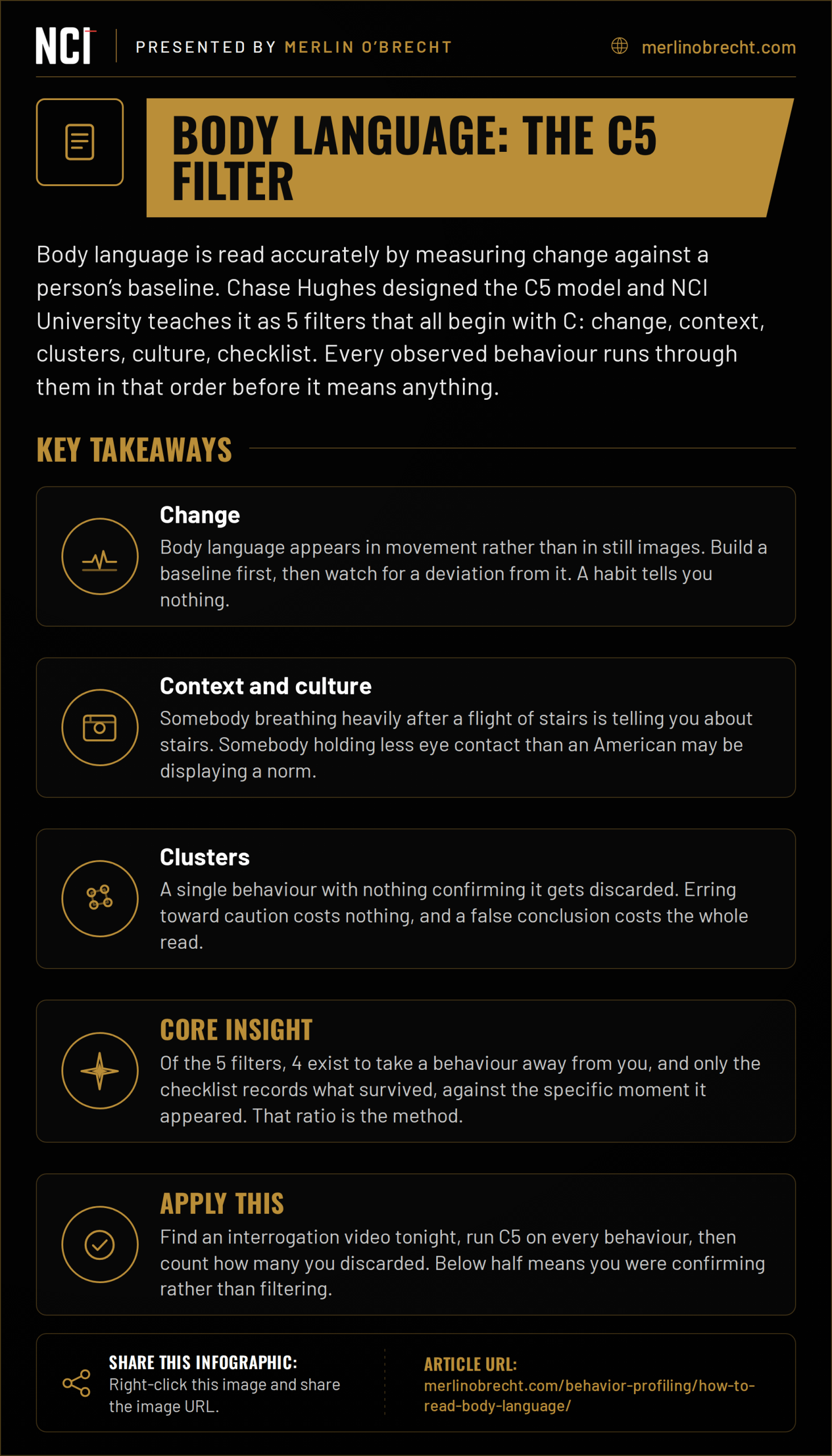
Body language is read accurately by measuring change against a person’s baseline rather than by matching gestures to fixed meanings. Chase Hughes’s C5 model gives five filters: change, context, clusters, culture and checklist. Crossed arms in a cold room is a temperature reading. The same behaviour appearing three times after one question is data.
“Every person that you’ve probably ever met in your life has been screaming the secrets of their mind through their body. And the problem is that essentially almost no one has been listening.”
The reason nobody is listening has nothing to do with attention. People are watching very closely. They just do not know how to understand the language the other person is speaking, so they translate it with the only dictionary anyone ever handed them, which is a list of gestures and what those gestures supposedly mean.
That dictionary is where confident misreading comes from. Here is the professional version: a filter you run before a behaviour is permitted to mean anything at all, and a fixed order for running it.
Key takeaways
- Body language predates speech, and the ability to read it is built into the human brain. Most of us have lost the accuracy rather than the ability.
- Accurate reading is subtraction. The skill is filtering out every other reason a behaviour could be appearing before you accept the reason you first thought of.
- Chase Hughes's C5 model gives the five filters in order: change, context, clusters, culture, checklist.
- A single behaviour with nothing confirming it gets discarded, not interpreted. That rule alone removes most of the errors.
- The people who are best at this speak almost entirely in probabilities, and that habit is the skill rather than a side effect of it.
What does body language actually tell you?
Body language tells you what kind of moment a person is in right now. Psychological profiling asks what kind of person this is, over years. Body language asks what changed in the last few seconds, and it answers only that.
“Psychological profiling fundamentally asks what kind of person is this? Whereas body language is asking the question, what kind of moment is this person in right now?”
That distinction is the whole reason both halves exist. A psychological profile gives you context. Body language gives you the current story. Context on its own is sometimes useful without the current story. A story told without proper context leads to complete misinterpretation surprisingly often, which is what happens every time somebody reads a gesture and skips everything around it.
The origins of body language go back well past the development of speech. Any time two humans communicate there is a second conversation running underneath the words, and the ability to read it is intuitively built into the brain. What most people have lost is the accuracy, and accuracy is trainable.
Why the gesture dictionaries get people confidently wrong
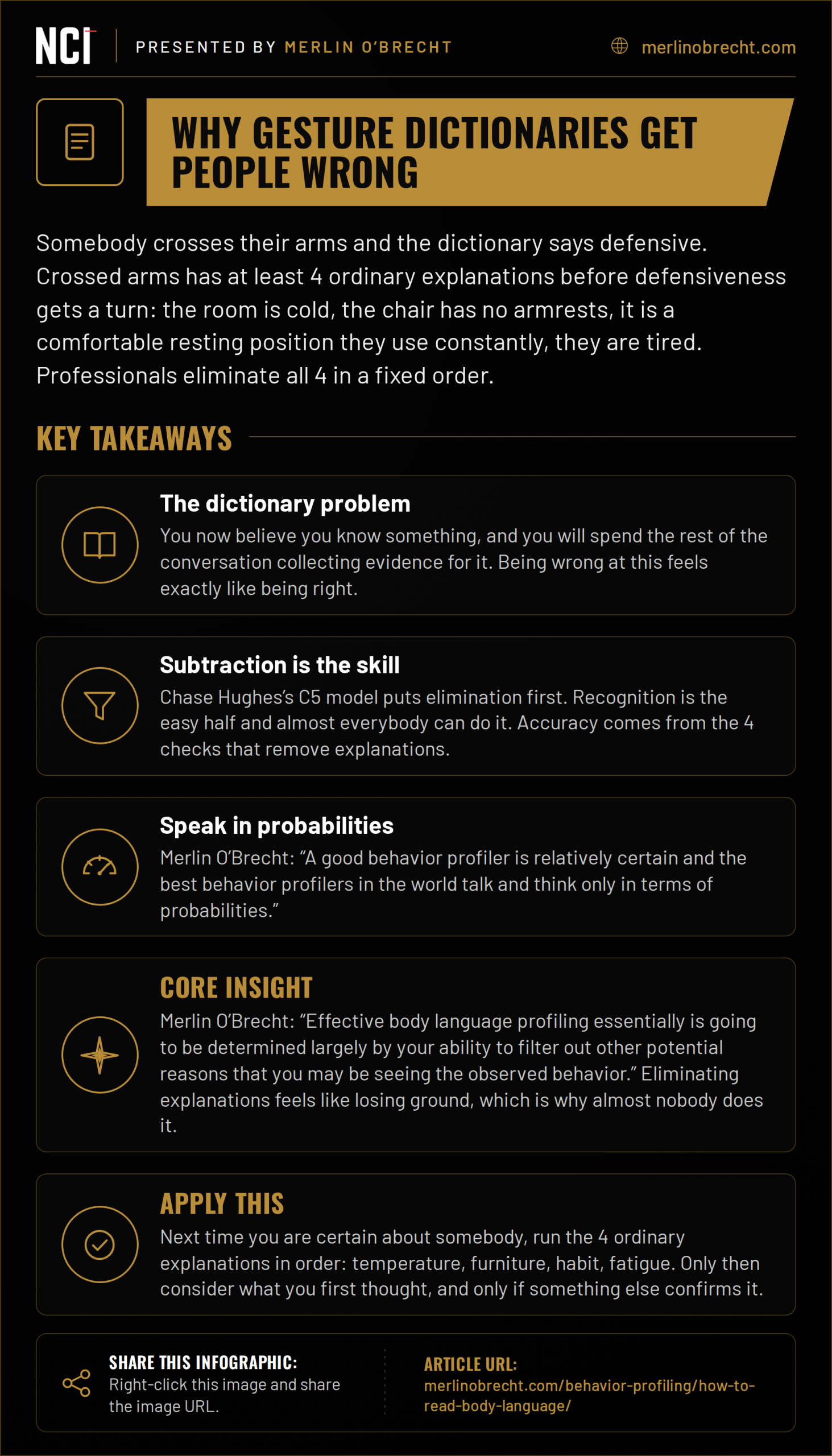
Somebody crosses their arms. The dictionary says defensive. You now believe you know something, and you will spend the rest of the conversation collecting evidence for it.
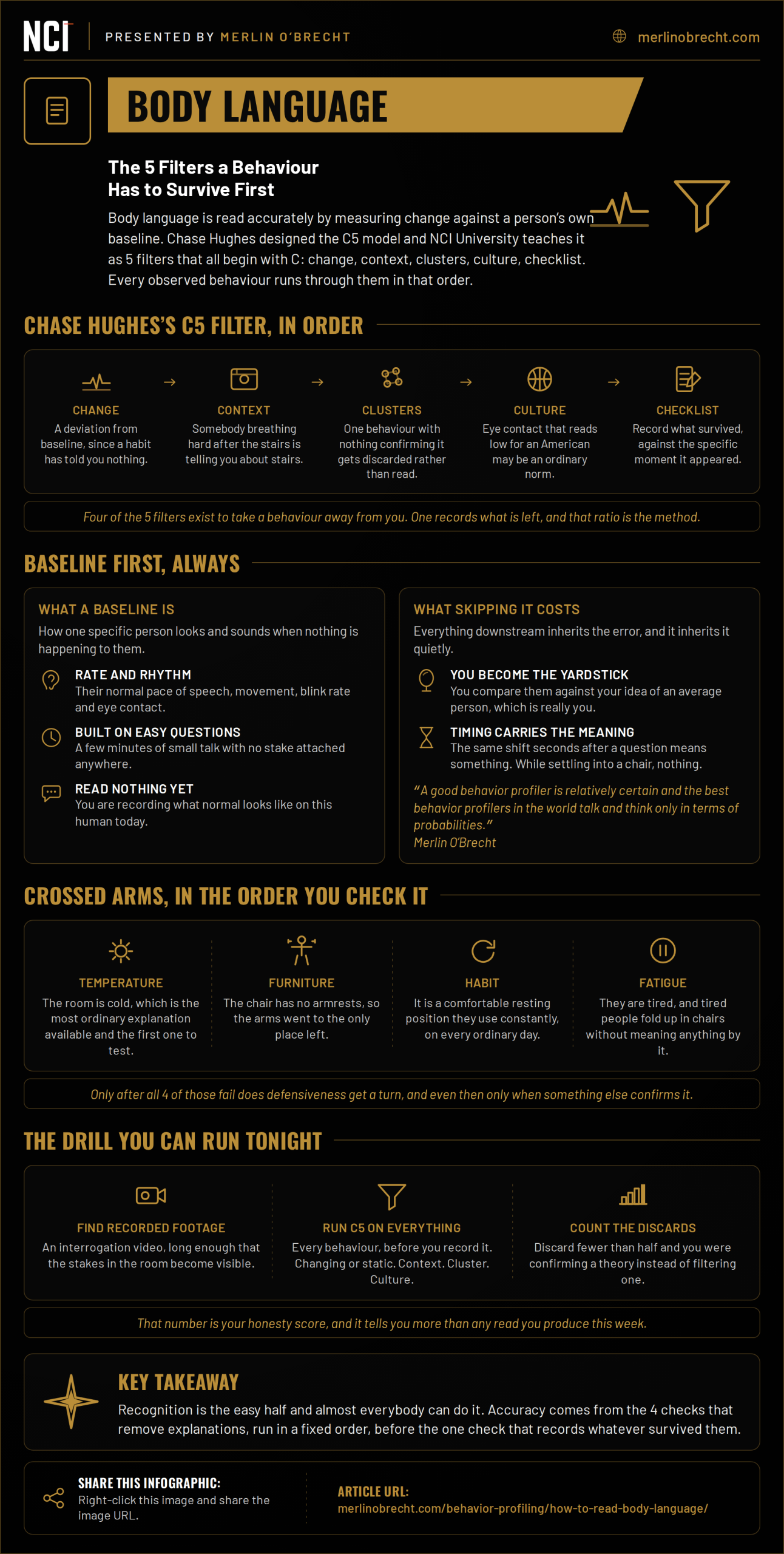
Crossed arms has at least four ordinary explanations before you get anywhere near defensiveness. The room is cold. The chair has no armrests. It is a comfortable resting position they use constantly. They are tired. Professionals have a fixed order for eliminating those explanations, and that order is the thing this page is actually about.
“Effective body language profiling essentially is going to be determined largely by your ability to filter out other potential reasons that you may be seeing the observed behavior.”
Read that carefully, because it inverts what most people think they are learning. The skill is subtraction. Recognition is the easy half and almost everybody can do it. Elimination is where accuracy comes from, and almost nobody does it, because eliminating explanations feels like losing ground when what you wanted was an answer.
How do you read body language accurately? The C5 model
You run every observed behaviour through five filters before you allow it to mean anything. Chase Hughes designed the model and NCI University teaches it as C5, for the five filters that all begin with C: change, context, clusters, culture, checklist. In that order.
- Change. Is this a static behaviour, or something that is changing? Body language does not appear in still images. It appears in the movement of the body. So you establish a baseline first and then watch for a deviation from it. A person who always sits with their hands clasped has told you nothing by sitting with their hands clasped.
- Context. Is there something in the situation that could explain this behaviour on its own? If somebody just ran up a flight of stairs and they are doing some heavy chest breathing, that very likely explains the breathing better than anything you just said does. Context gets checked before interpretation, not after it.
- Clusters. Any conclusion needs more than one behaviour supporting it. If you see one behaviour on its own with no other confirming behaviours, you throw that information out, because erring on the side of caution costs you nothing and a false conclusion costs you the whole read.
- Culture. Could this person’s culture explain what you are seeing? Somebody in Eastern Europe holding less eye contact than an American would in the same conversation is displaying a cultural norm. Reading it as stress is a mistake you will never find out you made.
- Checklist. This is the one everyone wants to jump straight to. It is where the Behavioral Table of Elements comes in, Chase Hughes’s reference chart of behavioural indicators, and where you record the cluster of behaviours you actually observed against the specific question that was asked.
Four of those five filters exist to take a behaviour away from you. Only the last one records anything. That ratio is the method.
Baseline first, always
A baseline is how a specific person looks and sounds when nothing is happening to them. Their normal rate of speech, their normal blink rate, where their hands usually sit, how much they usually move, how much eye contact they usually hold, what their voice does at rest.
You build one with easy questions, small talk, anything with no stake attached. It takes a few minutes of ordinary conversation for most people, and you are not looking for anything during that period. You are recording what normal looks like on this human being today.
A deviation is what changed, and when. The “when” carries as much information as the change does, because the timing is what ties a behaviour to a stimulus. The same shift 4 seconds after a specific question means something. The same shift while they are getting comfortable in a chair means nothing.
Skip the baseline and everything downstream inherits the error. You end up comparing a person against your idea of an average person, which is really a comparison against yourself, and the read you produce says more about you than about them. A reading with no baseline is a guess with vocabulary.
Why do trained profilers speak in probabilities?
Because certainty is the failure mode, and because the discipline of holding a conclusion loosely is what keeps cognitive bias from quietly steering the whole read.
“A good behavior profiler is relatively certain and the best behavior profilers in the world talk and think only in terms of probabilities.”
Limiting cognitive bias, and therefore cognitive dissonance, is the difference between somebody who is talented at this and somebody who is genuinely excellent at it. The mechanism is unglamorous. Once you have decided what a behaviour means, your brain will find you more evidence for it, and it will do that without telling you.
| How most people read a behaviour | How the C5 filter reads it | |
|---|---|---|
| What triggers the reading | A behaviour that matches something they have read about | A change from this person’s own baseline |
| What counts as evidence | The behaviour itself | A cluster of behaviours that survived four elimination checks |
| How a single cue is treated | As a finding | As discarded data |
| What the output sounds like | “He was lying” | “Three stress indicators clustered after that question. Worth going back to it.” |
| What happens when it is wrong | Nobody finds out, and confidence grows | The read gets revised, because it was held as a probability from the start |
That right-hand column is less satisfying to say out loud and it is the one that survives being checked.
What two fields with broken data can teach a body language reader
This comparison is mine rather than anybody’s curriculum, and it is the thing that made the discipline finally click for me.
Neuroendocrinology and archaeology have almost nothing in common except the problem they face. Both work with incomplete or uncertain data. Both have enormous room for subjective interpretation. Both would produce confident garbage if their practitioners were allowed to interpret freely.
Neither field solved that by getting better data, because better data was not available. They solved it with disciplined strategies designed to actively seek disconfirming evidence rather than looking for confirmation. They treat conclusions as probabilistic. They make their assumptions explicit rather than leaving them implied. They constantly try to break their own theories, and a theory that survives repeated attempts to break it earns a little more weight.
That is how those disciplines stay grounded in truth rather than falling into the old subjective belief trap. Body language reading faces the identical problem and the identical solution is available, which is what C5 is: an explicit, ordered, repeatable attempt to disprove your own reading before you keep it.
Reading body language in a negotiation or an interview
The practical version in a room with something at stake looks like this. Spend the first few minutes building a baseline while the conversation is still easy, and read nothing during that window. Then watch for the moment the baseline breaks, and note the question or the number that preceded it by a few seconds.
What you have found is not their position. It is where their attention went. In a negotiation that tells you which term actually matters to them, which is frequently not the term they have been arguing about. In an interview it tells you which part of a CV to ask a second question about.
A misread costs real money in the first case and a year of somebody’s working life in the second, which is the argument for the discipline rather than for confidence. One caution, and it is the one professionals repeat most: a single reading is a reason to ask another question, never a reason to conclude something about a person.
How do you practise this on your own tonight?
The drill I give everybody costs nothing and works.
- Find an interrogation video on YouTube. There are thousands of them, they are long, and the stakes in the room are visible.
- Have Chase Hughes’s Behavioral Table of Elements open beside you. Work from the top right corner of the chart, plus the 4.0 language indicators at the bottom of it.
- Find a section where stress behaviours start appearing. You will feel it before you can name it. Go back 30 seconds from there.
- Run C5 on every single behaviour before you record it. Is it changing or static. Is there a context explanation. Is there a cluster or is it alone. Could culture explain it. Only what survives goes on the checklist.
- Then check your own work. Count how many behaviours you recorded and how many you discarded. If you discarded fewer than half, you were not running the filter. You were confirming.
That drill will make you noticeably better within a few weeks, and then it will stop working, for a reason worth naming honestly. Running C5 on a paused video is a different skill from running it while a person is mid-sentence and your own nervous system is doing its thing. The only thing that closes that gap is repetitions with somebody who has scored the same footage and will tell you where you were generous with yourself. That is what the 32 skills-building calls with facilitators inside NCI-2 Behavior Profiler exist for, alongside 22 video modules and 12 hours of material, $795.
The checklist you build in step 4 is also the raw material for scoring a specific question window for deception, which is a separate instrument with its own threshold. That is covered on how the same behaviours get scored for deception.
One thing worth saying before the questions. If what you want is a list of tells you can memorise on the train, this method will annoy you, because the first thing it asks you to do is throw out most of what you notice.
Frequently asked questions
What is body language?
Body language is the communication that happens through movement, posture, expression and physical positioning, and it predates spoken language by a long way. Read professionally, it describes the moment a person is in rather than the kind of person they are, and it is read as change from that individual’s own baseline rather than as fixed meanings attached to gestures.
How do you read body language step by step?
Six steps. Establish the person’s baseline during low-stakes conversation. Watch for a change from it. Check whether the situation itself explains the change. Require a cluster of behaviours before concluding anything. Check whether culture explains what you are seeing. Then record the surviving behaviours against the specific question or moment that preceded them.
How long does it take to get good at reading body language?
The five filters take an afternoon to learn and you can start applying them to footage that evening. Running them live, while you are also holding up your end of a conversation and managing your own state, takes months of repetitions. That gap between understanding the method and executing it under load is the real timeline, and nobody can shorten it for you.
Is body language reading actually accurate?
Clusters of behaviour measured against a person’s own baseline, checked for context and culture, produce reliable probability shifts. Single cues with universal meanings do not, and most published body language material is built entirely from those. NCI University characterises its own system as capable of taking a trained reader above 90% accuracy, and my own assessment matches that, with the hedge I would apply to any number in this field: the honest output of a good read is still a probability rather than a fact.
What is the difference between a baseline and a deviation?
The baseline is the person on an ordinary day with nothing happening: their usual rate of speech, movement, eye contact and posture. The deviation is what changed from that, and when it changed. The timing matters as much as the change, because timing is what connects a behaviour to whatever caused it.
How do you read body language in a job interview?
From the interviewer’s side, use the first 5 minutes of easy questions to build the candidate’s baseline and read nothing during it. Then note which later question moved them off it. One context check is mandatory here: interview nerves are a whole-conversation state, so anything present from the first minute is baseline rather than signal.
Does crossing your arms really mean someone is defensive?
Usually it means the room is cold, the chair has no armrests, or that is where their arms live. Crossed arms carries no meaning on its own under any circumstances, because a single behaviour with nothing confirming it gets discarded rather than interpreted. If it appears alongside three other changes within seconds of one specific question, then you have something worth noticing.
Who created the C5 model?
Chase Hughes designed it, and it is taught through NCI University’s behavior profiling curriculum. The five filters are change (is this a deviation from baseline), context (does the situation explain it), clusters (is anything confirming it), culture (does a norm explain it) and checklist (record what survived, against the moment it appeared).
Is it manipulative to read someone's body language without telling them?
The test Chase Hughes teaches is whether the other person, seeing your full intent, would agree that what you did was in their interest. Noticing that somebody is uncomfortable and slowing down passes that easily. Noticing that somebody is uncomfortable and pressing there does not, and the observation skill is identical in both cases.
Where do you go after learning the basics of body language?
Baseline practice on real people you see regularly, then footage with the filter applied deliberately, then live conversation with feedback from somebody who saw the same thing you did. In that order. The step almost everybody skips is the first one, and it is the one everything else is measured against.
Where to go from here
I opened by saying the most common behaviour in the category has at least four ordinary explanations. Here they are again, in the order you check them: temperature, furniture, habit, fatigue. Only after all four fail does defensiveness become worth considering, and even then only if something else confirms it.
That order is the entire discipline in miniature. Four attempts to take the behaviour away from you, then one record of what survived.
If you want the version with an answer key, where somebody experienced tells you which of your reads were confirmation dressed up as observation, that is NCI-2 Behavior Profiler. 12 hours, 22 video modules, 32 skills-building calls, $795.
If you would rather buy nothing, run the drill. Pick one interrogation video tonight and count how many behaviours you throw away. That number is your honesty score, and it is more useful than any read you produce this week.