Deception detection
Deception detection: how behaviour gets scored rather than guessed at
By Merlin OBrecht · Dean of Academic Affairs, NCI University
Deception detection
Deception detection is the practice of scoring behaviour for stress and inconsistency rather than looking for a single lie sign. NCI University teaches it through Chase Hughes’s Deception Rating Scale, which scores one question window: from the moment a question starts to the moment the next begins. A score above 11 raises probability. It never declares a lie.
You have had the feeling. Somebody answered a question, the words were fine, and something in the room went slightly wrong.
“Authority functions, I think, kind of like a signal. People’s nervous system pick it up really fast. And even if you aren’t trained what to look for, you will instantly know that something feels a little bit off.”
That instinct is real and it is also useless in any setting where you have to justify a decision. A feeling does not survive a supervisor, a case file, a defence lawyer or an HR review. What survives is an apparatus: a defined observation window, a scoring reference, a threshold, and an output that is a probability rather than a verdict.
That apparatus is what this page is about. If you searched for this phrase rather than for how to tell if somebody is lying, you already know why the tells do not work.
Key takeaways
- Deception detection scores observable stress and inconsistency. Stress has many causes and deception is only one of them, which is why the output is never a verdict.
- Chase Hughes's Deception Rating Scale defines the observation window precisely: it opens when a question starts and closes when the next question starts.
- A score above 11 raises the probability of deception. It does not confirm it, and nothing in the method does.
- Every behaviour has to survive the C5 filter before it is eligible to be scored at all.
- The failure mode that matters is the false positive, and the whole structure exists to keep it rare rather than to eliminate it.
What is deception detection?
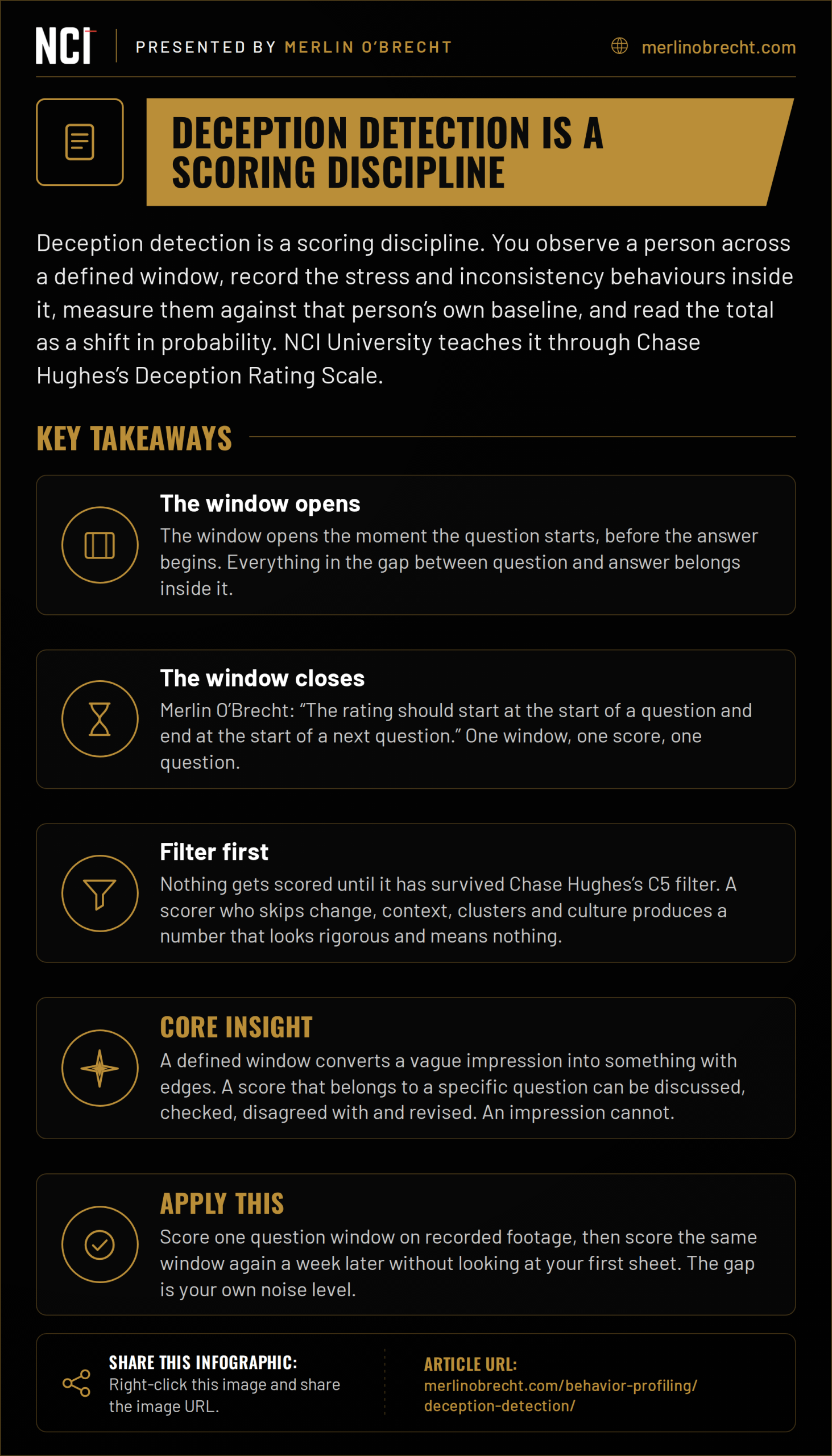
Deception detection is a scoring discipline. You observe a person across a defined window of time, record the stress and inconsistency behaviours that appear inside it, measure them against that person’s own baseline, and read the total as a shift in probability. NCI University teaches it through Chase Hughes’s Deception Rating Scale, and the output of a correct read is a number with a confidence attached, never a conclusion about a lie.
Everything below is the mechanics of that. The reason the mechanics matter is that they are what makes a read defensible when somebody asks you to explain it, which in professional work is always.
Stress is what you can see, and stress has many causes
Here is the correction the entire discipline turns on, and getting it wrong is how careers and cases go sideways.
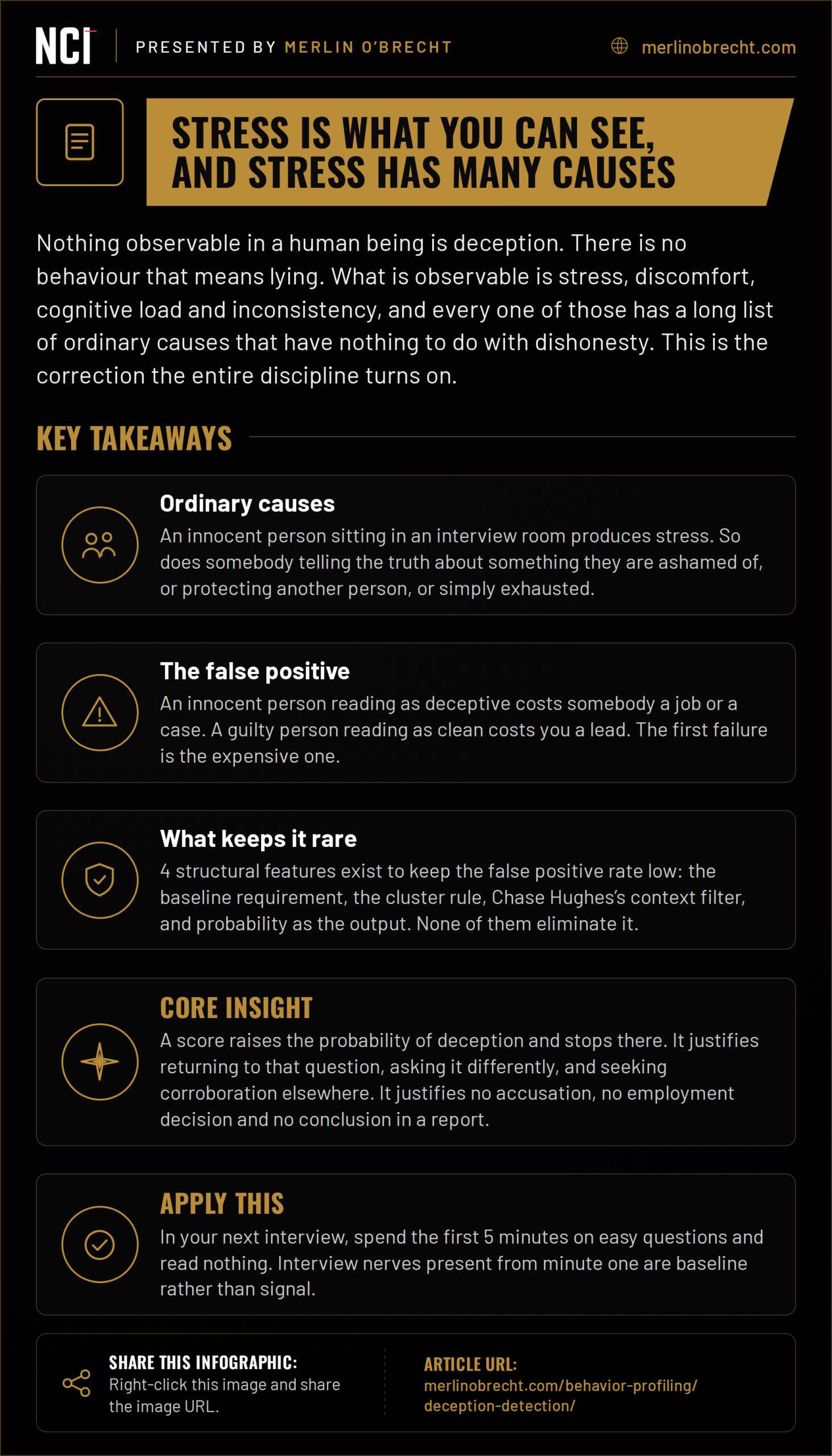
Nothing observable in a human being is deception. There is no behaviour that means lying. What is observable is stress, discomfort, cognitive load and inconsistency, and every one of those has a long list of ordinary causes that have nothing to do with dishonesty.
An innocent person sitting in an interview room produces stress. So does a person who is telling the truth about something they are ashamed of. So does a person who is protecting somebody else, or who is frightened of being disbelieved, or who is exhausted, or who is having a bad week entirely unrelated to the reason they are in the room.
The false positive is the real risk in this work. An innocent person reading as deceptive is more damaging than a guilty person reading as clean, because the second failure costs you a lead and the first one costs somebody their job or their case. Every structural feature described below exists to keep that rate low: the baseline requirement, the cluster rule, the context filter, and the decision to output probability rather than a finding.
How does the Deception Rating Scale work?
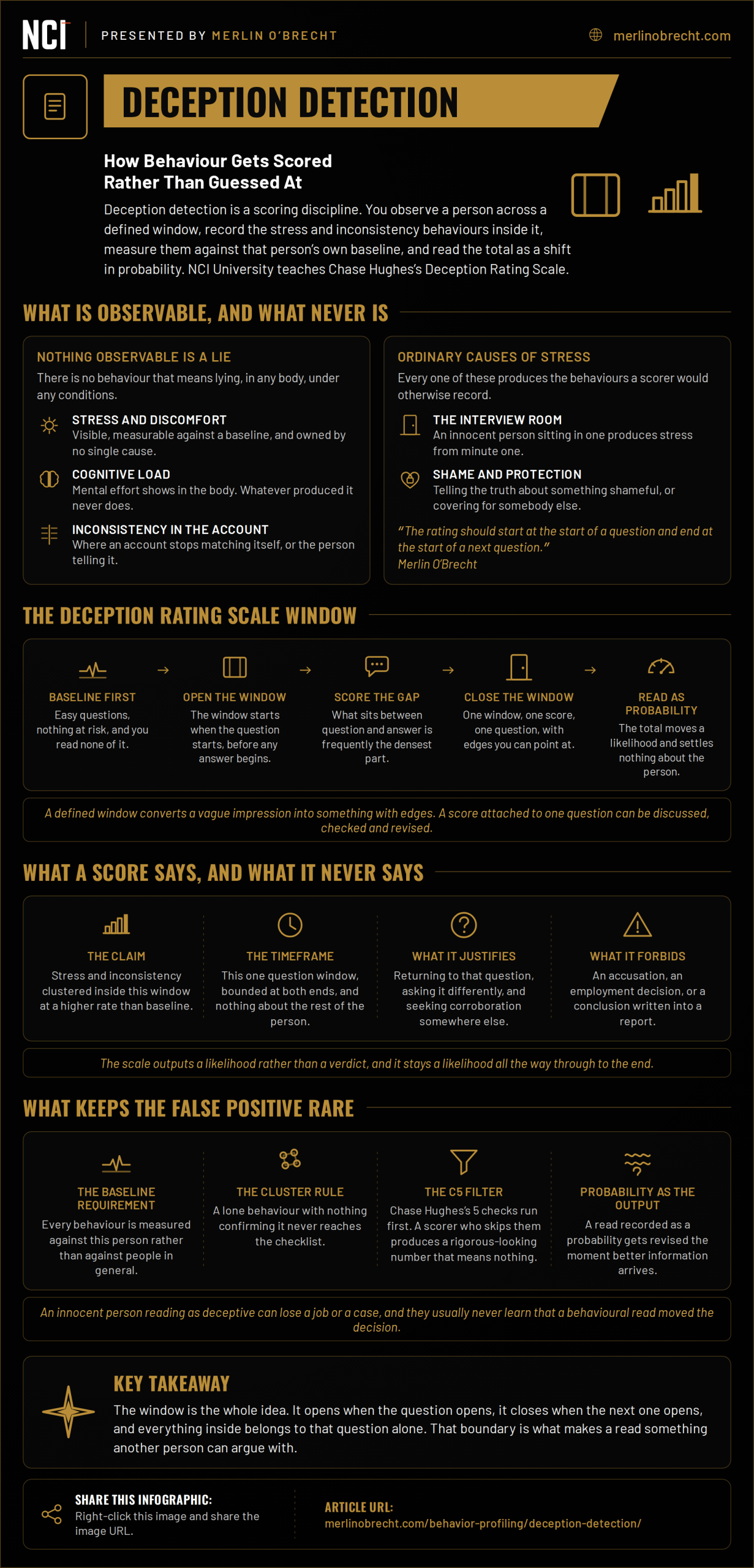
The Deception Rating Scale is Chase Hughes’s scoring instrument, and its most useful property is that the observation window is defined rather than left to judgment. Five steps.
- Establish the baseline before the sensitive questions. Easy questions, low stakes, nothing at risk. You are recording what this person looks and sounds like when nothing is happening, and you read nothing during that period.
- Open the window the moment the question starts. Not when the answer starts. As Merlin puts it on camera, the interviewer asks the subject a question, and before they even start answering the question you are allowed to start making ratings on their body language behaviour.
- Score behaviours as they appear inside the window, including everything that happens between the end of the question and the beginning of the answer. That gap is frequently the most information-dense part of the whole exchange, and it is invisible to anybody scoring answers rather than windows.
- Close the window when the next question begins. The rating score does not stop until the interviewer starts to ask the next question. One window, one score, one question. That boundary is what makes the score attachable to a specific stimulus.
- Read the total as probability. Above 11 tells you the probability of deception has risen. It does not tell you deception is present. The number is a reason to go back to that question, not a reason to conclude anything about the person.
“The rating should start at the start of a question and end at the start of a next question.”
That single sentence does more work than any list of tells ever written, because it converts a vague impression into something with edges. A score that belongs to a specific question can be discussed, checked, disagreed with and revised. An impression cannot.
Where the score comes from
The scoring inputs come from Chase Hughes’s Behavioral Table of Elements, the reference chart of behavioural indicators used across the NCI University curriculum. For deception work specifically, you are drawing from the top right corner of the chart, plus the 4.0 language indicators located at the bottom of it.
The Deception Triangle is the second Chase Hughes instrument in this area. It is a separate model with its own structure, and it is named here rather than taught, because the source material this page is built from names it rather than teaching it. Anybody who tells you what it contains without having been through the curriculum is guessing.
Two things this page deliberately does not do. It does not reproduce the Behavioral Table of Elements, and it does not offer you a copy. The chart is NCI’s and it comes with the training that makes it usable.
Why does a score above 11 not mean someone is lying?
Because the instrument measures something adjacent to deception rather than deception itself, and the threshold marks where the probability becomes worth acting on rather than where certainty begins.
| What the score says | What the score does not say | |
|---|---|---|
| The claim | Stress and inconsistency behaviours clustered inside this window at a higher rate than baseline | This person lied |
| The timeframe | This one question window, bounded at both ends | Anything about the rest of the interview or the rest of the person |
| The confidence level | A raised probability, held loosely, revisable | A finding, a verdict, or a conclusion |
| What action it justifies | Returning to that question, asking it differently, seeking corroboration elsewhere | An accusation, a decision about employment, or a conclusion in a report |
| What happens when it is wrong | The read gets revised, because it was recorded as a probability from the start | An innocent person carries a finding they cannot see or challenge |
The right-hand column is the one that gets forgotten under pressure, and it is the reason this method is written down the way it is.
Worth stating plainly: the threshold is NCI curriculum. It comes from Chase Hughes’s system and it is taught as part of it. It is not a validated cut-off derived from published research, and this page makes no comparison between it and any instrument that has a validation literature.
Reading incongruence before you ask anything
Before a single question is asked there is a read available, and it is the one that produced the “something feels off” signal in the first place.
Chase Hughes’s Authority Triangle has an external side, MACCI: movement, appearance, comfort, connection, intent. Five observable elements, and the useful thing is what happens when they disagree with each other.
Take a worked example. Somebody is slightly jittery. Their appearance is fine, well groomed. They are moving slowly. They look comfortable. And underneath that, they are not truly connected to the conversation, and their intentions seem a little uncertain.
Comfort and connection have just disagreed. The body is presenting settled and the engagement is presenting absent, and that disagreement is what incongruence looks like in practice. It is not evidence of deception and it is not scored on the DRS. It is a flag that tells you where to point the instrument, which is a different and earlier job.
The full tracking of a read like that, through the other two sides of the triangle and into what it implies about the person, sits on what sits underneath a stress read.
Every behaviour goes through the filter first
Nothing gets scored until it has survived Chase Hughes’s C5 filter, and this is the pre-condition rather than a refinement.
Change: is this a deviation from the person’s own baseline, or is it just how they sit? Context: does something in the room explain it, the temperature, the chair, the flight of stairs they climbed to get here? Clusters: is anything else confirming it, or is it alone, in which case it gets discarded? Culture: does a norm explain what you are reading as stress?
A behaviour that survives all four is a data point. A behaviour that fails any of them never reaches the checklist, and a scorer who skips this step is producing a number that looks rigorous and means nothing. The method for running the filter properly is on the C5 filter every scored behaviour has to survive.
How do you practise deception detection without a subject?
Footage, one question window at a time.
- Find recorded interview or interrogation material. There is a great deal of it publicly available and the stakes in the room are visible.
- Pick a section with a clear question-and-answer rhythm. You need to be able to hear where each question begins.
- Score exactly one window. Start at the beginning of the question, stop at the beginning of the next one. Do not let the window drift.
- Then audit yourself. Go back through every behaviour you scored and ask whether it would have survived C5. Change, context, cluster, culture. Count how many should have been discarded.
- Score the same window again a week later without looking at your first sheet, then compare. The gap between your two sheets is your own noise level, and knowing it is more useful than any single score you produce.
Do that for a month and you will get measurably better. Then you will hit the ceiling, and it is worth naming what the ceiling is: scoring footage alone teaches you your own habits and nothing else. There is no correction in the loop. Nobody tells you that the four behaviours you scored in window three were the same behaviour counted four times, or that you have been generous with yourself on every window since.
A score is only as good as the person calibrating it, and calibration needs somebody who has scored the same footage and will say where you were wrong. That is the function of the 32 skills-building calls with facilitators inside NCI-2 Behavior Profiler, alongside 22 video modules and 12 hours of material, $795.
What this method refuses to give you
It will not tell you who is lying. There is no score, no cluster and no combination of behaviours in this system that identifies a lie, and anybody who sells you one is selling you a liability.
It will not give you certainty, at any score, under any conditions. The output is a probability and it stays a probability all the way through.
It will not give you a single tell, and it will actively take away most of the ones you currently believe in.
If those three things are what you came for, every honest version of this training will disappoint you, and it should. The people who do this work professionally are the ones who wanted the apparatus rather than the answer.
Frequently asked questions
What is the Deception Rating Scale?
The Deception Rating Scale is Chase Hughes’s scoring instrument for deception work, taught through NCI University’s curriculum. It scores observable stress and inconsistency behaviours inside a single defined question window, measured against the subject’s own baseline. Its output is a number that shifts the probability of deception, and a score above 11 marks the point where that probability is worth acting on.
How do you detect deception in an interview?
Five steps. Build the subject’s baseline during low-stakes questions. Open the scoring window at the start of each sensitive question. Score only behaviours that survive the C5 filter, including everything in the gap before the answer begins. Close the window when the next question starts. Read the total as a raised or unchanged probability, then decide which question to return to.
How long does it take to learn deception detection?
Scoring recorded footage to a consistent standard is achievable in weeks of daily practice. Scoring a live interview while you are also conducting it, deciding the next question and managing your own state, takes considerably longer, and most people underestimate that second gap by an order of magnitude. No honest number exists for the second one because it depends heavily on how much feedback you get.
Does deception detection actually work, or is it discredited?
The general position of the deception research literature is that single-cue lie detection performs close to chance, and that finding is well established. This method accepts it completely. What is being scored here is a cluster of stress and inconsistency behaviours measured against an individual’s own baseline inside a bounded window, and what is being produced is a shift in probability rather than a determination. Those are different claims with different evidentiary weight, and conflating them is how the field earned its reputation.
What is the difference between deception detection and lie detection?
Deception detection scores behaviour to produce a likelihood. Lie detection claims a verdict about whether a specific statement was true. No behavioural method identifies a lie on its own, and any system claiming otherwise has overstated what its inputs can support.
How do investigators and HR use this in an internal investigation?
The score directs questioning rather than deciding outcomes. A window that scores high tells an investigator which topic to return to, which document to request, and which corroborating source to check, and none of that requires the score to be right. It is a search heuristic. Reaching a finding about an employee remains a matter of evidence, process and whatever your jurisdiction and your policy require, and a behavioural score is not evidence.
Can you tell someone is lying from their eyes or their hands?
No. Eye direction in particular has been popularised heavily and carries no reliable information about truthfulness. Hands carry information about stress and comfort, which is a different thing entirely. Any single behaviour, from any part of the body, gets discarded when nothing else confirms it, and that rule is what keeps the method honest.
Who created the Deception Rating Scale?
Chase Hughes built it, along with the Behavioral Table of Elements it scores from and the Deception Triangle that sits alongside it. All three are taught inside NCI University’s certification ladder, primarily at the NCI-2 Behavior Profiler level. My own role is teaching the system rather than having designed any part of it.
What are the risks of getting a deception read wrong?
The false positive is the one that matters. An innocent person reading as deceptive can lose a job, a custody arrangement or a defence, and they usually never learn that a behavioural read is what moved the decision. The method reduces that risk with the baseline requirement, the cluster rule, the context filter and the probabilistic output. It does not eliminate it, and treating a score as anything other than a reason to look further is where the harm comes from.
How do you train deception detection properly?
Footage first, until your scoring is consistent with itself across repeated attempts. Then feedback, from somebody who scored the same material and will tell you where you were generous. Then live, with low stakes, where you are scoring one window while somebody else conducts the conversation. Skipping straight to live work is the most common route to a confident scorer who has never been corrected.
Where to go from here
The window is the whole idea. It opens when the question opens, it closes when the next question opens, and everything inside it belongs to that question and to nothing else.
Everything else on this page hangs off that one boundary. It is what makes a read attachable to a stimulus, what makes it discussable, and what makes it possible to be wrong in a way somebody can point at.
If you want the version with correction in the loop, that is NCI-2 Behavior Profiler. 12 hours, 22 video modules, 32 skills-building calls with facilitators, $795.
If you would rather buy nothing, score the same window twice a week apart and compare your two sheets. Almost nobody has ever measured their own noise, and you cannot calibrate an instrument you have never tested.