How to read a room before you speak
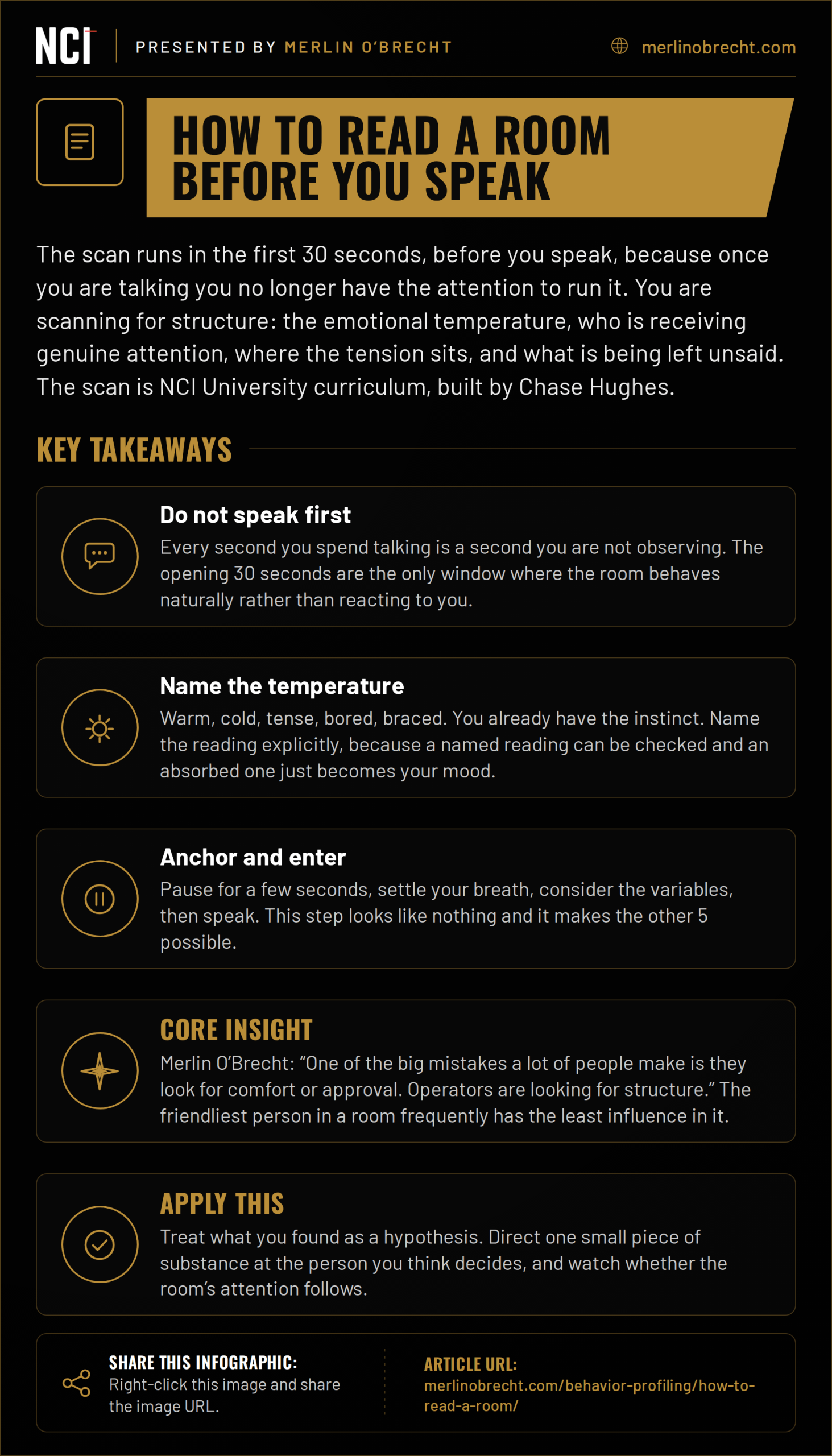
How to read a room before you speak: the 30-second scan operators run
How to read a room before you speak
Key takeaways
- The scan takes about 30 seconds and it happens before you speak, not while you are speaking.
- Amateurs look for comfort and approval in a room. Operators look for structure.
- The three things worth finding before anyone talks: whether there is trust, whether there is concealed tension, and whether there is a power struggle between multiple decision makers.
- What is missing from a room carries as much information as what is present. Nobody teaches this and it is the highest-yield habit on this page.
- A room read is a hypothesis you test in the first 2 minutes of talking, never a conclusion you act on.
How do you read a room before you speak?
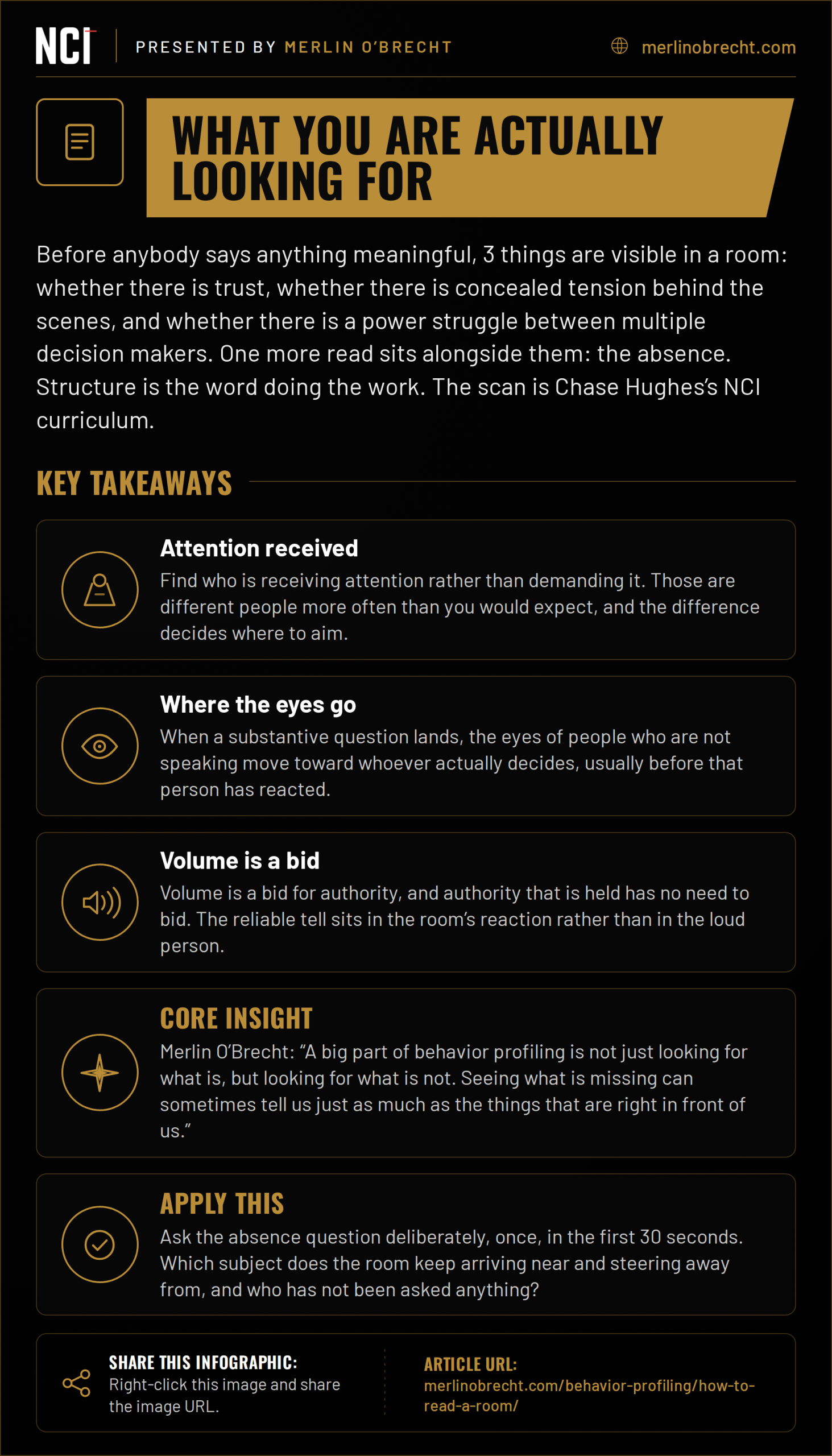
What you are actually looking for
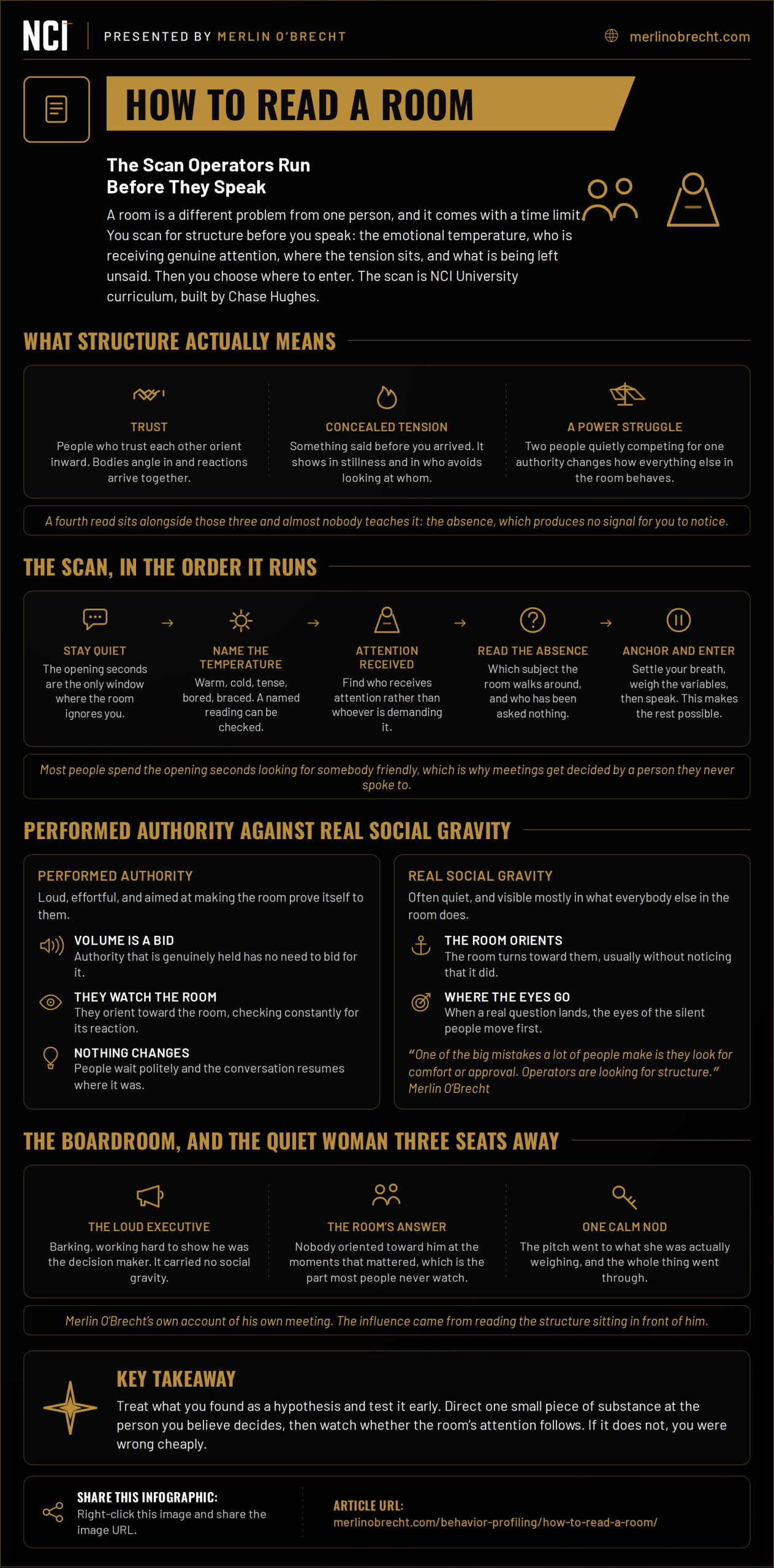
Whether there is trust in the room. People who trust each other orient toward each other. Their bodies angle in, their reactions arrive at the same time, and there is a shared rhythm to how they respond. People who do not trust each other sit in a room that looks the same and behaves nothing like it.
Whether there is concealed tension happening behind the scenes. Something that was said before you arrived, or something everybody knows and nobody has raised. It shows up in stillness, in the careful way certain names get said, and in who avoids looking at whom.
Whether there is a power struggle between multiple decision makers. Two people quietly competing for the same authority changes how everything else in the room behaves, and you can usually see it in the first minute if you are looking for it rather than looking for an ally.
How to read a room in 30 seconds
- Do not speak first. Every second you spend talking is a second you are not observing, and the opening 30 seconds are the only window where the room is behaving naturally rather than reacting to you.
- Read the emotional temperature. Is this room warm, cold, tense, bored, braced? You already have an instinct for this. Name it explicitly rather than absorbing it, because a named reading can be checked and an absorbed one just becomes your mood.
- Find who is receiving attention rather than demanding it. Those are different people more often than you would expect. Watch where eyes go when a decision-shaped question is raised, particularly the eyes of people who are not speaking.
- Note what is not being said, and who is not being addressed. Which topic does the room walk around. Which person gets talked past. Absence is data.
- Look for the opening rather than for a friendly face. Where is the gap in the pattern that you can enter usefully. The friendliest person in a room is frequently the one with the least influence in it, which is exactly why they have time to be friendly to you.
Anchor your breath and compose before you enter. - Pause for a few seconds, settle, consider the variables, and then speak. This step looks like nothing and it is the one that makes the other five possible.
The boardroom, and the quiet woman three seats away
Why does the loudest person in a meeting usually not decide anything?
| Performed authority | Real social gravity | |
|---|---|---|
| Volume | Loud, and the volume is doing work | Whatever is comfortable, often quiet |
| Who orients toward whom | They orient toward the room, watching for its reaction | The room orients toward them, usually without noticing |
| What happens when they speak | People wait politely, and the conversation resumes where it was | The conversation adjusts, even when they said very little |
| What happens when they stop | Nothing changes | The room checks in, waits, or looks over |
| Where the room’s eyes go before a decision | Anywhere except them | Straight to them, in the half second before anyone answers |
Reading the absence
Composure is what makes the scan possible
What to do with what you found
Frequently asked questions
Where to go from here