The deepest way of reading behaviour
Body language secrets: the 3 lenses that sit underneath every gesture
By Merlin OBrecht · Dean of Academic Affairs, NCI University
Body language secrets
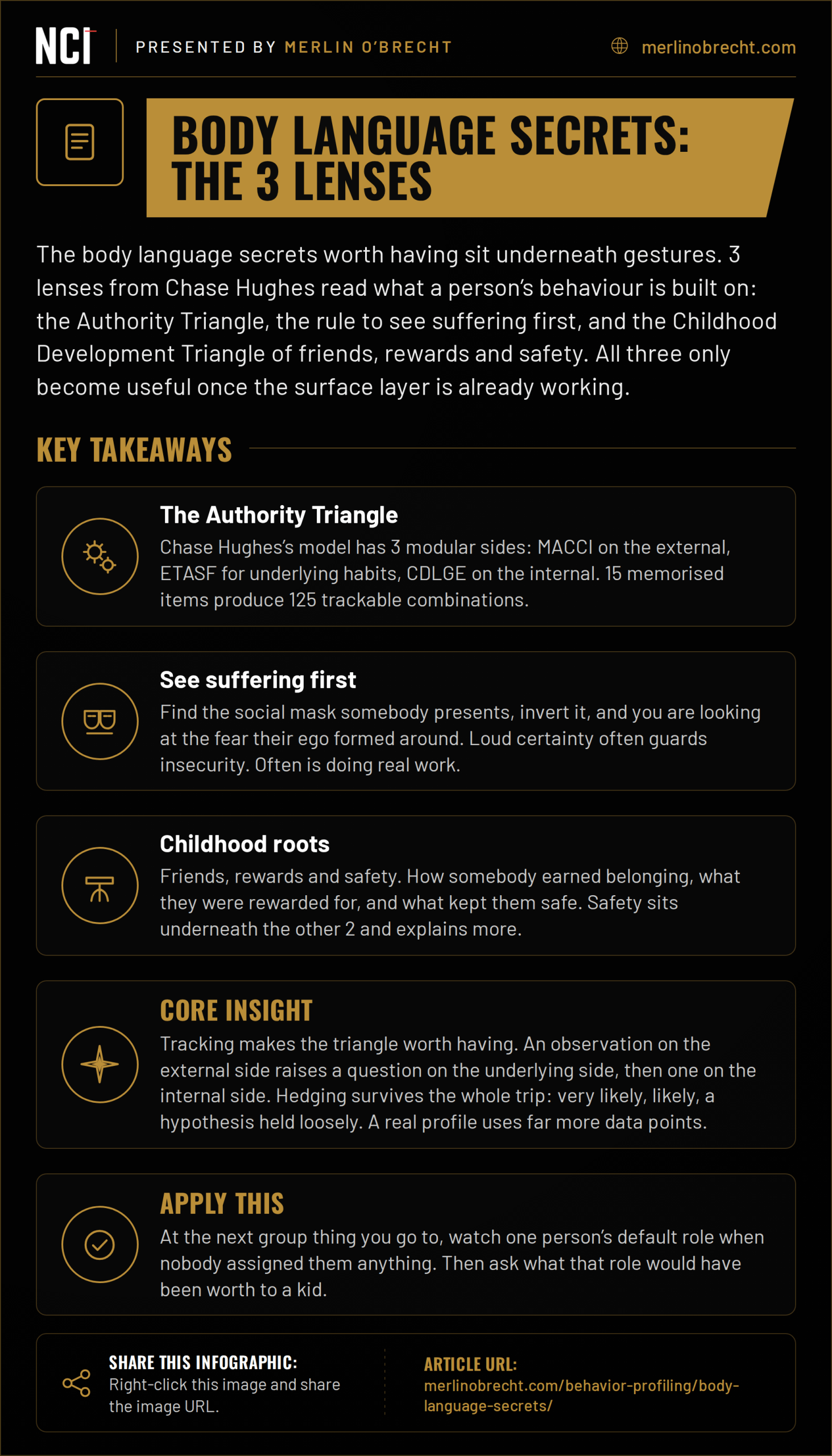
The body language secrets that matter most sit underneath body language. Three lenses from Chase Hughes go deeper than any gesture: the Authority Triangle, which tracks 125 combinations from 15 memorised items; the rule to see suffering first, which inverts someone’s social mask to find the fear under it; and the Childhood Development Triangle of friends, rewards and safety.
You have probably heard of body language profiling and thought this has to be the key to reading people. Maybe you went one layer deeper and learned NCI University’s 6MX system from Chase Hughes’s book, and thought, this is the real McCoy, this is the most in-depth I could ever see a person.
I used to think body language and 6MX was the end of the story when it came to profiling skills that resemble something close to a superpower.
There is a deeper level, and it is a set of psychological factors that make the rest of behavior profiling look like an old dented Toyota Corolla sitting next to a brand new Porsche 911.
Three lenses. Here they are.
Key takeaways
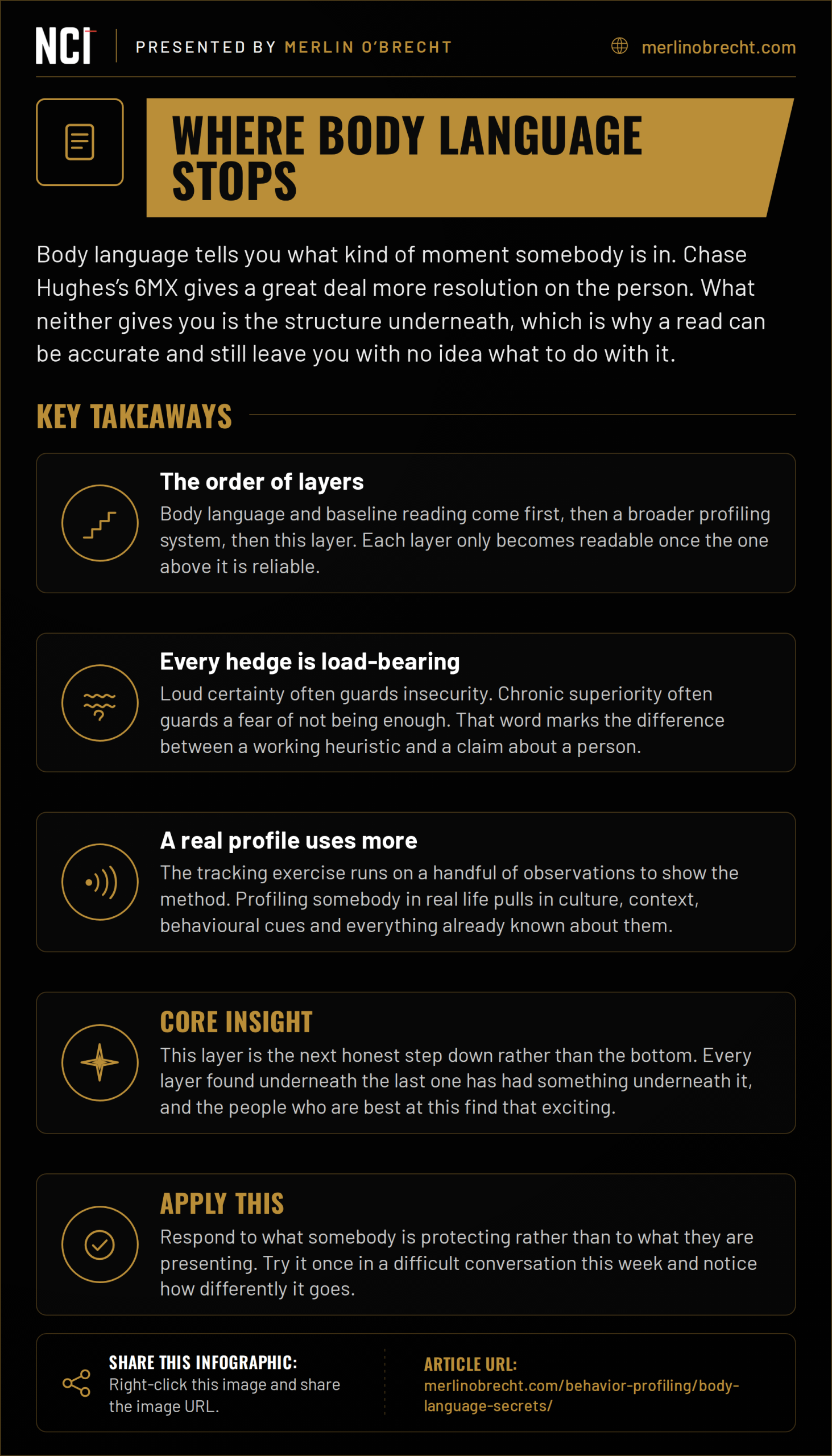
- The Authority Triangle tracks a read across three connected sides, giving 125 combinations from 15 items you have to memorise.
- The three sides are MACCI (external), ETASF (underlying habits) and CDLGE (internal).
- "See suffering first" inverts a person's social mask to find the fear the ego is built around.
- The Childhood Development Triangle covers friends, rewards and safety, and the safety pattern shapes the deepest habit.
- Every conclusion at this depth carries a hedge. The word "often" is doing real work throughout and it is not padding.
What do body language secrets actually refer to?
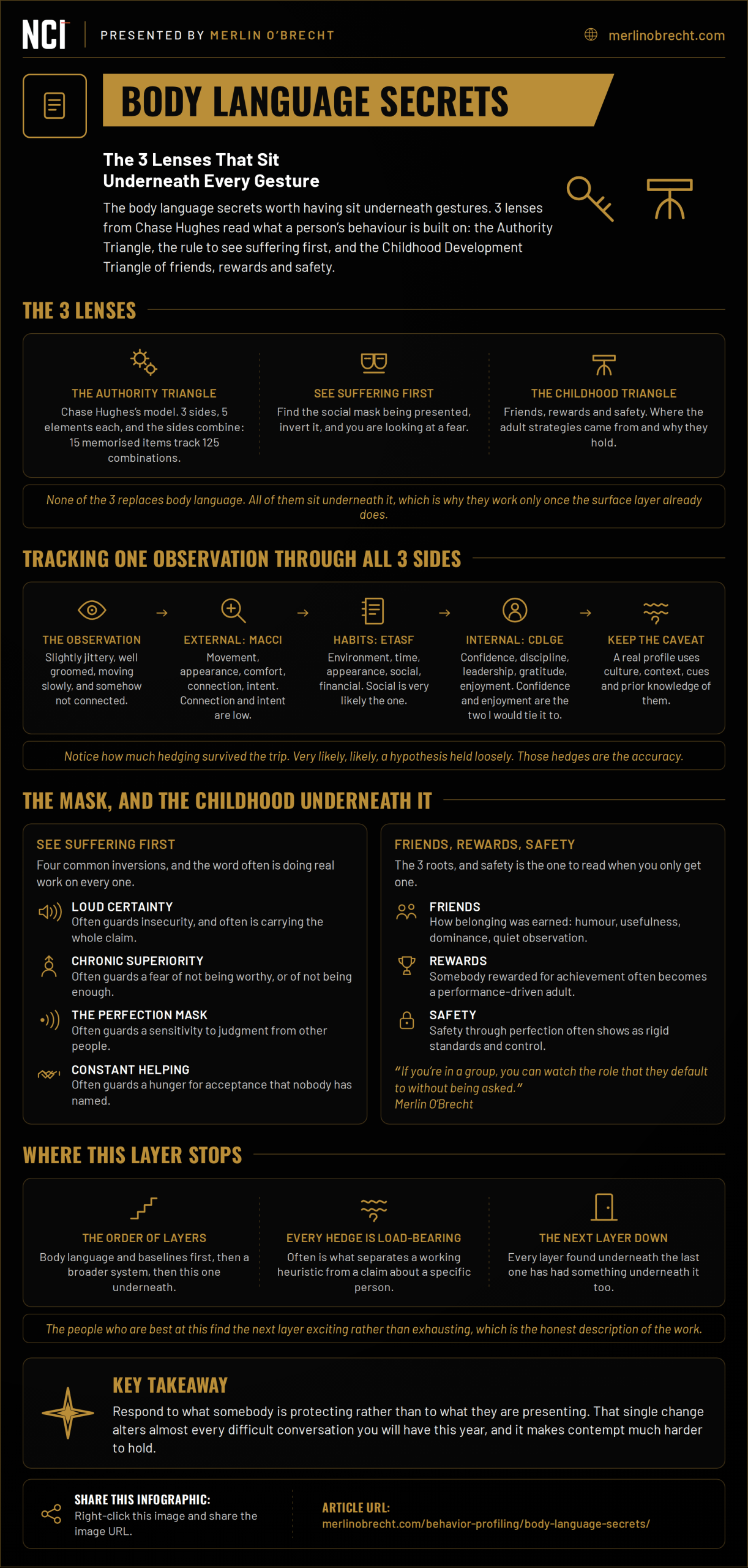
The body language secrets worth having are not hidden gestures. They are the layer underneath gestures: three lenses that read what a person’s behaviour is built on rather than what it is doing.
- The Authority Triangle. Three sides, five elements each, tracked through each other. Chase Hughes's model, and the one that turns an isolated observation into a chain.
- See suffering first. Find the social mask a person is presenting, invert it, and you are looking at the fear their ego formed around.
- The Childhood Development Triangle. Friends, rewards and safety. Where the adult strategies came from and why they hold.
None of these replace body language. All of them sit underneath it, which is why they only become useful once the surface layer is already working.
Where body language stops
I want to be careful about how I frame this, because the correction I am making here is to my own past position rather than to anybody else’s.
Body language told me what kind of moment somebody was in. 6MX gave me a great deal more resolution on the person. Both of those are real and I use them constantly. What neither of them gave me was the structure underneath, which is why a read could be accurate and still leave me with no idea what to do with it.
“It’s a set of psychological factors that make the rest of behavior profiling look like an old dented Toyota Corolla sitting next to a brand new Porsche 911.”
The pool has more depth below this too, which I will come back to at the end. What follows is the next honest layer down, not the bottom.
How does the Authority Triangle work?
Authority functions kind of like a signal. People’s nervous systems pick it up really fast, and even if you are not trained in what to look for, you will instantly know when something feels a little bit off.
The Authority Triangle, which is what we use at NCI University and which is developed by Chase Hughes, gives you three sides to track behaviour through. The property that makes it usable is that it is modular. You can combine elements from different sides of the same model, which is what produces 125 variations from only 15 things to memorise. Five per side, three sides, 5 x 5 x 5 for the combinations and 5 + 5 + 5 for the memorisation load.
That arithmetic is the reason the model is teachable at all. A hundred and twenty-five separate patterns would be a career. Fifteen items and a tracking rule is an afternoon.
External: MACCI. Movement, appearance, comfort, connection, intent. This is the observable side, the one you can see in the first minute.
Underlying habits: ETASF. Environment, time, appearance, social, financial. The habit layer, which is what a person’s life is actually organised around.
Internal: CDLGE. Confidence, discipline, leadership, gratitude, enjoyment. The internal side, and the one that explains the other two.
Chase Hughes and NCI define confidence precisely, and the definition matters for the next section: a feeling of comfort and a generalised expectation of positive outcomes in the future.
Tracking one observation through all three sides
Here is the exercise, run all the way through. It is the most useful thing on this page.
The observation. Somebody is a little bit jittery. Their appearance seems fine, they seem well groomed. They are moving pretty slowly and they look comfortable. And underneath that, they are not truly connected to the conversation, and their intentions seem a little bit uncertain.
Step 1, the external side. Run that against MACCI. Movement is fine. Appearance is fine. Comfort is fine. So the problem sits in connection and intent, which are the last two, and that is the whole finding at this level: two of five external elements are low and three are not.
Step 2, the underlying habits. If connection and intent are the low ones, what could that relate to in environment, time, appearance, social or financial? Social is, I think, definitely the right answer here, and that is likely what we are going to see. If there is a problem with those two things it is fairly obvious, and there is very likely a problem going on with social.
Step 3, the internal side. Now take a low social score into CDLGE. Confidence, discipline, leadership, gratitude or enjoyment, or some combination. The precise two elements I personally would tie it to are confidence and enjoyment.
The caveat, and it is not optional. If we were profiling this person in real life, we would want to be looking at as many data points as we could. Culture, context, any behavioural cues, and anything we already know or understand about this person. What is above is an isolated exercise, run on a handful of observations, in order to show the tracking.
What the chain produced. We saw a problem with connection and intent, and just by tracking it through this simple triangle we have deduced that there is very likely an issue with this person’s level of enjoyment in their life, and with their ability to feel a generalised expectation of positive outcomes in the future. We also know they are very likely not involved in many social activities.
That is one tiny lens, one tool in the set, and it produced a fairly deep snapshot of the human being in front of us in about 30 seconds of thinking. Notice how much hedging survived the trip. Very likely. Likely. The precise two elements that I personally would tie it to. Those are not weasel words, they are the accuracy.
How do you see what someone's ego is protecting?
Chase has this great saying, which is to see suffering first.
The ego forms as a reflection of fear, and personality often becomes a shield for that fear. So when you spot the private insecurity somebody’s ego protects, you can find the lever behind their identity. All you really have to do is spot a mask and invert it, and once you do, you can instantly see the tree of somebody’s ego, the root of which is their greatest fears.
Four common inversions. Note the word “often” on every single one of them, because it is the difference between a heuristic and a claim about a person.
| What the mask shows | What it is often guarding |
|---|---|
| Loud certainty | Insecurity |
| Chronic superiority | A fear of not being worthy, or of not being enough |
| Perfection | A sensitivity to judgment |
| Constant helping | A hunger for acceptance |
The question to hold is simple. What is this person trying to show me with their social mask? What is their ego trying to present? And what is the opposite of that?
Answer those and you can draw a direct connection between the formation of somebody’s ego and their greatest fears. What you have then is a hypothesis about a fear, held loosely, and not a fact about a person.
The Childhood Development Triangle: friends, rewards, safety
The third lens adds to the rule above. The Childhood Development Triangle is how somebody gained friendships when they were a kid, how they gained rewards, and how they gained safety.
One correction first, because it is the thing people get stuck on. I see a lot of people we train get really hung up on the age. Does this happen at 5, at 6, at 10, what is the exact age? That is the wrong question. What we are really looking for are the patterns, generally speaking, in the psychological development of this person’s brain.
Friends. How did they get belonging? Was it humour, usefulness, dominance, agreeableness, or maybe just being the quiet observer?
Rewards. Somebody rewarded for achievement is often a performance-driven adult. Somebody rewarded for obedience becomes authority-seeking and rule-attuned. Somebody rewarded for appearance and the way they looked becomes an image-attuned adult.
Safety. The safety patterns shape the deepest habit. If safety came from perfection, you see rigid standards and a high neediness for control. If being invisible was the thing that kept them safe, you see avoidance and low expression.
Safety is the one to read first when you only get one. It sits underneath the other two and it explains more of an adult’s behaviour than either of them.
Reading the role someone takes without being asked
The friends side has the most immediately usable observation on this page, and you can run it at the next thing you go to.
“If you’re in a group, you can watch the role that they default to without being asked.”
Nobody assigns these. Somebody becomes the one who makes the joke when it gets tense. Somebody becomes the one who explains what is happening to whoever arrived late. Somebody becomes the one who gets the drinks, the one who keeps the quiet person included, the one who watches.
That default is the strategy that earned them belonging as a child, still running, decades later, in a room where none of the original conditions apply. It is unusually visible because nobody thinks of it as behaviour. They think of it as just being themselves, which is exactly what makes it worth watching.
The three lenses in one breath
The Authority Triangle: start with what you see on the external side and track it through the underlying and the internal.
See suffering first: the ego protects pain, so find the social mask being presented, invert it, and you find the insecurity and the behavioural identity key.
The Childhood Development Triangle: friends, rewards and safety, which predicts the adult strategies and reveals the childhood survival patterns.
That is the whole system in about 60 words, and having it compressed like that is genuinely useful in a room.
What the compression hides is the sequence. I did not learn these in this order and nobody does. Body language first, then 6MX, then this, over years, inside a curriculum where somebody was correcting the reads I got wrong. The tracking exercise above works on paper because the observation was handed to you already made. Making that observation yourself, live, on a person who is talking, is the part that gets drilled. That is what the NCI-2 Behavior Profiler course is built around: 12 hours of material, 22 video modules and 32 skills-building calls with facilitators, $795.
Worth knowing before you go anywhere near it. The first thing this depth of reading does is make you notice your own mask, which is not what most people are shopping for when they search for secrets.
What this is for
“I hope that you can take this and use this to stop being fooled by kind of surface performance of others and use it to choose better leaders, better allies, and make better moves in your everyday life.”
That is the purpose and it is worth stating plainly, because a set of tools this specific will find its own use if you do not give it one.
Choosing better leaders means you stop being impressed by loud certainty and start asking what it is guarding. Choosing better allies means you notice who defaults to the useful role and who defaults to the visible one. Better moves in everyday life mostly means responding to what somebody is actually protecting rather than to what they are presenting, which changes almost every difficult conversation you are going to have this year.
I said earlier that this is the next layer down rather than the bottom. It is. There is more underneath it, and the honest version of that sentence is that there is always more underneath it. That is the part I like about this work.
Frequently asked questions
What is the Authority Triangle?
The Authority Triangle is Chase Hughes’s three-sided model of authority and confidence, used at NCI University as a profiling tool. Its sides are MACCI (movement, appearance, comfort, connection, intent), ETASF (environment, time, appearance, social, financial) and CDLGE (confidence, discipline, leadership, gratitude, enjoyment). Because the sides are modular, 15 memorised items produce 125 trackable combinations.
How do you read someone's childhood from their adult behaviour?
Three steps, using the Childhood Development Triangle. Watch what role they default to in a group without being asked, which points at how they earned belonging. Notice what they still perform for, which points at what they were rewarded for. Then look at what they organise their life to avoid, which points at how they stayed safe. The specific age never matters, and getting stuck on it is the most common mistake.
How long does it take to read at this depth?
It follows a sequence rather than a schedule. Body language and baseline reading come first, then a broader profiling system, then this layer, which only makes sense once the surface reads are already reliable. My own path ran in exactly that order over years, and I would be inventing a number if I gave you one.
Is reading someone's ego this way actually reliable?
Reliable enough to generate a hypothesis and nowhere near reliable enough to conclude anything, which is why every inversion in the table carries the word “often.” The discipline that keeps it honest is the same one that governs every other read in this discipline: require more than one indicator, check what else could explain it, and hold the conclusion as a probability that can be revised when the next piece of information arrives.
What is the difference between 6MX and the Authority Triangle?
6MX reads a person quickly across a broad set of behavioural indicators, which is what makes it useful in a short interaction. The Authority Triangle reads authority and confidence specifically, across three connected sides, and its value is the tracking: an observation on one side leads to a question on the next. Both are Chase Hughes’s and they answer different questions.
How do you use this to pick better leaders or business partners?
Watch which side of the triangle the person’s authority is coming from. Somebody whose external presentation is strong and whose underlying habits are disorganised is usually presenting rather than operating, and the gap shows up under pressure long before it shows up on a CV. The partner worth having tends to look unremarkable on the external side and consistent on the other two.
Can you really tell someone's deepest fear from how they act?
You can generate a decent hypothesis about it, and that is a different claim. Loud certainty often guards insecurity, and often is not always. What the mask inversion gives you is a direction to look in and a question worth asking, and treating it as a fact about somebody is the fastest way to be confidently wrong about a person you have known for years.
Who developed the Childhood Development Triangle?
Chase Hughes developed it, and it is taught within NCI University’s behavior profiling curriculum. It connects directly to his six social needs: the friends, rewards and safety patterns from childhood are where an adult’s social need generally comes from, which is why the two models are usually taught together.
Is it intrusive to profile someone at this depth without telling them?
The test Chase Hughes teaches is whether the person, seeing your full intent, would agree it was in their interest. There is also a practical answer worth adding. Reading somebody at this depth reliably makes contempt harder to hold rather than easier, because you end up looking at what a person is protecting instead of what they are doing. That effect is consistent enough that I would call it the main thing this material does to people who learn it.
What comes after these three lenses?
More of the same layer, honestly. Body language and baseline reading come first, then this, and then the material that connects a person’s identity to their behaviour, which is where the work stops being observational and starts being about the reader. The sequence matters more than the speed, since each layer is only readable once the one above it is reliable.
Where to go from here
I opened by saying I used to think 6MX was the end of the story. Here is what closing that loop actually looks like.
It was not the end. This is not the end either. Every layer I have found underneath the last one has had something underneath it, and the people I know who are best at this are the ones who find that exciting rather than exhausting.
If you want the version where the layers get built in order and somebody corrects the reads you get wrong, that is NCI-2 Behavior Profiler. 12 hours, 22 video modules, 32 skills-building calls with facilitators, $795.
If you would rather buy nothing, run the group observation this week. Watch one person’s default role in a room where nobody assigned them anything. Then ask yourself what that role would have been worth to a kid.