How to build real confidence
Confidence training: the tangible half, and the part underneath it
By Merlin OBrecht · Dean of Academic Affairs, NCI University
Confidence training
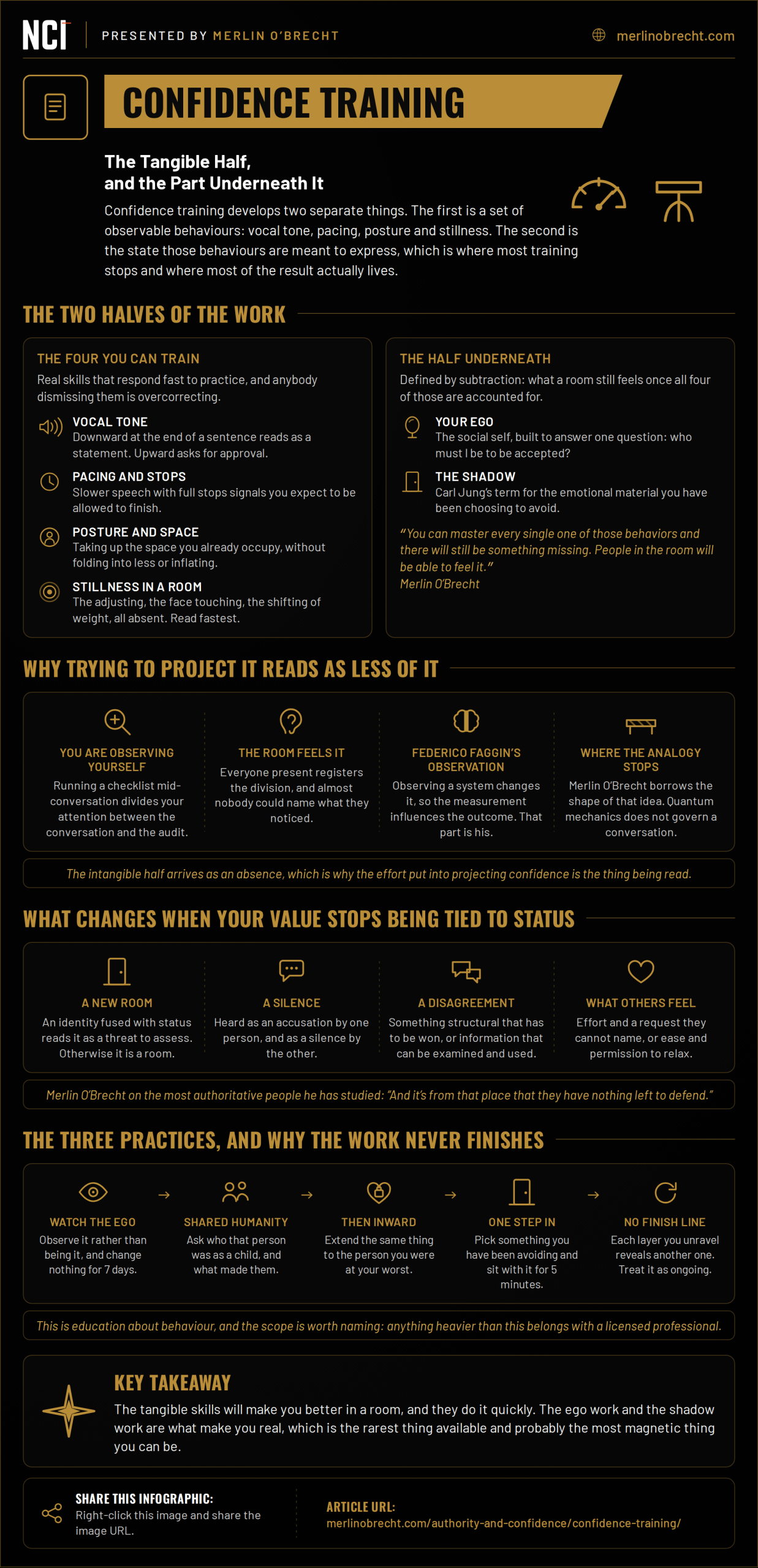
Confidence training has two halves. The tangible half is posture, vocal tone, pacing and stillness. The intangible half is what people in the room still feel after all of that is accounted for. It comes from two places: your relationship with your ego, and the material Carl Jung called the shadow.
“I want to warn you upfront. This is very likely going to get uncomfortable in a good way.”
There is no shortage of people explaining how to become more confident. Stand differently. Speak with a more authoritative tone. Manage your eye contact. Firm handshake.
Every one of those works, and here is the problem with the analysis underneath them.
“You can master every single one of those behaviors and there will still be something missing. People in the room will be able to feel it.”
That leftover is what this page is about. It has two sources, both of them nameable, and neither of them is a technique.
Key takeaways
- Authority is how much autonomy and control you have over yourself. Confidence is the overall feeling of safety you carry.
- Neither is something you have. Both are perceived in you by other people, and both communicate one message: this person is safe to follow.
- The tangible half of confidence training is vocal tone, pacing, posture and stillness, and it genuinely works.
- The intangible half is defined by subtraction: it is what a room still feels once the behaviours are accounted for.
- The two sources of the intangible half are your relationship with your ego, and the material Carl Jung called the shadow.
What is confidence training, and what does it actually train?
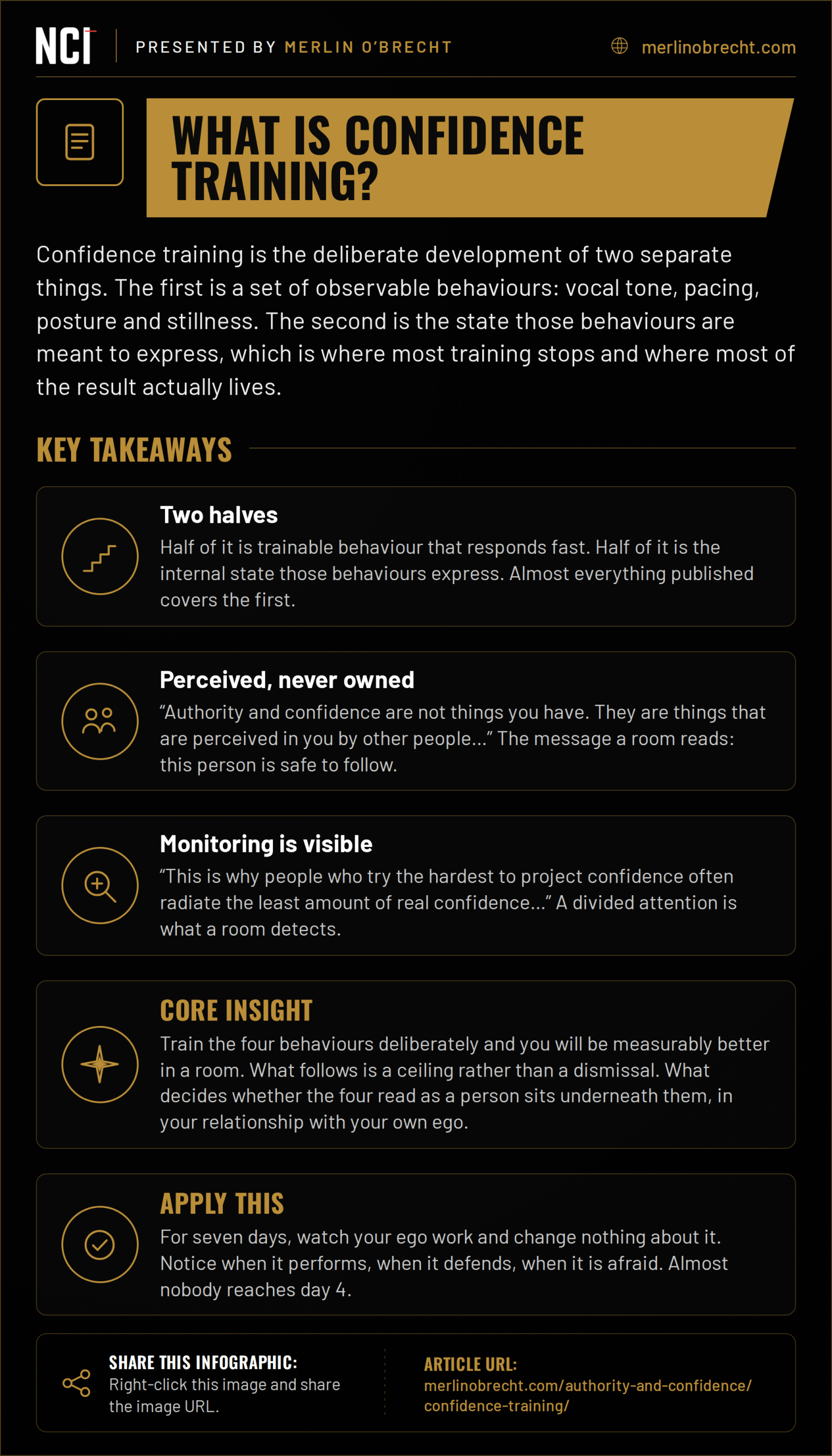
Confidence training is the deliberate development of two separate things. The first is a set of observable behaviours: vocal tone, pacing, posture and stillness. The second is the state those behaviours are supposed to be expressing, which is where most training stops and where most of the result actually lives.
Two definitions make the rest of the page work.
Authority is how much personal autonomy and control you have over yourself. Not position, not seniority, not who reports to you.
Confidence is the overall feeling of safety you have, or how much safety you feel.
And then the reframe that changes what you are aiming at.
“Authority and confidence are not things you have. They are things that are perceived in you by other people and that communicate one fundamental message. This person is safe to follow.”
Human beings are wired, evolutionarily and neurologically, to look for leaders, to look for somebody who signals I know where we are going and I know I can handle what comes next. That is the message being read. Everything below is about what makes it legible.
The tangible half: the part that can be trained directly
These are real skills, they respond quickly to practice, and anybody telling you they do not matter is overcorrecting.
- Vocal tone. Downward inflection at the end of a sentence reads as a statement. Upward reads as a request for approval, even when the words are identical.
- Pacing. Slower speech with complete stops signals that you expect to be allowed to finish. Rushing signals you expect to be interrupted.
- Posture. Taking up the space you already occupy, rather than folding into less of it or inflating into more.
- Stillness. The absence of the small management movements: the adjusting, the touching of the face, the shifting of weight. Stillness is the one people read fastest.
Train those four and you will be measurably better in a room within weeks. I want that stated plainly before the rest of the page, because the rest of the page is about a ceiling rather than a dismissal.
And if you have ever done every one of those things correctly and still felt the room decline to buy it, you already know where the ceiling is.
Why does trying to project confidence make you look less confident?
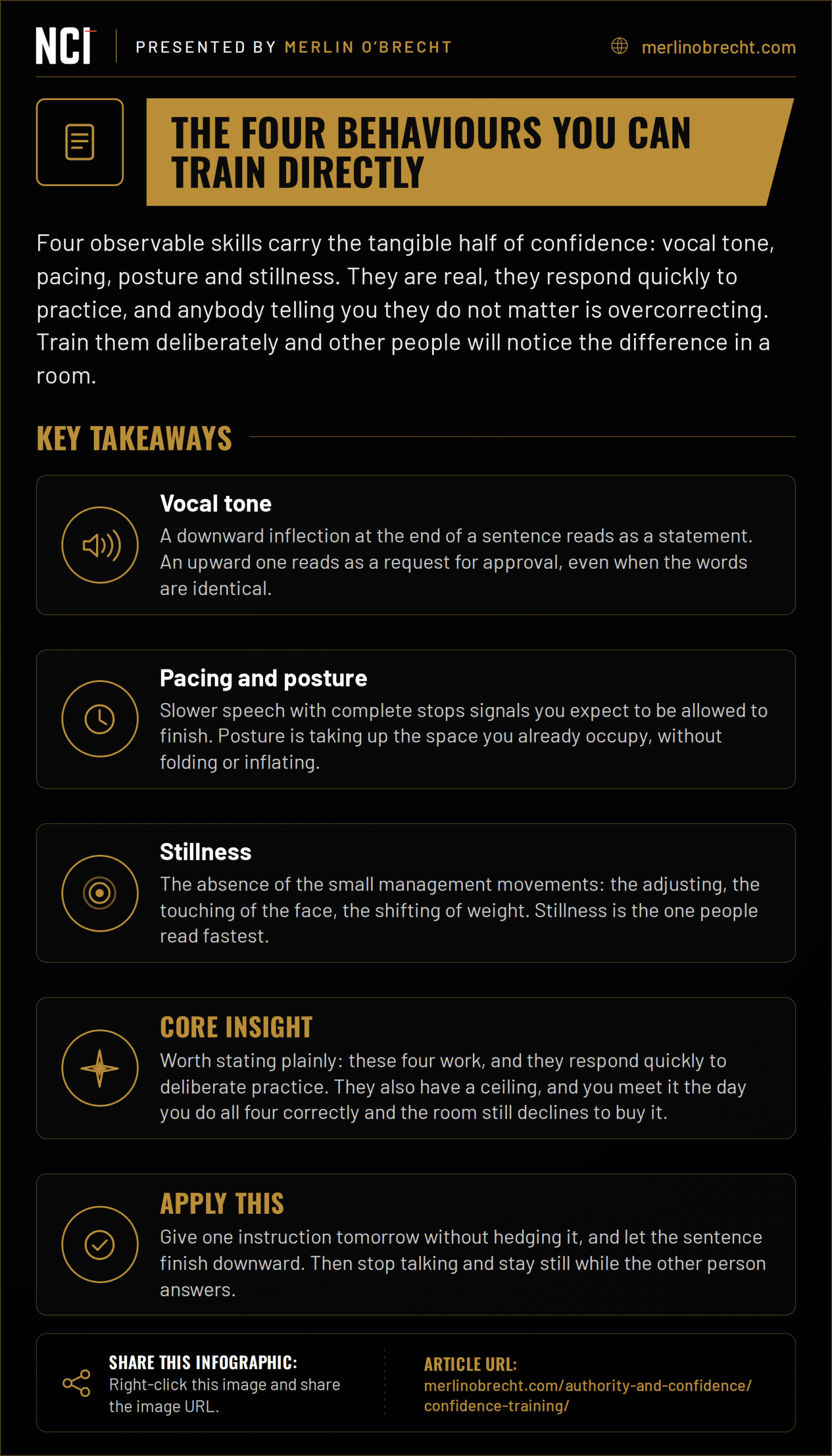
Because the act of monitoring your own performance is itself visible, and it is the thing being read.
There is a physicist called Federico Faggin, one of the inventors of the microchip and later one of the most serious scientific thinkers on the nature of consciousness. He made an observation about quantum systems: they are fundamentally irreducible. You cannot understand the whole by examining the sum of its parts. The act of observing a thing changes the thing being observed, so the measurement influences the outcome, and you cannot stand outside the system and study it without becoming part of what you are studying.
That is an analogy rather than a mechanism, and I want to be clear that I am borrowing the shape of the idea rather than claiming that quantum mechanics governs a conversation. But the shape fits exactly.
“This is why people who try the hardest to project confidence often radiate the least amount of real confidence. Essentially they are observing themselves.”
Somebody running a checklist in a conversation has divided their attention between the conversation and the audit. Everyone present can feel the division, even though almost nobody could name what they are noticing. That is the intangible half, arriving as an absence.
The ego, and the difference between having one and being one
Your ego is the social self, the constructed identity you have been building since childhood. It is a projection, and it is the answer to one question: who do I need to be for people to accept me?
It is also not you, and the gap between those two statements is where a great deal of confidence lives.
When somebody’s identity is fused with their status, their accomplishments, their social position or their possessions, they are constantly defending.
| Identity fused with status | Value not tied to status | |
|---|---|---|
| What a new room means | A potential threat to be assessed | A room |
| What a silence means | An accusation | A silence |
| What a disagreement costs | Something structural, so it has to be won | Information, so it can be examined |
| What the person is defending | The resume, the title, what others think | Nothing, because none of it is load-bearing |
| What other people feel | Effort, and a request they cannot name | Ease, and permission to relax |
The most genuinely authoritative people I have studied all have one thing in common. Their fundamental sense of value is not tied to any of it. Who they are is not the resume, not the title, and not even what other people think of them.
“And it’s from that place that they have nothing left to defend.”
Somebody with nothing to defend is not performing calm. They have no live threat to manage, which is a different physical state and one that other people read instantly.
What is shadow work, and what does it have to do with confidence?
Shadow work is confronting the unresolved emotional content you have been choosing to avoid. Carl Jung introduced the concept of the shadow, and the reason it belongs on a page about confidence is mechanical rather than mystical.
Most of us have an extraordinary capacity to compartmentalise emotional pain and to keep functioning efficiently while carrying something difficult underneath. Most of us never go back to it. And unless you are willing to turn around and face it, it leaks.
It comes out sideways. It shows up in your relationships, in your emotional triggers, and in the way you shut down in conversations that start getting close to something real. That leakage reads to most people as instability, which is the precise opposite of the signal you were trying to send.
My own working definition is deliberately unromantic: feeling the feeling you were never allowed to feel, in a context safe enough to actually hold it. In practice it looks like an honest conversation with people you trust.
Worth being straight about the limits of that. This is education about behaviour rather than treatment, and material involving trauma belongs with a licensed professional rather than with an article or a training course. That sentence is the accurate scope of this page rather than a disclaimer attached to it.
When you meet somebody who has gone into that room and turned the light on, they walk differently. There is an ease to them, almost as though they are not carrying a hidden backpack the rest of us are burdened by, and it reads to everyone around them as true authority.
Three practices to start this week
- Treat your ego as an object rather than as your identity. Every day, practise observing it rather than being it. Notice when it is afraid, when it is trying to perform, when it is defending itself. You do not have to fix it, and you certainly do not have to burn it or destroy it. I am not a proponent of those ideas at all. The noticing, repeated over time, is what starts to loosen its grip.
- Look for shared humanity before you look for differences, then extend the same thing to yourself. Practise letting other people off the hook. Ask who that person was as a child and what made them the way they are. Then apply it inward, which is the half everybody skips. Radical self-forgiveness is a large component of this, and the person you were at your worst deserves your compassion rather than your contempt or your dismissal.
- Pick one thing you have been avoiding emotionally and take one step toward it. One psychological room you have not been willing to walk back into. You do not have to do the whole thing. Start a conversation. Sit with the feeling for 5 minutes instead of reaching for your phone. The shadow shrinks the moment you stop running from it, because these things grow on avoidance.
Why this work never finishes
Let that be an ongoing project rather than a task with a completion date.
It is not something we are going to get across the finish line of. We do not evolve one day and turn into demigods. Each layer we unravel will always reveal another layer.
I do not come to you as somebody who claims to be perfect at any of this. I am certainly not. I am another student on the journey, sharing what I have picked up along the way.
That is also where a page reaches its honest limit. Both the ego practice and the one-step practice ask you to observe yourself accurately at the exact moment you are least able to, which is a problem structure solves and reading does not. Working on that under supervision, with feedback, is what NCI-3 Behavior Scientist is built around: 6 to 8 weeks, self-paced, $2,987.
One warning before you start. The first practice asks you to watch your own ego perform for a week before you change anything about it, which is slower than most people want and is the reason the fast version keeps failing.
What "real" actually buys you
The tangible skills will make you better. They will.
The intangible work, the ego, the shared humanity, the shadow, is what will make you real. And real, in this world, is the rarest thing available, which is probably why it is the most magnetic thing you can possibly be.
Frequently asked questions
What is confidence training?
Confidence training is the deliberate development of the behaviours a room reads as authority, alongside the internal state those behaviours are meant to express. The first half covers vocal tone, pacing, posture and stillness. The second half covers your relationship with your own ego and the emotional material you have been avoiding, which is what people still perceive after the behaviours are accounted for.
How do you build confidence step by step?
Four steps. Train the tangible behaviours, since they respond fast and give you something to stand on. Start noticing your ego as an object rather than as yourself. Practise shared humanity toward others and then toward the person you were at your worst. Then take one step toward something you have been avoiding emotionally, and sit with it rather than distracting yourself.
How long does it take to build real confidence?
The tangible behaviours change inside a few weeks of deliberate practice, and you will notice the difference in rooms. The intangible work has no finish line, and I say so on camera rather than selling a timeline. Every layer you unravel reveals another one. Anybody promising a fixed number for the second half is describing the first half.
Does confidence training actually work, or is it just positive thinking?
The behavioural half is trainable and observable, and you can measure it: whether your voice drops at the end of a sentence, whether you stop moving when something lands. The internal half is slower and does not respond to affirmation at all. The failure mode of the positive-thinking approach is visible from outside, and it is a performance other people can feel the seam in.
What is the difference between confidence and authority?
Confidence is the overall feeling of safety you carry. Authority is how much autonomy and control you have over yourself. Neither one is a position in a hierarchy, and somebody can hold a senior title with very little of either, which is usually obvious to everyone in the room except them.
How do you build confidence for leading a team or presenting at work?
The tangible layer will carry a presentation on its own: pace, stops, stillness, a voice that finishes its sentences downward. What decides whether the room follows you afterwards is the other half, because a presentation is a performance and the weeks around it are not. Train the delivery for the event and the ego work for everything else.
Can you fake confidence until you make it?
No, and the reason is structural rather than moral. Real authority is trained into behaviour rather than performed, which I put more bluntly in a separate video: it needs to be felt internally first. A performance requires monitoring, monitoring divides your attention, and the division is exactly what a room detects. (Video 011, 31 December 2025.)
Where does the idea of the shadow come from?
Carl Jung introduced the concept of the shadow, and the term as used here is his. The other definition on this page comes from elsewhere: confidence as a feeling of comfort and a generalised expectation of positive outcomes in the future is Chase Hughes’s, taught through the NCI University curriculum.
Is shadow work the same as therapy?
No. What is described here is an honest conversation with people you trust and a willingness to sit with a feeling rather than distract yourself out of it. That is education about your own behaviour. Material involving trauma belongs with a licensed professional, and this article is not one and is not a substitute for one.
What do you work on after the ego and the shadow?
Composure under a specific trigger, which is the point where all of this becomes testable, and then the conditions that make composure possible in the first place. That sequence is worth following in order, because composure practised without the ego work tends to hold right up until the moment it matters.
Where to go from here
The distinction that matters is between performing confidence and becoming the kind of person from whom confidence simply radiates. That is the whole game, and it is the one thing on this page worth carrying if you forget the rest.
If you want the structured version, where the self-observation happens with feedback rather than alone, that is NCI-3 Behavior Scientist. 6 to 8 weeks, self-paced, $2,987.
If you would rather buy nothing, do practice 1 for seven days. Watch your ego work and change nothing about it. Almost nobody makes it to day 4, and finding that out is the most useful thing in this article.