How to stay composed under pressure
Composure under pressure: the pendulum, and the four conditions underneath it
By Merlin OBrecht · Dean of Academic Affairs, NCI University
Composure under pressure
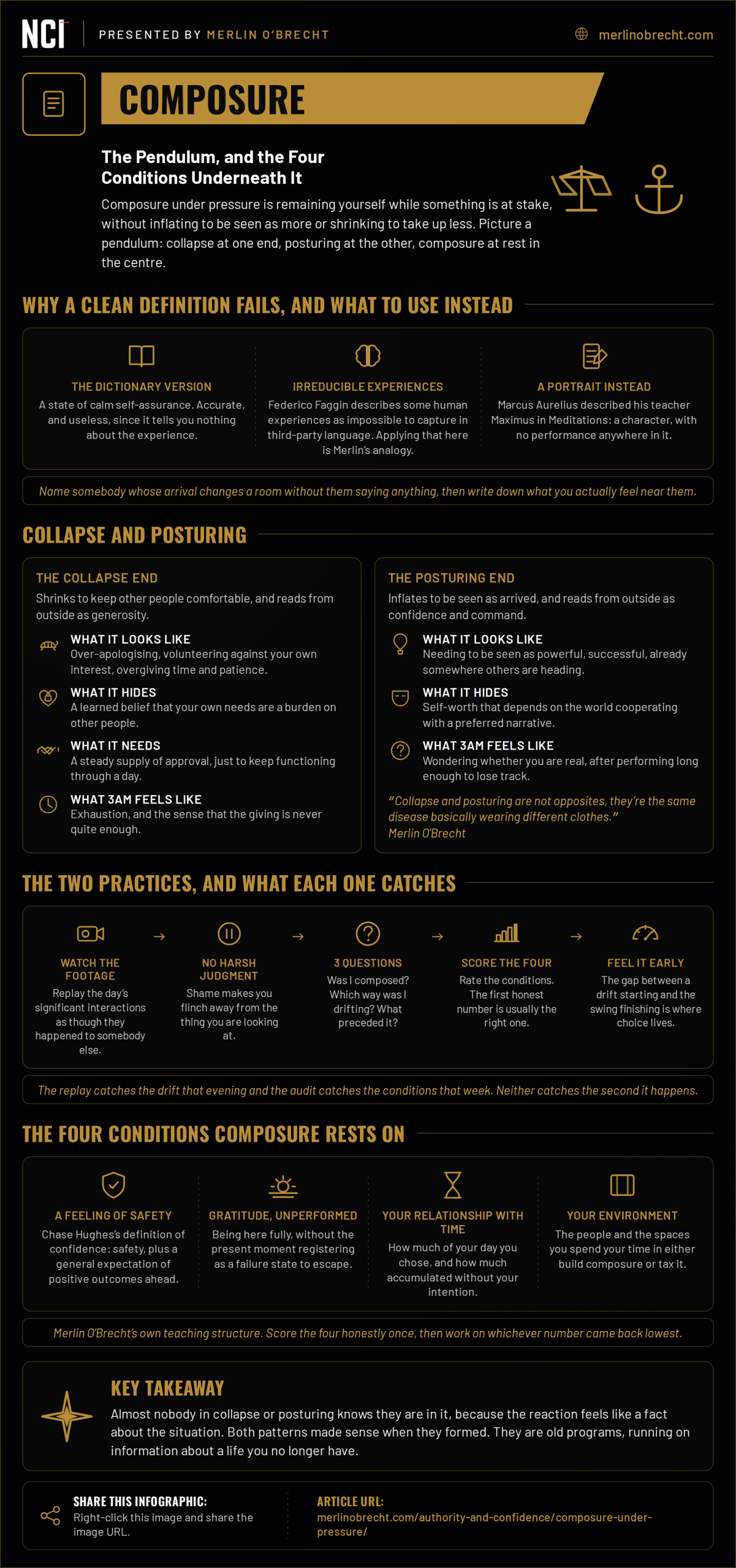
Composure under pressure is the state at the centre of a pendulum that swings between collapse, which shrinks to keep other people comfortable, and posturing, which inflates to be seen as powerful. It rests on four trainable conditions: confidence, gratitude, your relationship with time, and your environment.
“I want to make you a promise. It’s serious to me and I intend to keep it. I’m going to permanently change the way you think about composure. Not just refine it and not supplement it. I’m going to attempt to fully change it at the root.”
Most advice on this subject teaches you to breathe. Breathing helps, and it is not the reason your composure keeps failing.
It keeps failing because you are not aiming at composure. You are somewhere on an arc between two states that both feel like reasonable responses at the time, and neither of them is the thing you are trying to reach.
Key takeaways
- Composure sits at rest in the centre of a pendulum, with collapse at one end and posturing at the other. Most people live somewhere out on that arc.
- Collapse and posturing look like opposites and are the same failure, because both are trying to extract something from the room.
- The way out is perpendicular to the pendulum rather than across it, which means stopping the swing rather than swinging better.
- Four conditions make composure possible: confidence, gratitude, your relationship with time, and your environment.
- Almost nobody in collapse or posturing knows they are in it, because they experience their reaction as a fact about the situation.
What is composure under pressure?
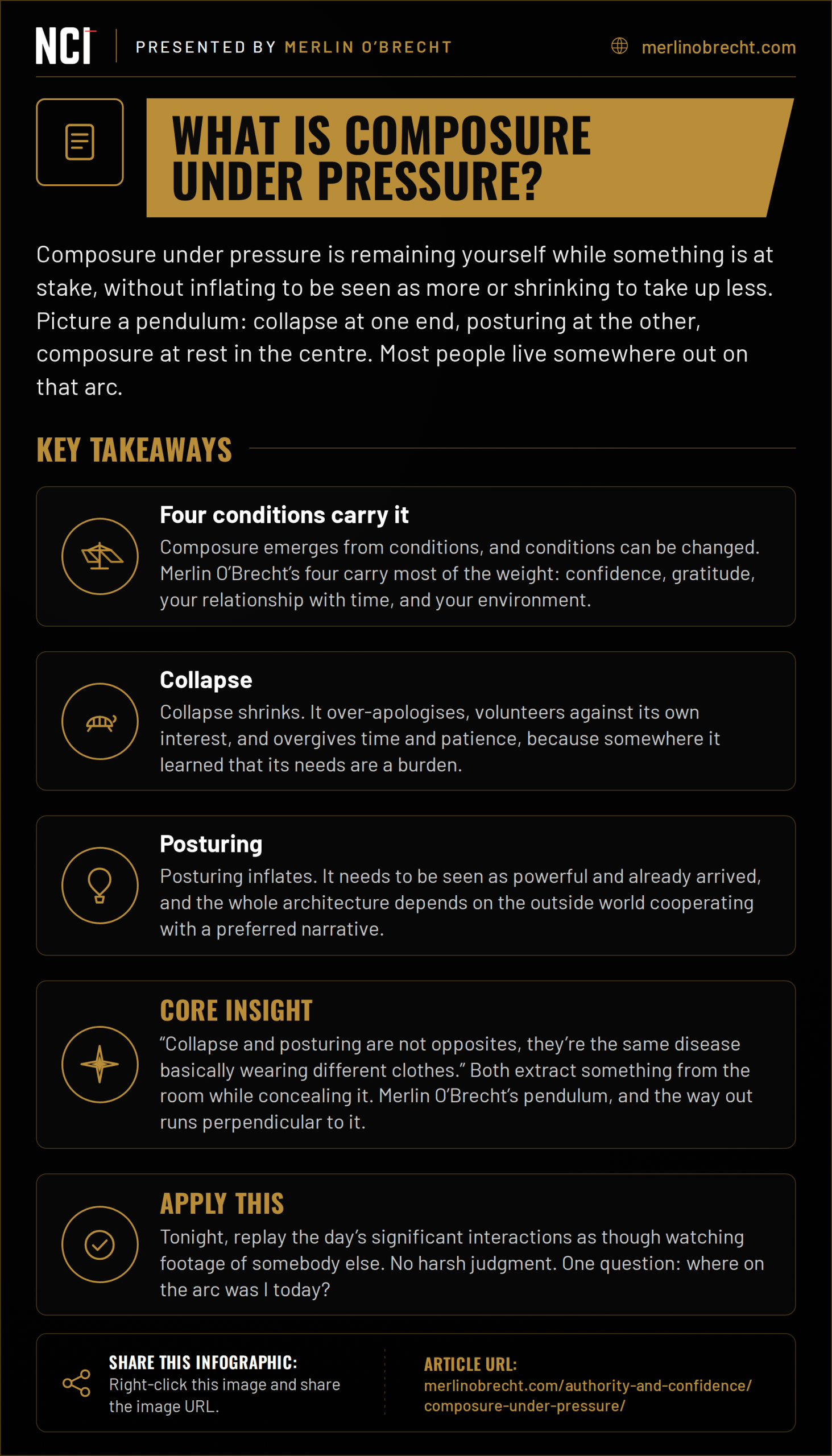
Composure under pressure is the state of remaining yourself while something is at stake, without inflating to be seen as more or shrinking to take up less. It sits at the centre of a pendulum: collapse at one end, posturing at the other, composure at rest between them.
It is not a personality trait and it is not distributed at birth. It emerges from a set of specific conditions, and those conditions can be changed. Four of them carry most of the weight: confidence, gratitude, your relationship with time, and your environment.
Why a clean definition of composure fails
Worth admitting up front that a clean definition of composure, in its truest sense, is impossible.
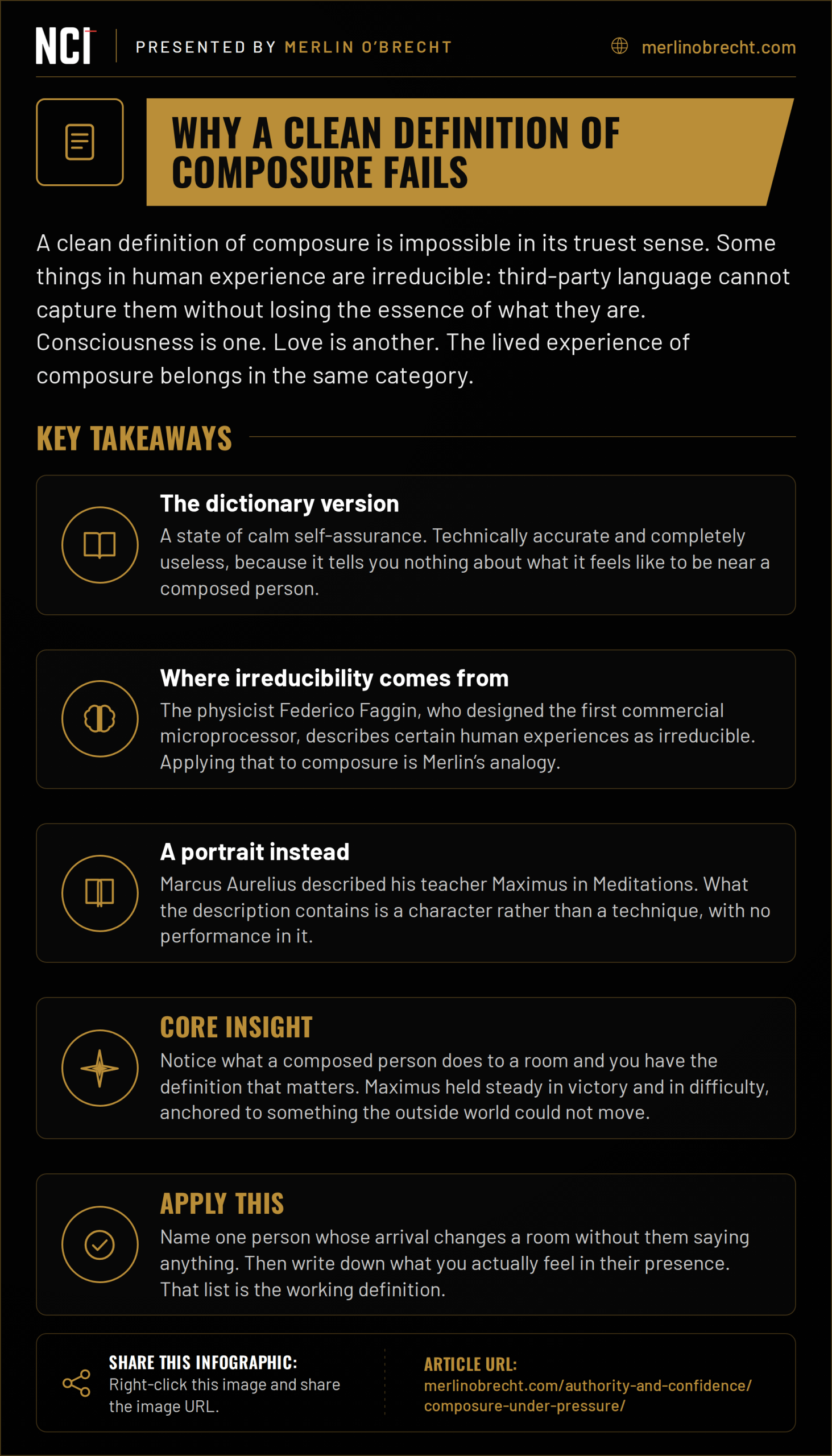
The physicist Federico Faggin, who designed the first commercial microprocessor and then spent much of the second half of his career on the nature of consciousness, describes certain things in human experience as irreducible. They cannot be fully captured in objective third-party language without losing the essence of what they are. Consciousness is one. Love is another. Composure, the lived experience of it, belongs in the same category.
You can write the dictionary version if you want. A state of calm self-assurance. Technically accurate and completely useless, because it does not tell you what it feels like to be in the presence of a composed person. It does not explain why some people walk into a room and the room changes while others walk into the same room and nothing happens. And it does not capture why we instinctively trust certain people long before they have said anything we could logically evaluate.
So instead of a definition, here is a portrait, and the useful thing to do with it is to notice what you feel.
The portrait: what Marcus Aurelius saw in Maximus
Maximus was a Roman senator and consul in 144 AD, a Stoic philosopher, and a teacher and mentor to Marcus Aurelius during his formative years. Aurelius, who was at the time the most powerful man in the Roman Empire, wrote this about him in Meditations.
“From Maximus I learned self-government, and not to be led aside by anything; and cheerfulness in all circumstances, as well as in illness… and he never showed amazement and surprise, and was never in a hurry… nor was he perplexed nor dejected… and he presented the appearance of a man who could not be diverted from right.”
Marcus Aurelius, Meditations, Book I.15, translated by George Long
Now notice what is missing from that portrait.
There is no performance in it. No theatre. The man simply was what he was, in every room and in every circumstance. He did not inflate in victory and he did not shrink in difficulty, and he was anchored to something the outside world had no lever to move.
That is composure. And notice that it is not described as a technique. It is described as a character. Maximus was not performing composure. He was too busy simply being to perform anything.
If you can name somebody whose arrival changes a room without them saying anything, you already believe this is a real property of people rather than a personality type.
Collapse and posturing: the same failure in two directions
Picture the pendulum. Collapse on the far left, posturing on the far right, composure at rest in the centre. Most people spend the large majority of their time out on that arc, reacting to the last thing that happened, compensating for something they expect to happen, or adjusting their self-presentation in real time based on what they believe the room wants.
| Collapse | Posturing | What both are doing | |
|---|---|---|---|
| What it looks like from outside | Shrinking, over-apologising, volunteering against your own interest, overgiving time and energy and patience | Needing to be seen as powerful, successful, already arrived somewhere other people are still trying to reach | Managing the room’s perception in real time |
| What it is hiding | A learned belief that your needs are a burden, and that if you stopped accommodating people would be disappointed | A brittle architecture where self-worth depends on the outside world cooperating with a preferred narrative | Insecurity, in both cases |
| What it needs from the room | A steady supply of approval, just to keep functioning | Recognition, and confirmation that the narrative holds | To extract something: respect, love, validation, admiration, safety |
| What 3am feels like | Exhaustion, and the sense that the giving is never enough | Wondering whether you are real, after performing long enough to lose track of where it ends | A concealed agenda the person cannot see |
| How it gets mistaken for composure | Reads as generosity and selflessness | Reads as confidence and command | Both are sincere. Neither is composed. |
“Collapse and posturing are not opposites, they’re the same disease basically wearing different clothes.”
Both operate from a concealed agenda and both are rooted in insecurity. One makes itself smaller so nobody can see how much it wants. The other makes itself bigger so nobody can see how afraid it is.
Which means the path to composure is not across the pendulum. It is perpendicular to it, and it requires stopping the swing altogether.
What conditions make composure possible?
Composure is a state that emerges from conditions, and there are four worth working on directly.
- Confidence. The best definition I have heard is Chase Hughes’s: a feeling of safety and a generalised expectation of positive outcomes occurring in the future. Note what it is not. It is not the feeling that arrives when enough people have validated you, because that is approval, and approval comes from insecurity. The more confidence you have, the easier composure becomes. The work underneath it sits on the confidence page and the ego work beneath it.
- Gratitude. Not performed gratitude. There is a particular kind of person who has genuinely good things in their life and cannot see them, because they are too focused on what they have not earned yet and the distances they have not covered. That chronic forward fixation creates a background static of insufficiency that makes composure almost impossible. The standard is modest: the ability to be here, fully present, without the present moment feeling like a failure state. Gratitude at length lives on enjoyment and gratitude.
- Your relationship with time. Ask yourself how much of your day you actually chose, and how much was chosen for you. People who struggle with composure tend to have days stacked with obligations that accumulated without their intention, filled with commitments made to avoid disappointing somebody. They move through the day reacting to the next email, the next request, the next fire. By the end they have worked hard and are exhausted and none of it was theirs.
- Your environment. Your immediate environment either builds composure or taxes it. The people you spend the most time with and the spaces you inhabit determine the quality of input you receive daily, and all of it is either serving your development or eroding it. Be honest about what yours is doing to you. Edit what can be edited, exit what needs exiting. And where neither is currently possible, acknowledge the tax you are paying and compensate for it accordingly.
Those four are the supports. They are the scaffolding rather than the building.
There are people who have had careers stripped away, reputations destroyed, freedom removed and relationships reduced to almost nothing, and who remain composed. They are anchored to something the outside world does not have access to. The long, humbling, most likely lifelong goal is to develop so thoroughly inward that external conditions become genuinely secondary. They will never be irrelevant. They can be made secondary.
Why every conversation starts to feel load-bearing
Underneath the four conditions sits one more, and it is the deepest.
When we conflate the ego with the actual self, every interaction becomes load-bearing. Every conversation functions as a structural test. Every perceived slight becomes a threat to the edifice, and every disagreement becomes an attack on the person rather than on the idea. From inside that state there are only two moves available: fight to defend it, or fall into collapse.
There are two versions of the trap and they meet in the middle. Believing you are fundamentally special in your accomplishments produces a low-grade, chronic worry that the specialness will not be recognised, which produces posturing. Believing you are fundamentally special in your suffering lets pain become an identity and hardship become a credential, which produces the flavour of collapse where a person gives and gives and makes sure you know exactly what it is costing them.
The same key opens both, and it is the genuine understanding that you are one conscious being among millions of them, all roughly as baffled and frightened and hopeful as you are. You might be the main character of your story, and you are a character. A squirrel does not care how much money you make.
The ego work itself is on the confidence page.
Competitive frames and collaborative frames
A competitive frame is fundamentally incompatible with a composed state, and the reason is structural rather than moral.
A competitive frame organises your experience around comparison. Above or below, ahead or behind, more or less, winning or losing. If you are always in comparison then you are always somewhere on the arc, by definition: posturing when you are ahead, collapsing when you are behind, and cycling between the two as circumstances change.
Real, lasting excellence comes from somewhere else. It comes from measuring yourself against your own potential and your own values rather than against somebody else’s performance.
The professional cost is worth naming, because a negotiation invites the competitive frame structurally. Walk into one holding it and you will spend the meeting somewhere on the arc, and the person across the table is reading exactly that.
“You do not need to win the room. You need to enlarge the room. And when you enlarge the room, when you become the person who makes space rather than take space, people will begin to move towards you without knowing why.”
How do you practise composure?
Two practices. Both are free and both work.
- The 5-minute replay. At the end of each day, sit down and replay the day’s significant interactions as though you were watching footage of somebody else. The guardrail matters more than the practice. Do this without harsh judgment, because judging yourself shamefully makes you flinch away from what you are looking at, and flinching is the opposite of the point. Ask three things. Was I composed? Was I drifting toward collapse or toward posturing? What conditions, relationships or situations preceded the drift? Do it consistently and it produces an internal calibration, and once you have seen it clearly enough times you start to feel the drift before it completes. That gap, between the drift starting and the swing finishing, is where your actual choice lives.
- The four-score audit. Every morning or evening, rate yourself on the four conditions: confidence, gratitude, relationship with time, environment. Do not overthink it. Give each one a number, and whatever the first honest answer is, that is probably the right one. Then for each score ask three questions. What behaviour could I start that would improve it? What behaviour could I stop? And what relationship needs to be edited, modified, or where real honesty demands it, released? Your brain is extraordinarily good at pattern recognition. The only thing it needs is accurate data, which means the whole practice depends on you not lying to yourself in the small comfortable ways.
Both practices have the same honest limit and you can probably feel it already. The replay catches the drift that evening. The four scores catch the conditions that week. Neither catches the drift in the second it happens, which is the only moment that changes an outcome, and self-observation is precisely the faculty that degrades as pressure rises.
Closing that gap needs structure and somebody watching, which is what NCI-3 Behavior Scientist is built around: 6 to 8 weeks, self-paced, $2,987.
Worth saying plainly: the first practice asks you to watch footage of yourself every evening for a fortnight before anything changes, which is the opposite of what a search for staying calm under pressure usually wants.
The gap you are actually measuring
Most people in posturing or collapse do not know it, and the reason is worth understanding rather than judging. They experience their emotional reactions as facts about the external world rather than as information about their internal state. The person yelling genuinely believes the situation demands it. The person over-apologising genuinely believes it requires it. Neither is lying. Neither can see the gap between what is happening outside them and how they are responding to it, because nobody ever showed them where to look.
As Chase Hughes puts it, who you are when no one is watching is who you actually are. The gap between that person and the one you present to the world is the measure of your composure deficit.
“Some of you are probably posturing every day. And it’s not because you’re bad people, because some version of the performance got you to this place that you’ve achieved in your life.”
And some of you are collapsing almost every day, not because you are weak, but because at some point collapse kept you safe. Both patterns made sense when they formed. They are old programs running on outdated information, written for a version of your life that no longer exists.
So here is the question worth sitting with.
What would it cost you right now to simply stop? Not stop trying. Not stop working. Stop performing. Stop inflating, stop shrinking, stop trying to manage what the room thinks of you, because you cannot control it anyway.
Frequently asked questions
What is composure?
Composure is remaining yourself while something is at stake, without inflating or shrinking to manage how you are perceived. Picture a pendulum with collapse at one end and posturing at the other: composure is the resting point in the centre, and it is a state produced by conditions rather than a temperament somebody is born with.
How do you stay calm under pressure in the moment?
Three things are actually available mid-incident. Notice which direction you are drifting, collapse or posturing, since naming it interrupts it. Stop adding, meaning no more words, no more gestures, no more concessions. And delay your response by about one breath’s worth of time. That is genuinely all you get in the moment. The real work happens outside it, which is what the two practices are for.
How long does it take to become composed?
The drift becomes visible to you after a few weeks of the evening replay, which is the first real milestone and the one you can verify. The deeper target, being anchored to something external circumstances cannot move, is something I describe as a lifelong project rather than a programme, and I am not going to attach a number to it.
Is composure just suppressing your emotions?
No, and the distinction is behavioural rather than philosophical. Suppression is a performance held in place under load, which is posturing wearing a calm face, and it fails the moment the load exceeds the effort available. Composure has nothing to hold in place. As I put it elsewhere, this is not about repressing emotions or repressing anger. (Video 011, 31 December 2025.)
What is the difference between collapse and posturing?
Collapse makes itself smaller so nobody can see how much it wants. Posturing makes itself bigger so nobody can see how afraid it is. From outside they look like opposite personality types, and underneath they are the same move: extracting something from the room while concealing that anything is being extracted.
How do you stay composed in a high-stakes meeting or negotiation?
The specific trap here is the competitive frame, because a negotiation invites it structurally. Framed as winning or losing, you will posture while ahead and collapse while behind, and the other side is reading the switch. The move is to measure the meeting against what you actually came to achieve rather than against the other party’s position, which also happens to produce better agreements.
Are some people just born calm?
No, and I am fairly firm about that one. Composure is not a gift some people receive and others do not. It is a state that emerges from a set of very specific conditions, and those conditions can be changed, because behaviour is not fixed and states are not permanent. The four worth starting with are confidence, gratitude, your relationship with time, and your environment.
Where does this model of composure come from?
Three separate sources, and they should not be blurred together. The portrait of Maximus is Marcus Aurelius’s, from Meditations, written in the second century. The definition of confidence is Chase Hughes’s, taught at NCI University. The four conditions, and the collapse-and-posturing pendulum, are my own structure for teaching this material.
Is it manipulative to stay calm when someone else is upset?
It depends entirely on what the calm is for. Composure held in order to win the exchange is posturing with a calm face, and the other person will feel it even if they cannot name it. The test Chase Hughes teaches settles it: would that person, seeing your full intent, agree it was in their interest?
What should you work on first if you lose composure often?
Run the four-score audit once, honestly, and work on whichever number came back lowest. That is genuinely the whole answer. Most people already know which of the four is their problem and have been avoiding it, and the audit’s only real function is removing the option of not knowing.
Where to go from here
NCI describes its own positioning as Effortless Authority, and defines it as composure under pressure, precision under scrutiny, and control without strain. This page is that phrase’s subject, and Merlin’s own version of it is less glamorous and more useful:
“It’s not the management of appearances, it’s the dissolution of the need to manage them.”
If you want the structured version, where the drift gets caught while it is happening rather than in a notebook that evening, that is NCI-3 Behavior Scientist. 6 to 8 weeks, self-paced, $2,987.
If you would rather buy nothing, do the replay tonight. Five minutes, no judgment, one question: where on the arc was I today?