Self mastery
Self mastery: why willpower fails, and what moves instead
By Merlin OBrecht · Dean of Academic Affairs, NCI University
Self mastery
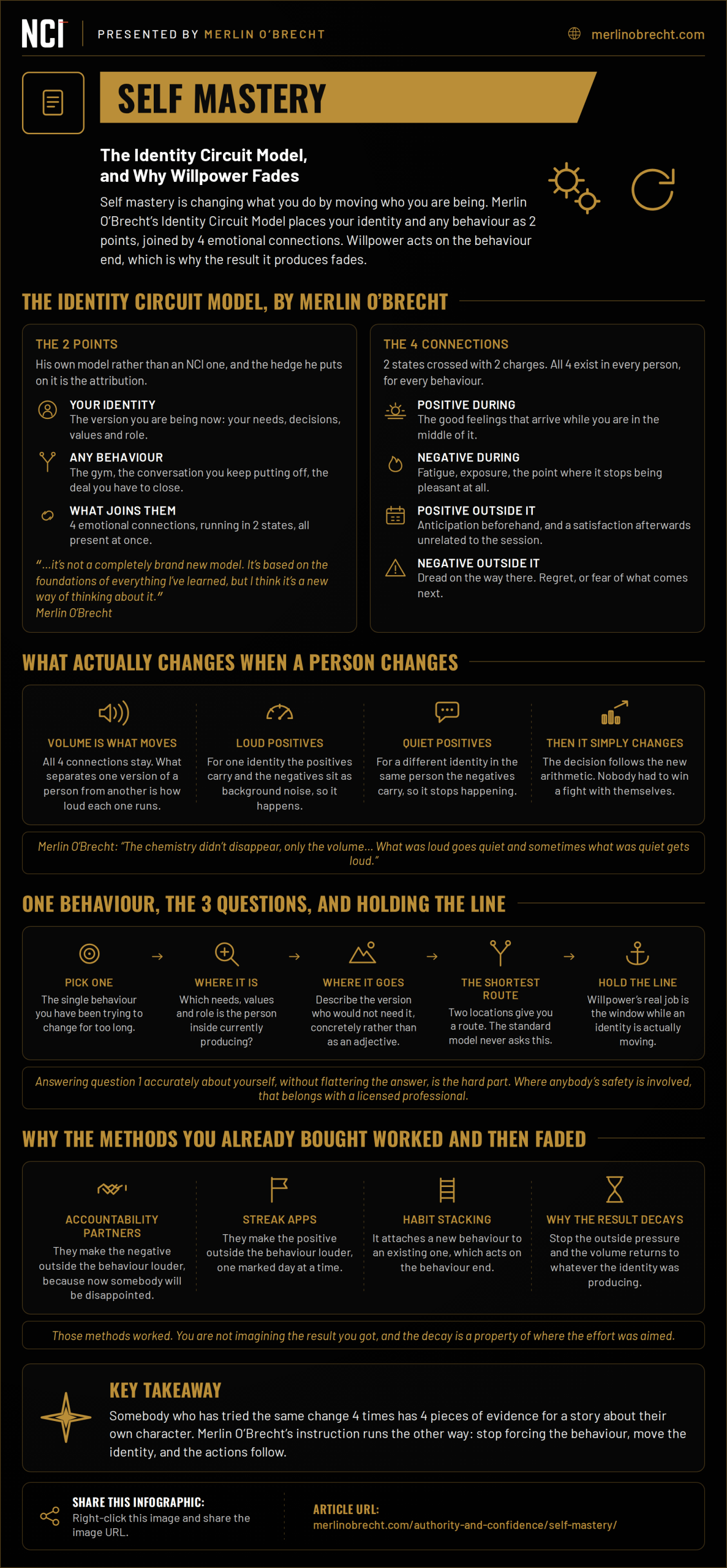
Self mastery is the ability to change what you do by moving who you are being, rather than by forcing a behaviour against itself. Willpower fails because it acts on the behaviour end. In Merlin OBrecht’s Identity Circuit Model, identity and any behaviour are joined by four emotional connections, and change comes from altering their relative volume.
Why do people fail to act on what they already know is best for them?
That question has a better answer than the one you have been given. The one you have been given is that you did not want it enough.
“I would be willing to bet that there’s a behavior somewhere in your life that you’ve been trying to change for a long time.”
Maybe it is smoking or drinking, or eating things you know you should not, or going to the gym, or a hard conversation you keep putting off. And most of us have noticed the same thing: willpower does not work for very long, because discipline eventually runs out.
What follows is a model of what is actually happening underneath a behaviour, and why the same change keeps arriving and then leaving.
Key takeaways
- Willpower acts on the behaviour end of the system, which is why it produces a real result that decays rather than no result at all.
- Every behaviour carries four emotional connections to your identity at all times, in two states: during it, and every other moment.
- What separates one version of a person from another is not which connections exist. It is how loud each one is relative to the others.
- Change the identity and the arithmetic on those four connections changes, so the behaviour follows without a fight.
- Three diagnostic questions locate where an identity currently sits, where it needs to go, and the shortest route between them.
What is self mastery, and why does willpower fail?
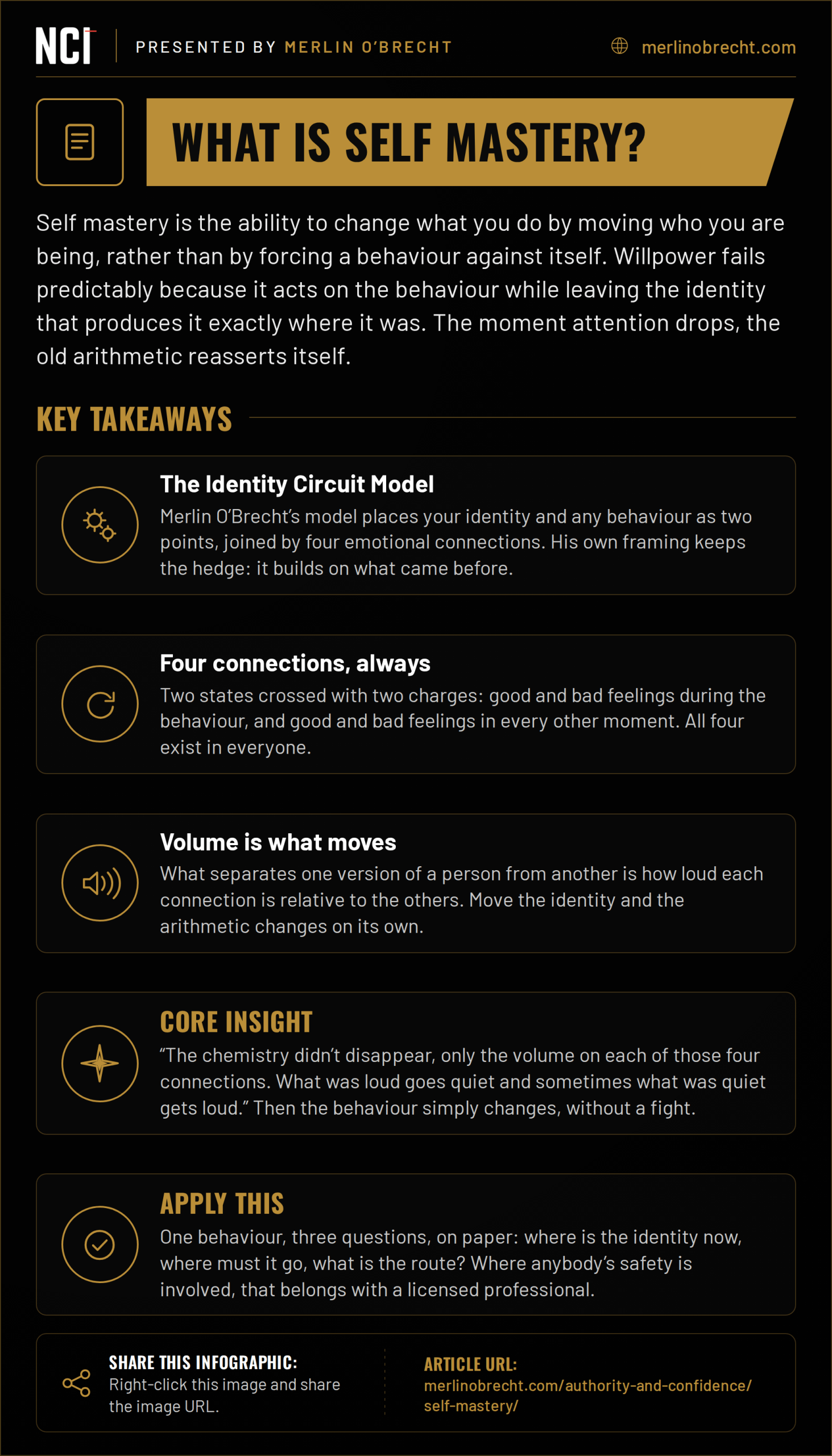
Self mastery is the ability to change your behaviour by moving your identity rather than by overpowering yourself. Willpower fails predictably because it operates on the behaviour while leaving the identity that produces the behaviour exactly where it was. The moment attention or energy drops, the original arithmetic reasserts itself and the old behaviour returns.
Underneath that sits a structure. Your identity and any behaviour are joined by four emotional connections, running in two states, and what changes when a person genuinely changes is the relative volume of those four. That model is the Identity Circuit, and the rest of this page walks it.
Why willpower doesn't work, and what the standard model concludes about you
Here is the version almost everyone was taught. You decide you want to change. You make a plan. You exercise willpower until the new behaviour becomes automatic.
It is a reasonable-sounding model and it works often enough to stay believable. The problem is what it says about you when it does not work.
“If you fail, the assumption is that you didn’t want it badly enough or you weren’t disciplined enough. And inside we tell ourselves story like maybe I wasn’t good enough or maybe there’s something wrong with me or maybe I’m broken.”
Sit with that for a second, because it is the actual cost. Not the failed change. The conclusion drawn from it. Somebody who has tried the same thing four times has four pieces of evidence for a story about their own character, and every method that acts only on behaviour quietly adds to the pile.
That frame is the wrong way of thinking about it. What shifts when a behaviour changes permanently is something deeper, more architectural, and frankly more interesting than discipline.
The person who does not have to fight it
Think of somebody you know who is naturally the kind of person who does the thing you have been trying to do.
The person who does not have to negotiate with themselves to go to the gym. The person who can say no to a drink without it being a big deal or an internal struggle. The person who handles the hard conversation without spending a week dreading it.
Now notice something about them.
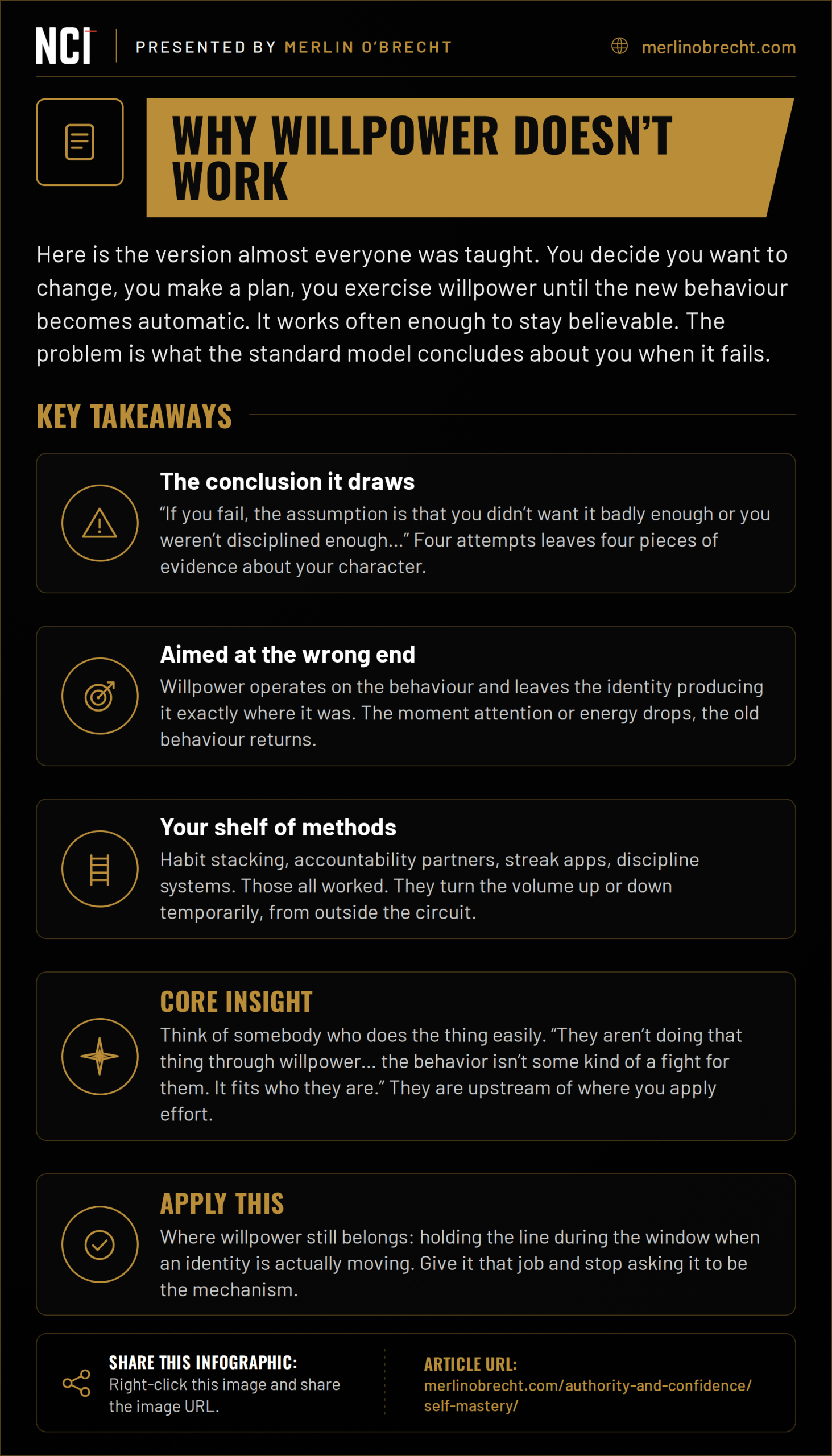
“They aren’t doing that thing through willpower. They aren’t exercising more discipline than you and the behavior isn’t some kind of a fight for them. It fits who they are.”
They are not winning a battle you keep losing. They are not in the battle. Whatever is happening for them, it is happening upstream of the moment where you are applying effort.
If you can picture that person clearly, you already accept the premise of this page: the behaviour is downstream of something, rather than a matter of how hard you are willing to push.
What is the Identity Circuit Model?
“So, this model I call the identity circuit, which it’s not a completely brand new model. It’s based on the foundations of everything I’ve learned, but I think it’s a new way of thinking about it.”
That hedge is mine and it stays, because it is accurate. The Identity Circuit is my own model, built on the foundations of what I learned at NCI University, and I think it is a genuinely new way of thinking about behaviour change.
Picture a graph with two points on it.
- Point one is your identity. By identity I mean the version you are currently being: your needs, your decisions, your values, and the role you are playing in your own story. Not who you were, not who you intend to become. Who is running the machine right now.
- Point two is a behaviour. Any behaviour at all. Smoking, the gym, asking your partner the hard question, closing a business deal. It genuinely does not matter which.
Between those two points run four connections, and they are produced by two states crossed with two charges.
- The two states. During the behaviour, when you are in the middle of doing it. And not during, which is every other moment, including when you are anticipating it and when you are remembering it.
- The two charges. Inside each state there is a positive connection, the good feelings tied to the behaviour, and a negative connection, the bad feelings tied to it.
And here is the claim that makes it a model rather than a description: all four connections are always present, for every behaviour, in every person, at any given time.
The four connections, worked through three behaviours
Test it against your own life with these three.
| Behaviour | Positive during | Negative during | What it feels like outside the moment |
|---|---|---|---|
| Drinking | Social ease, the relief that arrives with it | The point where it stops being pleasant | Anticipation beforehand. The hangover, and sometimes regret, or the feeling of slipping into something you do not want to be the next morning |
| The gym | Accomplishment, and a clarity you can feel | Fatigue, muscle pain, soreness | Dread on the way there. Satisfaction afterwards that has nothing to do with the session itself |
| A hard question to your partner | Relief at finally getting it off your chest, being vulnerable and completely open | The exposure of having said it out loud | Fear of what comes next and how they might react. Afterwards, either closeness or the confirmation you were bracing for |
Every one of those rows has all four cells filled, which is the point. No behaviour is purely good or purely costly. Both polarities are present before, during and after, in every case.
One thing worth saying plainly here, because the first row invites it. This is a model of how behaviour change works, not advice about dependency. Where a behaviour involves dependency, or anyone’s safety, that belongs with a licensed professional, and nothing on this page is a substitute for one.
What actually changes when a person changes
This is the paragraph the whole model turns on.
What changes between two different versions of you is not whether those four connections exist, because the four connections always exist, for all people, with all behaviours. What changes is their relative volume, proportional to each other.
For one identity, the positives are loud and the negatives are a quiet background noise, so the behaviour happens. For a different identity in the same person, the negatives are loud and the positives have gone quiet, so it does not.
“The chemistry didn’t disappear, only the volume on each of those four connections. What was loud goes quiet and sometimes what was quiet gets loud.”
And then the behaviour simply changes. Not because the person decided to change, but because from the new identity the arithmetic on the four connections is now completely different.
None of those were willpower. None of them were motivation. None of them were a new system or a clever plan. In every case the identity moved, and the decisions did the rest on their own.
How do you move an identity instead of forcing a behaviour?
Three questions. Run them on one behaviour, on paper.
- Where is the identity right now? Not where you wish it was. Where it is actually sitting. What needs, decisions, values or story is the person inside at the moment, and what is that producing? Take somebody trying to quit drinking. They are not drinking because they want a hangover. They are drinking because their current identity is somebody who has not yet learned a real way to handle pressure, or social discomfort, or whatever the actual trigger is. That is the location.
- Where does the identity need to go? What is the version of this person who would not need the behaviour any more, or who would choose the better one automatically, without forcing anything? Describe that person concretely rather than as an adjective.
- What is the most efficient path from where the identity is to where it needs to be? This is the question almost nobody asks, because the standard model never generates it. Once you have two locations, you have a route.
Notice what question 1 does to the drinking example. It moves the problem from the drink to the coping strategy, which is a different problem with different solutions and a much better hit rate.
Why the things that worked stopped working
If you have been at this a while, you have a shelf. Habit stacking. Accountability partners. Streak apps. Discipline systems. Motivation content. Possibly a coach.
Here is the thing worth saying clearly: those all worked. You are not imagining the result you got. Most of them produce a genuine, measurable change for a period of time, which is exactly why they are still sold and still recommended.
They work by turning the volume up or down temporarily. An accountability partner makes the negative-not-during connection louder, because now there is somebody to disappoint. A streak app makes the positive-not-during louder. Both are real effects on the circuit, and both are applied from outside it.
When the external pressure stops, the volume returns to whatever the identity is producing, because the identity never moved. The result decays. And the decay gets read as a personal failure rather than as a predictable property of where the intervention was aimed.
That is worth more than it sounds. Each failed attempt at the same change costs more than the attempt, because it adds another line to the story that the problem is you.
Where willpower still belongs
None of this means discipline is wrong.
“This is not because discipline is wrong, it’s because at some point the person that you’re trying to be isn’t going to need to fight that behavior anymore.”
Willpower has a real job and a finite one. It holds the line during the period when an identity is actually moving, which is the window where the new behaviour has not yet become automatic and the old arithmetic is still partly in force. That is a genuine use and it is a hard one.
What it cannot do is be the mechanism. Used as the mechanism, it is a permanent tax on a system that was supposed to stop needing it.
Where self mastery stops being something you can read about
Everything above is usable today with a pen and one behaviour.
What it does not include is the diagnostic layer, and I want to be straight about that rather than imply this page is the whole thing.
Question 1 asks where your identity is actually sitting. Reading that question is easy. Answering it accurately about yourself, without flattering the answer, is the hard part, and it is the part where an outside read is worth more than any amount of thinking. Doing it for another person, deliberately, is harder again.
What this article walks is the entry point to a much larger model, the full Identity Circuit. The diagnostic tools for engineering that movement in another person, identifying it in yourself, and understanding what an identity is actually made of, sit inside NCI University’s grad school curriculum.
The layer below that, where the self-work and the influence skills that make an identity movable get trained, is what NCI-3 Behavior Scientist covers: 6 to 8 weeks, self-paced, $2,987.
One honest warning. The first question in this model asks you to describe who you currently are, accurately, without flattering the answer. Most people find that harder than going to the gym.
Pick one
One behaviour. Just one, the thing you have been trying to change for too long.
Ask the three questions. Where is the identity now, where does it need to be, and what is the shortest route.
“Don’t force the behavior, move the identity, and all of the actions will follow as a natural result of that.”
Frequently asked questions
What is the Identity Circuit Model?
The Identity Circuit Model is Merlin OBrecht’s model of behaviour change. It places identity and any behaviour as two points, joined by four emotional connections: a positive and a negative during the behaviour, and a positive and a negative in every other moment. All four always exist, and what changes between versions of a person is how loud each one is.
How do you change a behaviour without relying on willpower?
Three steps. Locate where your identity is actually sitting, in terms of needs, values and the role you are playing. Describe the version of you who would not need the behaviour. Then work the route between them. Somebody trying to stop drinking is usually not attached to the drink but to a way of handling pressure, and that is what has to move.
How long does it take for a new identity to hold?
There is no honest number, so here is the signal instead. The change has held when the behaviour stops requiring negotiation, meaning you are not talking yourself into or out of it any more. Until then the identity is still moving. Anyone offering a fixed timeline for this is describing something else.
Does willpower work at all?
Yes, for a defined and finite job. Willpower holds the line during the window when an identity is genuinely moving and the new behaviour has not yet become automatic. That is real work and it matters. Where it fails is as the mechanism itself, because used that way it has to be supplied forever and nobody has an unlimited supply.
What is the difference between identity-based habits and habit stacking?
They share a target. Identity-based approaches, including the popular treatments of the idea, correctly say that lasting change runs through who you believe you are. Habit stacking attaches a new behaviour to an existing one, which acts on the behaviour end. What the Identity Circuit adds is the mechanism underneath both: four connections whose relative volume explains why an approach produces a real result and why that result decays.
How do you use this with a team member or a teenager?
Carefully, and with the same test you would want applied to you. The three questions work on somebody else, but the first one requires you to be honest about where they actually are rather than where it would be convenient for them to be. Chase Hughes’s empathy test applies: if they could see your full intent, would they agree it was in their interest?
If I keep failing, does that mean I lack discipline?
No. Repeated failure at the same change is information about where the identity is sitting, not evidence about your character. The pattern of trying, succeeding briefly and returning is exactly what the model predicts when an intervention is aimed at the behaviour end, and it happens to people with a great deal of discipline in every other part of their lives.
Who created the Identity Circuit Model?
Merlin OBrecht, Dean of Academic Affairs at NCI University, and it is taught inside NCI University’s grad school curriculum. His own framing is that it is not a completely brand new model, that it builds on the foundations of everything he has learned, and that he thinks it is a new way of thinking about it.
Is it ethical to move someone else's identity?
The test Chase Hughes teaches is whether that person, seeing your full intent in full, would agree it was in their interest. Applied here it is a high bar, because identity movement is the most powerful thing in this material. The honest use is helping somebody out of what is holding them back. The dishonest use is producing an outcome you wanted from them, and the mechanics look identical from outside.
What comes after the three questions?
Run them on one of your own behaviours before running them on anybody else’s, since the accuracy problem is much more obvious from the inside. After that, the useful next step is understanding what an identity is actually made of, which is where needs, values and role stop being one word each and start being something you can locate.
Where to go from here
The whole model reduces to one instruction, and it is worth carrying even if you forget everything else on this page.
Stop trying to force a behaviour. Work out where the person who does that behaviour automatically would have to be standing, and move there instead.
If you want the version with the diagnostic layer and someone to check your read, that is NCI-3 Behavior Scientist. 6 to 8 weeks, self-paced, $2,987.
If you would rather buy nothing, take the one behaviour and answer question 1 honestly tonight. Most people cannot, on the first attempt, and finding that out is worth more than another month of trying harder.