The science of charisma
Charisma: what the research measures, and what sits underneath it
By Merlin OBrecht · Dean of Academic Affairs, NCI University
The science of charisma
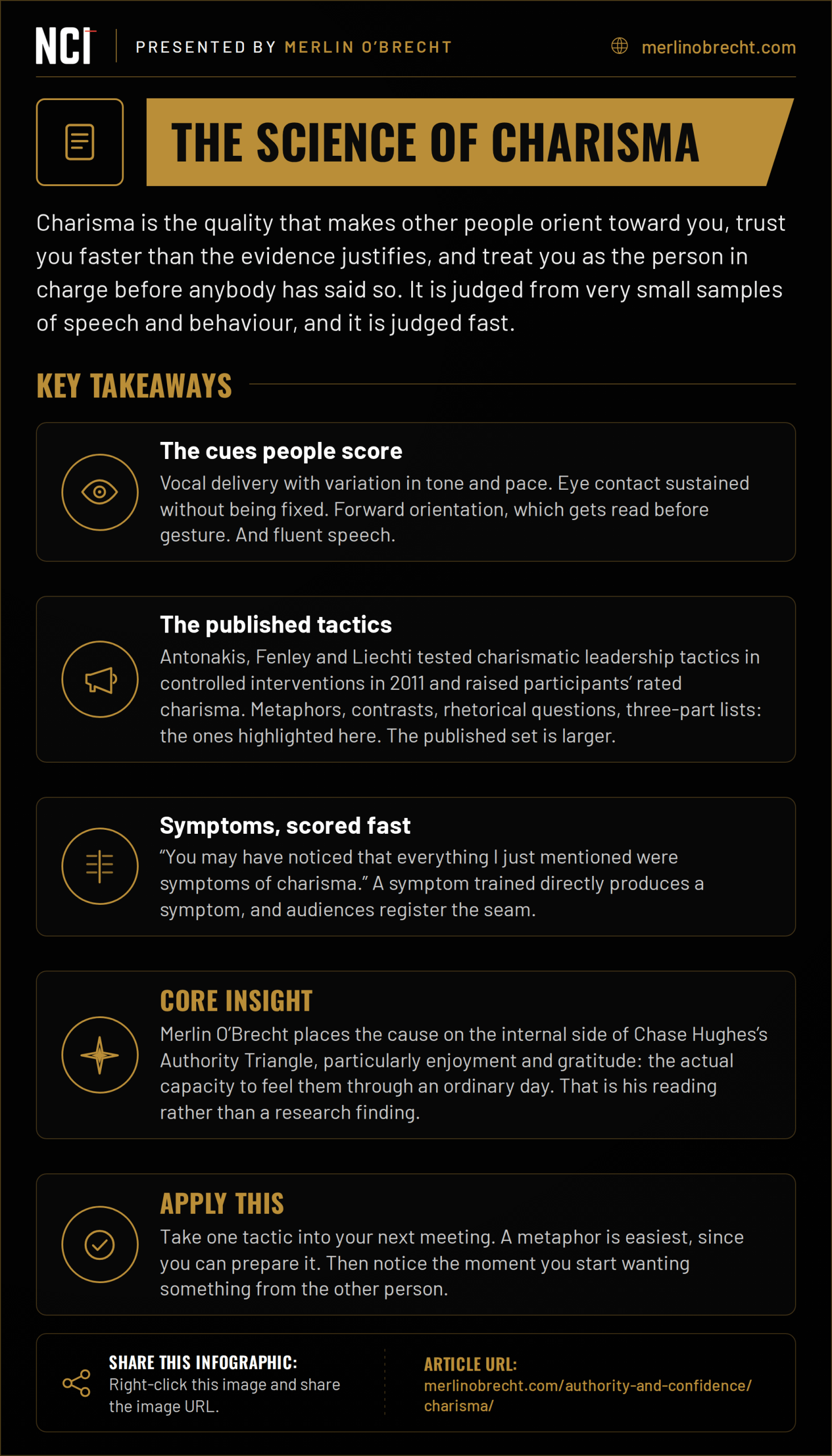
Charisma is read in seconds from thin slices of behaviour, and the cues people score are vocal delivery, eye contact, forward orientation and fluent speech. Those cues are symptoms. Merlin OBrecht places the cause on the internal side of Chase Hughes’s Authority Triangle: enjoyment and gratitude, plus not needing anything from the person in front of you.
Most articles with “the science of” in the title contain one study, glued to the front of a tips list.
This one takes the framing literally. There are four research strands worth knowing about, they are named and sourced below, and there is a published set of verbal behaviours that measurably raises how charismatic somebody is rated.
Then there is the part the research does not reach, which is the argument I actually want to make.
Key takeaways
- People judge charisma from very short exposures, and those snap judgments predict who gets treated as the leader.
- The scored cues are vocal delivery, eye contact, forward orientation and fluent speech.
- A published set of verbal tactics reliably raises rated charisma, and it has been tested in controlled interventions.
- All of that is the symptom set. The cause sits on the internal side of Chase Hughes's Authority Triangle, particularly enjoyment and gratitude.
- Running any of it while needing something from the other person is exhausting, and other people can feel it.
What is charisma?
Charisma is the quality that makes other people orient toward you, trust you faster than the evidence justifies, and treat you as the person in charge before anybody has said so. It is judged from very small samples of speech and behaviour, and it is judged fast.
There are two halves to it. The cues people actually score, which are observable and teachable. And what produces those cues in a person who is not performing them, which is where this page ends up.
How fast do people decide someone is charismatic?
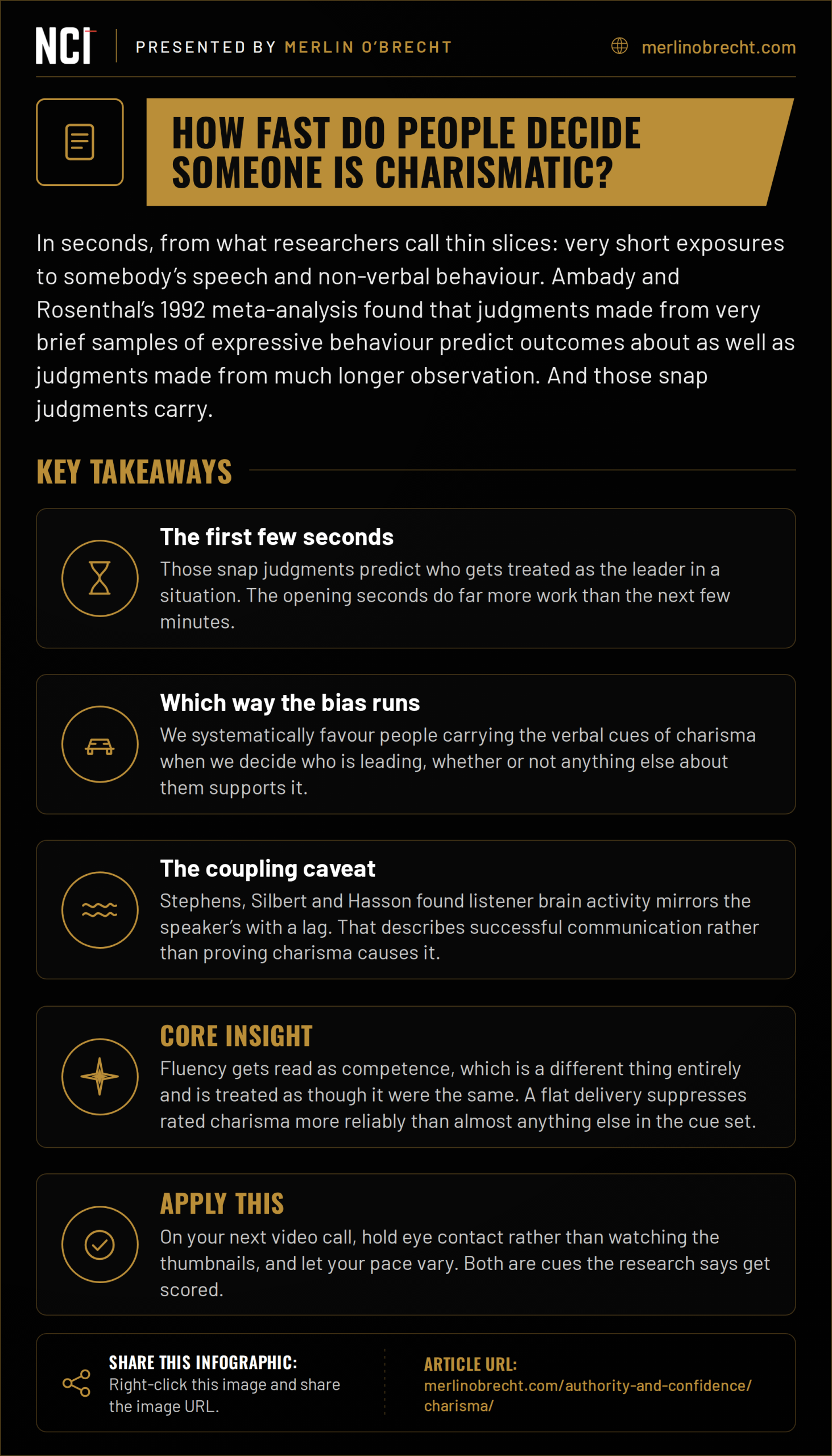
In seconds, from what researchers call thin slices: very short exposures to speech and non-verbal behaviour. Those snap judgments then predict who we treat as the leader in a situation, which is a considerably larger consequence than it first sounds.
The bias runs in a specific direction. We systematically favour people carrying the verbal cues of charisma when we decide who is leading, whether or not anything else about them supports it.
Here is the cue set and what each one buys.
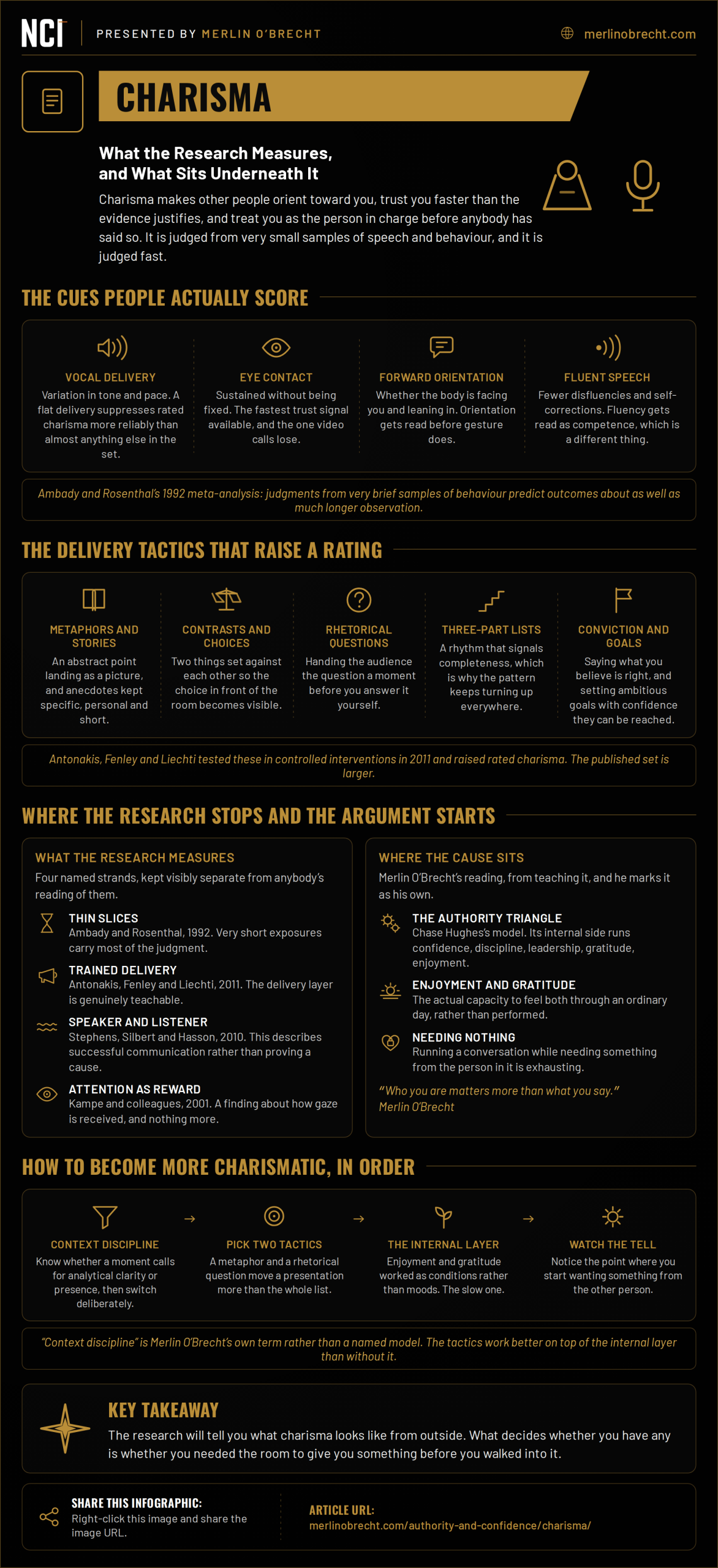
- Vocal delivery. Variation in tone and pace. A flat delivery suppresses rated charisma more reliably than almost anything else in the set.
- Eye contact. Sustained without being fixed. It is the fastest trust signal available and the one people miss most in video calls.
- Forward orientation. Whether the body is facing you and leaning in. Orientation is read before gesture is.
- Fluent speech. Fewer disfluencies and self-corrections. Fluency gets read as competence, which is not the same thing and is treated as though it were.
The effect of the set is that people find it easier to like you and to trust you.
If you have ever decided within a few seconds that you would follow somebody, you have already run the judgment this research measures.
What the research actually measures
Four strands, named, so that “the science of” means something on this page.
| Research strand | What it found | What it means for you |
|---|---|---|
| Thin-slice judgment · Ambady & Rosenthal, Psychological Bulletin, 1992 [LINK] | A meta-analysis finding that judgments made from very brief samples of expressive behaviour predict outcomes about as well as judgments made from much longer observation | The first few seconds are doing far more work than the next few minutes, and improving them is disproportionately efficient |
| Charismatic leadership tactics · Antonakis, Fenley & Liechti, Academy of Management Learning & Education, 2011 [LINK] | Charisma was treated as a trainable set of verbal and non-verbal behaviours, and controlled interventions raised participants’ rated charisma | The delivery layer is genuinely teachable, and this is the strongest evidence available that charisma is not fixed at birth |
| Speaker-listener neural coupling · Stephens, Silbert & Hasson, PNAS, 2010 [LINK] | Listener brain activity mirrors speaker brain activity with a time lag, and stronger coupling is associated with better comprehension | Being understood is partly a synchronisation problem, which is why pace and pauses matter more than vocabulary |
| Social reward response · Kampe, Frith, Dolan & Frith, Nature, 2001 [LINK] | Direct gaze from a face rated attractive was associated with activity in the ventral striatum, part of the brain’s reward circuitry | Attention from somebody is processed as a reward, which is a finding about how attention is received rather than advice about appearance |
Two honest notes about that table. The neural coupling work describes what happens during successful communication rather than proving that charisma causes it. And the ventral striatum finding is about how gaze is received, not something to act on.
The verbal tactics, and what they sit on top of
The Antonakis work identifies a set of charismatic leadership tactics, and the ones highlighted in the video are these.
- Metaphors and analogies. Making an abstract point land as a picture.
- Stories and anecdotes. Specific, personal, short.
- Contrasts. Setting two things against each other so the choice is visible.
- Rhetorical questions. Handing the audience the question before you answer it.
- Three-part lists. A rhythm that signals completeness.
- Statements of moral conviction. Saying what you believe is right rather than what is optimal.
- Reflecting the group’s sentiment. Naming what the room is already feeling before you ask it to feel something else.
- Setting ambitious goals, with confidence they can be reached.
Those eight are the ones Merlin highlights. The published set is larger and includes non-verbal tactics alongside the verbal ones, so treat this as the shortlist rather than the literature’s full inventory.
And then the turn.
“You may have noticed that everything I just mentioned were symptoms of charisma.”
Why charisma resists being trained as a behaviour set
Composure is a state that emerges from conditions, and there are four worth working on directly.
You can learn all eight tactics this week. Used by somebody comfortable in the room, they are how a person naturally talks when they have something to say. Used by somebody monitoring their own delivery, they arrive as technique, and the audience registers the seam without being able to name it.
This is my reading rather than a research finding, and I want that boundary visible, because the table above is doing a different kind of work from this section. What the research establishes is that the delivery layer is trainable and that trained delivery raises ratings. What I am claiming is that the ceiling on it is set somewhere else.
Where charisma actually comes from
“I can think of nothing better to sum this up than something Chase developed in NCI called the NCI authority triangle.”
Chase Hughes’s Authority Triangle tracks a person across three connected sides. The internal side is CDLGE: confidence, discipline, leadership, gratitude, enjoyment. The full model, and how a read tracks across all three sides, is on the Authority Triangle, all three sides.
At its root, charisma is a by-product of confidence and authority as a whole, and I think it connects most specifically to enjoyment and gratitude on that internal side. Not performed enjoyment. The actual capacity to feel enjoyment and gratitude through an ordinary day, which then shows up in how you communicate without you doing anything about it.
Those two are worth taking seriously as trainable conditions rather than moods, and they are covered at length in enjoyment and gratitude.
The hedges in that paragraph are deliberate and they are mine. This is an argument from what I have observed teaching it, sitting next to research that was done properly by other people, and the page keeps those two things visibly separate.
What it costs to need something from the room
On a deeper level, charisma is related to your relationship with your ego, your fear of social judgment, and your ability to be fully present and focused on connection rather than performance.
Which reduces to one thing: your ability to not need something from other people. Their reassurance. Their approval. Their belief that you are smart, or that you are making an impact. You want to draw that from inside yourself instead.
“I can be fully present and fully grounded in connection, but if I need something from you, if I’m trying to fill something inside of myself from your emotions, then it is going to be, take it from me, incredibly, incredibly exhausting.”
That is the most useful sentence in the video, and the tell is the exhaustion. Needing something from a conversation means running two processes at once: the conversation, and the monitoring of whether you are getting what you came for. It is expensive, it is detectable, and it is the thing that caps every technique in the list above.
What is being asked for instead is specific. Be grounded in helping other people and in being fully connected, and do it from a place of not needing anything from anybody.
How do you become more charismatic?
In an order, and the order is the useful part.
First, context discipline. Charisma is most potent when the task, the identity and the stakes are in alignment within yourself. This is not a universal solvent. What it means practically is knowing when the moment calls for analytical clarity and when it calls for genuine presence, and being able to switch deliberately rather than defaulting to whichever one you are more comfortable in. That term is mine rather than a named model.
Second, the delivery layer. Use the tactics deliberately. Pick two, not eight. A metaphor and a rhetorical question will change a presentation more than trying to run the whole list.
Third, the internal layer. Enjoyment and gratitude, worked on as conditions rather than as feelings you wait for. This is the slow one and it is the one that decides whether the second step reads as competence or as technique.
The order matters because the tactics work better on top of the internal layer than instead of it, and most training in this category only sells you the second step.
Which is where a page reaches its limit. The eight tactics are learnable from an article. Running a conversation without needing anything from the person in it is trained rather than read, and the training is mostly other people telling you when you were doing the thing you could not see yourself doing. That is what NCI-3 Behavior Scientist works on: 6 to 8 weeks, self-paced, $2,987.
Authority over yourself
There is one thing almost all influence training misses, whether it is influence training, management training or anything adjacent.
The effectiveness of influence is defined far more by the person talking than by what they are saying.
“Who you are matters more than what you say.”
Your authority and confidence is what defines who you are in communication. And I do not mean authority in terms of hierarchical position.
“I mean your authority over yourself.”
Frequently asked questions
What is charisma in psychology?
In psychological research, charisma is treated as a rated quality judged from very short exposures to somebody’s speech and behaviour, an approach known as thin-slice judgment following Ambady and Rosenthal’s 1992 meta-analysis. The cues that carry it are vocal delivery, eye contact, forward orientation and fluent speech, and the ratings predict who observers treat as the leader.
How do you become more charismatic?
Four steps, in order. Pick the register the moment actually calls for, analytical or present, rather than defaulting. Use two of the verbal tactics deliberately rather than all of them. Work on enjoyment and gratitude as conditions rather than moods. And stop needing the outcome of the conversation, which is the slowest step and the one that makes the others land.
Can charisma be taught, and how long does it take?
The delivery layer can be taught, and that is not an opinion: Antonakis and colleagues ran controlled interventions and raised participants’ rated charisma. Expect the tactics to be usable within a few sessions of deliberate practice. The internal layer underneath has no timeline attached to it, and I do not give one on camera or here.
Is charisma real, or is it just confidence?
The measurable part is real and replicated: ratings made from very brief exposure predict leadership emergence, and trained delivery moves those ratings. The part where charisma is downstream of confidence, and specifically of enjoyment and gratitude, is my reading of what produces the cues rather than a research finding, and this page keeps the two clearly separated.
What is the difference between charisma and charm?
Charm is aimed at the person in front of you and its purpose is to be liked by them. Charisma is what a room reports feeling regardless of whether anything was aimed at it. The practical tell is that charm is usually more exhausting to run, because it requires continuous monitoring of whether it is landing.
How do you use charisma in a presentation or a sales meeting?
Three tactics carry most of a presentation: one metaphor for the central idea, one rhetorical question before the part you most want people to think about, and one contrast where the decision is. Deliver those with variation in pace and full stops rather than trailing sentences. One caution: run them while needing the room’s approval and they read as technique, which is worse than a flat delivery.
Are charismatic people born that way?
No, and this is the question the published intervention work answers most directly. Charisma has been treated as a set of trainable behaviours and taught successfully in controlled conditions, which means the delivery layer at minimum is acquired rather than innate. What varies more between people is the internal layer, and that is also not fixed.
Who researched charismatic leadership tactics?
John Antonakis and colleagues, including Marika Fenley and Sue Liechti, in work published in Academy of Management Learning & Education in 2011. On the NCI side, the model underneath this page is Chase Hughes’s Authority Triangle, whose internal side covers confidence, discipline, leadership, gratitude and enjoyment.
Is charisma a form of manipulation?
The test Chase Hughes teaches is whether the other person, seeing your full intent, would agree it was in their interest. There is also a practical answer that settles it faster: charisma run from a place of needing something from the other person is exhausting to maintain and legible to almost everyone, which makes the manipulative version self-limiting in a way most influence skills are not.
What should you work on first to become more charismatic?
Enjoyment and gratitude, before delivery. That sounds like the soft answer and it is the structural one, because the delivery tactics amplify whatever state is underneath them. Somebody genuinely enjoying a conversation and using two tactics badly outperforms somebody running all eight correctly while waiting to be validated.
Where to go from here
Take one of the eight tactics into your next meeting. Just one. A metaphor is the easiest to start with because you can prepare it in advance.
Then notice something separate and more useful: at what point in the conversation did you start wanting something from the other person, and what changed in you when that happened. That noticing is the actual skill, and it is free.
If you want the structured version, that is NCI-3 Behavior Scientist. 6 to 8 weeks, self-paced, $2,987.
The research will tell you what charisma looks like from outside. What decides whether you have any is whether you needed the room to give you something before you walked in.