Fear of failure
Fear of failure: what it is actually a fear of, and the tax it charges
By Merlin OBrecht · Dean of Academic Affairs, NCI University
Fear of failure
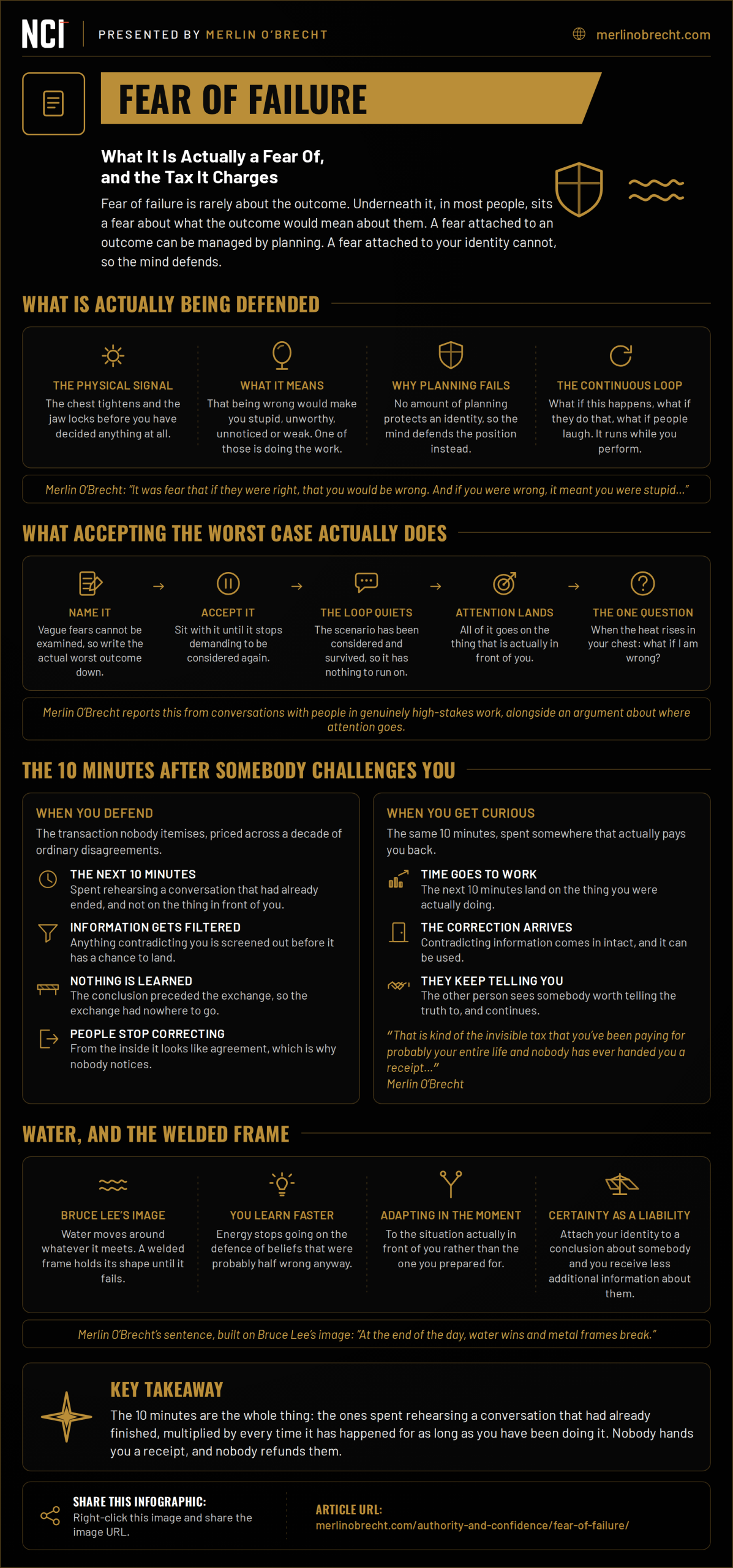
Fear of failure is usually a fear of being wrong underneath, and it costs more than the failure would. When a belief is challenged, the chest tightens and 10 minutes go on defending it, which stops information arriving. People at the top of high-stakes fields accept the worst outcome in advance, and that acceptance is what raises their odds.
“If you are one of the people out there who’s aspiring to not just be good at what you do, but to be truly great or maybe even to be one of the best in the world at what you do, this is something you can’t afford to overlook.”
Here is what is interesting about people at the very top. Not the pretty good ones. The actual top: multi-billionaire entrepreneurs, leading academics who are miles ahead of their field, people on tier one military teams, and a friend of mine who is a WBC world Muay Thai champion.
Every one of them I have spoken to arrives at the same slightly old-fashioned idea. Obviously it matters to have a plan, and obviously nothing goes according to plan.
The trouble starts when rigidity about how it unfolds gets multiplied by an unwillingness to accept that it could all blow up in your face. That combination slashes your odds dramatically, and this page is about why.
Key takeaways
- Fear of failure usually resolves, underneath, to a fear of what being wrong would mean about you.
- Accepting the worst outcome in advance is what people in genuinely high-stakes work do, and it raises rather than lowers their performance.
- Defending a challenged belief consumes capacity that would otherwise be available to the situation in front of you.
- The cost is not the argument. It is everything the reflex prevented from arriving, compounded across years.
- The whole practice reduces to one question, asked while your chest is tight: what if I am wrong?
What is the fear of failure actually a fear of?
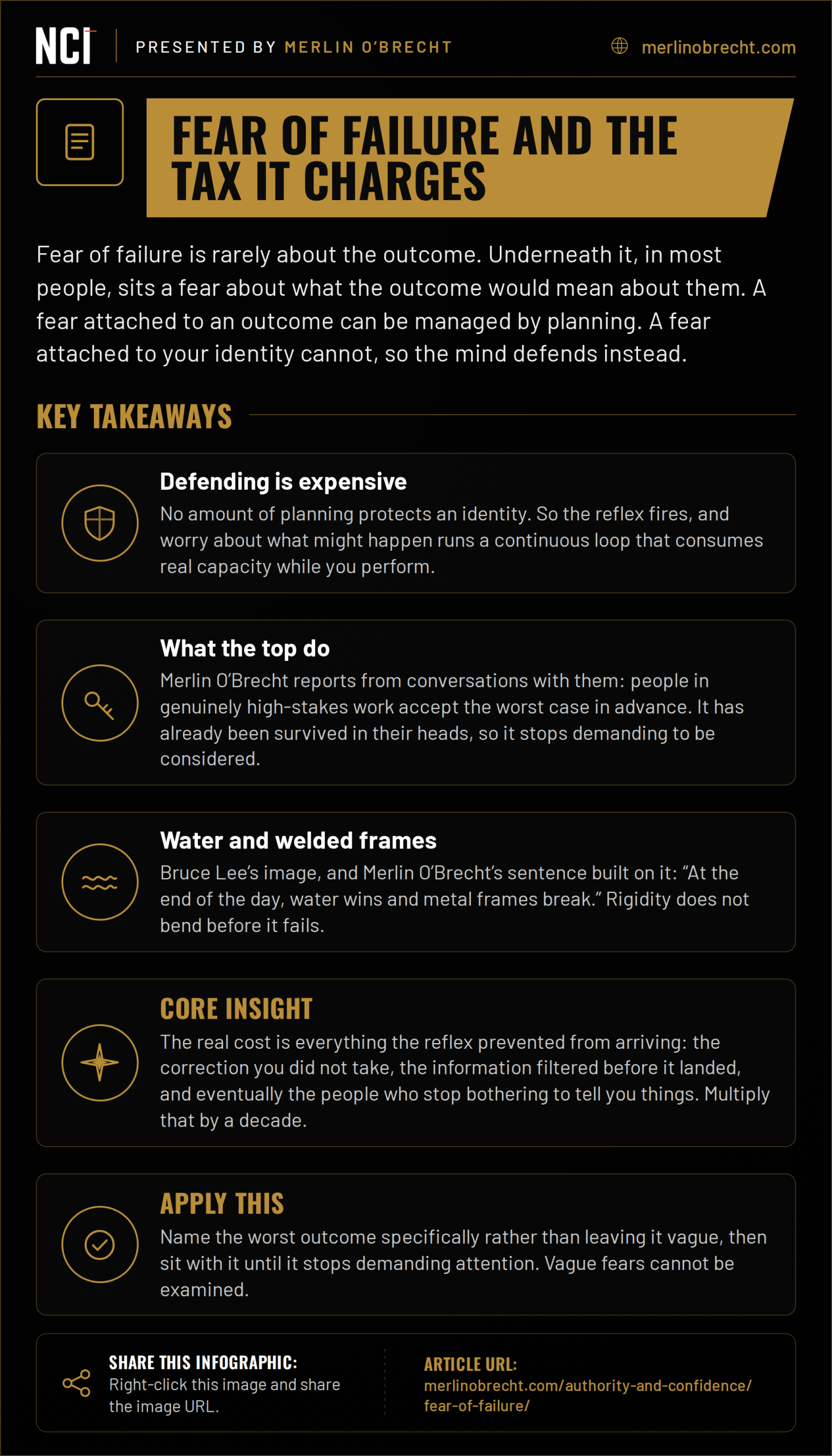
Fear of failure is rarely about the outcome. Underneath it, in most people, sits a fear about what the outcome would mean about them: that being wrong would make them stupid, unworthy, unnoticed or weak.
That distinction matters practically rather than philosophically. A fear attached to an outcome can be managed by planning. A fear attached to your identity cannot, because no amount of planning protects an identity, so the mind defends instead. And defending is expensive.
The 10 minutes after somebody challenges you
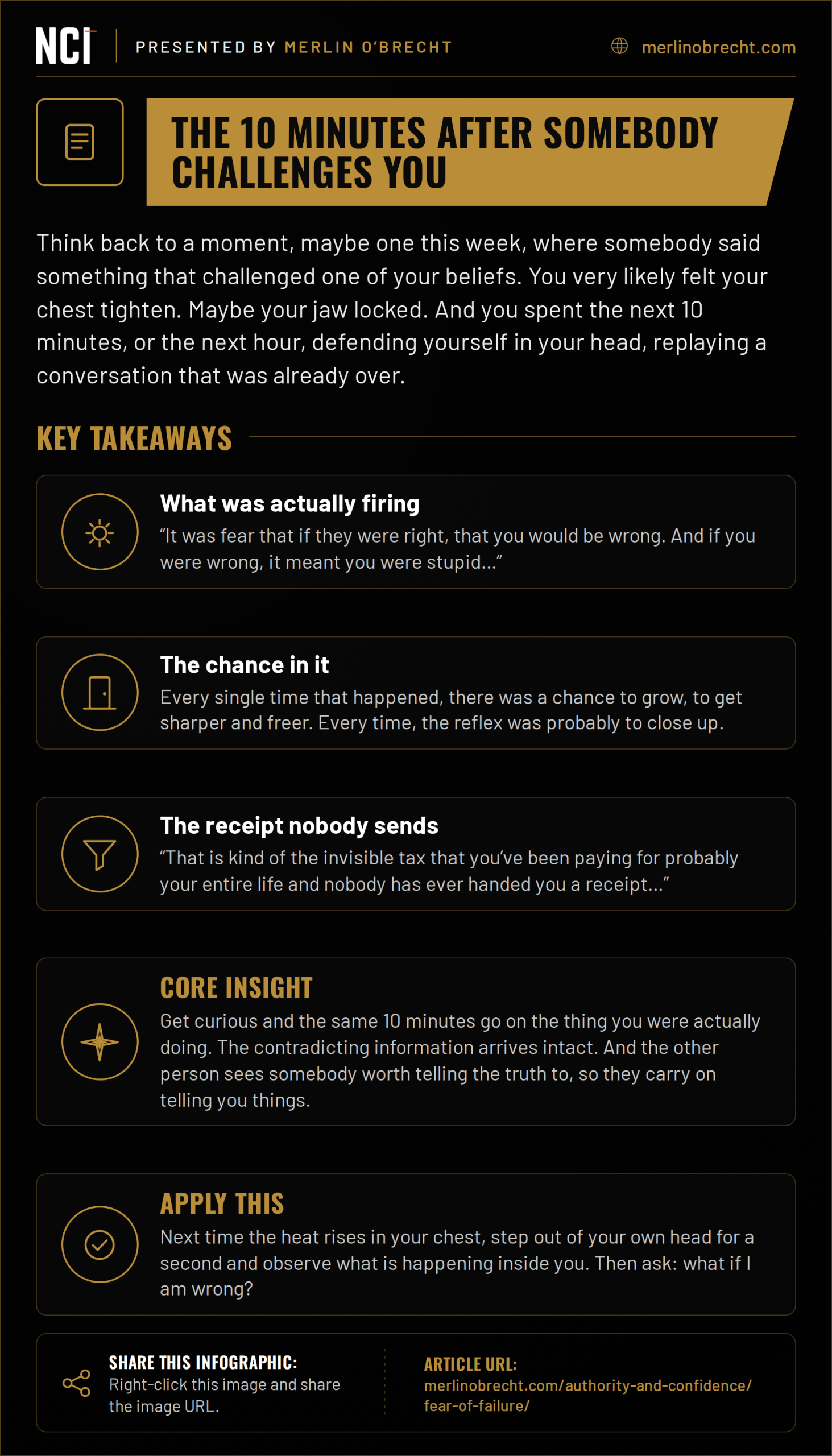
Think back to a moment, maybe one this week, where somebody said something that challenged one of your beliefs.
You very likely felt your chest tighten. Maybe your jaw locked. And you spent the next 10 minutes, or the next hour, defending yourself in your head, replaying a conversation that was already over.
Here is an idea worth sitting with. That was probably not anger. It may not even have been conviction.
“It was fear that if they were right, that you would be wrong. And if you were wrong, it meant you were stupid. It meant you weren’t worthy of love.”
It meant nobody was going to notice you. It meant you would be seen as weak. Whichever of those it is for you, it is doing the work.
And every single time that happened, there was a chance to grow, to get sharper and freer. Every time, the reflex was probably to close up rather than open up.
If you can remember the last conversation you replayed in your head after it ended, you already have the whole mechanism. What you are missing is only the name for it.
What people at the top do with the worst case
The cleanest example I know is the tier one military world, and I want to be precise about what I am reporting: these are conversations I have had with people in those categories rather than anything I have done myself.
Those operators walk into rooms several times a week where the next breath could genuinely be the last. If they were carrying the fear and anxiety of what happens if somebody is waiting on the other side of that door, they would be slower and worse. So instead they fully accept the possibility of death and make peace with the absolute worst case in advance.
Because of that, they walk into the room with a level of calm, alongside aggression and confidence, that is genuinely impossible to fake.
The same principle shows up in a world champion fighter, a Formula One driver, and a CEO running something enormous. Different game, identical mechanic underneath.
They have finally reached a place where they stopped pretending they can control the outcome of everything. And, strangely, that is exactly what gives them more control and a higher percentage chance of success.
So the next time you are anxious about a specific outcome, about a job or a relationship or a result, it is worth realising that you are very likely reducing your chance of success while you do it.
Why does accepting the worst outcome improve the odds?
Because attention is finite, and fear of a specific outcome consumes a large amount of it.
- What defending costs. Anxiety about what might happen runs a continuous loop: what if this happens, what if they do that, what if I lose, what if people laugh at me. That loop consumes real processing capacity while you are trying to perform.
- What accepting frees. Make peace with the worst case in advance and the loop has nothing to run on. The scenario has already been considered and survived in your head, so it stops demanding to be considered again.
- What the freed capacity goes to. All of it lands here, in this moment, on the thing actually in front of you. You still try to succeed with every ounce of your being. You are simply no longer paralysed by the potential of failure while doing it.
That is a plain description of where attention goes rather than a claim about the brain, and it does not need to be more than that to be useful.
Water and the welded frame
There is a connection here almost nobody makes.
Understanding cognitive bias, and the dissonance it generates, puts you in a state where you are more like water and less like a welded frame that cannot move. Bruce Lee’s image, and two things follow from it.
You learn faster, because you are no longer spending energy defending beliefs that are probably half wrong anyway.
You can adapt in the moment to exactly what is in front of you, rather than to the version of the situation you prepared for.
“At the end of the day, water wins and metal frames break.”
The invisible tax
Every defended challenge is a transaction, and the accounting is worth seeing laid out.
| What happens when you defend | What happens when you get curious |
|---|---|
| The next 10 minutes go on rehearsing a conversation that already ended | The next 10 minutes go on the thing you were actually doing |
| Information that contradicts you gets filtered before it lands | The contradicting information arrives intact and can be used |
| You learn nothing from the exchange, since the conclusion preceded it | You leave with something you did not walk in with |
| Across a decade, the compounding cost is every correction you refused | Across a decade, the compounding gain is every correction you took |
| The other person sees somebody who cannot be corrected, and stops trying | The other person sees somebody worth telling the truth to, and continues |
That fourth row is the one that matters and it is the hardest to feel, because nothing visible happens on any given day.
“That is kind of the invisible tax that you’ve been paying for probably your entire life and nobody has ever handed you a receipt. Not even a refund, nothing.”
The final row is the one that hurts most in professional settings. People stop correcting a person who cannot be corrected, and the correction stopping is invisible from the inside. It looks like agreement.
Why is certainty a liability when you are reading people?
Why do people fail to act on what they already know is best for them?
Part of the answer is that some of what they already know is wrong, and the fear of finding that out keeps them acting on the old version.
We see this in behaviour profiling constantly. The quicker you attach your identity to a particular conclusion about the person in front of you, the less additional information you can receive about them. You have the best skills available, you may be trained better than anybody in the room, and you have put chains around your own mind.
That is why trained profilers speak almost entirely in probabilities, which is covered on why trained profilers speak only in probabilities.
And it generalises past profiling. A posturing sense of confidence and certainty is, more often than not, the biggest difference between people who are great at what they do and people who are the best in the world at it.
Which is where an article reaches its honest limit. Noticing that you have attached your identity to a read, while the read is still forming and the other person is still talking, is a trained skill rather than an insight. It is the difference between somebody with good instincts and somebody whose instincts hold up under scrutiny. That is what NCI-3 Behavior Scientist works on: 6 to 8 weeks, self-paced, $2,987.
The one question
Here is the offer, and it is free. There is no course behind this one, no routine, and not even necessarily a mindset overhaul.
It is one thing.
The next time you feel that heat rise in your chest, and it feels like this person’s idea is challenging your identity, get real about what is actually happening. Step out of your own consciousness for a second and observe what is going on inside you.
When you do that, you will not need to defend. You will be able to get curious instead.
And it all comes back to one question.
What if I am wrong?
What stops being frightening after this
“I promise, the second you stop being afraid of being wrong is the second that you stop being afraid period in most situations.”
Keep the qualifier on that. In most situations. It is not a cure for fear and it was never offered as one.
What it is, reliably, is the removal of a cost you have been paying without a receipt.
“All I wanted to do today was just put these ideas on your table. But from here, the game is yours.”
One thing worth knowing before you try it: the practice on this page asks you to consider that a position you have held for years is wrong, on purpose, repeatedly. That is a great deal less comfortable than reading about it.
Frequently asked questions
What is the fear of being wrong?
The fear of being wrong is the reflex that fires when somebody challenges a belief you hold, and it protects your sense of yourself rather than the belief. It shows up physically as chest tightness or a locked jaw, and behaviourally as rehearsing the argument long after it ended. What it defends is not the idea but what being mistaken would seem to say about you.
How do you stop being afraid of failing?
Three steps. Name the worst outcome specifically rather than leaving it vague, because vague fears cannot be examined. Accept it in advance, meaning sit with it until it stops demanding attention. Then run the one question when the heat rises in a conversation: what if I am wrong? The first two are done beforehand and the third is done live.
How long does it take to stop taking disagreement personally?
The practice works the first time you run it, and it holds for that one exchange. That is genuinely useful and it is also the honest limit. Making it your default takes as long as changing any other reflex, and I do not put a number on it, because the number would be invented.
Does accepting failure in advance actually improve performance?
Worth being straight about the evidence here. This is my observation from conversations with people across several high-stakes professions, plus a reasoning argument about where attention goes, rather than a controlled study. I find it consistent and I would act on it, and you should weigh it as what it is rather than as research.
What is the difference between fear of failure and imposter syndrome?
Fear of failure attaches to an outcome that has not happened yet. The imposter pattern attaches to success that already has, and consists of discounting it as luck or timing. Worth noting that imposter syndrome is a popular description of a recognisable pattern rather than a clinical diagnosis, and it gets used loosely.
How do you handle being wrong in front of your team?
Name the correction out loud and keep going. That is the whole move, and it takes about four seconds. Treat the argument for it as an information question rather than a moral one: a leader who cannot be corrected stops being corrected, and the flow of bad news dries up first. That cost compounds quietly and is invisible from the top of it.
Is confidence the same as certainty?
No, and the gap between them is where most of the skill lives. A posturing sense of certainty is more often than not the biggest difference between people who are great and people who are the best. The parallel in behaviour profiling is exact: the best readers of people speak almost entirely in probabilities, and that habit is what makes them accurate.
Where does "be like water" come from?
Bruce Lee, whose water image is the source of the metaphor used here. The sentence built on it, that water wins and metal frames break, is my own phrasing rather than his, and I use it because the second half is the part people forget. Rigidity does not bend before it fails.
Is admitting you were wrong a weakness in a negotiation?
Treat it as an information question rather than a moral one. Conceding a specific factual point costs you that point and buys you the other side’s willingness to keep telling you things, which is usually worth more across a long negotiation. What genuinely weakens a position is defending something demonstrably false, because everything else you say gets repriced afterwards.
What do you practise after the one question?
Run it on small disagreements before large ones, since the reflex is easier to catch when the stakes are low. After that, work on noticing the physical signal earlier, the chest before the jaw, which is what makes the question available in time to matter. That noticing is the same faculty composure work trains.
Where to go from here
The 10 minutes are the whole thing.
Not the disagreement, not who was right. The 10 minutes afterwards, spent rehearsing a conversation that had already finished, multiplied by every time it has happened, for as long as you have been doing it.
Nobody handed you a receipt for those, and nobody is going to refund them. What you can do is stop paying, starting with the next one.
If you want the trained version, where you catch the attachment while the read is still forming, that is NCI-3 Behavior Scientist. 6 to 8 weeks, self-paced, $2,987.
If you would rather buy nothing, you already have the whole method and it costs one question.