How to feel enjoyment again
How to feel enjoyment again, and why hitting the number didn't do it
By Merlin OBrecht · Dean of Academic Affairs, NCI University
How to feel enjoyment again
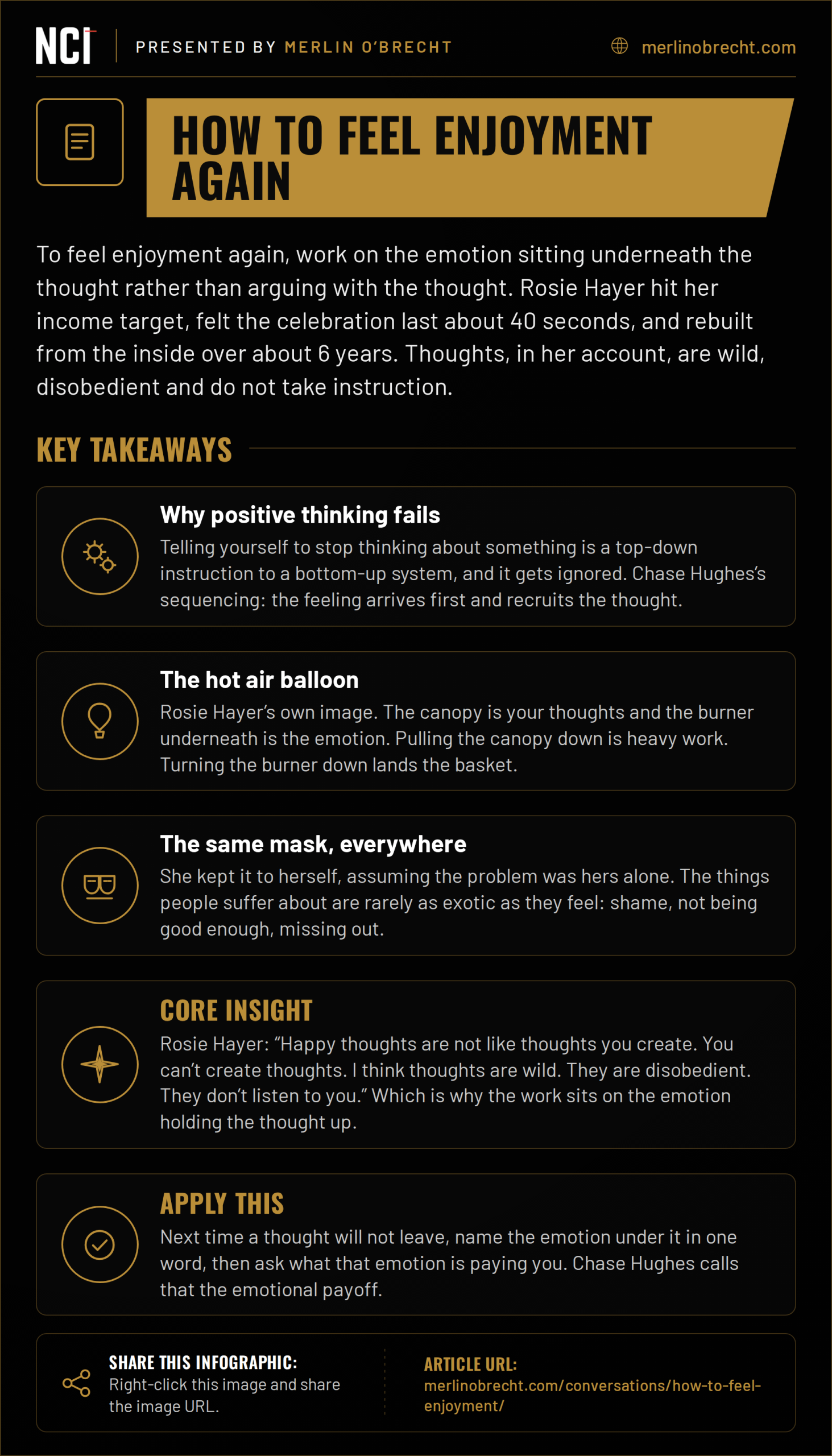
To feel enjoyment again, work on the emotion sitting underneath the thought rather than arguing with the thought. Rosie Hayer hit her income target, felt the celebration last about 40 seconds, and rebuilt from the inside over 6 years. Her practice: name the emotion, ask what it pays you, write it down badly, read it back tomorrow.
I’ve watched Rosie Hayer run one of Chase’s hardest influence formulas better than almost anyone alive. She’s now CEO of NCI Sales. The thing I wanted to ask her about was Christmas 2018.
She’d hit the number. Everything outside was working. She couldn’t make herself pick up a phone.
What she did next took about 6 years, and it started with something so small it sounds like a joke out loud. I’ll name it at the end, and give you the mechanism on the way, because the mechanism explains why the advice you’ve already been given hasn’t worked.
Key takeaways
- Rosie Hayer describes hitting her income target and getting about 40 seconds of celebration followed by a void, repeatedly, for years.
- Her practice works on the emotion underneath a thought, because thoughts aren't something you choose.
- The mechanism: the part of the brain generating emotion doesn't respond to reasoning, which is why arguing yourself into a better mood fails.
- She hasn't missed a day of her practice since March 2019, and she says the point of it was never the practice.
Why does hitting the goal feel empty?
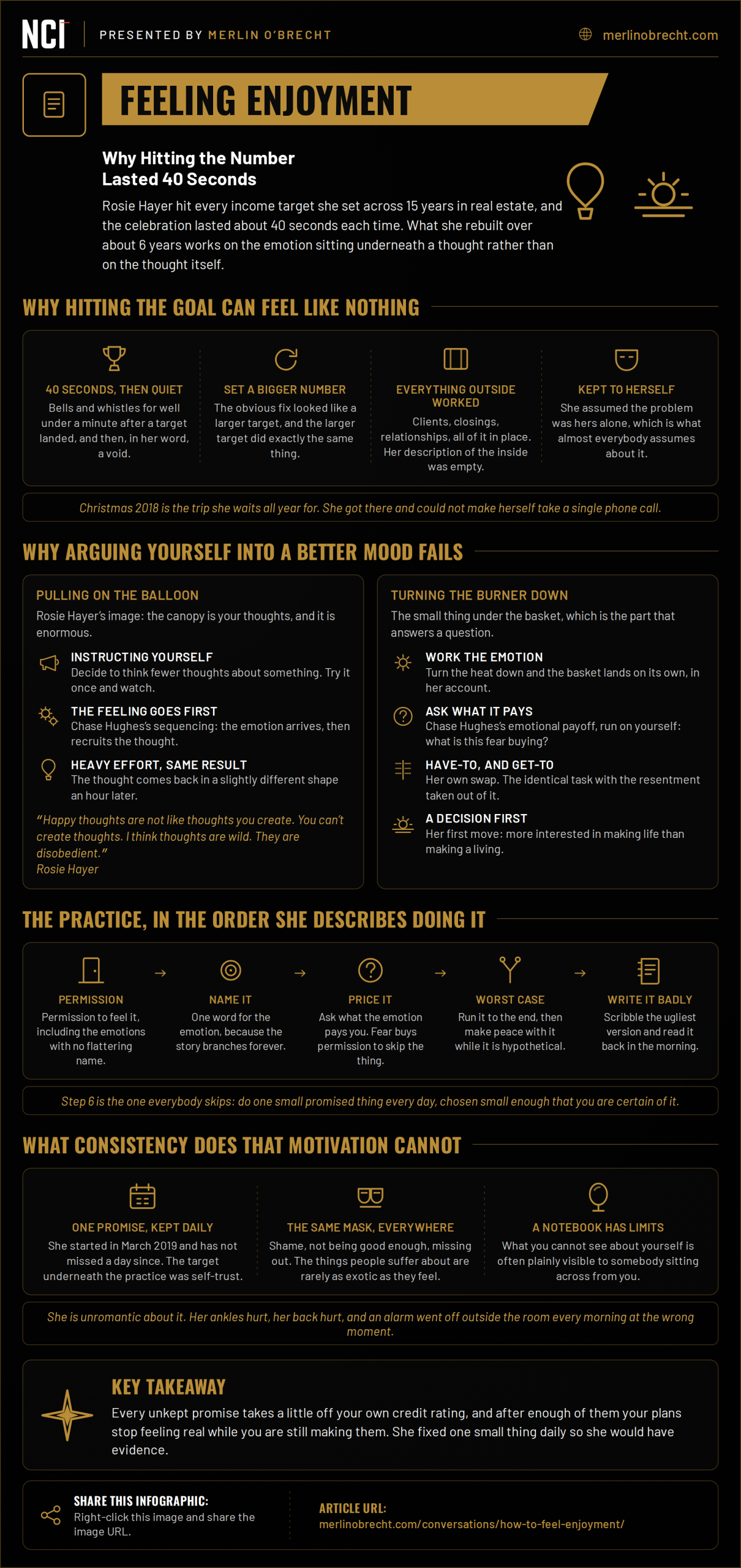
Because the number was never the thing generating the feeling. Rosie Hayer spent years hitting income targets in real estate and getting a burst of celebration that lasted under a minute, then nothing. So she’d set a bigger number and run it again.
The credentials matter here for one reason: she isn’t describing this from the bottom of anything. She built a real estate career decorated enough to earn the Eagle Award for Business and Cultural Excellence, she holds NCI-4 Author, the highest certification NCI University issues, and she’s a graduate of Chase Hughes’s Black Course. She’s board certified in Cognitive Modification Technology and an Avery practitioner. She now runs NCI Sales as its CEO, and she built and ran its first live event in Austin in May 2026. All of that sat on the other side of what she describes below, and none of it fixed the 40 seconds.
“Instantaneously, I hit the number. It was always like bells and whistles for like 40 seconds, and then it’s complete silence, complete void.”
Christmas 2018 was where it stopped being survivable. That trip is the one she waits all year for, her birthday sits inside it, and she and her husband pick a destination at random. She got there and couldn’t take a single phone call.
“Everything on the outside was perfect. This is what success is, you got to have these many clients, these many closings, business relationships. But inside I felt so empty.”
How to feel enjoyment again, one step at a time
Here’s how to feel enjoyment again, in the order Rosie describes doing it. None of these steps require you to feel differently first, which is why they work.
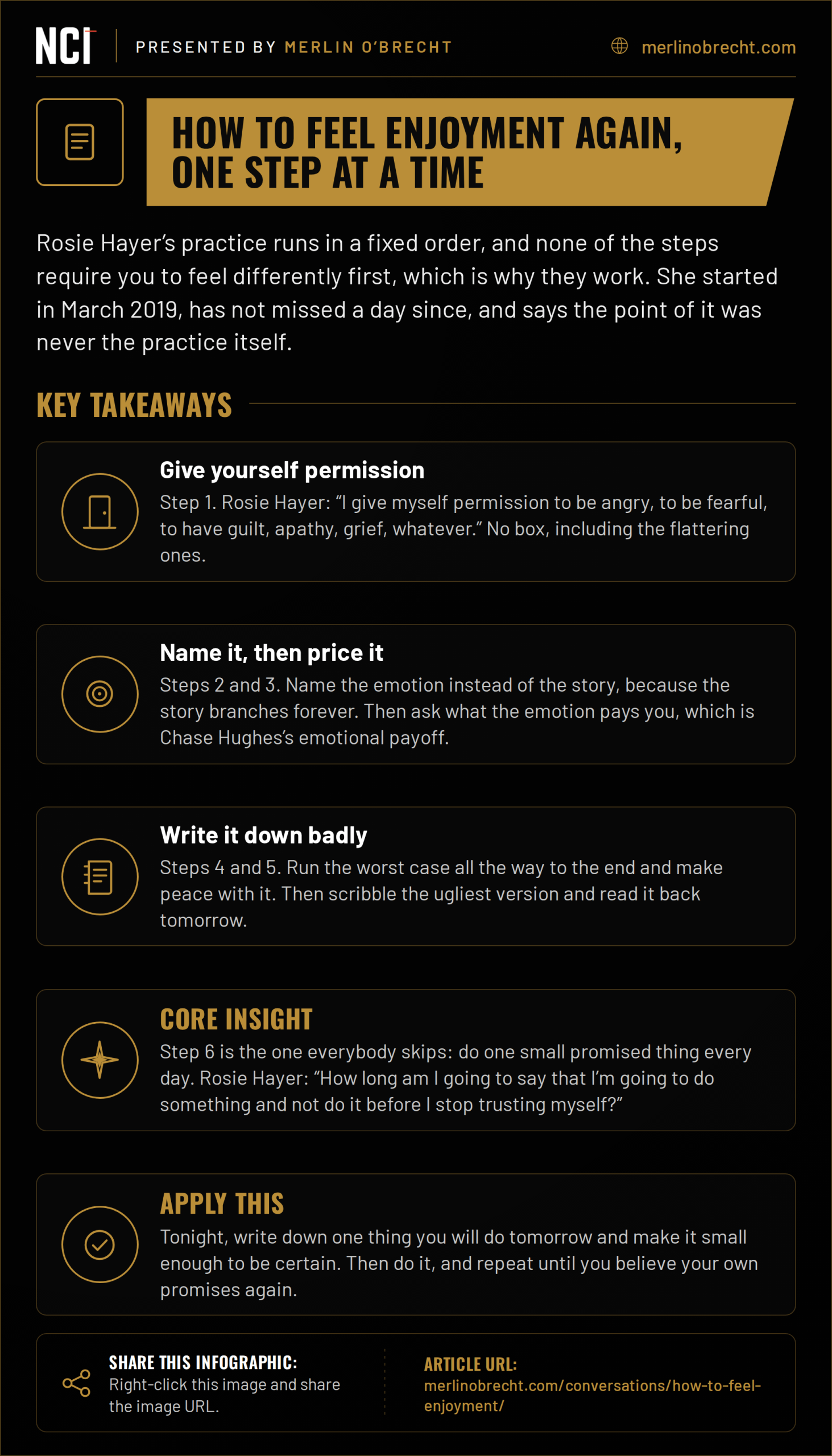
- Give yourself permission to feel the thing. Her words: “I give myself permission to be angry, to be fearful, to have guilt, apathy, grief, whatever.” No box, including the flattering ones.
- Name the emotion instead of the story. The story branches forever. The emotion is one word and it holds still long enough to look at.
- Ask what the emotion pays you. Chase Hughes’s emotional payoff idea, run on herself: what is my payoff, why am I seeking this fear? Fear buys you permission to not do the thing.
- Run the worst case all the way to the end. If I let go of this fear and make a fool of myself, what happens next? Then make peace with that outcome while it’s still hypothetical.
- Write it down badly and read it back tomorrow. Skip the ritual. Scribble the ugliest version, get it out of your head, and read it in the morning when the emotion has moved and the paper hasn’t.
- Do one small promised thing every day. The self-trust step, and the one everybody skips.
Enjoyment as a byproduct
Rosie won’t accept enjoyment as a behaviour you perform, and she’s precise about why.
“Playfulness is a byproduct of a state of mind… Enjoyment is what you see on the outside, but internally there’s like a sweetness or pleasantness of emotion happening.”
Then the line that undercuts most self-help advice in about 15 words:
“Happy thoughts are not like thoughts you create. You can’t create thoughts. I think thoughts are wild. They are disobedient. They don’t listen to you.”
Try it. Decide to think fewer thoughts about something. Her version: the mind only knows how to add and multiply, and has no idea how to subtract.
Why doesn't positive thinking work?
Positive thinking fails for a structural reason rather than a motivational one. You’re aiming the wrong instrument at the problem. How I put it to her on camera:
“We’re basically asking the limbic region of our brain which is generating the emotions to be influenced by the prefrontal cortex which is interpreting language and thought and rational thinking. And unfortunately the limbic system just does not speak English.”
Telling your brain to stop thinking about something is a top-down instruction to a bottom-up system, and it gets ignored.
Underneath that sits a sequencing point Chase Hughes teaches both of us. Most people assume a thought arrives and produces a feeling. It runs the other way: the feeling arrives and recruits the thought that justifies it. Rosie summed it up better than I did, so I’ll give her the line: the limbic brain makes the decision, and the prefrontal cortex takes the credit.
The hot air balloon
This image is hers and I’ve stolen it about 40 times since. A hot air balloon has an enormous canopy on top and a small basket underneath with a burner in it. The canopy is your thoughts. The burner is the emotion.
“We don’t fight the thing on the top to bring it down. That would be such a heavy effort. What we do is we turn the heat down and we slowly land the basket.”
| Pulling on the balloon | Turning down the burner |
|---|---|
| You act on the thought: argue with it, replace it, affirm over it | You act on the emotion holding the thought up |
| Costs enormous effort, and the canopy is far bigger than you | Costs one honest question, asked while you’re uncomfortable |
| The thought reappears in a slightly different shape | The thought loses its lift and stops being interesting |
| An hour later you’re still up there negotiating | An hour later you’d forgotten it was a problem |
She’d had this demonstrated at home. Two days after telling her son his father would be the best friend he’d ever find, she stood there complaining about the same man in front of the same kid. He caught it: mom, 2 days ago you told me he’s the greatest human being on earth, what changed? Nothing had, except her emotion.
Have-to, and get-to
Her first move was a decision, taken before any technique: to live the life rather than perform it.
“I became more interested in making life than making a living.”
The practical version is a swap she makes constantly. A have-to is an obligation you resent while doing it. A get-to is the identical task with the resentment gone, usually because you finished the obligations that earned it. Change what your have-tos mean, she says, and “a lot of misery starts going away.”
It costs nothing and it’s available at 6am on a Tuesday, which is more than most advice about enjoyment can say.
What consistency does that motivation cannot
In 2019 she started breath work and meditation, and she’s unromantic about it. It was the most painful experience of her life. Her ankles hurt, her back hurt, an alarm went off outside the room every morning at exactly the wrong moment, and she was furious at a clock. She only kept going because the alternative was worse.
The target underneath it was self-trust.
“How long am I going to say that I’m going to do something and not do it before I stop trusting myself?”
That’s the sentence I’d put on a wall. Every unkept promise takes a little off your own credit rating, and after enough of them your plans stop feeling real while you’re still making them. She fixed one thing so she’d have evidence.
She hasn’t missed a day since 29 March 2019.
Everybody in the room is wearing the same mask
Rosie kept all this to herself for the same reason everyone does. She assumed the problem was hers alone. Here’s what I’ve found from the other side of behaviour profiling:
“Most people, I think well above 90% of people, kind of live this life in a little silo, in this bubble, walking around suffering, wearing this mask to everybody else… Meanwhile, everybody else is in the same bubble wearing the same masks.”
The things people suffer about are almost never as exotic as they feel from inside. Shame, not being good enough, not being worthy of love, missing out. That’s most of it, in most people, most of the time.
Which is why a notebook has a ceiling. What you can’t see about yourself is often plainly visible to somebody sitting across from you. The state work is the first module of our training rather than the last, and the entry point is the NCI-1 Behavior Observer course, 6 hours, $252, where reading other people starts with reading yourself.
One thing to know before you consider any of it. The first thing this training asks you to look at is you, which is exactly the part most people arrive hoping to skip.
Frequently asked questions
What does it mean to work on the emotion rather than the thought?
It means treating the feeling as the cause and the thought as the symptom. Instead of arguing with “I’m going to embarrass myself,” you locate the fear underneath and ask what it’s doing for you. Rosie Hayer’s image: turn the burner down and the balloon lands on its own.
How do you actually process an emotion?
Four steps. Name it in one word rather than a story. Ask what it pays you, since emotions usually bought you safety at some point. Write it down badly, with no attempt at insight. Read it back the next day, when the emotion has moved on and the writing hasn’t.
How long before this changes how you feel day to day?
Rosie Hayer describes roughly 6 years of work and a daily practice she hasn’t missed since March 2019. The early changes were small and unglamorous: keeping one promise, then another. Anybody offering a 30-day version is describing something else.
Does journaling actually do anything?
The writing itself does less than people think. The value sits in reading it back the next day, when you’ve moved and the page hasn’t, and you see how much of what felt like analysis was a mood with a vocabulary. Rosie Hayer’s own words: wow, that was a bunch of emotions.
What is the difference between happiness and enjoyment?
Happiness usually gets framed as an outcome you’re waiting on, tied to something arriving. Enjoyment is a state you’re in while doing something ordinary, and it shows up as playfulness. One depends on the world cooperating. The other is available on a boring Wednesday.
How does this apply on a sales call or in high-pressure work?
The other person’s state decides more than your argument does, and safety changes their state faster than logic. Chase Hughes teaches this through the PCP model: perspective, context, permission. Rosie Hayer’s version after 15 years in real estate: permission is persuasion, and the sale happens afterward. It’s the same principle she now teaches as CEO of NCI Sales.
Where does the emotional payoff idea come from?
Chase Hughes teaches it inside the NCI University curriculum: emotions persist because they pay you something, often safety that was genuinely useful in childhood. Rosie Hayer applies it by asking what a fear is buying her now. The hot air balloon image is entirely her own.
Is it risky to do this kind of work on your own?
Mostly it’s slow rather than risky, since you can’t see your own blind spots by definition. Worth saying plainly though: this is training rather than treatment, and if you’re genuinely struggling, the right move is a qualified professional rather than a notebook.
Who is Rosie Hayer?
Rosie Hayer is the CEO of NCI Sales, a separate company built on Chase Hughes’s behavioural work, and she spearheaded its first live event in Austin in May 2026. She holds NCI-4 Author, the highest certification NCI University issues, is board certified in Cognitive Modification Technology, is an Avery practitioner and is a graduate of Chase Hughes’s Black Course. She spent 15 years in real estate and holds the Eagle Award for Business and Cultural Excellence.
What comes next if this landed?
Start with the daily practice rather than a purchase. Pick one small thing, promise it to yourself, do it tomorrow, and repeat until you believe your own promises again. Rosie Hayer built everything on that one move.
Where to go from here
I said her first move was smaller than anyone expects, so here it is. She picked one thing she’d said she would do, and did it on a day she didn’t want to. Then she did it again. That’s the whole beginning, and it has now run for over 7 years.
If you want the structured version, where the state work sits inside a curriculum and other people can correct what you can’t see, the entry point is NCI-1 Behavior Observer. 6 hours, $252.
If you’d rather buy nothing, do step 6. It’s free, it’s harder than it sounds, and everything else was built on it.