Merlin O'Brecht

Executive presence

Executive presence: why people follow some leaders and not others

By Merlin OBrecht · Dean of Academic Affairs, NCI University

Executive presence

Executive presence is what makes people follow one person and not another: a signal read by an old part of the brain that says this person is safe to follow under pressure. It is built from stillness in conflict, direction given without hedging, and calm eye contact. Volume and a raised chin work against it.
“Have you ever had a moment where you suddenly just follow somebody without even knowing why?”
There is a moment where somebody goes from being just a guy to being a person you think you should probably follow. Almost everybody has felt it. It arrives as an unspoken shift in attention, and it changes your propensity toward compliance and suggestibility with no conscious decision attached.
It is a switch built into the unconscious mammalian mind, assembled over thousands of years because deferring to the right person in a tribal setting was a survival advantage.
The useful question is what the switch is actually reading, because it is not reading what most training teaches.

Key takeaways

What is executive presence?

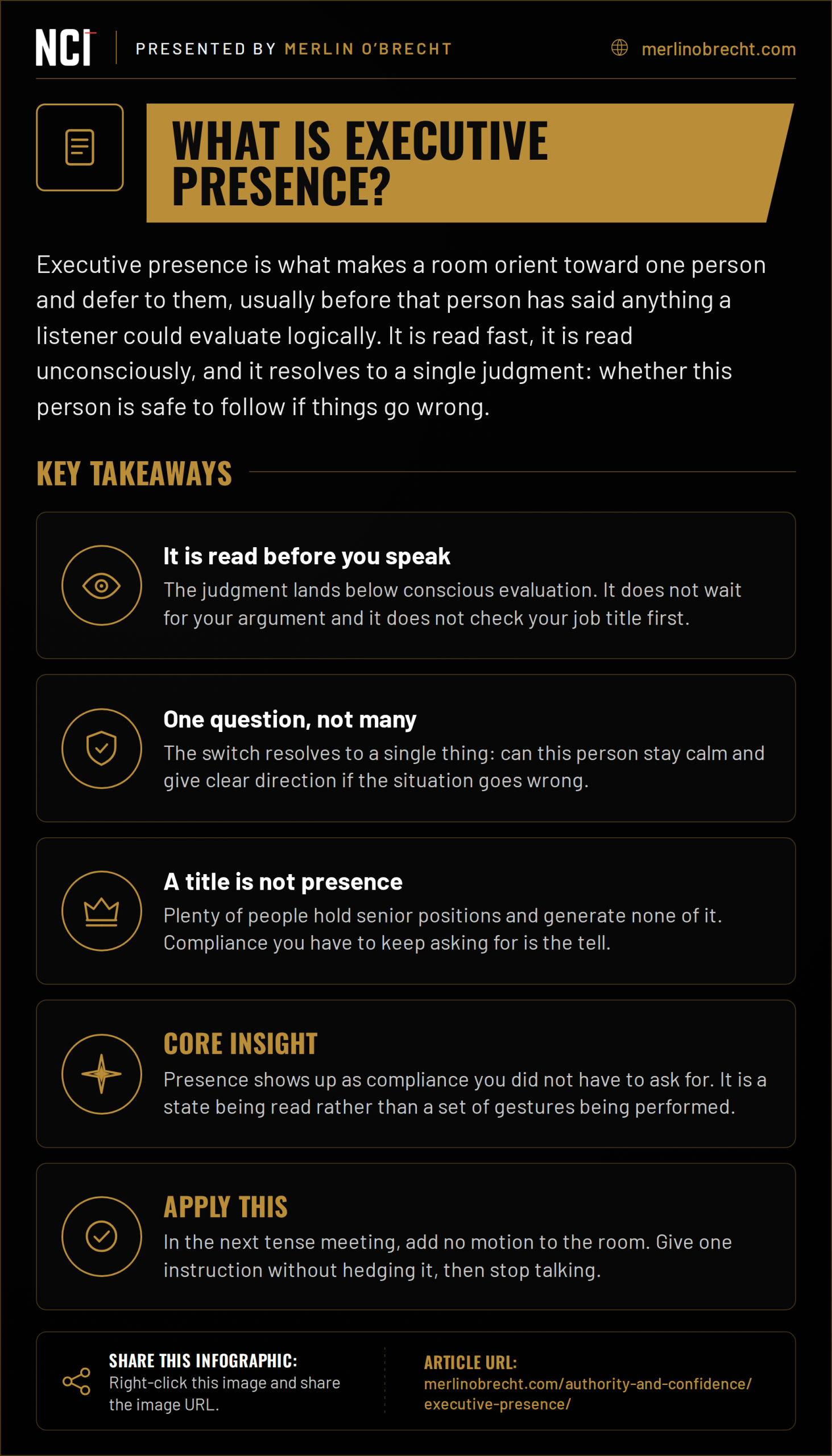
Executive presence is the quality that makes a room orient toward one person and defer to them, usually before that person has said anything a listener could evaluate logically. It is read fast, it is read unconsciously, and it resolves to a single judgment: whether this person is safe to follow if things go wrong.
It shows up as compliance you did not have to ask for. And it is not a title. Plenty of people hold senior positions and generate none of it, which is the observation this whole page comes out of.

A roof in July, and the two sentences that changed it
I used to be a roofer, for anyone who does not know.
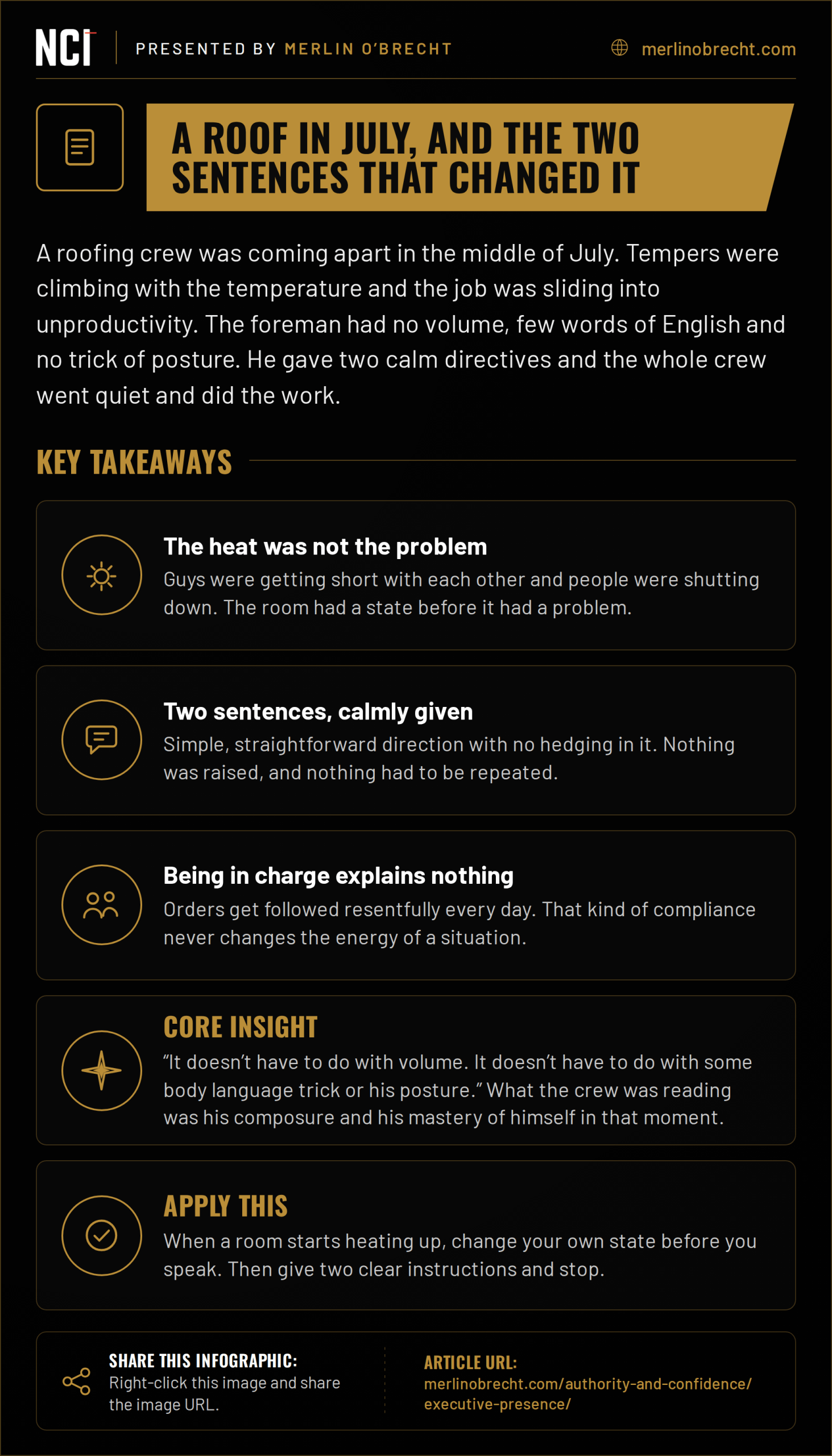
We were on a roof in the middle of July. Imagine the hottest day you have ever had, doubled, because the thermal reflection off a roof is out of this world. The job was not going well. People were upset, guys were getting short with each other, and the whole thing was sliding into unproductivity. People were shutting down. The temperature and the tempers were both climbing.
Our foreman walked up. He had roofed since he was a little kid, he did not speak many words of English, and he was a fairly grizzled type of guy. He calmly gave two simple, straightforward directives.
The whole crew went quiet and started doing what he said.
It would be easy to say he was the guy in charge and that is why people followed him. If you have ever been in a group with an appointed leader, you already know why that explanation does not hold. You have watched somebody give an order that people technically followed while muttering under their breath, resentful, slower than they needed to be. Where there is no real authority and confidence present, the order does not change the energy of the situation and it does not shift how the room behaves in any substantial way.
This did. A few quiet words reoriented an entire crew on the worst day of the summer.
“It doesn’t have to do with volume. It doesn’t have to do with some body language trick or his posture or the way he held his head or the way he moved his chin or something silly like that.”
It was his calm presence, and the reflection of his mastery of the environment and of himself in that moment. That is what produced the reaction in everyone else.
If you have ever watched a room ignore the person with the title and orient toward somebody else, you have already seen this switch operate.

Why do people follow some leaders and not others?

Because the part of the brain making the decision is old, and it is running a survival calculation rather than an organisational one.
The human brain still runs on software from about 100,000 years ago. Your conscious mind knows the difference between you now and a more ancestral version of you. Your prefrontal cortex knows. The limbic system and the older regions do not.
Why would that difference matter so much for authority? Because historically, if we followed the wrong person, our ancestors could have been killed. So we learned to look for the people who could stay calm and give clear direction under pressure.
That framing is mine rather than a research finding, and the hedges in it are deliberate. What is not in question is what the switch selects for, because you can watch it operate in any room where something goes wrong.
The image I always come back to is the still one in the storm. A monk sitting on top of a mountain in the middle of an enormous storm, meditating. The ability to be calm, present and composed in the middle of chaos. That is what we have looked for in other people throughout the whole of our development, and it is what the foreman had on that roof.

What people actually read before they decide to follow

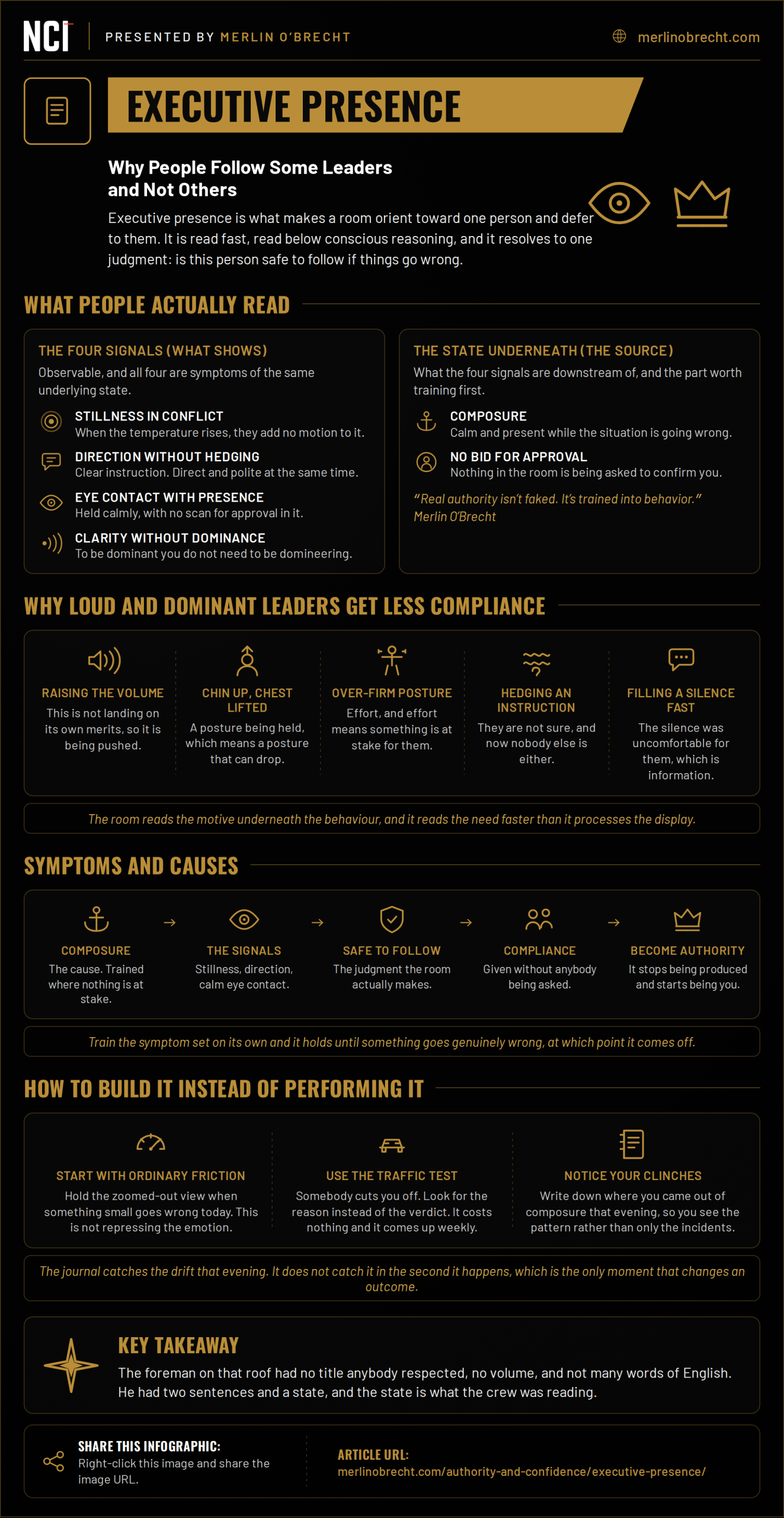
Four observable signals. All four are symptoms of the same underlying state.

Why do loud and dominant leaders get less compliance?

Because the room reads the motive underneath the behaviour, and the motive is the opposite of what the behaviour is claiming.
What the person is doing What the room reads
Raising their volume This is not landing on its own merits, so it is being pushed
Raising the chin, lifting the chest A posture being held, which means a posture that can drop
Over-firm posture, exaggerated stillness Effort, and effort means something is at stake for them personally
Hedging an instruction They are not sure, and now nobody else is either
Filling a silence quickly The silence was uncomfortable for them, which is information
“Those people underneath, deep down inside of themselves, are still seeking approval and they’re fearing rejection. And the brain is really able to just instantly kind of pick up on that.”
That is the whole mechanism. The signals of dominance are frequently produced by a person who needs the room’s approval, and the room detects the need faster than it processes the display.

Symptoms and causes

Most training you will find on this subject, on the internet or on YouTube, focuses on the symptoms of authority and confidence rather than the root causation. What is the systemic cause of that calmness, that peace, that composure?
That is the question worth asking, because the symptom set is trainable in the way a costume is trainable. You can produce all four signals from H2 4 on a Tuesday morning with enough attention, and they will hold until something goes genuinely wrong, at which point they come off.
There is a practical cost to running it that way, and it is paid weekly rather than once. A leader who has trained the symptom set gets compliance that requires maintenance, because the display has to be re-run every time the room tests it.
“Real authority isn’t faked. It’s trained into behavior.”
That is his phrasing and it is the version of this idea I would put in front of anything else. It needs to be felt internally first. What NCI’s approach does differently is work on the causes rather than the mouth or the gestures, so that the signals arrive as an output rather than as a performance.

How do you build executive presence instead of performing it?

You work on composure in the situations that do not matter, so that it is available in the ones that do.

Start with ordinary friction. Something will come up today that makes you stressed or frustrated. This is not about repressing emotion or repressing anger, and that distinction matters. It is about remembering the perspective of your life, living with gratitude for what you have, and holding a zoomed-out view so you do not get overly focused on small consequences. Recognising the inconsequentiality of the small situation you happen to be in.

Use the traffic test. Somebody cuts you off. The move is to look for the reason rather than the verdict, which is really just a broader worldview: empathy for the world and an understanding of our small place in a big universe. It costs nothing and you get several opportunities a week.

Then notice your clinches. When you start to come out of composure, take note of it. Write it down in your journal that evening. The more you consciously bring your awareness to the moments you are falling out of that state, the more control you get over it, because so many people go through life getting angry and frustrated and falling out of composure without ever being consciously aware it is happening.

That drill works, and it has an honest limit built into it. The journal catches the drift that evening. It does not catch it in the second it happens, which is the only moment that changes an outcome, and the thing you are trying to notice is the same thing that removes your ability to notice.
Closing that gap takes structure and feedback rather than reading, which is what NCI-3 Behavior Scientist is built around: 6 to 8 weeks, self-paced, $2,987.
Worth knowing who is in the room when this gets worked on properly. It is executives, therapists and operators in the same cohort, which is a stranger mix than most people expect and the reason the corrections are any good.

What it means to become authority

If you keep working on this and it becomes your new baseline, something changes about the transaction.
“You’re going to stop chasing authority. You will start to become authority.”
And once that happens, people give you the compliance and the suggestibility automatically. It stops being something you produce and becomes an unconscious result of what you are.
Teaching hard skills and behavioural tactics is interesting work. What defines your reality is who you are, more than what you say or what you see.

Frequently asked questions

What makes people follow a leader?
People follow whoever their nervous system judges is safe to follow if things go wrong, and that judgment is made fast and below conscious reasoning. The three markers it reads are stillness when conflict arrives, direction given without hedging, and eye contact held without checking for approval. Position in a hierarchy is not one of them.
How do you build executive presence?
Four steps. Fix composure in low-stakes friction first, since that is where repetitions are free. Give one instruction a day without hedging it. Hold eye contact without scanning for approval. Then record where you lost composure and what preceded it, so you can see the pattern rather than only the incidents.
How long does it take to develop real authority?
The visible signals change inside a fortnight of deliberate practice, and people around you will notice before you do. The baseline underneath them moves on the timescale of the composure work, which has no honest number attached to it. Anybody quoting you a fixed figure for the second part is selling the first part.
Is executive presence a real thing or just confidence?
They are related and they come apart often enough to be worth separating. Confidence is what the person feels. Presence is what other people report perceiving. The clearest observable case is the appointed leader whose instructions get followed resentfully: the position is real, the confidence may well be real, and the presence is absent.
What is the difference between authority and dominance?
Authority is autonomy and control over yourself, which other people can feel. Dominance is a bid for position in a room. A bid can be delivered politely or rudely without changing what it is, and to be dominant in a situation you do not need to be domineering.
How do you command respect from a team that is already tense?
Change your own state before you speak, because a tense room reads agitation faster than it reads content. Then give two clear instructions and stop talking. That is what worked on the roof, and the silence afterwards is doing as much work as the instructions. One caution: running this while visibly agitated produces the opposite result, and the room will notice the mismatch before it processes the words.
Does standing taller and speaking louder make you seem more authoritative?
Usually the reverse. A loud voice, an overly raised chin and an over-firm posture are the signals people reach for when they are seeking approval underneath and fearing rejection, and other people pick that up almost instantly. The display and the need arrive together, and the need is the louder of the two.
Where does NCI's model of authority and confidence come from?
Chase Hughes built it, and the relevant model is the Authority Triangle, taught through NCI University’s curriculum. It tracks a person across three connected sides: the external signals, the underlying habits their life is organised around, and the internal side covering confidence, discipline, leadership, gratitude and enjoyment.
Is getting people to follow you a form of manipulation?
The test Chase Hughes teaches is whether the other person, seeing your full intent, would agree it was in their interest. What this page describes largely passes it by construction, since the compliance is a by-product of your own state rather than something done to anybody. A crew that calms down and gets the job finished safely got a better afternoon out of it than they would have otherwise.
What should you work on first if you want people to follow you?
Composure, before any of the signals. The signals are what composure looks like from outside, and training them first produces something people can feel the seam in. Start with the situations where nothing is at stake, because that is where you get enough repetitions for it to become a baseline rather than a performance.

Where to go from here

The foreman on that roof had no title anybody respected, no volume, and not many words of English. He had two sentences and a state, and the state is what the crew was reading.
You get several chances a week to work on the same thing, and all of them are small: traffic, a slow queue, an email that lands wrong. Those are the repetitions. The meeting where it matters is the test, not the training.
If you want the structured version, where the drift gets caught in the second rather than in a journal, that is NCI-3 Behavior Scientist. 6 to 8 weeks, self-paced, $2,987.
Either way, keep the distinction. Who you are and who you become is what defines the world around you, considerably more than what you say.