How people react under threat
Signs someone feels threatened: the 8 patterns people fall into
By Merlin OBrecht · Dean of Academic Affairs, NCI University
Signs someone feels threatened
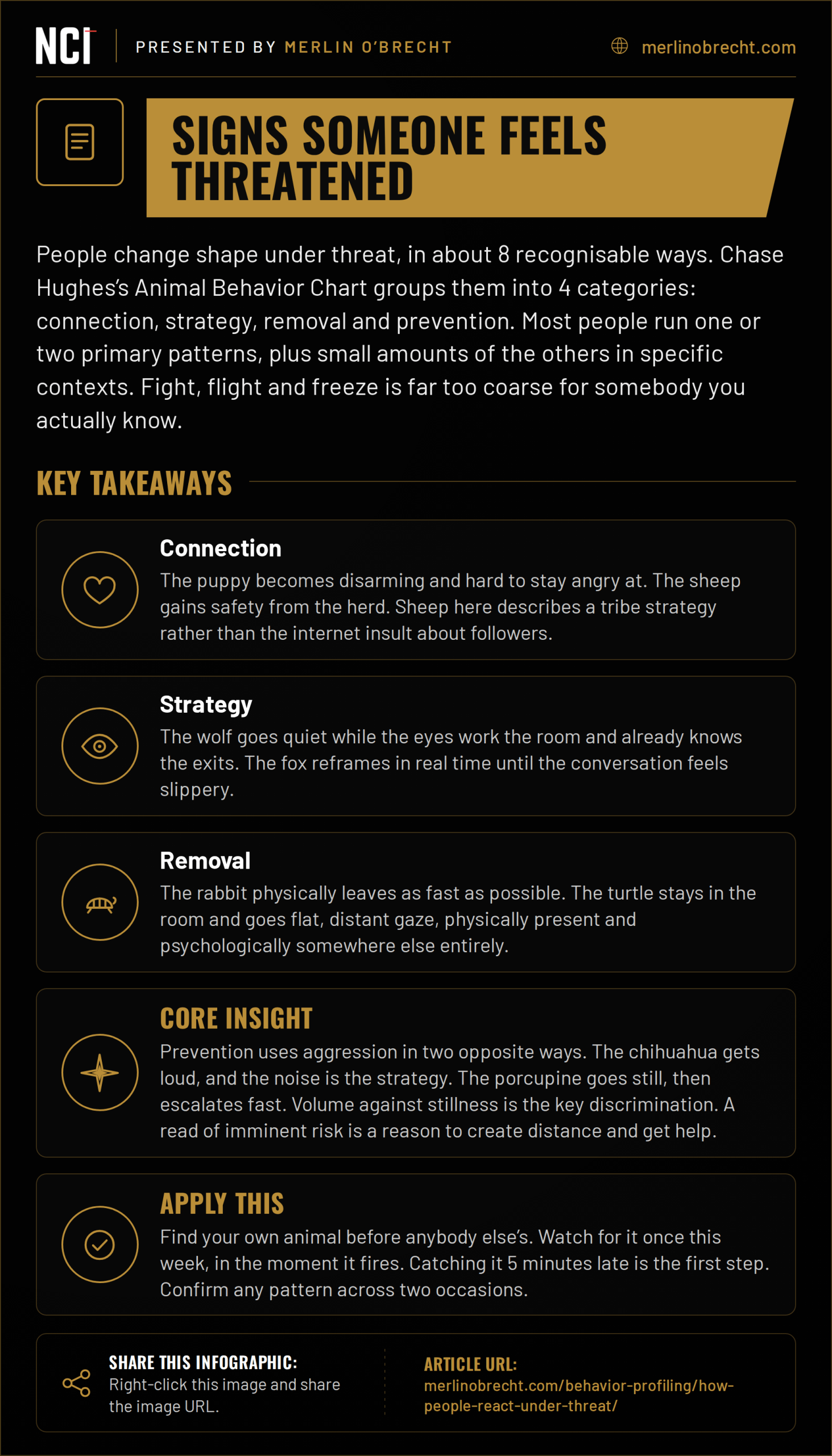
Signs someone feels threatened fall into eight patterns grouped in four categories on Chase Hughes’s Animal Behavior Chart: connection (puppy, sheep), strategy (wolf, fox), removal (rabbit, turtle) and prevention (chihuahua, porcupine). Most people run one or two of them. Each one is a survival strategy built in childhood and still running now.
I want to know if you have ever noticed how people change whenever they feel threatened.
In an argument, in a fight, in a heated debate, some people go silent. Some crack a joke to try to diffuse it. Some get louder. Some leave the room, and some stay in the room and leave anyway.
There are essentially eight specific patterns we fall into, and you are running one of them every single time something hits you wrong or you feel like you are not safe. Fight, flight and freeze is the vocabulary most people have for this and it is far too coarse to be useful on a Tuesday afternoon with somebody you actually know.
Fair warning about what happens next. Once you really see these, you are never going to be able to unsee them.
Key takeaways
- Eight threat responses, grouped into four categories: connection, strategy, removal and prevention.
- Most people run one or two primary patterns, plus small amounts of the others in specific contexts.
- Each pattern is a survival strategy a child worked out before they had words for any of it, refined by thousands of repetitions.
- The two most useful to tell apart are the chihuahua and the porcupine, because volume and stillness mean opposite things.
- The goal is the healthier version of the animal you already are, since no animal is better than any of the others.
What are the signs someone feels threatened?
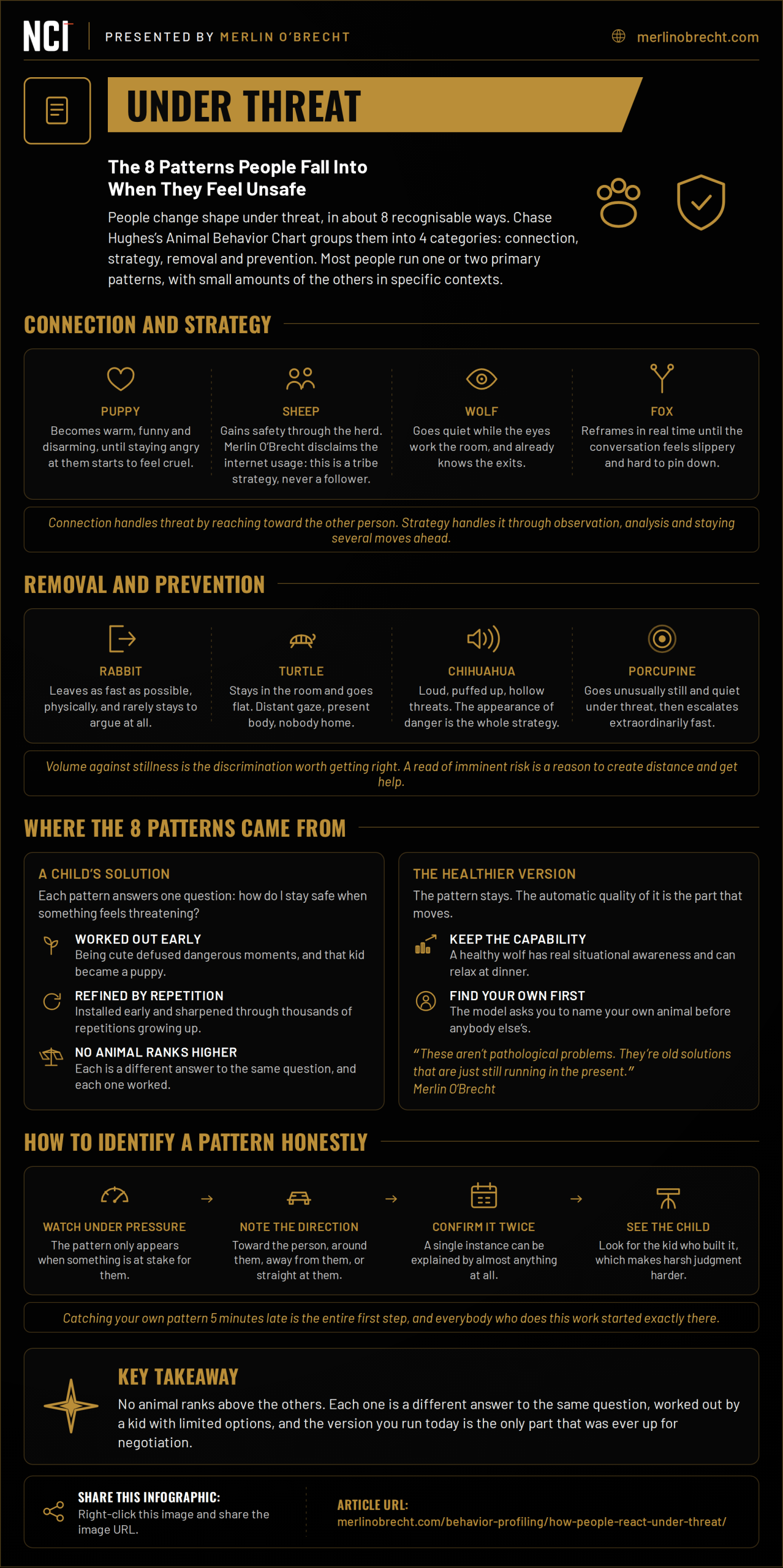
Connection. Handles threat by reaching toward the other person.
- Puppy. Becomes disarming, warm, funny, hard to stay angry at.
- Sheep. Moves toward the group, checks alliances, gains safety through the herd.
Strategy. Handles threat through analysis, observation and planning.
- Wolf. Goes quiet while the eyes work the room. Knows the exits already.
- Fox. Shifts shape mid-conversation. Reframes, redirects, becomes difficult to pin down.
Removal. Handles threat by getting away from it.
- Rabbit. Physically leaves as fast as possible.
- Turtle. Stays in the room and goes somewhere else. Flat energy, distant gaze.
Prevention. Handles threat through aggression, in two completely different ways.
- Chihuahua. Loud, puffed up, hollow threats, no bite underneath.
- Porcupine. Unusually still and quiet, then escalates extraordinarily fast.
Where the eight patterns come from
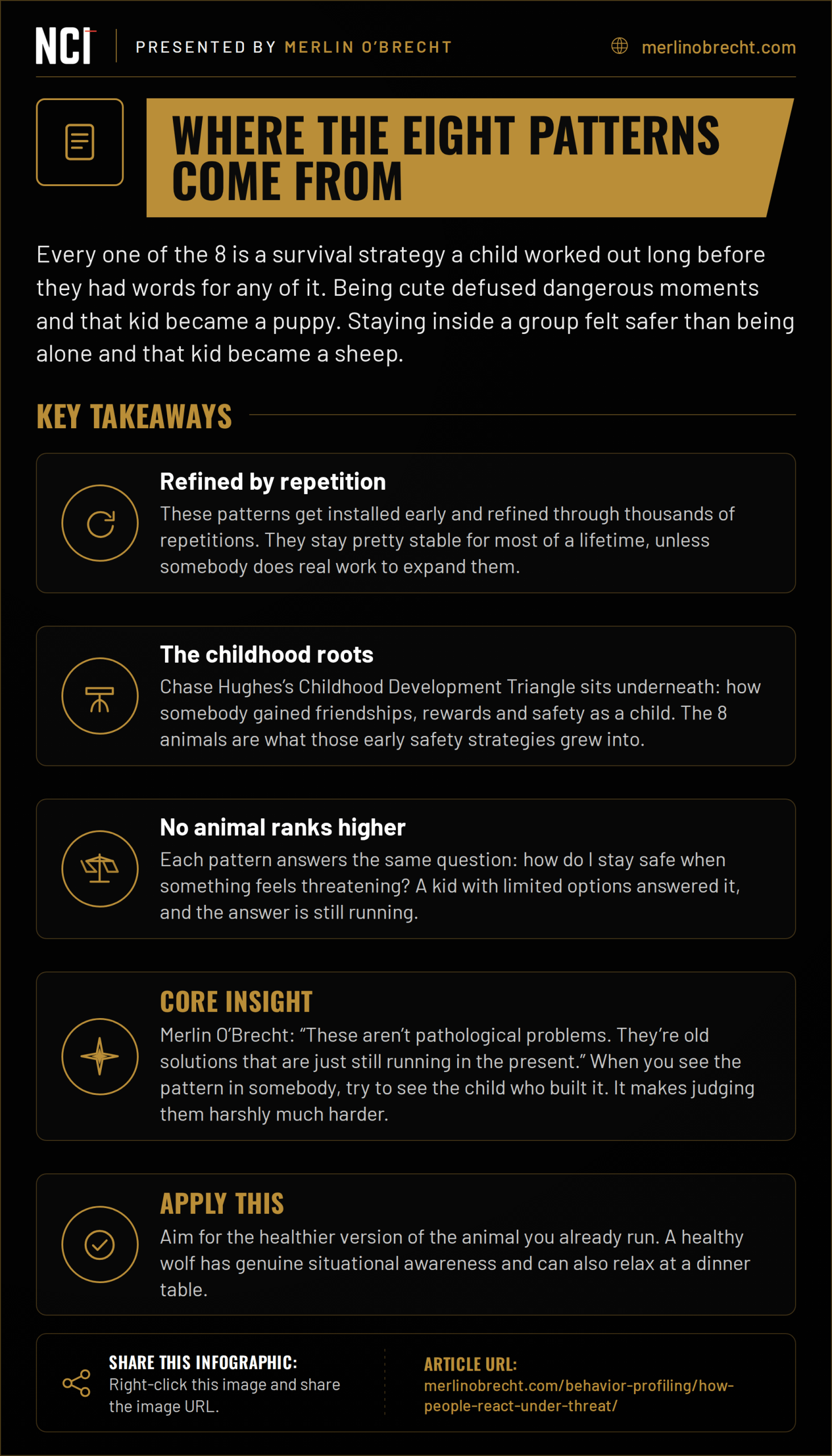
Every one of these is a survival strategy that a kid worked out long before they had words for any of it.
Maybe being cute diffused dangerous moments at home, and that kid eventually became a puppy. Or staying inside a group just felt safer than being alone, and that kid became a sheep. Or the only way to make a threat stop was to hurt it back even harder, and that is the kid who became a porcupine.
These patterns get installed early and they get refined through thousands of repetitions as we grow up. They tend to be pretty stable for most of our lives, unless we do real work to expand them and become less reactive to those tendencies.
“These aren’t pathological problems. They’re old solutions that are just still running in the present.”
That distinction is worth sitting with, because it changes what you do with the information. The system is officially called the NCI Animal Behavior Chart, and it is developed by Chase Hughes, like most of the models at NCI.
If you already know which one of these your father was, you have been running this chart informally your whole life. What you have not had is the eight names and the four categories they sit in.
Connection: the puppy and the sheep
The puppy works off innocence. Puppies handle conflict by being so disarming that you cannot possibly stay mad at them even if you want to. They make themselves so hard to hate that you actually feel bad just for being upset with them, which is an extraordinarily effective defence and almost impossible to be angry at, by design.
Spot it in the joke that arrives 2 seconds after the tension does, the softened voice, the slight physical shrinking, the self-deprecating line that makes continuing the argument feel cruel.
The sheep deals with threat in terms of friends. Sheep gain safety through friendships and social connections, relying on the strength of the herd. Under pressure they check who else is with them, name allies, and move toward the group rather than toward the threat.
I am not meaning sheep in the way you may have heard it talked about online or on the internet. This is not about being a follower or being naive. It describes a human being who gains safety from their tribe, which is one of the oldest functioning strategies our species has. People who are in gangs and rely on a close-knit group of friends to stay safe are running the same pattern in a much harder environment.
Strategy: the wolf and the fox
The wolf runs on vigilance. Wolves are typically hyper-vigilant and hyper-observant, and they walk into every room already analysing the risk.
“They know where all the exits are in a room and where all the social or psychological exits are before they even sit down.”
The social and psychological exits are the interesting half of that sentence. A wolf has already worked out which topic ends the conversation, which person could be appealed to, and what they would say if this goes wrong. They notice things like your microexpressions before anybody else in the room does, and they usually have a small inner circle they trust completely.
You can spot a wolf when somebody is quiet but their eyes are working the whole room, constantly on guard, pre-thinking any potential threat coming their way.
The fox focuses on stealth. A fox cannot rely on size or raw strength to keep itself safe, so it shapeshifts based on what the moment is specifically calling for. It will twist or reframe the whole situation in real time, almost like a chess player thinking five steps ahead.
You can normally spot a fox when a conversation feels like it keeps changing shape, and the person almost feels slippery, impossible to pin down or impossible to outmanoeuvre. The subject you thought you were discussing is somehow no longer the subject and you cannot identify the moment it moved.
Removal: the rabbit and the turtle
The rabbit focuses on retreat, and the strategy is simple. When a rabbit feels threatened, they leave. Rabbits typically do not get lost in arguments. As soon as they feel that stress or that threat to their safety, they exit the situation, and the instinct is to physically remove themselves as fast as possible.
The turtle is the other side of removal. A turtle cannot physically run, so it hides inside the shell instead. In human terms that is psychological removal rather than physical.
The turtle might stay in the room, and they are the type of person who completely dissociates from what is happening. You might see them glazing off into the distance, half phased out, and their energy just goes flat. Physically there, but nobody is home.
Here is the detail that makes it land, and it comes straight from people describing their own experience. Some turtles will literally tell you that they might stare at a wall and picture a beach while somebody is yelling at them.
If you have been on the receiving end of that and read it as not caring, this is what was actually happening. The turtle is not indifferent to the argument. The turtle has left the building and taken the furniture.
Prevention: the chihuahua and the porcupine
Both of these handle threat through aggression and they go about it in completely different ways.
The chihuahua runs hollow posturing. Just like chihuahuas in real life, it looks really tough and aggressive for the exact reason that it knows how weak and vulnerable it actually is. The appearance of toughness is its only real protection.
The voice gets loud. Hollow threats start arriving. There is a lot of chest puffing, and no real bite underneath any of it. The whole strategy is built on one calculation: if I can create enough fear that I am dangerous, then I will never have to escalate the situation.
The porcupine keeps threats away by causing real harm, and there are two flavours of it.
Sometimes it is verbal. The porcupine will not necessarily escalate to physical violence, and if they use language it is going to be specifically engineered to cut the other person exactly where it hurts them the most, designed to create real, lasting, substantial pain in a matter of a few sentences. Anybody who has been on the end of that remembers the sentence years later.
The other version focuses on physical violence, and that often goes much further than anybody was expecting based on the general situation.
A porcupine is usually not a big talker in conflict. They go pretty quiet. Then the moment they feel truly threatened, and their life feels really unsafe, they escalate extraordinarily fast, with all their actions directed at creating the maximum amount of pain in the other person as quickly as they possibly can.
| Animal | What it looks like | What it is protecting |
|---|---|---|
| Puppy | Disarming, warm, humour arriving right on the tension | Innocence, and a childhood where being hard to hate worked |
| Sheep | Moves toward the group, checks allies, names who agrees | Belonging, and safety found in the herd rather than alone |
| Wolf | Quiet, eyes working the room, already knows the exits | Preparedness, and never being caught unready again |
| Fox | Reframes in real time, feels slippery, hard to pin down | Manoeuvrability, when size and force were never options |
| Rabbit | Leaves, physically and quickly, rarely argues | Distance, and the shortest possible exposure to threat |
| Turtle | Stays put, goes flat, distant gaze, nobody home | Interior space, when leaving the room was not permitted |
| Chihuahua | Loud, puffed up, threats with nothing behind them | The appearance of danger, so nothing ever has to be tested |
| Porcupine | Unusually still and quiet, then very fast escalation | Deterrence through real cost, learned where nothing softer worked |
How do you tell the difference between someone posturing and someone about to act?
Volume against stillness. It is the most useful discrimination on this page and the one worth getting precisely right.
The chihuahua gets louder. The noise is the strategy, and the strategy only works if you can hear it, which is why it keeps going. A chihuahua who is still shouting is still running the plan.
The porcupine goes quiet. You can spot a porcupine when somebody goes unusually still and quiet under threat, and then you start seeing body language gestures typically seen in pre-violence indicators. Nostril flaring. The micro-expression of anger as somebody starts to flash the canines on their teeth. Twitch movement starting in the hands. Those are real good indicators that this person may be about to become violent.
Read that hedge exactly as written. May be about to. Nothing here predicts violence, and no combination of behaviours is a forecast.
One thing matters more than the accuracy of the read. A read of imminent risk is a reason to create distance and get help. It is not a reason to stay in the room and keep analysing. If you find yourself running a careful behavioural assessment on somebody who has gone still and started twitching, you have chosen the wrong task. Leave, and involve somebody whose job this is.
Which animal are you?
Most people I have ever met have one or two primary animals. Sometimes one, often two, and most of us also carry a small amount of all the others, showing up in very specific contexts or in small degrees.
The instruction I would give is deliberately gentle. You can identify your own animal, as I did. You can notice when it is running in your life. And then you can ask yourself gently whether this is the version of this animal you actually want to be.
So much of self-improvement starts with recognition and awareness of what is happening inside us, and for a lot of people this chart is the first thing they look at, which lets them start digging into what is really taking place underneath.
There is an honest problem with doing that alone, and you have probably already found it. The pattern fires fastest exactly when you are least able to observe yourself. By the time you are calm enough to analyse it, the pattern has finished running and your memory of it has been written by the version of you that was running it.
Naming your own is the hardest read on this list. What shortens that gap is other people watching the same footage and telling you what they saw, which is the shape of the NCI-2 Behavior Profiler course: 12 hours of material, 22 video modules and 32 skills-building calls with facilitators, $795.
Worth saying before you go looking: the model asks you to find your own animal before you start naming anybody else’s, which is the opposite of what most people want from it.
Seeing the child in the pattern
“Every animal pattern is a child’s solution. What I want to encourage you to do is that when you see the pattern in somebody, also try to see the child. And at least for myself, it makes it really difficult to keep judging them quite so harshly.”
No animal is better than any of the others. Each one is just a different solution to the same fundamental question, which is how do I stay safe when I really feel like something is threatening me.
That question got answered by a kid with limited options, and the answer worked, which is exactly why it is still here.
“The goal isn’t to stop being your animal… The goal is to become the healthier version of whatever animal you already are.”
A healthy wolf is somebody with genuine situational awareness who can also relax at a dinner table. A healthy puppy can defuse a room and still say the hard thing. A healthy porcupine has the same capacity for real cost and almost never needs it.
The pattern is not the problem. The version of the pattern you are running is the only thing in this that was ever up for negotiation.
Frequently asked questions
What is the Animal Behavior Chart?
The Animal Behavior Chart is Chase Hughes’s model of how people respond to perceived threat, taught in NCI University’s behavior profiling curriculum. It maps eight patterns across four categories: connection, strategy, removal and prevention. Each pattern is described as a survival strategy formed in childhood and refined through repetition rather than as a personality type.
How do you identify someone's threat response?
Three steps. Watch them under mild pressure rather than when they are calm, since the pattern only appears when something is at stake. Note the direction of the movement: toward the person, around them, away from them, or at them. Then confirm across two separate occasions before you trust it, because a single instance can be explained by almost anything.
Can you change your threat response?
The patterns are described as pretty stable for most of a lifetime, unless somebody does real work to expand them and become less reactive. The target is not a different animal. It is the healthier version of the one you already run, which means keeping the capability and losing the automaticity. No honest timeline exists for that, and anybody offering one is describing something else.
Is this the same as fight, flight or freeze?
They describe different layers. Fight, flight and freeze is a physiological description of what the body does under threat. The Animal Behavior Chart is a behavioural map of eight observable social patterns, several of which look identical physiologically and completely different in a room. The chart is NCI curriculum rather than a peer-reviewed taxonomy, and it is used as a practical observation tool.
What is the difference between the chihuahua and the porcupine?
Volume against stillness. The chihuahua gets loud, puffs up and makes threats it has no intention of carrying out, because the appearance of danger is the entire strategy. The porcupine goes unusually quiet and still, and when it escalates it does so quickly and aims for real damage. Loud is usually the safer of the two to be standing near.
How do you de-escalate someone who has gone into their threat response?
One move per category. Connection animals need reassurance that the relationship survives this conversation. Strategy animals need information and time, since being kept in the dark is the threat. Removal animals need the pressure taken off and permission to pause, rather than being pursued. Prevention animals need space and a lowered voice, and with a porcupine specifically, distance rather than engagement.
Does going quiet mean someone is dangerous?
Almost never. Most quiet people under stress are turtles or rabbits, which are the two least aggressive patterns on the entire chart. Quietness on its own carries no information, and treating it as a warning sign would mean misreading the majority of people who go quiet. What matters is whether it appears alongside other specific indicators, and even then the honest output is heightened caution rather than a conclusion.
Who created the eight animal threat responses?
Chase Hughes developed the Animal Behavior Chart, as he did most of the models taught at NCI University. It connects directly to his Childhood Development Triangle, which describes how somebody gained friendships, rewards and safety as a child, and the eight animals are essentially what those early safety strategies grew into.
Is it fair to label someone with an animal?
No animal is better than the others, and the point of the read is to see the child rather than to file the adult. Used as a label it becomes a way to dismiss somebody, which is the opposite of what the model is for. Used properly it tends to produce the reverse effect, since it becomes noticeably harder to hold contempt for a pattern once you can see what it was built to survive.
What do you learn after the eight animals?
The childhood roots underneath them, which is where the patterns came from and what else those roots produced. Then the six social needs, which describe how the same person wants to be perceived when they are not under threat at all. Those two layers together explain most of what the eight animals only describe.
Where to go from here
Pick your own first. Not your partner’s, not your boss’s, not the person you had the argument with last week. Yours.
Then watch for it once, this week, in the moment it fires. You will not catch it in time to stop it and that is fine. Catching it 5 minutes late is the entire first step, and everybody who does this work started exactly there.
If you want the structured version, where other people can see the pattern you cannot, that is NCI-2 Behavior Profiler. 12 hours, 22 video modules, 32 skills-building calls with facilitators, $795.
And the next time somebody’s pattern lands on you, try the harder thing. See the pattern, and also see the child who built it. It makes it very difficult to keep judging them quite so harshly, which turns out to be worth more than the read.