Merlin O'Brecht

How to read a room before you speak

How to read a room before you speak: the 30-second scan operators run

By Merlin OBrecht · Dean of Academic Affairs, NCI University

How to read a room before you speak

To read a room before you speak, spend the first 30 seconds scanning structure instead of looking for someone friendly. Find the emotional temperature, find who is receiving real attention rather than demanding it, and note what nobody is saying. Merlin OBrecht once closed a boardroom deal by reading a quiet woman three seats away.
In any interaction you walk into, before you open your mouth, the unconscious part of your mind is already scanning every detail about the people in front of you. It is doing that whether you asked it to or not.
The question is whether anyone ever taught that part of your mind what to look for.
You have about 30 seconds, and often a lot less, to work out what is actually happening in a room before you have to start participating in it. Most people spend those 30 seconds looking for somebody who seems friendly. That is the amateur move, and it is the reason so many meetings get decided by a person you never spoke to.

Key takeaways

How do you read a room before you speak?

You scan for structure in the first 30 seconds: the emotional temperature of the room, who is receiving genuine attention, where the tension sits, and what is being left unsaid. Then you pause, anchor your breath, and choose where to enter based on what you found. The scan happens before you speak, because once you are talking you no longer have the attention to run it.
Structure is the word doing the work there. Not mood, not friendliness, not who looks approachable. Structure.

What you are actually looking for

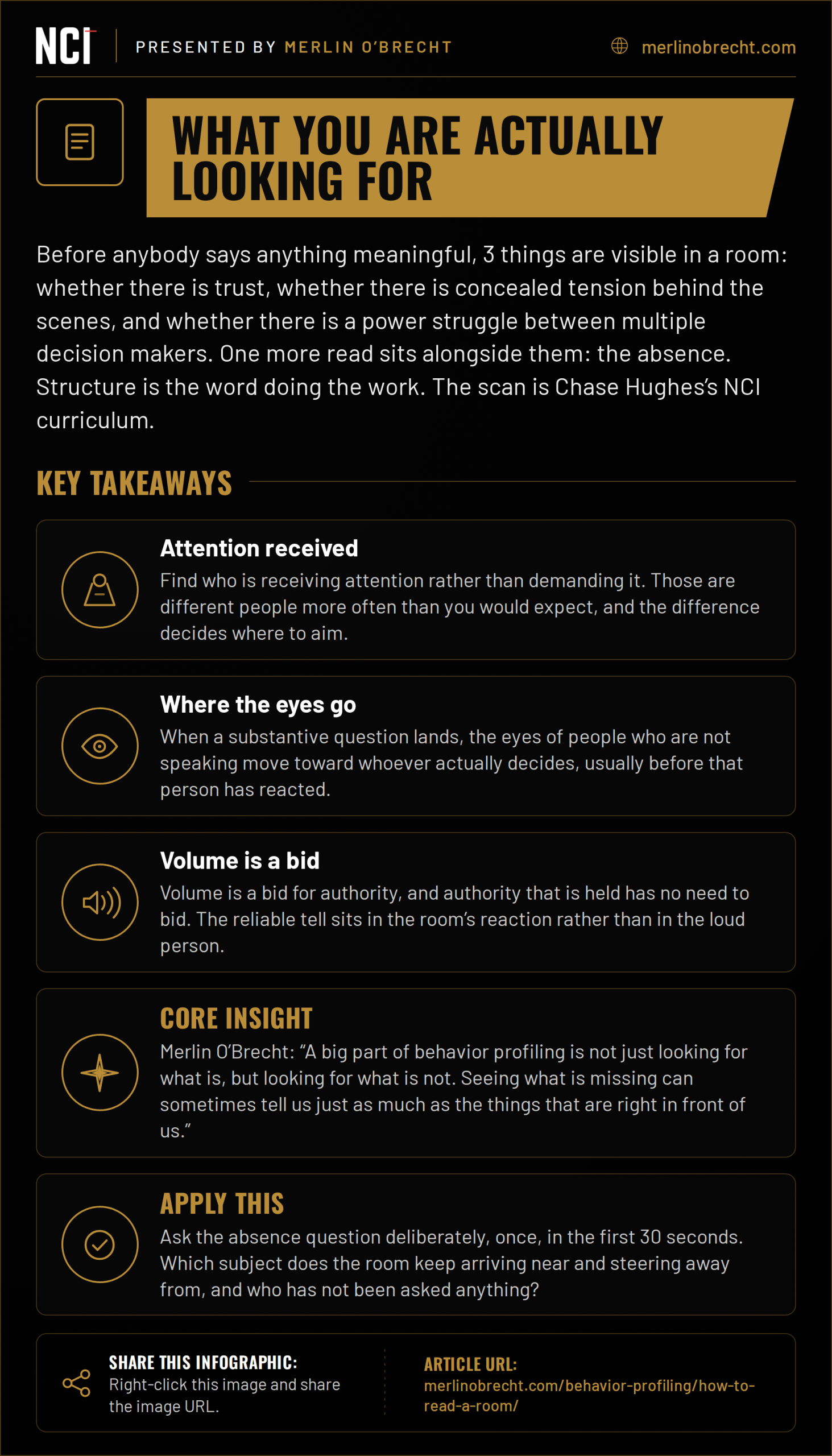
Three things, and all three are visible before anybody says anything meaningful.

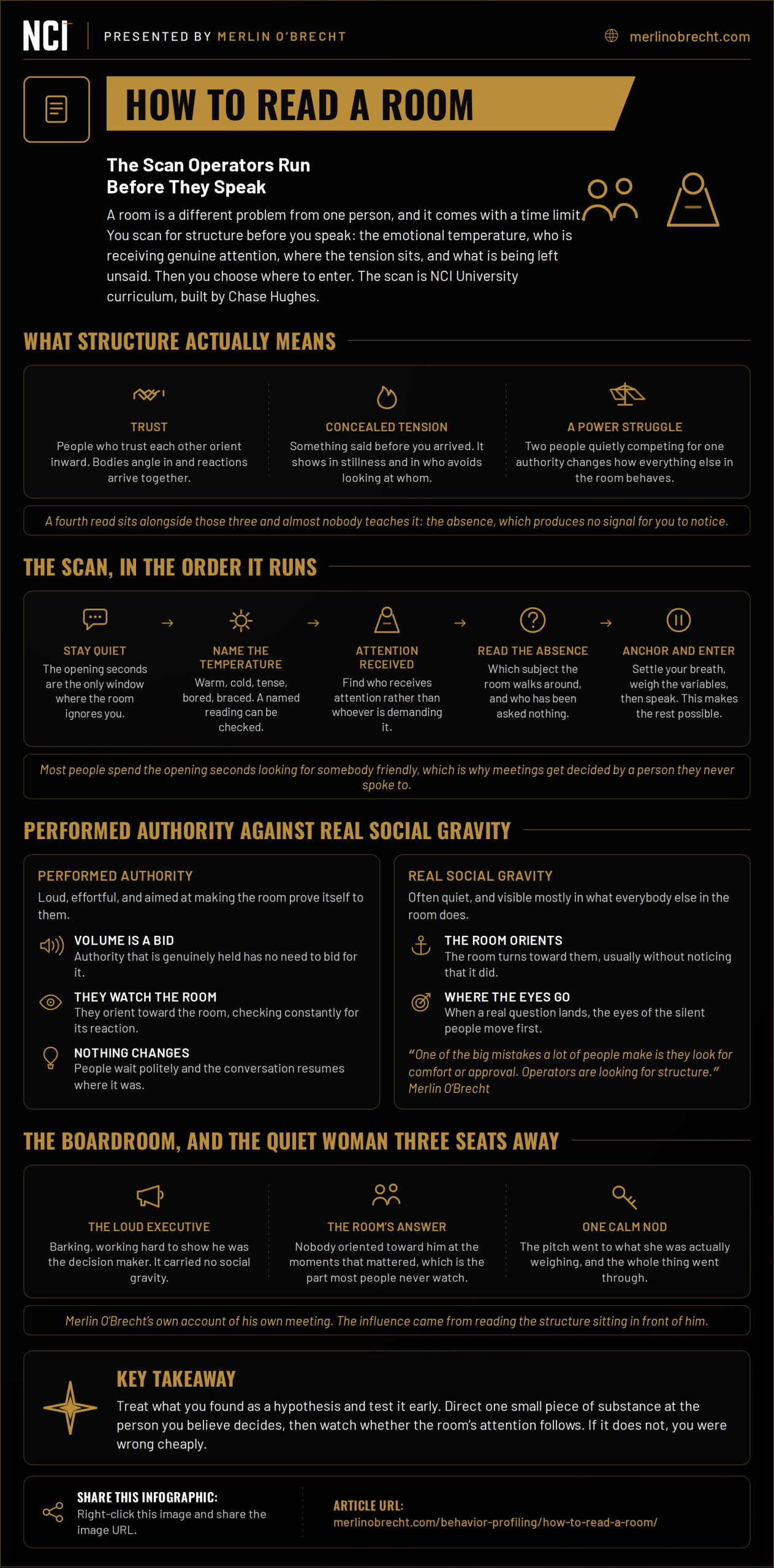
Whether there is trust in the room. People who trust each other orient toward each other. Their bodies angle in, their reactions arrive at the same time, and there is a shared rhythm to how they respond. People who do not trust each other sit in a room that looks the same and behaves nothing like it.

Whether there is concealed tension happening behind the scenes. Something that was said before you arrived, or something everybody knows and nobody has raised. It shows up in stillness, in the careful way certain names get said, and in who avoids looking at whom.

Whether there is a power struggle between multiple decision makers. Two people quietly competing for the same authority changes how everything else in the room behaves, and you can usually see it in the first minute if you are looking for it rather than looking for an ally.
“One of the big mistakes a lot of people make is they look for comfort or approval. Operators are looking for structure.”
If you have ever walked out of a meeting knowing the decision was made by somebody who barely spoke, you already ran a version of this scan. What you did not have was the order to run it in.

How to read a room in 30 seconds

Six steps, and the first one is the one people break.
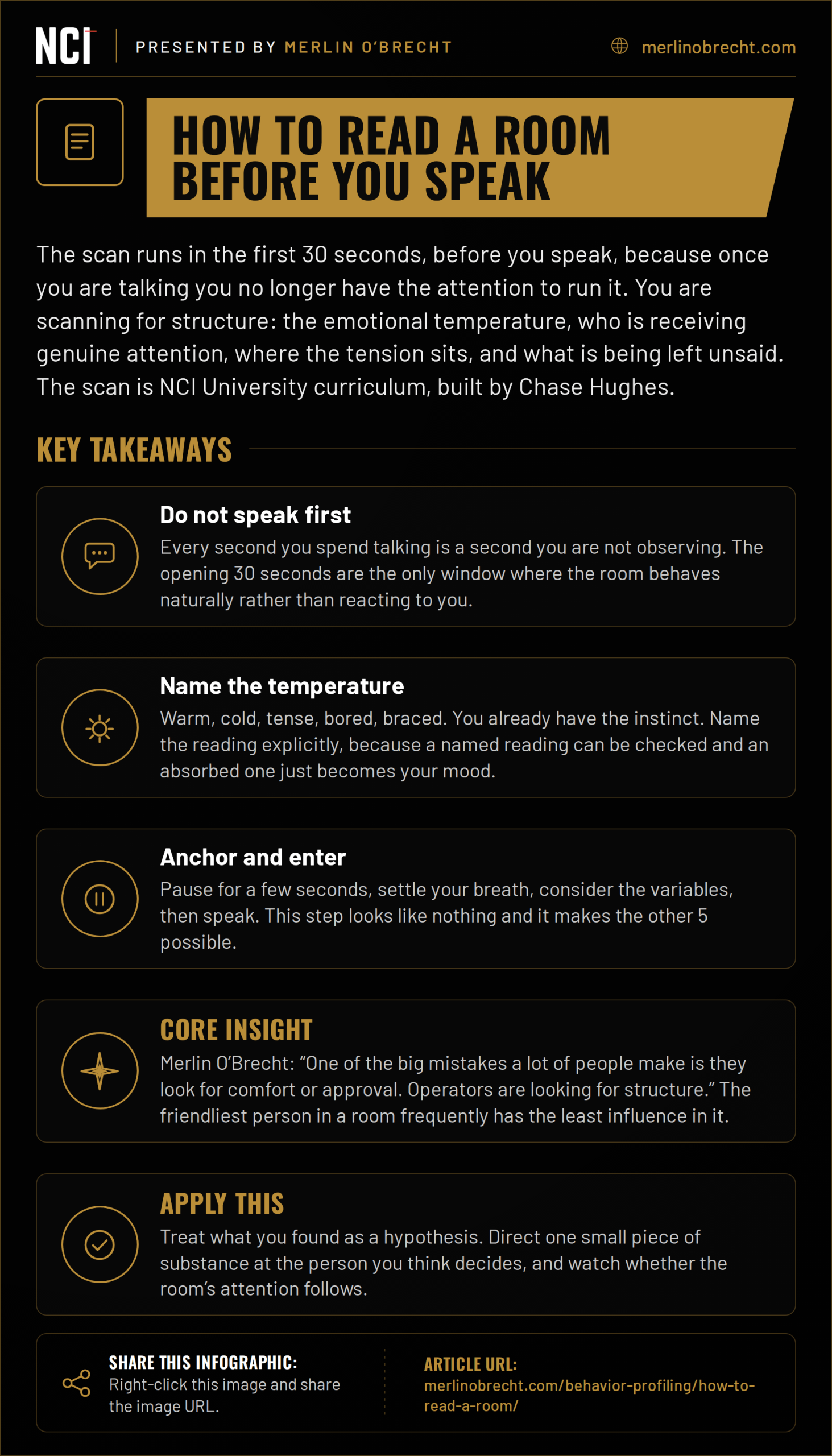
  1. Do not speak first. Every second you spend talking is a second you are not observing, and the opening 30 seconds are the only window where the room is behaving naturally rather than reacting to you.
  2. Read the emotional temperature. Is this room warm, cold, tense, bored, braced? You already have an instinct for this. Name it explicitly rather than absorbing it, because a named reading can be checked and an absorbed one just becomes your mood.
  3. Find who is receiving attention rather than demanding it. Those are different people more often than you would expect. Watch where eyes go when a decision-shaped question is raised, particularly the eyes of people who are not speaking.
  4. Note what is not being said, and who is not being addressed. Which topic does the room walk around. Which person gets talked past. Absence is data.
  5. Look for the opening rather than for a friendly face. Where is the gap in the pattern that you can enter usefully. The friendliest person in a room is frequently the one with the least influence in it, which is exactly why they have time to be friendly to you.
    Anchor your breath and compose before you enter.
  6. Pause for a few seconds, settle, consider the variables, and then speak. This step looks like nothing and it is the one that makes the other five possible.

The boardroom, and the quiet woman three seats away

This one is mine, from a negotiation a while back. High dollar, boardroom, a pitch with real money attached.
I walked in and there was a loud executive leading the room. Barking, essentially. Very loud, working hard to show how important he was, and putting visible effort into demonstrating that he was the primary decision maker. Everything about the performance was aimed at making the room, and me, prove ourselves to him.
Reading his behaviour, something felt fake almost immediately. There was a falsity to it. It had no real social gravity. That read came partly from his own authority and confidence, or the lack of it, showing through his body language. It came much more from the body language of everybody else in the room, which is the part most people never think to look at.
Because the room was not responding to him. Not really. Nobody was orienting toward him at the moments that mattered.
There was one quiet woman about three seats away. Watching the micro gestures and the underlying psychological structure, it became clear fairly quickly that she was the actual decision maker. So the whole job changed. The job was no longer to win the loud man’s approval. The job was to sync with her.
I connected with her, read her body language and her decision patterns, and directed the substance of the pitch at what she was actually weighing.
It took one quick, calm nod from that woman and everything went through perfectly fine. The big loud guy’s opinion did not matter at all.
Influence did not come from dominance in that room. It came from reading the real underlying structure of what was happening right in front of my eyes.

Why does the loudest person in a meeting usually not decide anything?

Because volume is a bid for authority and authority that is genuinely held does not need to bid. The reliable tell is not in the loud person at all. It is in the room’s reaction to them.
Performed authority Real social gravity
Volume Loud, and the volume is doing work Whatever is comfortable, often quiet
Who orients toward whom They orient toward the room, watching for its reaction The room orients toward them, usually without noticing
What happens when they speak People wait politely, and the conversation resumes where it was The conversation adjusts, even when they said very little
What happens when they stop Nothing changes The room checks in, waits, or looks over
Where the room’s eyes go before a decision Anywhere except them Straight to them, in the half second before anyone answers
That last row is the whole read compressed into one observation. When a real question lands, watch where the eyes go before anybody speaks. The room will tell you who decides, and it will do it in under a second.

Reading the absence

This is the part almost nobody teaches, and it is the highest-yield habit on this page.
“A big part of behavior profiling is not just looking for what is, but looking for what is not. Seeing what is missing can sometimes tell us just as much as the things that are right in front of us.”
Think about what space is being ignored. What is not being said. Which subject the conversation keeps arriving near and then steering away from. Which person is in the room and has not been asked anything. Which name comes up and produces a half-second of nothing.
Absence is harder to notice than presence, for an obvious reason: your attention is built to detect things, and a missing thing produces no signal to detect. The fix is to ask the question deliberately rather than waiting to notice. Once, in the first 30 seconds. What is not here.
In a sales meeting the absence is usually the objection nobody has raised. In a team meeting it is usually the person who has already decided and has not said so. In a family it is usually the subject everyone is being careful about. All three are visible if you go looking, and invisible if you wait for them to announce themselves.

Composure is what makes the scan possible

Here is the honest wall, and it is worth hitting it now rather than in a meeting.
Everything above is easy on paper and close to impossible when your heart rate is up and you are next to present. You cannot read structure while you are managing your own state. Attention is finite, and a nervous system that is busy with you has nothing left over for the room.
Authority and confidence, in the way we teach it, is largely the ability to be fully present and to stay composed in yourself. That is the enabling condition for every other skill on this page, which is why it comes first rather than last.
“You control your behaviors. Don’t let the outcome or the scenario define you.”
The scan and the composure that makes it possible get trained together, and in that order, which is why our behavior profiler training opens on authority and confidence before it touches anybody else’s behaviour. That is the shape of NCI-2 Behavior Profiler: 12 hours of material, 22 video modules and 32 skills-building calls with facilitators, $795.
Merlin’s own description of what that training does is worth quoting rather than paraphrasing, because he is describing an outcome rather than promising one: it “installs that scan into your nervous system,” to the point where you are no longer consciously processing variables and simply perceive the room differently.

What to do with what you found

Treat it as a hypothesis, and test it in the first 2 minutes of talking.
That is the discipline that separates this from a party trick. You walked in, you read structure, you concluded that the quiet person in the corner decides. Now check it. Direct one small piece of substance at them and watch whether the room’s attention follows. If it does, you were right and you now know where to aim. If it does not, you were wrong cheaply, in the first 2 minutes, before you built anything on it.
Reading the room is trainable, and I want to be careful about how I say that. The instinct is already pre-programmed into all of us. What is trainable is the accuracy, and it trains to professional levels the same way any perceptual skill does, with repetitions and correction.
Worth knowing who is actually doing this work. On any given Tuesday the people running this scan are executives, therapists, investigators and detectives, sitting in the same cohort, working the same footage, correcting each other. It is a stranger room than most people picture, and the mix is the reason the corrections are good.

Frequently asked questions

What does "reading the room" actually mean?
Reading the room means identifying the structure of a group before you participate in it: where the trust sits, where the tension sits, who holds real attention, and what subject is being avoided. It is a scan for organisation rather than for atmosphere. The most concrete marker is where people’s eyes go in the half second after a decision-shaped question lands.
How do you read a room in a meeting you just walked into?
Four steps, compressed. Stay quiet for the first 30 seconds and name the room’s temperature to yourself. Watch where attention lands when something real is said. Ask yourself which subject the room is walking around. Then breathe, settle and choose where to enter. The whole thing fits inside the time it takes to sit down and open a notebook.
How long does it take to get good at reading a room?
The sequence works at a basic level the first time you run it, because you are mostly redirecting attention you were already spending. Reading a room reliably while you are also presenting, answering and thinking about your own material takes months. That second version is the professional skill and it comes from repetitions under load rather than from understanding the steps better.
Is reading a room a real skill or just intuition?
Both, in a specific order. The instinct is pre-programmed and everybody has it, which is why you sometimes walk out of a meeting knowing something you cannot explain. The accuracy is trained, and it fails in a predictable way when it is untrained: people assume the loudest person matters, and they look for somebody friendly rather than for structure.
What is the difference between reading a room and being socially anxious?
Both involve scanning a room closely, and they scan for opposite things. Reading a room scans outward for structure: who decides, where the tension is, what is missing. Social anxiety scans outward for threat to the self, which means the data collected is all about you and almost none of it is about the room. That is why anxious scanning feels exhausting and produces so little usable information.
How do you find the real decision maker in a sales meeting?
Watch the room rather than the candidates. When a substantive question is raised, the eyes of people who are not speaking will move toward whoever actually decides, usually before that person has reacted. The person working hardest to appear in charge is frequently doing it because the room already knows they are not. Test the read with one small piece of substance and see whether attention follows.
Can you read a room over video calls?
Less well, and differently, and it is worth being honest about which parts survive. Gesture and full-body orientation are mostly gone. Timing, silence, who unmutes and who does not, and who gets talked over remain fully readable, and the absence rule works better on video than in person, because a video call makes it painfully obvious who has not spoken. Expect a thinner read rather than an equivalent one.
Where does this room-reading method come from?
It comes out of NCI University’s behavior profiling curriculum, built by Chase Hughes, and I teach and extend it. The scan combines Chase’s work on authority and confidence, his behavioural reference material and the observational discipline that runs through all of the NCI models, which is the requirement to check what else could explain what you are seeing before you accept it.
Is it manipulative to read a room before you speak?
The test Chase Hughes teaches is whether the other person, seeing your full intent, would agree it was in their interest. In the boardroom I described, reading correctly meant the actual decision maker got a pitch aimed at what she was weighing rather than a performance aimed at somebody who did not decide. She got a better meeting out of it than she would have otherwise, which is usually what accurate reading produces.
What should you learn after this?
Individual baseline reading first, so that you can tell what a specific person’s normal looks like before you interpret anything they do. Then how groups behave, which is what this page covers, and then the psychological layer underneath, which tells you what each person in the room wants the room to give them. Doing it in that order is slower to start and much faster overall.

Where to go from here

The next room you walk into, run one step. Not six. One.
Stay quiet for the first 30 seconds and ask yourself where the eyes go when something real is said. That single observation will change what you do next more than anything else on this page, and you can run it this afternoon without buying anything or telling anybody you are doing it.
If you want the trained version, where the scan and the composure that makes it possible get built together, that is NCI-2 Behavior Profiler. 12 hours, 22 video modules, 32 skills-building calls with facilitators, $795.
Once you can scan at that level, something shifts that is difficult to describe before it happens to you. You stop adjusting to the room. The room starts adjusting to you.