The six social needs
The six social needs: what each one wants, and how to speak to it
By Merlin OBrecht · Dean of Academic Affairs, NCI University
The six social needs
The six social needs are acceptance, approval, intelligence, significance, strength and power, and pity. Chase Hughes’s model describes how a person wants to feel in a social situation rather than who they are. A strength and power need does not mean the person is strong. It means control is how they want to feel.
It is easy to get lost in the psychological chaff, for lack of a better word, where people become hyper-fixated on the theories and the thoughts.
The six social needs are one of the models this happens to most, because the list is short enough to memorise in a minute and the list on its own does nothing at all. Anybody can name six words. Very few people can walk into a room, work out which one is running the person in front of them, and then say something that actually lands.
So this page is the list, and then it is the part that comes after the list: how to spot each need without asking, the four rules that decide whether a compliment works, twelve worked examples, and the diagnostic for when one falls flat.
Key takeaways
- The six social needs describe how a person wants to feel in a social situation, and they say nothing about what that person actually is.
- You cannot ask. Nobody admits to an intelligence need or a pity need, and the social mask exists specifically to conceal them.
- A needs compliment has to be a derivative of the need rather than a direct statement of it. This is the rule people break most.
- When a compliment fails, check the profile first and the four rules second, in that order.
- Significance and strength and power get confused constantly, and the difference is control. One wants to be seen as important. One wants to be in charge.
What are the six social needs?
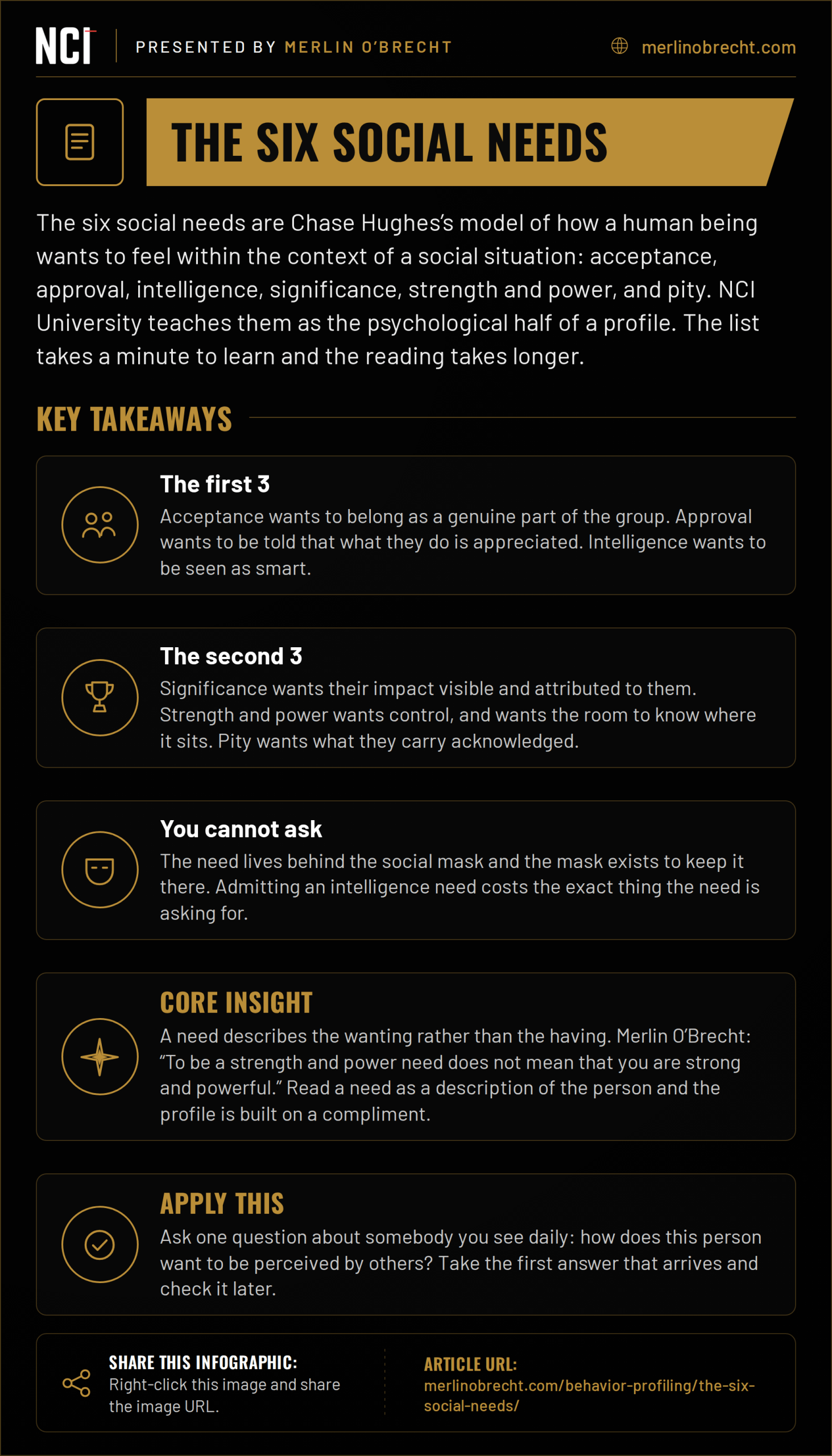
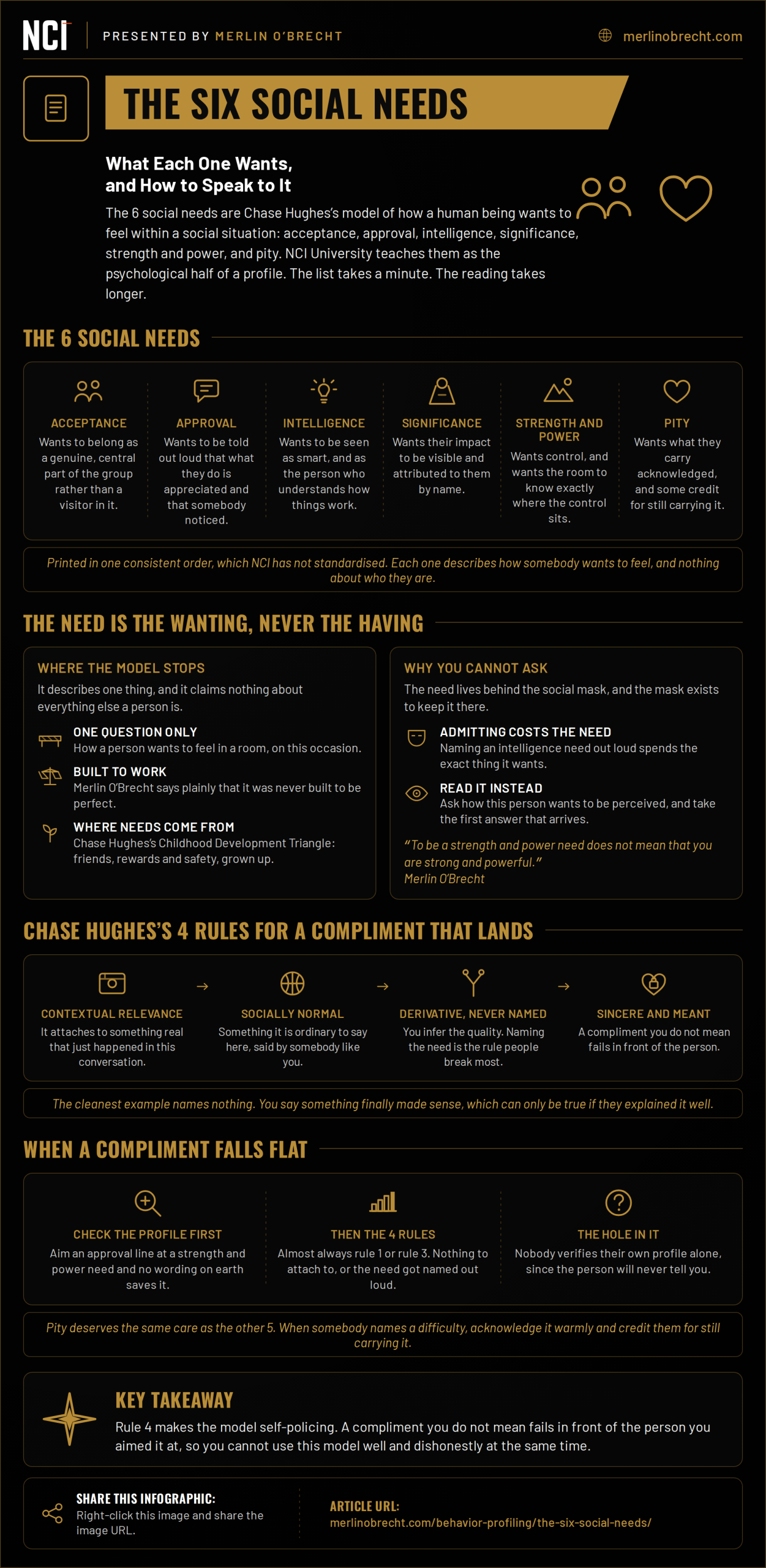
The six social needs are Chase Hughes’s model of how a human being wants to feel within the context of a social situation. In the order he teaches them:
- Acceptance. Wants to belong. Wants to be a genuine, central part of the group rather than a visitor in it.
- Approval. Wants to be told, out loud, that what they do is appreciated and that somebody noticed.
- Intelligence. Wants to be seen as smart, knowledgeable, and as the person who understands how things work.
- Significance. Wants to be seen as important. Wants their impact to be visible and attributed to them.
- Strength and power. Wants control, and wants the room to know where the control sits.
- Pity. Wants what they are carrying to be acknowledged, and wants some credit for still carrying it.
“The social needs, simply put, are how a human being wants to feel within the context of a social situation.”
What a social need describes, and where the model deliberately stops
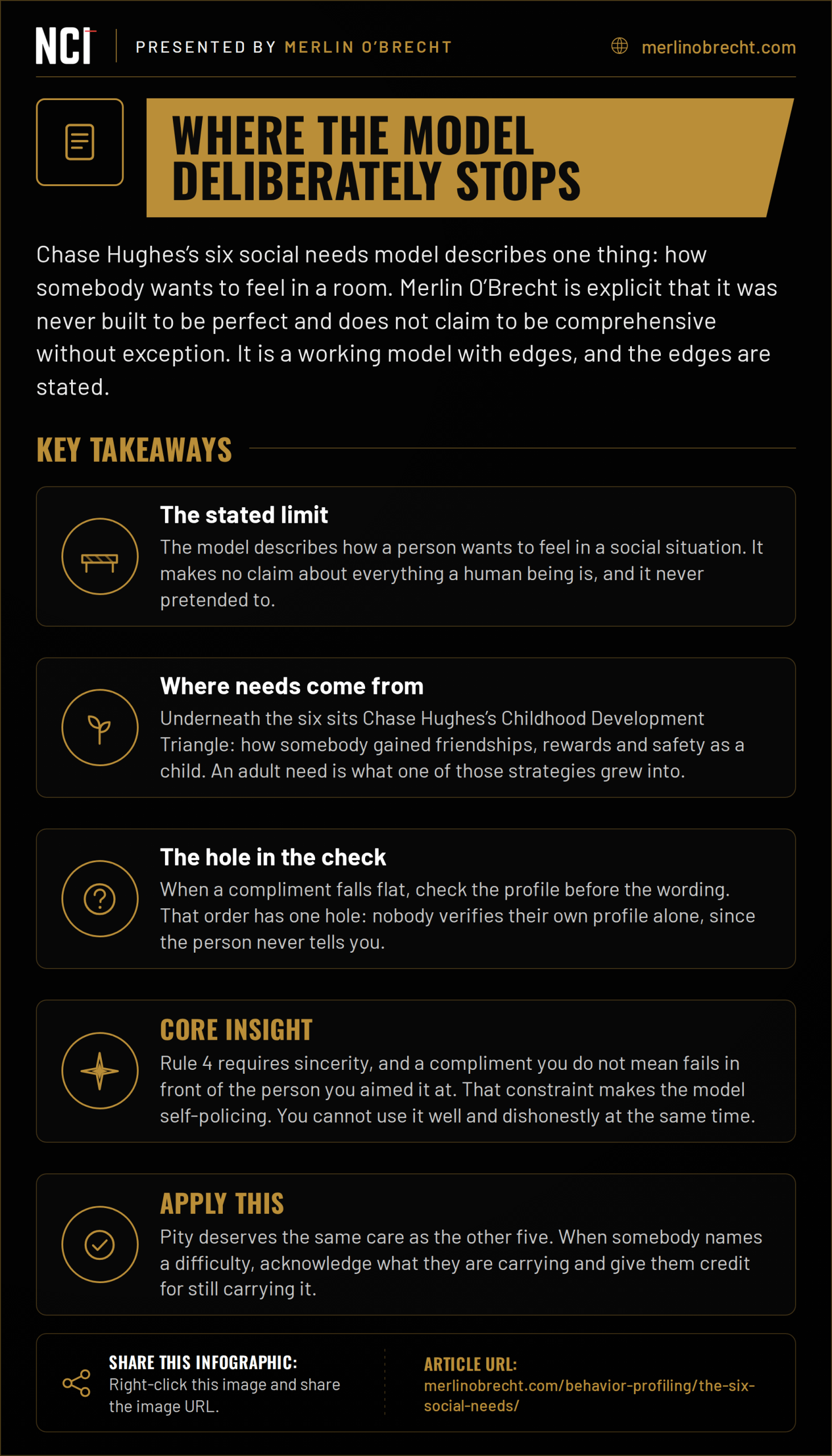
The model is not built to be perfect and it does not claim to be comprehensive without exception. What it is, in my own words on camera, is an extraordinarily effective model that describes way above 90% of the population in terms of how they want to feel in different social situations. That figure is my own assessment of a model I teach rather than a research finding, and the sentence before it matters as much as the number does.
It is also not seeking to be a broad philosophical or psychological model that describes everything a human being is. It describes one thing: how they want to feel in a room.
Here is the correction the whole model turns on, and it is the misreading that ruins every profile built on top of it.
“To be a strength and power need does not mean that you are strong and powerful. You could be a small, short, weak, frail person who is obsessed with feeling as though they are in control.”
The need is the wanting, never the having. A significance need does not mean somebody is significant. An intelligence need does not mean somebody is clever. Read the need as a description of the person and you have built your entire profile on a compliment to them, which is a strange foundation for accuracy.
How to spot each need without asking
One observable marker each. These are starting points rather than proof, and they hold up surprisingly well in a first conversation.
- Acceptance. Checks the group’s reaction before committing to a position. Uses “we” a lot. Notices who is left out.
- Approval. Reports what they did, in detail, and leaves a small pause at the end of it.
- Intelligence. Loves to explain how things work, and will explain them slightly past the point where you needed it.
- Significance. Counts the size of accomplishments out loud. Names the scale, the number, the room it happened in.
- Strength and power. Resists being told, even about small things. Reframes instructions into decisions.
- Pity. Mentions the difficulty first, and the outcome second, in the same breath.
The instruction I give everybody starting on this is the one they ignore: do not overintellectualise it. What people do instead is build a chain of logical extrapolations. “Well, I saw this and I saw this thing and maybe it could mean that if you perceive it from this angle and look at it from this one Daoist teacher that I learned from.”
That is a person talking themselves out of an answer they already had.
“They already know the right answer. They just need to kind of slow down, pump the brakes.”
The question that replaces all of the analysis: how do I feel like this person generally wants to be perceived by others? You usually know within a minute. Trust that and check it later.
Why does asking someone their social need never work?
Because the need lives behind the social mask, and the mask exists to keep it there.
Walk up to somebody with an intelligence need and say it looks like they really want to be seen as smart. They will not admit to that at all. Not because they are dishonest, but because admitting it costs them the exact thing the need is asking for, which is to be seen as smart rather than as somebody who needs to be seen as smart.
The same holds for every one of the six, and it holds hardest for pity and for significance. The need has to be read rather than reported, and that constraint is the whole reason profiling exists as a skill. The layer underneath, where these needs come from in the first place, sits on the childhood patterns underneath every social need.
The four rules of a needs compliment
Once you can profile a need accurately, the next part of the equation is saying something that feeds it. Four rules, and all four have to hold.
- Contextual relevance to the conversation. The compliment has to be based on something real that just happened. Imagine I walked up to you in a convenience store while you were standing in line and said, “Man, I am willing to bet that you are one of the most intelligent people in every room that you walk into.” You would probably look at me like I was likely high on drugs or a crazy person, and you would be right to look at me like that. It is an extreme example and the same failure happens in ordinary conversations constantly, in smaller doses.
- Do not be socially awkward or weird. Is this something that, within the cultural and socio-normative behaviour of this situation, is acceptable to say? Or are you being a weirdo by saying it?
- The compliment should be a derivative of the need, not a direct statement of the need. This is the rule that gets broken most and the one that does the most damage. You infer the quality. You never name it.
- Sincere, genuine, and delivered with real confidence. Delivered with a kind of unconscious authority over yourself. Miss this one and the person sees through it almost immediately, which is a feature rather than a bug.
What does a good needs compliment sound like for each of the six?
Twelve examples, one failure and one success per need. Read the failures carefully, because they all fail the same way.
| Need | What not to say | What to say instead |
|---|---|---|
| Acceptance | “You seem like somebody who really wants to fit in here.” | “I really appreciate how much of a critical member of this team you are. Even last week at that meeting, everyone was talking about what a central element of the team you really are.” |
| Approval | “You seem like you need a lot of praise.” | “I don’t know that you probably get people telling you this as much as you should, but I just wanted to say I appreciate what you do at this company so much.” |
| Intelligence | “You are so smart.” | “I’m not always the best at understanding this kind of stuff, but something about the way that you said it just there really made sense to me.” |
| Significance | “Boy, I can tell you’re a really important person.” | “The value that you bring to this company is like a shining light. Every day that you show up, it seems to inspire everyone else on the team to do better.” |
| Strength and power | “Boy, you are a really strong and powerful dude.” | “I am so happy that I’m your good friend and I’m on your side. Seeing how you deal with people that aren’t on your team makes me really grateful that I get to be on your team.” |
| Pity | “Boy, you really seem like you want people to feel bad for you, don’t you?” | “Man, thank you for sharing that. That is really heavy. Honestly, I think it’s incredible to me that you’re somehow able to keep going.” |
Every entry in the middle column names the need directly. Every entry in the right column arrives at the same place by inference, which is why the person can accept it without having to admit anything.
The intelligence example is the cleanest demonstration of rule 3. Nobody said the person was smart. The speaker said they finally understood something, which can only be true if the other person explained it well, which requires them to be intelligent. The compliment arrives fully assembled and the recipient did the assembling.
Significance and strength and power are not the same need
These two get confused more than any other pair, and confusing them produces a compliment that actively backfires.
The strength and power person wants to feel power and control. The significance person just wants to be seen as important, as making a big impact. So the significance person will be very happy to defer control to somebody else, as long as they are still viewed as the superstar of the scenario.
The practical consequence shows up the moment you need something done. Telling a strength and power person what to do causes massive reactance. They feel like you are trying to control the situation, and now the need is in deficit and you have made the outcome harder rather than easier.
The alternative costs nothing. “Hey, I really value you as kind of a central leader on this team. What do you think is the right thing to do here?” If you are good at communication you can frame that conversation so that you still arrive at the outcome you wanted, and the person you are speaking to feels like the power and control sat with them, because in a real sense it did.
When it does not land: the failure diagnostic
Your compliment fell flat. Here is the order to check, and the order matters.
First, check whether you profiled the need correctly. Not the delivery, not the wording. The profile. If you aimed an approval compliment at somebody with a strength and power need, no phrasing on earth was going to save it. If the profile was wrong, no big deal. Go back to the drawing board, try again, and try a different need.
Second, if you are relatively sure the need was right, it failed on one of the four rules. Almost always rule 1 or rule 3. Either the compliment had nothing to attach to in the conversation, or you named the need instead of inferring it.
That diagnostic is genuinely useful and it has one hole in it, which you will have already found. The first step asks you to check whether your profile was correct, and there is no way to check that on your own. The person is never going to tell you, and the only feedback available is whether the compliment worked, which is the thing you were trying to diagnose.
That loop closes when somebody else has profiled the same person and you can compare reads. It is the whole reason the NCI-2 Behavior Profiler course runs 32 skills-building calls with facilitators alongside its 22 video modules and 12 hours of material, $795.
Using this on a team without it becoming a technique
The obvious worry about a model like this is that it turns conversation into a manoeuvre. The model has an unusual property that handles most of that on its own.
Rule 4 requires sincerity. A compliment you do not mean fails in front of the person you aimed it at, because insincerity is one of the easiest things in the world to detect and everybody has been detecting it since childhood. So the model is self-policing in a way that most influence material is not. You cannot use it well and dishonestly at the same time.
What is left when you strip the technique language away is fairly ordinary. You paid enough attention to somebody to work out what they want the room to give them, and then you gave it to them, truthfully, using something that actually happened. Managers who do this have teams that feel seen. Managers who do not have teams that get told they are doing a great job in a tone that means nothing.
One honest warning before you take this anywhere. If what you want is six lines you can say to anyone, rule 4 will stop you, because a compliment you do not mean fails in front of the person you aimed it at.
Frequently asked questions
What is a social need in behavior profiling?
A social need is how a person wants to feel in a social situation. It describes the impression they are trying to leave rather than the person they are, which is why somebody with a strength and power need can be physically unimposing and still organise their whole day around being in control of it.
How do you identify someone's social need?
Three steps. Watch what they steer conversations toward when nobody is directing them. Ask yourself the simple question of how this person wants to be perceived by others, and take the first answer that arrives. Then test it with one small derivative compliment and watch what happens to their posture, their pace and how much they give you afterwards.
How long does it take to get good at reading social needs?
Most people can identify the obvious ones inside a week, because significance and intelligence announce themselves loudly. The subtle ones take months, particularly acceptance and pity, which both hide behind behaviour that looks like something else. Expect to be confidently wrong about a few colleagues for a while before it settles.
Do social needs actually predict behaviour?
Within the range the model claims, yes, and the claim is deliberately narrow. It describes how somebody wants to feel in a social setting and nothing more. Merlin OBrecht’s own framing is that the model is not built to be perfect and does not claim to be comprehensive without exception, and that coverage claim belongs to NCI’s system rather than to any published research.
What is the difference between the six social needs and Maslow's hierarchy?
Maslow’s hierarchy describes what a person requires in order to function, arranged from physical survival upward. The six social needs describe how a person wants to be perceived while they are in a room with other people. Different subject matter and different purpose, and neither one ranks above the other.
How do you use social needs to manage a team?
Match the recognition to the need rather than to your own preference. An approval need wants to be told directly and specifically what they did well. A significance need wants their impact named in front of other people. A strength and power need wants to be asked rather than told. The same information delivered three different ways lands three times better, and none of it requires you to claim an outcome you cannot deliver.
Is a needs compliment just flattery?
Flattery states the need and a needs compliment infers it, which is rule 3, and the two produce opposite reactions. Flattery also fails rule 4, since it is by definition insincere, and people detect insincerity in a compliment faster than in almost anything else. A needs compliment that is true, relevant and inferred does not feel like being complimented. It feels like being noticed.
Who created the six social needs model?
Chase Hughes built it, and it is taught through NCI University’s behavior profiling curriculum. Underneath the six needs sits his Childhood Development Triangle, which describes how a person gained friendships, rewards and safety as a child, and a social need in an adult is usually what one of those strategies grew into.
Is it manipulative to give someone a needs compliment?
The test Chase Hughes teaches is whether the other person, seeing your full intent, would agree that what you did was in their interest. A sincere compliment aimed at what somebody actually wants to feel passes that comfortably, and an insincere one fails rule 4 and does not work anyway. The model closes its own loophole better than most.
What should you learn alongside the social needs?
Baseline reading, so that you can tell when somebody’s behaviour has changed rather than guessing at what it means in isolation. Then the childhood roots underneath the needs, which is where the reads that look like mind reading actually come from. In that order, since the needs are much easier to spot once you know what formed them.
Where to go from here
The six words take a minute to learn. The instruction that actually decides whether you get good at this takes longer to accept, so here it is again.
Slow down and pump the brakes. Ask how this person wants to be perceived, take the first answer, and stop building the elaborate case. You already know. Almost everybody does. What gets in the way is the belief that a real read has to be complicated.
If you want the version where somebody checks your profile before you act on it, that is NCI-2 Behavior Profiler. 12 hours, 22 video modules, 32 skills-building calls with facilitators, $795.
If you would rather buy nothing, pick one person you see every day, name their need this week, and give them one derivative compliment that is completely true. Watch what happens to the next 10 minutes of that conversation.