Chase Hughes
Chase Hughes: the full life story, told in order
By Merlin OBrecht · Dean of Academic Affairs, NCI University
Chase Hughes
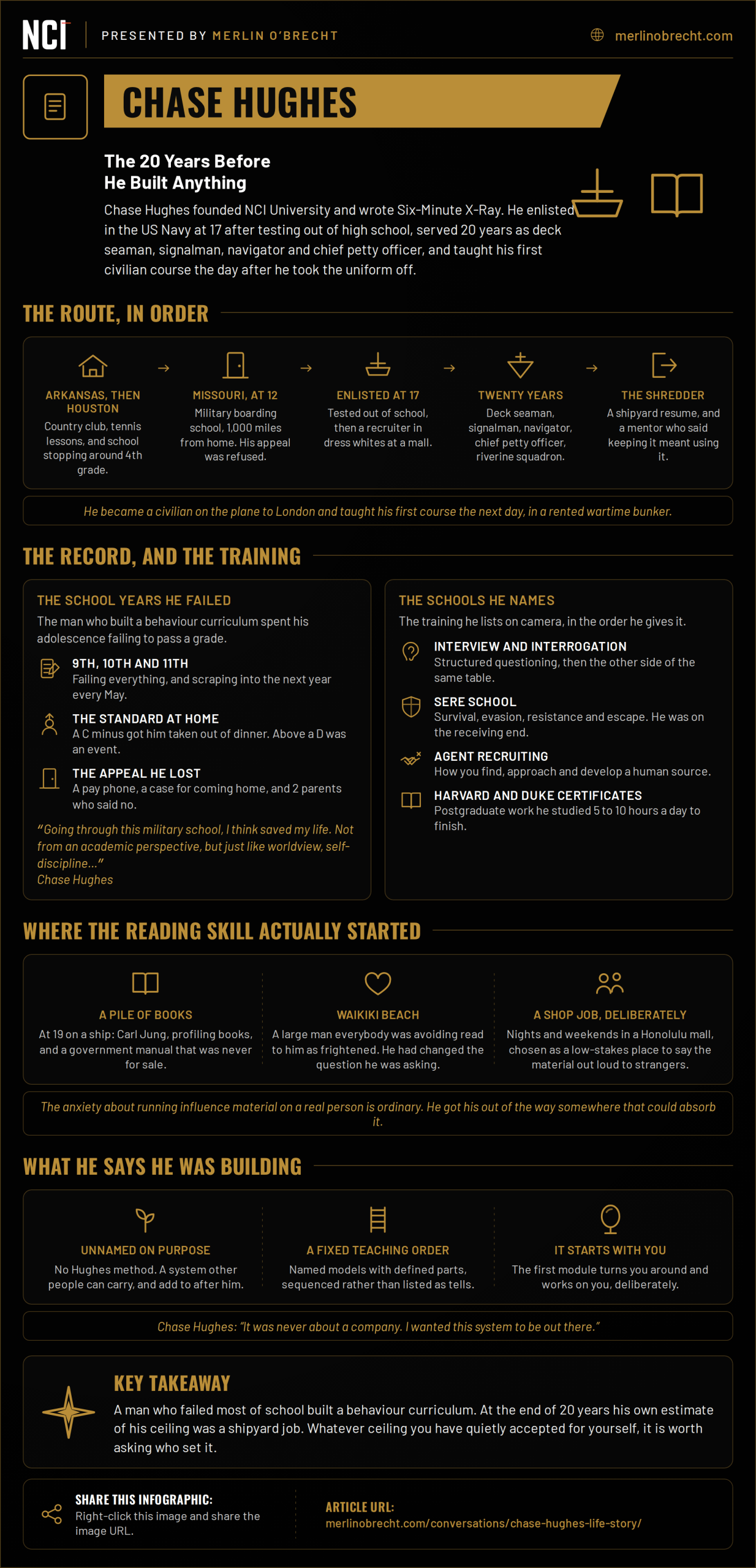
Chase Hughes is the founder of NCI University and the author of Six-Minute X-Ray. He enlisted in the US Navy at 17 after testing out of high school, served 20 years as a signalman, navigator and chief, trained in interview, interrogation and SERE schools, and shredded his civilian resume at retirement to build the system full time.
I’ve known Chase for about 5 years and I’ve watched him sit through something like 100 podcasts. Almost all of them ask the same 2 questions. What’s in the books, and how do the models work.
Nobody asks him about the D’s.
So I put him in a chair in my own house, turned a camera on, and started at the beginning. Arkansas. A country club. A kid whose report card needed CPR every May. About half of what came out I’d never heard, and I talk to the man constantly.
This page is that conversation, in order. Every quote is his, from the interview recorded 18 November 2025.
Key takeaways
- Chase Hughes failed most of school, got sent to a military boarding school in Missouri at 12, and tested out of high school at 17 to enlist in the Navy.
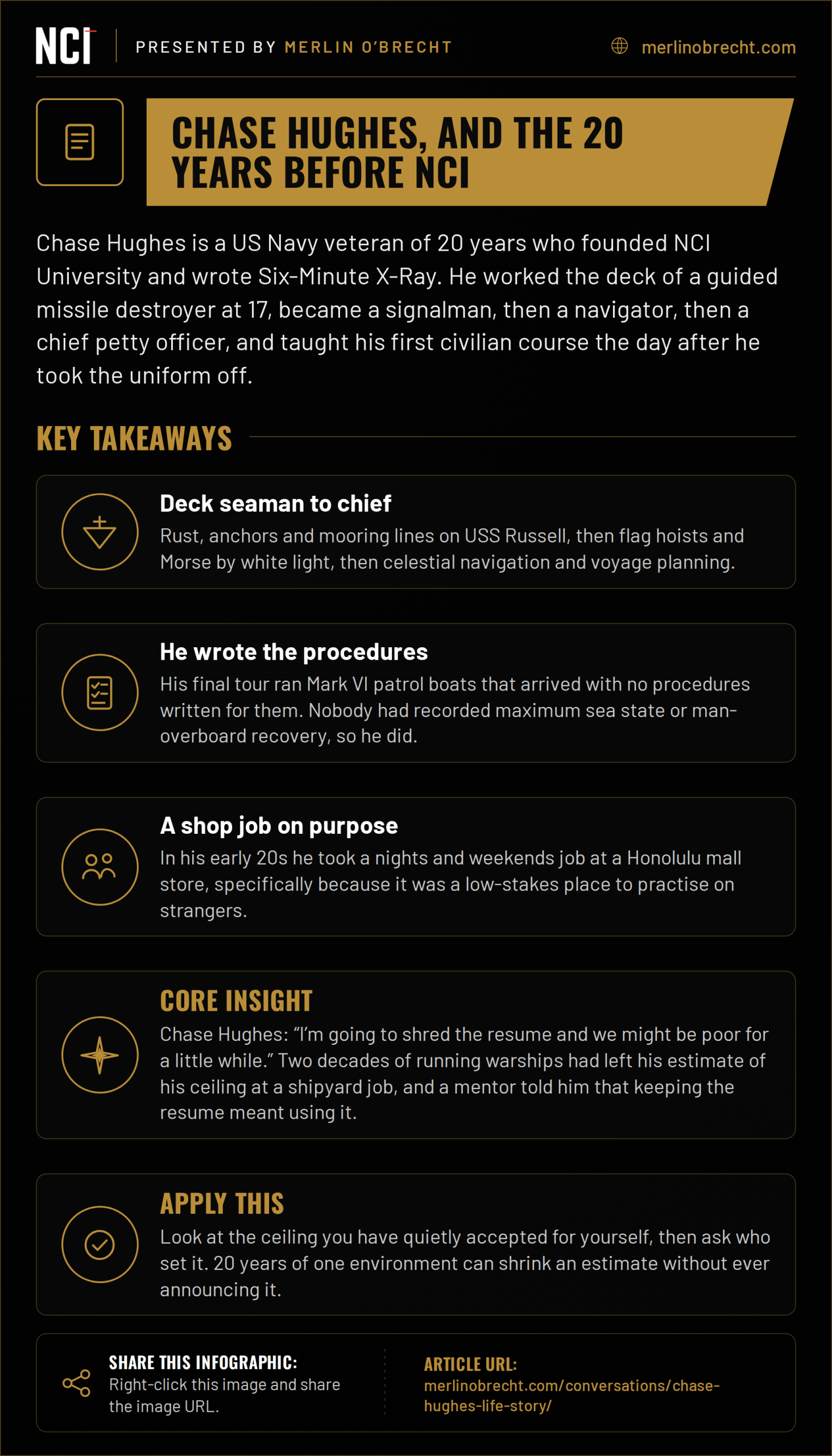
- He spent 20 years in uniform: deck work on a destroyer, then signalman, then navigator, then chief petty officer, then a riverine squadron.
- He started reading psychology at 19, and says that at 35 a protocol he wrote was adopted by the Department of Defense.
- At retirement he shredded a resume aimed at a $16-an-hour job and taught his first course in London the day after he stopped being a sailor.
Who is Chase Hughes?
Chase Hughes is a US Navy veteran of 20 years who founded NCI University and wrote Six-Minute X-Ray. He enlisted at 17, worked the deck of a guided missile destroyer, became a signalman, a navigator and a chief petty officer, then retired and taught his first civilian course the day after he took the uniform off.
He also co-hosts The Behavior Panel. The man who built a behaviour curriculum spent his adolescence failing to pass a grade.
Growing up in Houston, and the report card nobody could save
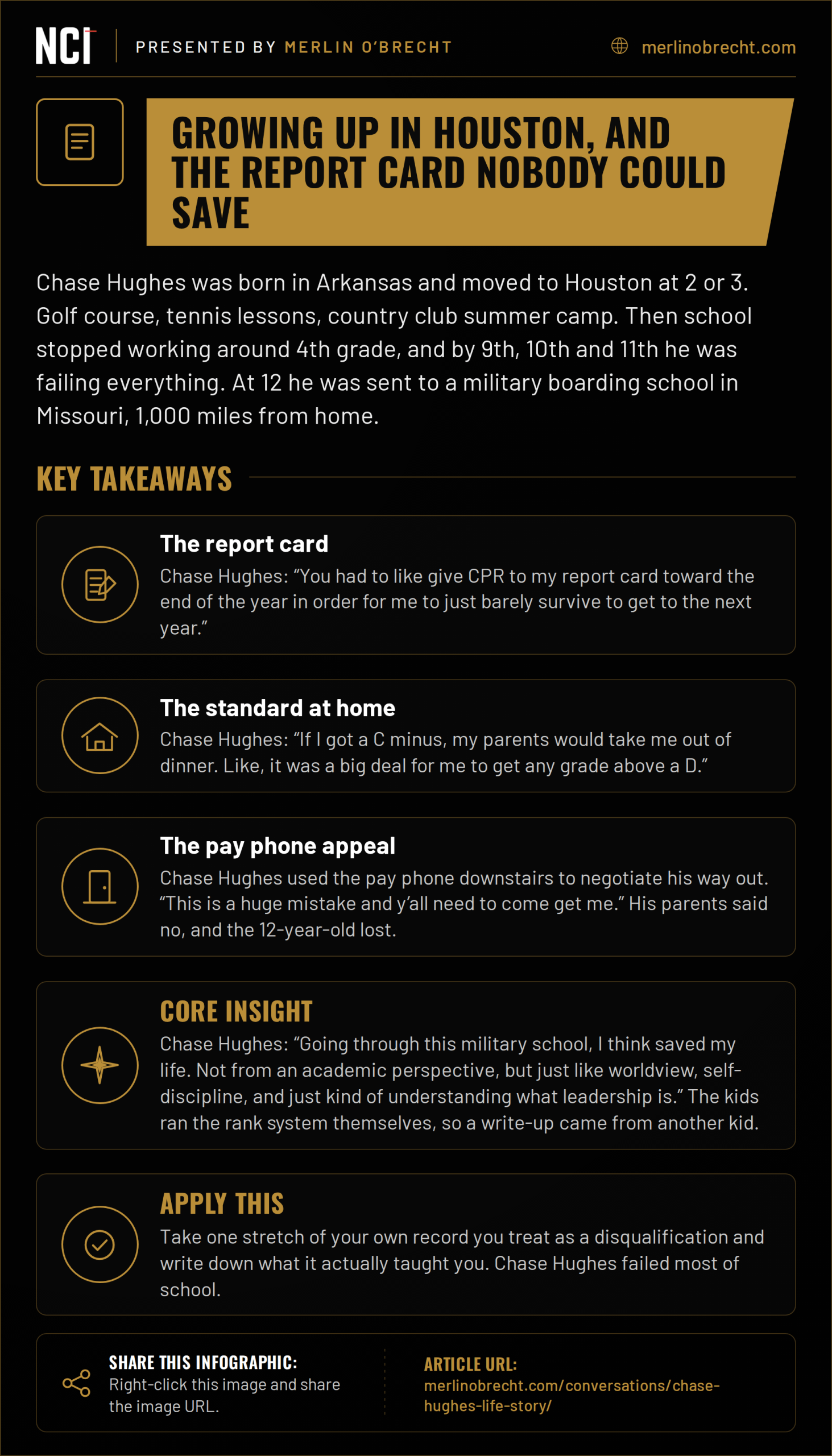
He was born in Arkansas and moved to Houston at 2 or 3. His grandfather had been a Louisiana senator and owned a company hauling pipeline sections for oil rigs. Golf course, tennis lessons, country club summer camp. Chase’s summary: “It was a very country club existence.”
Then around 4th grade school stopped working. “I think I just lost interest in school. Like, it wasn’t fun. Something changed in my brain around 4th grade.”
The standard in his house: “If I got a C minus, my parents would take me out of dinner. Like, it was a big deal for me to get any grade above a D.”
By 9th, 10th and 11th he was failing everything. His own line for it: “you had to like give CPR to my report card toward the end of the year in order for me to just barely survive to get to the next year.”
Military boarding school at 12
At 12 he got sent to a military boarding school in Missouri, 1,000 miles from Houston, full of boys who had also had trouble. “Everyone there’s got sent there for a reason.” His roommate was Brian Bonsall, the kid from Blank Check.
Every other night the boys could use a pay phone on the first floor with scratch-off calling cards. Chase used his to negotiate. “I said, this is a huge mistake and y’all need to come get me.”
His parents said no. That’s the first fork in the story, and the 12-year-old lost it.
“Going through this military school, I think saved my life. Not from an academic perspective, but just like worldview, self-discipline, and just kind of understanding what leadership is.”
The reason he gives is structural. The kids ran the rank system themselves, so if you got written up, a kid wrote you up. “Which was not me at that time.”
Enlisting at 17, and the job he did not get
He left before graduating, took an exam (his air quotes, not mine) and tested out of high school at 17, as his senior year started. Friends from that school went to Yale, Harvard, Brown and LSU. He went to Memorial City Mall.
There was a Navy recruiter in there in dress whites, all the medals. Chase’s reaction, verbatim: “Whatever that is, that sounds cool.” The Army recruiter had offered Germany. The Navy recruiter offered Thailand, Japan and Singapore. That was the whole decision.
He signed as a mineman, the job where you find and take apart underwater mines. Then he got to boot camp, sat cross-legged on the floor while the job cards came round, and read his.
Undesignated seaman.
He raised his hand when the drill commander asked if anybody had a problem. “Put your hand down, Hughes.” That was the appeals process.
Chase Hughes's Navy career, in order
Here’s the whole 20 years as he laid it out. Ages are approximate; he gave the sequence, not the dates.
| Service years | Age | Role | What it involved |
|---|---|---|---|
| 1 to 3 | 17 to 20 | Deck seaman, USS Russell (DDG-59), Pearl Harbor | Rust, anchors, mooring lines, helm and lookout watches, refuelling alongside a tanker at 13 knots |
| 3 to 7 | 20 to 24 | Signalman, third then second class | Flag hoists, semaphore, Morse by white light and infrared, no electronic comms |
| 7 onward | 24 onward | Quartermaster and navigator | Celestial navigation, voyage planning, fuel burn |
| about 3.5 years | mid 20s | Detainee operations, shore duty | Inside a detainee facility, applying what he’d been reading |
| after that | late 20s | Chief petty officer and navigator, USS Chafee (DDG-90) | Selected by a board of 40 to 50 master chiefs he never met, in Millington, Tennessee |
| years 12 to 14 | around 30 | Navy recruiter, Cleveland, Texas | A one-man station, high school visits, keychains |
| next tour | early 30s | ROV and UUV platoon chief, mobile diving and salvage, Virginia | First posting off the ship side of the Navy, under Explosive Ordnance Disposal |
| about 18 months | early 30s | Port operations, Little Creek, Virginia | Harbour master’s office |
| final tour | mid 30s | Leading chief petty officer, Coastal Riverine Squadron 4 | Mark VI patrol boats, a couple of hundred people, wrote the procedures |
Three rows deserve more than a row.
The signalman rating doesn’t exist any more, deleted for being ancient, which is fair since it dates to the 1910s. The test ran twice a year: “this giant fat deck of flashcards of the flags, and you had to go through them in 90 seconds.” He can still do the alphabet.
The Mark VI boats arrived with no procedures. Somebody had bought 40 racing hulls and decided to “make it look like a stealth bomber and make it inside look like a spaceship cockpit.” Nobody had written down maximum sea state or man-overboard recovery. “I wound up being the guy that developed all of these procedures. So there’s dudes out there on these boats right now.”
His final deployment ended in the Persian Gulf at 2am, mid-operation, while he calculated moonrise so the boat wouldn’t get lit up. Chest pains started. He asked his navigator, Jake Harris, how long back to base if they turned now. An hour and 45. Then 2 hours and 45. He kept asking. A hospital in Bahrain found a health problem that ended the deployment on the spot. He retired 18 months later, after 8 and a half deployments.
What training did Chase Hughes actually receive?
Chase Hughes went through the US Navy’s interview and interrogation schools, SERE, agent recruiting and 2 in-house sales programmes, then added postgraduate certificates from Harvard and Duke. He names all of them on camera, in this order.
- Interview school. Structured questioning.
- Interrogation school. The other side of the same table.
- SERE. Survival, Evasion, Resistance and Escape. He describes the relevant half as resistance to interrogation, which means being on the receiving end.
- Agent recruiting. How you find, approach and develop a human source.
- A "valor" system. His words. He describes it as essentially sales, teaching manipulation and sales form.
- PSS. Another in-house programme he also calls sales training.
- Postgraduate certificates from Harvard and Duke, in neuroscience and neuroendocrinology, then medical neuroscience and neuroimaging.
He studied 5 to 10 hours a day for those, and any word he didn’t know cost him a week. He also says, flatly, that becoming a good student is not what happened. “I think it was desperation.”
The night on Waikiki Beach when reading people turned on
He was 19, reading Carl Jung, profiling books, and an FBI profiling manual he’d got hold of. “It was a government manual that you couldn’t even find on Amazon. To this day, you can’t find it on Amazon.”
No instructor. No course. A kid on a ship with a pile of unrelated books, and his own description of that is the best line in the interview: “piecing all this stuff together like a schizophrenic with the yarn.”
Then one night on Waikiki Beach in Honolulu there was a man everybody was giving a wide berth. Big guy, Austrian, behaving badly. Chase felt something switch.
“Something like, I went from brain to heart instantly. Something shifted where I was like, there’s a voice in my head is like, oh my god, he’s scared, he’s just fearful.”
He compares it to Neo seeing the code behind the Matrix. Everyone else is watching an angry man. He’s watching a frightened one.
Why did Chase Hughes build a behaviour system from scratch?
Chase Hughes built his own system because the training he’d been given was thin and 2 people he knew were dead. He read a daily classified news summary describing intelligence failures, decided the fixes were basic, and concluded that if nobody was teaching this properly he’d write it himself.
Craig Wibberley went through boot camp with him. He was aboard USS Cole in the Gulf of Aden on 12 October 2000 when a small boat packed with explosives detonated beside the mess deck, and he was killed. Michael Noeth had been on USS Russell with him and moved to Washington DC as a draftsman. He was killed at the Pentagon on 11 September 2001. (Chase remembers the 2 losses as one event. They were 11 months apart.)
Hold a clearance and you get a one-page daily news summary called the early bird. Chase pulled a copy in the days after and read about operatives who hadn’t developed assets on the ground, because they couldn’t. “And I thought, man, this is like basic stuff.” He was 21 and, by his own account, arrogant. It stuck anyway:
“If I’m not teaching them now, I’m going to develop a system that’s the most devastatingly powerful psychological system that will ever exist. And that’s where NCI got its beginnings.”
Then there’s his verdict on what the elite pipeline had handed him. All of it “was nothing more than a how to win friends and influence people book. Look them in the eye. Use their name. Merlin. Touch them on the shoulder. Remember their kids’ names. That’s what our most elite intelligence operatives were getting.”
It’s 60-year-old technology, and we’d accept that nowhere else. You don’t go back to a rotary phone just because it still works.
Here’s the honest gap in that story. A 19-year-old assembled this from Jung, an out-of-print government manual and whatever he could test on strangers, because there was nothing to enrol in. There is now. The version he built so nobody has to start from a stack of unrelated books is the NCI-1 Behavior Observer course, 6 hours, $252, the same first step every NCI student takes, me included.
Where he practised: a mall job in Honolulu
He also had to practise on people, and this is my favourite thing in the 90 minutes.
At Ala Moana Center in Honolulu there were 2 Abercrombie & Fitch stores, a men’s and a women’s. In his early 20s, Chase took a nights and weekends job at the women’s store. On purpose. “That is where I practised a lot of this behaviour stuff and behaviour profiling and influence and persuasion stuff.”
The reasoning transfers. When you first learn influence material you get a specific anxiety about saying it out loud, because it feels like you’re doing something to a person. “I need to be in a really low stake situation. That’s the place where I got all of that out of my system.” He called that shop “the perfect proving ground.”
The resume he shredded
Skip to the end of the 20 years. He’s about to retire, living with his girlfriend Michelle, now his wife. He has a resume typed up, reviewed by the Navy’s transition programme, aimed at a job in the Norfolk shipyard fitting paint respirators to people’s faces. About $16 an hour.
Here’s how that happens after 2 decades of running warships:
“One thing they’ll make you do is think small. The Navy will force you to think very, very small. And after 20 years of that kind of programming…”
Then a mentor told him: keep that resume and you’ll use it, and if you get an offer you’ll take it, and never build the thing.
“I remember talking to Michelle and I said, I’m going to throw this away. I’m going to shred the resume and we might be poor for a little while.”
Michelle said: “Okay, that’s fine. We’ll be poor.” She believed in him at a level he did not. “My belief is like 5% of what she believed that I was capable of doing.”
I said this to him on camera, so I’ll say it here:
“It makes me feel like, dang, well if Chase was feeling like he was about to go just fit masks in a Navy shipyard at one point in his life, maybe some roofer from Canada could be more than a roofer from Canada as well.”
That’s the reason I wanted this interview to exist.
Winston Churchill's bunker, and the first course
Michelle’s position was that if they were doing this, they were doing it properly. So they rented Winston Churchill’s Second World War bunker in London and Chase taught his first course inside it. He became a civilian on the plane over. The course started the next day.
It sold out. 30 to 40 people, most of whom had found him through his first book, which hit number 1 on Amazon within a week and stayed there. His first thought on seeing that ranking was that Amazon had made a mistake, so he screenshotted it before they could fix it.
At the end of the course, 10 or 12 people came up and asked when the upsell was coming. “I thought they were asking me because they were suspicious of me.”
They weren’t. They wanted to pay him more and he had nothing to sell. What they talked him into was a weekly Zoom call. It has run every Sunday at 5pm for 6 years and he’s never missed one. I told him it’s basically a church. He didn’t argue.
What Chase Hughes says he is after now
What he wanted originally was a system that outlives him and isn’t named after him.
“It’s not named after me. It’s not the Hughes method or anything like that. Build a system that other people can kind of carry. But not only just carry, other people can add on to it and make it better.”
What he wants now is larger. “I want to train people to be so good at these skills that they live in a completely different version of reality than other people.” Underneath that is a distinction he admits took him most of his life to notice: “for 99% of my life, deeply confused the difference between something that’s true and something that is the truth.”
I’ll give him the closing line, because he said it first. “So we got no Scientology ticket to sell you. We got no leader. No guru.” My version: the people participating become their own guru.
One fair warning before the questions. This material starts with you, not with whoever you’re hoping to read. If you came for a list of tells, the first module will frustrate you, and that’s deliberate.
Frequently asked questions
What is Chase Hughes known for?
Chase Hughes is known for Six-Minute X-Ray, his rapid profiling system and the book of the same name, and for the Behavioral Table of Elements, a chart that organises behaviours for cluster analysis. He founded NCI University and co-hosts The Behavior Panel.
How long did it take Chase Hughes to develop his system?
He started reading psychology at 19, on the deck of a destroyer. He was around 35 when a protocol he wrote was adopted by the Department of Defense, the first external validation he says he’d had. Roughly 30 years in, he still calls the work ongoing.
Is Chase Hughes's military background real?
The verifiable parts are verifiable. He served 20 years in the US Navy, retired as a chief petty officer, and names his ships (USS Russell DDG-59 and USS Chafee DDG-90), his ratings and his schools on camera. What no outsider can pull up is his personnel file, or the detainee and intelligence specifics.
Did Chase Hughes work for the CIA?
No, and he doesn’t claim it. He served 20 years in the US Navy and says he trained intelligence specialists, several of whom told him his instruction beat the schools they’d been sent to. He also says a protocol he wrote was adopted by the Department of Defense.
Who created the Six-Minute X-Ray?
Chase Hughes created Six-Minute X-Ray. It’s a rapid profiling system for reading a person’s behaviour, communication style and likely drivers inside a short first conversation, and it exists as a published book. In NCI University’s curriculum it sits under the reading skills NCI-1 introduces.
What is the difference between NCI University and The Behavior Panel?
NCI University is Chase Hughes’s training institution, with a 4-level certification ladder running from NCI-1 Behavior Observer up to a 12-month graduate programme. The Behavior Panel is a YouTube show he co-hosts with 3 other analysts. One is a school. One is analysis in public.
How do you profile someone the way Chase Hughes teaches?
Three moves, in order. Build a baseline, meaning how this person behaves when nothing is happening. Read clusters rather than single cues, because one gesture on its own means nothing. Check context before concluding, since cold rooms and bad news both produce behaviour that looks like something else.
How do professionals use this in interviewing or hiring?
A hiring manager uses it to notice where a candidate’s behaviour shifts, which tells you which question to go back to. If a relaxed baseline changes on one line of an employment history, ask a second and third question there. The reading tells you where to look, not what you found.
Is what Chase Hughes teaches manipulation?
Chase applies a test he calls the empathy test: if the person you’re influencing could see your full intent from behind your own eyes, would they agree it was in their interest? Influence passes that. Manipulation fails it, because manipulation needs the other person not to know.
Where should someone start with Chase Hughes's material?
Start with the books, because they’re cheap and they’ll tell you quickly whether the way he thinks fits the way you think. Six-Minute X-Ray is the usual entry point. If you want it sequenced rather than read, the first NCI level is NCI-1 Behavior Observer.
Where to go from here
Chase spent 15 years building this because there was nothing to enrol in. That’s the part of his story I’d want you to keep, and it’s the part that no longer applies to you.
If you want the skills rather than the biography, the entry point is NCI-1 Behavior Observer. 6 hours, $252, the first level of the ladder every one of our students climbs, including the ones who arrive certain they already read people well.
Start there, or start with the books. Either one beats a stack of yarn and a corkboard.