Chase Hughes interview
Chase Hughes interview: how he actually reads behaviour
By Merlin OBrecht · Dean of Academic Affairs, NCI University
Chase Hughes interview
In this Chase Hughes interview, he describes reading behaviour as chasing layers rather than spotting single cues. He traces the habit to a moment at 19 on a Honolulu beach, when a man everyone else was afraid of read to him as frightened. He has spent roughly 30 years since then asking what the next layer is.
Chase has explained his models on a lot of podcasts. What almost nobody gets out of him is how he thinks, which is a different thing.
I got 90 minutes of it in my own house in November 2025. This page is the methodology half: where the material came from, what he thinks the state of the art actually is, and what he’s still chasing after 30 years.
Key takeaways
- Chase Hughes describes behaviour reading as an addiction to layers, and says he's been asking "what's the next layer" for about 30 years.
- He taught himself from Carl Jung, profiling books and an FBI manual he couldn't buy, with no instructor.
- His verdict on the most advanced influence training he was given: a firm handshake and using someone's name.
- He built the system deliberately unnamed after himself, so other people could carry it and add to it.
What does Chase Hughes teach? The short version of this interview
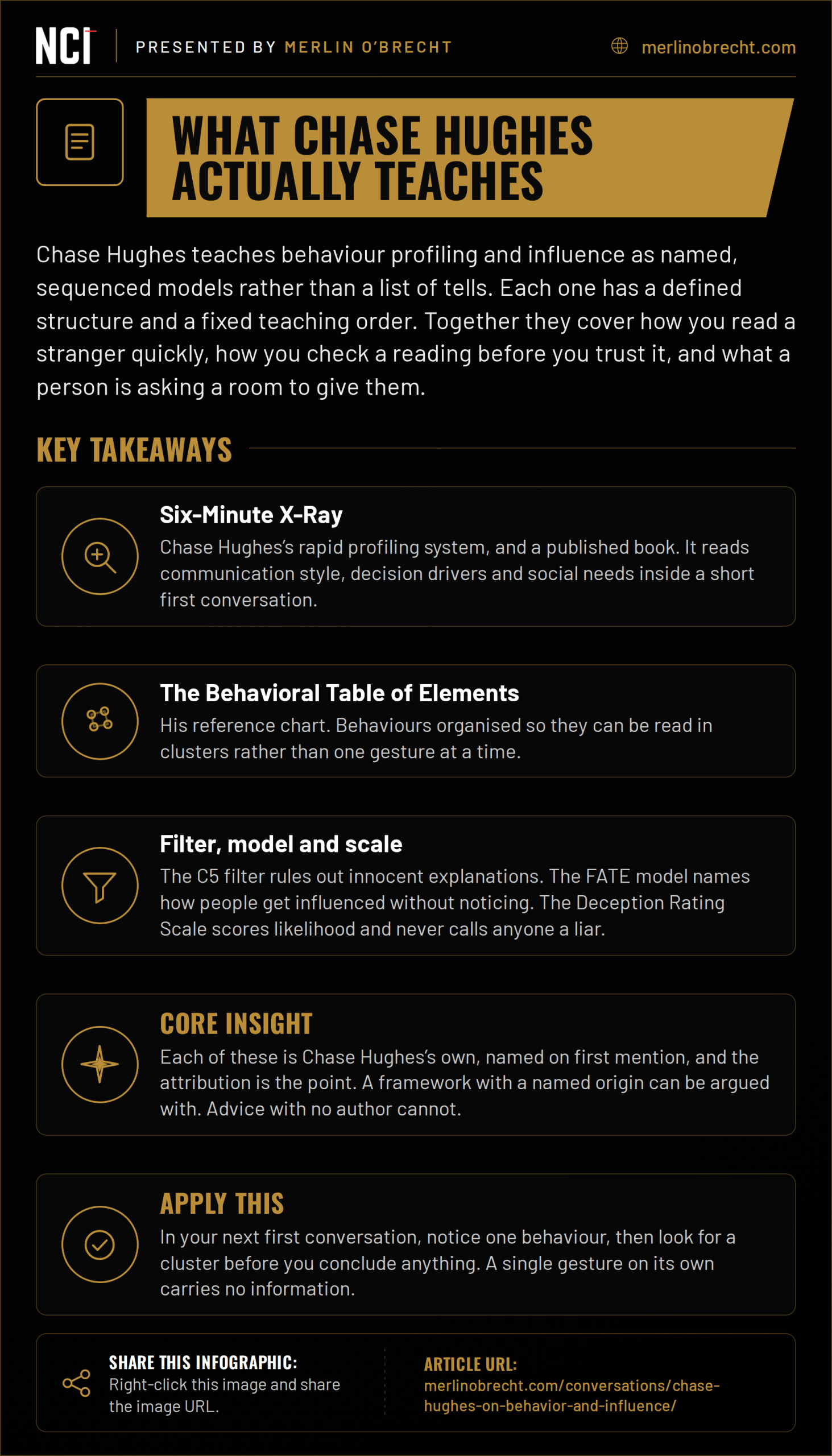
Chase Hughes teaches behaviour profiling and influence as a set of named, sequenced models rather than a list of tells. They cover how you read a stranger fast, how you check a reading before you trust it, and what a person needs from a room. Each has a defined structure and a fixed order.
Here’s what a Chase Hughes interview usually names, with the short version of each.
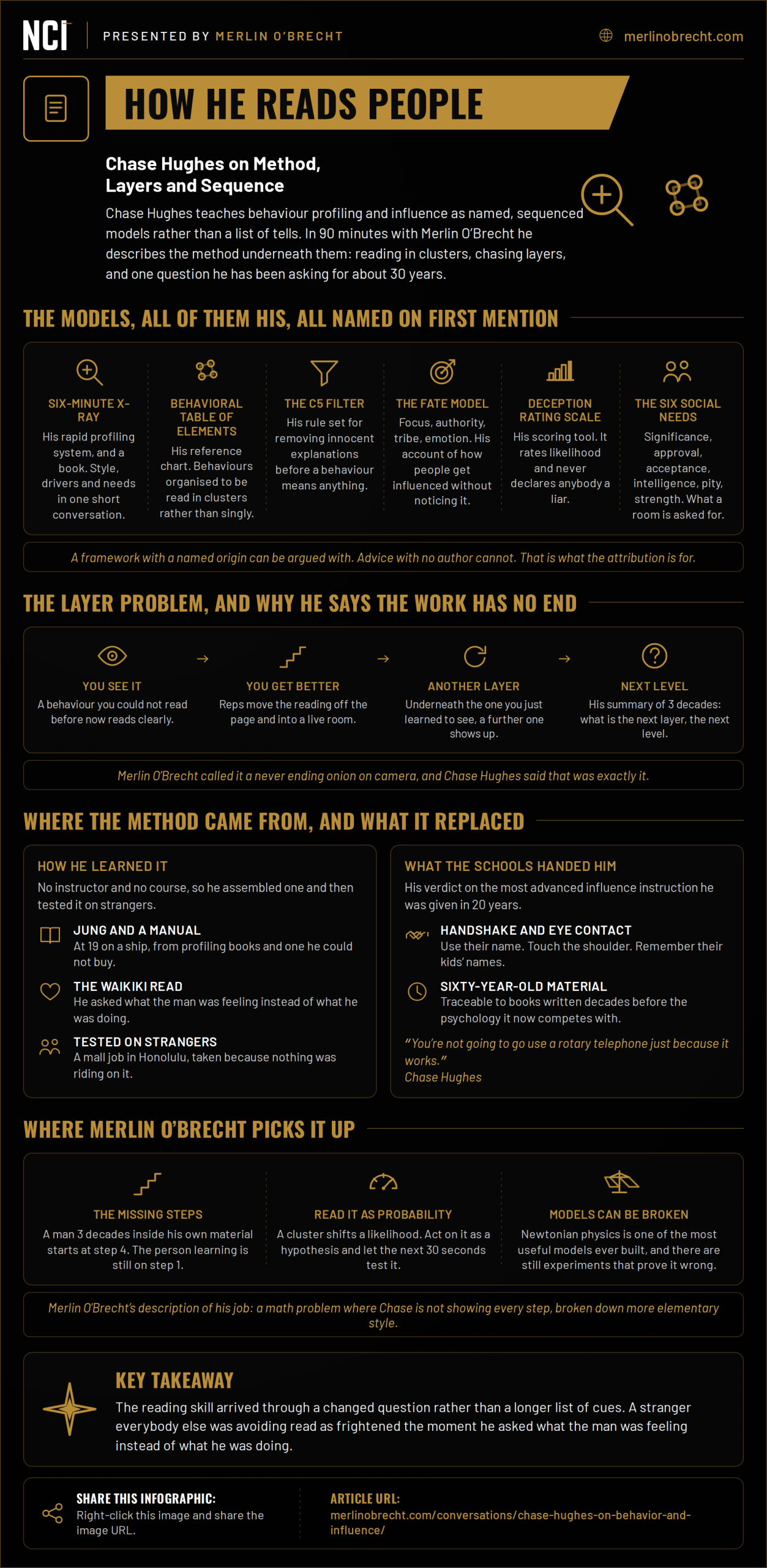
- Six-Minute X-Ray. Chase Hughes's rapid profiling system, and a published book. Reads communication style, drivers and needs in a short first conversation.
- The Behavioral Table of Elements. His reference chart. Behaviours organised so they can be read in clusters rather than one at a time.
- The C5 filter. His rule set for ruling out innocent explanations before you call a behaviour meaningful.
- The FATE model. Focus, Authority, Tribe, Emotion. His account of how people get influenced without noticing.
- The Deception Rating Scale. His scoring tool. It rates likelihood of deception. It does not declare anyone a liar.
- The Six Social Needs. Significance, approval, acceptance, intelligence, pity and strength. What a person asks a room to give them.
- The empathy test. His ethical gate. Would this person, seeing your full intent, agree it was in their interest?
The layer problem, and why he says the work has no end
What keeps him in it is the sense that he keeps almost arriving and then finding another floor underneath.
“It’s addicting because you live in a layer of reality that other people don’t live in. And that’s not hyperbole.”
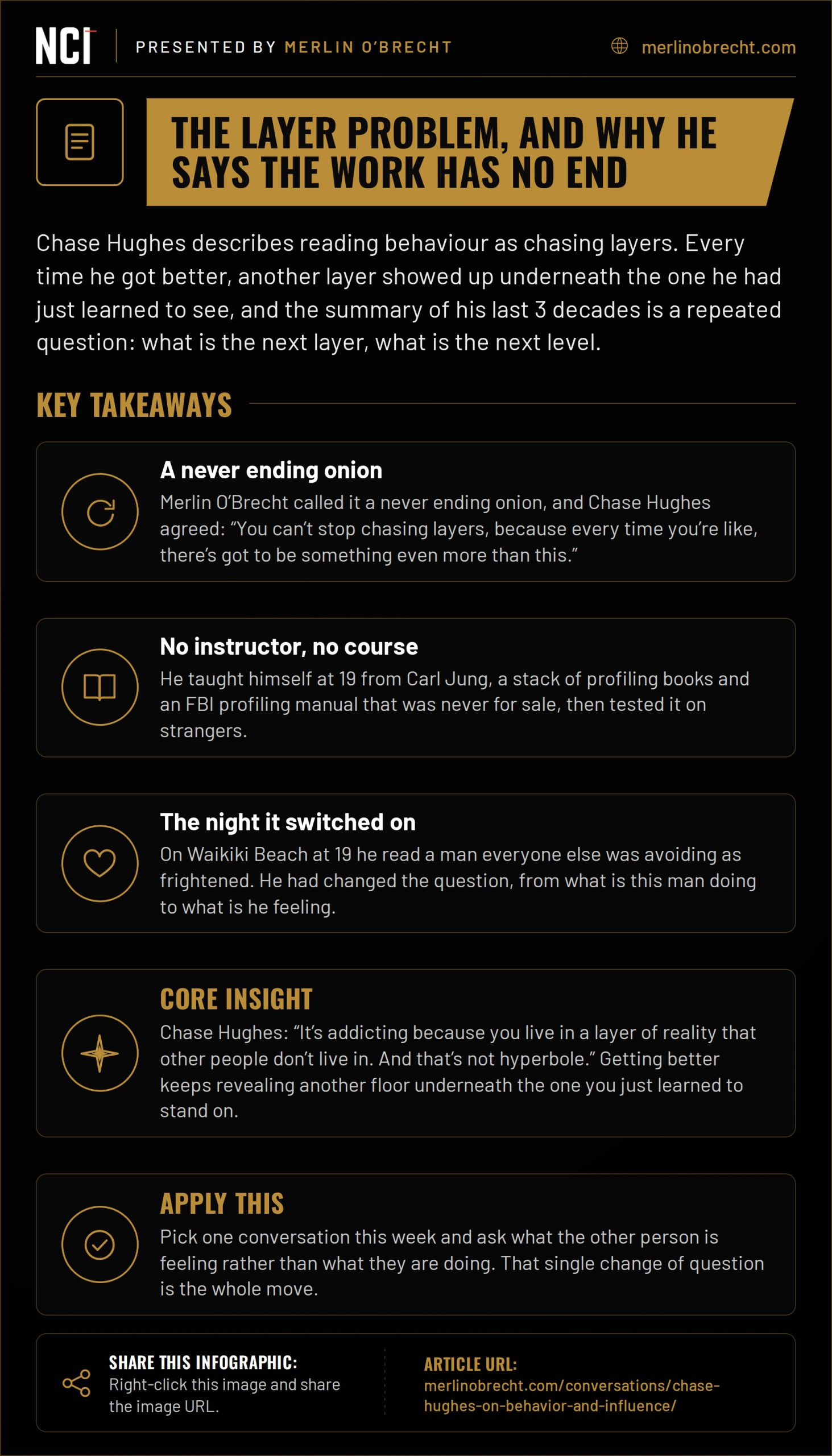
Then he explains the mechanic. Every time you get better, another layer shows up underneath the one you just learned to see. “You can’t stop chasing layers, because every time you’re like, there’s got to be something even more than this.”
I called it a never ending onion. He said yes, that’s exactly it. His summary of the last 3 decades: “what’s the next layer, what’s the next level.”
How did Chase Hughes learn to read people?
Chase Hughes taught himself. No course, no instructor, no curriculum, so he assembled one out of Carl Jung, a stack of profiling books and an FBI profiling manual that was never for sale. “It was a government manual that you couldn’t even find on Amazon.”
Then he tested it on people, which is the part most self-taught readers skip.
His own description of the process is the funniest and most honest thing in the interview: “piecing all this stuff together like a schizophrenic with the yarn.”
That explains the shape of what he built. A man who spent 15 years assembling a method from unrelated sources has strong opinions about sequence.
The night the empathy switch flipped
He was 19, in Honolulu, and there was a large Austrian man on Waikiki Beach who everybody was avoiding.
Chase’s read went somewhere else. “There’s a voice in my head is like, oh my god, he’s scared, he’s just fearful.” He describes it as going “from brain to heart instantly,” and compares it to Neo seeing the code behind the Matrix.
Notice what actually happened. He changed the question, from what is this man doing to what is this man feeling, and the answer inverted. That’s why the ethics and the accuracy end up being the same subject.
The first time he used influence, and what it cost his nervous system
The first time he ran a real influence sequence on a real person, it worked, and he nearly came apart.
“My heart rate was probably at like 180 or 200. I was like, I’m going to go to prison. Like, I just felt like I was breaking the rules of reality.”
I want that on record, because the version of Chase people meet now is unusually calm. The founder of the system had a panic response the first time it worked. If your body does something strange the first time a technique lands, that’s normal, and the next section is what it’s for.
Where he practised, and why low stakes is the method rather than the warm-up
In his early 20s he took a nights and weekends job at a clothing shop in a Honolulu mall, specifically so he had somewhere to practise.
His reasoning is worth stealing: “That’s the anxiety that anybody has when they start learning, especially the influence stuff. I need to be in a really low stake situation. That’s the place where I got all of that out of my system.”
Nothing was riding on it. He got the nerves out of the way somewhere that could absorb them, and by the time it mattered they were gone.
Reading a cluster description on a page and reading one in a live conversation, while the other person is still talking and your own nervous system is doing its thing, are 2 different skills, and the gap between them closes with reps against real footage. That’s what the NCI-1 Behavior Observer course exists to do, 6 hours, $252.
Why does Chase Hughes say most influence training is 60 years out of date?
Chase Hughes says the most advanced influence training he received in 20 years of military service amounted to a firm handshake and remembering someone’s kids’ names. His argument is that psychology and neuroscience have moved and the training has not, so the field teaches 1960s material to people whose work depends on it.
“Everything that I’ve got through all of the stuff that was apparently the most advanced supposedly was nothing more than a how to win friends and influence people book.”
| What the schools taught, in his account | What he built instead |
|---|---|
| Firm handshake, eye contact, use their name | Named models with defined parts, taught in a fixed order |
| Remember their kids’ names, and call that rapport | Behaviour read in clusters, measured against that person’s own baseline |
| Advice traceable to books written in the 1940s, 50s and 60s | Method updated to what psychology and neuroscience know now |
| Delivered to elite operatives and nobody else | “A human brain is a human brain,” so it goes to civilians too |
| A course you attended once | A system he refused to name after himself, so others can carry it and add to it |
His line on why the old material lasting this long is a problem:
“You’re not going to go use a rotary telephone just because it works. We have an iPhone now, and our persuasion and influence and behavior profiling stuff should evolve.”
What makes a behavioural model worth teaching
A model earns its place by predicting behaviour more often than not, and by being falsifiable when it fails.
My own assessment, and I’ll own it as an assessment: Chase has somehow figured out how to build systems and models that represent truth above 90%, and it can’t be overstated how impressive that is. Above 90% is high for anything involving human beings. It is not 100%, and he’d be the first to say so.
The counterweight, in the same breath. Newtonian physics is one of the most useful models ever built, and there are still experiments you can run that prove the whole thing wrong. That’s what a model is.
So read a cluster as a probability, act on it as a hypothesis, and let the next 30 seconds tell you whether you were right.
Where Chase starts, and where Merlin picks it up
Chase gives the theory, the framework and why it works. That’s his job and he’s the best in the world at it.
The gap is that he often starts at step 4, because steps 1 through 3 are obvious to a man 3 decades inside the material. The person learning is still asking why and how.
“It’d be like a math problem where Chase is not showing as many of his steps, and I’m breaking it down a little more elementary style.”
That’s my whole role, with no competitive edge in it. If you’ve ever watched him read a clip in 40 seconds and thought “wait, how did you get there,” that gap is the one I work in.
What he says he wants now
He says the company was never the point. He wanted a system that survives him.
“It’s not named after me. It’s not the Hughes method or anything like that. Build a system that other people can kind of carry. But not only just carry, other people can add on to it and make it better.”
What he wants now is bigger. “I want to train people to be so good at these skills that they live in a completely different version of reality than other people.” Underneath it sits a distinction he says took him most of his life to see: the difference between something that’s true and something that is the truth.
His guard against the obvious risk is plain: “So we got no Scientology ticket to sell you. We got no leader. No guru.” My version: the people participating become their own guru.
The reaction he didn't believe
Every time he trained intelligence specialists who’d been through the government schools, they told him the same thing: this is 10 times better than our school. Universally, in his word.
His reaction the first few times: “In the back of my mind, I was like, they’re lying to make me feel good.”
It took him a while to believe the material was going to change lives. Make of that what you like, but a man inventing credentials does not usually include that part.
Frequently asked questions
What is the Six-Minute X-Ray?
Six-Minute X-Ray is Chase Hughes’s rapid profiling system and a published book of the same name. It reads a person’s communication style, decision drivers and social needs from behaviour and language inside a short first conversation, so you know how to talk to them rather than what they’re hiding.
How does Chase Hughes read someone in a first conversation?
Three steps, in order. Build a baseline, which is how this person behaves when nothing much is happening. Look for clusters, because a single gesture carries no information. Read the cluster against context before you conclude anything, since a cold room and a bad morning produce the same behaviour as stress.
How long does it take to learn behaviour profiling?
The foundation course runs 6 hours, and you’ll be able to name what you’re seeing by the end of it. Doing it live, while someone is talking and you’re holding your side of the conversation, takes months of repetition. Anyone who promises you a timeline for that is guessing.
Is behaviour profiling real science?
Partly, and the honest answer matters. The Behavioral Table of Elements is Chase Hughes’s own organisation of a large body of published psychology, which is not the same as a validated instrument. The system reads probabilistically: clusters indicate likelihood, not fact. And it does not detect lies. The Deception Rating Scale scores likelihood, and that distinction is the whole discipline.
What is the difference between the Six-Minute X-Ray and body language reading?
Body language reading usually assigns fixed meanings to single cues, so crossed arms means defensive. Six-Minute X-Ray reads clusters against the individual’s own baseline, then filters for context. One treats people as a shared dictionary. The other treats each person as their own.
How would an interviewer or negotiator use this?
An interviewer uses it to find where a candidate’s behaviour shifts, then returns to that topic with 2 more questions instead of concluding. A negotiator reads which social need the other side wants met. Never act on a single reading. Confirm it or drop it.
Can you really read someone in 6 minutes?
You can get a usable read in 6 minutes on communication style, decision drivers and social needs. That’s enough to change how you talk to someone. What 6 minutes will not give you is their honesty, their history, or a verdict on their character.
Where did Chase Hughes's frameworks come from?
From 2 places. His military training, which included interview school, interrogation school, SERE and agent recruiting, and the psychology he read on his own from 19 onward, including Carl Jung and an FBI profiling manual. He translated both into civilian language and a fixed teaching order.
Is behaviour profiling manipulation?
Not on its own, and the discriminator is intent rather than technique. Chase Hughes applies the empathy test: if this person could see your full intent from behind your own eyes, would they agree it was in their interest? Influence passes. Manipulation fails, because it needs concealment to work.
Where does a beginner start?
Read Six-Minute X-Ray first. It’s cheap and it will tell you within an hour whether the way Chase thinks fits the way you think. After that, the useful move is structured practice against real footage with someone correcting you, because skills need feedback.
Where to go from here
The one thing Chase never had was somewhere to enrol. He read Jung on a ship, tested it on strangers in a mall, and it took 15 years.
If you want the reading skill rather than the story, the entry point is NCI-1 Behavior Observer. 6 hours, $252, and it’s the level everything else at NCI is built on top of.
Or watch the conversation first. It’s 90 minutes and free, and the layers thing lands better in his voice.