Overcoming adversity
Overcoming adversity: the mindset that changes before anything else does
By Merlin OBrecht · Dean of Academic Affairs, NCI University
Overcoming adversity
An overcoming adversity mindset starts with a purpose that outranks the fear, and it changes you before it changes anything around you. Nick Karvon went more than a year without seeing his daughter, trained at NCI University, and worked on his own composure first. His first real attempt at what he’d learned ended in a hug and an apology.
Nick and I met in a Wednesday night study group. He gave an example, I told him it was tired old NLP, and he took it about as well as anybody could. Two and a half years later he’s the 4th person ever certified at NCI-4, he’s on our coaching team, and he helps run NCI’s Avery department alongside Kisma Orbovich.
That sentence skips everything that matters.
What I wanted on camera was the middle. The day he sat in a room full of people he was sure he didn’t belong with, and the week he went home, ran a formula badly, and got a result anyway.
Key takeaways
- Nick Karvon spent more than a year unable to see his daughter, and rebuilt the relationship over roughly 2 and a half years.
- The first thing that changed was his own composure, before he used a technique on anybody.
- His account of the mechanism: he became safe to be around, and his daughter responded without him doing anything.
- He describes the shift from doing influence to being influential the way a drummer describes rudiments becoming muscle memory.
What is an overcoming adversity mindset?
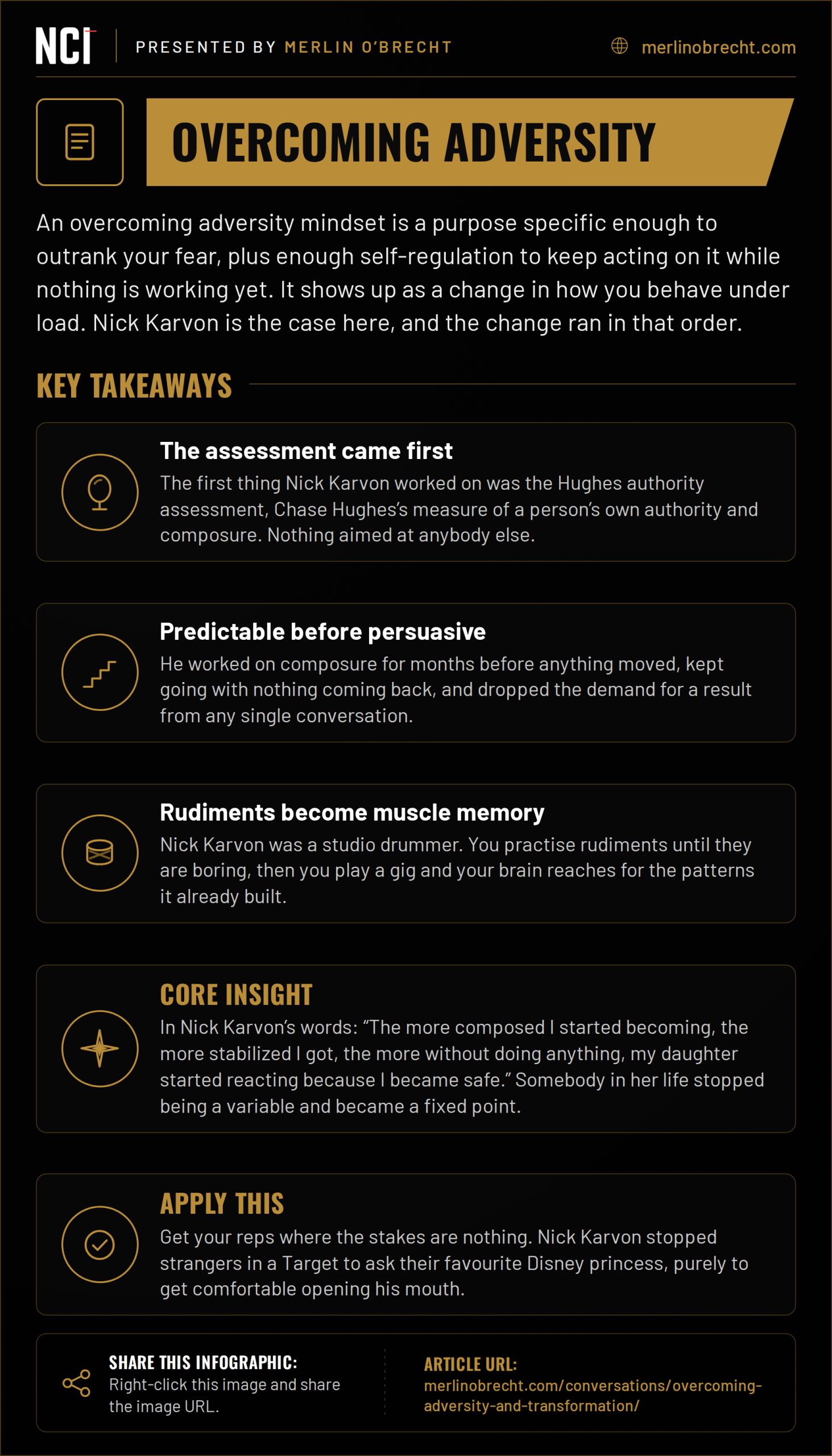
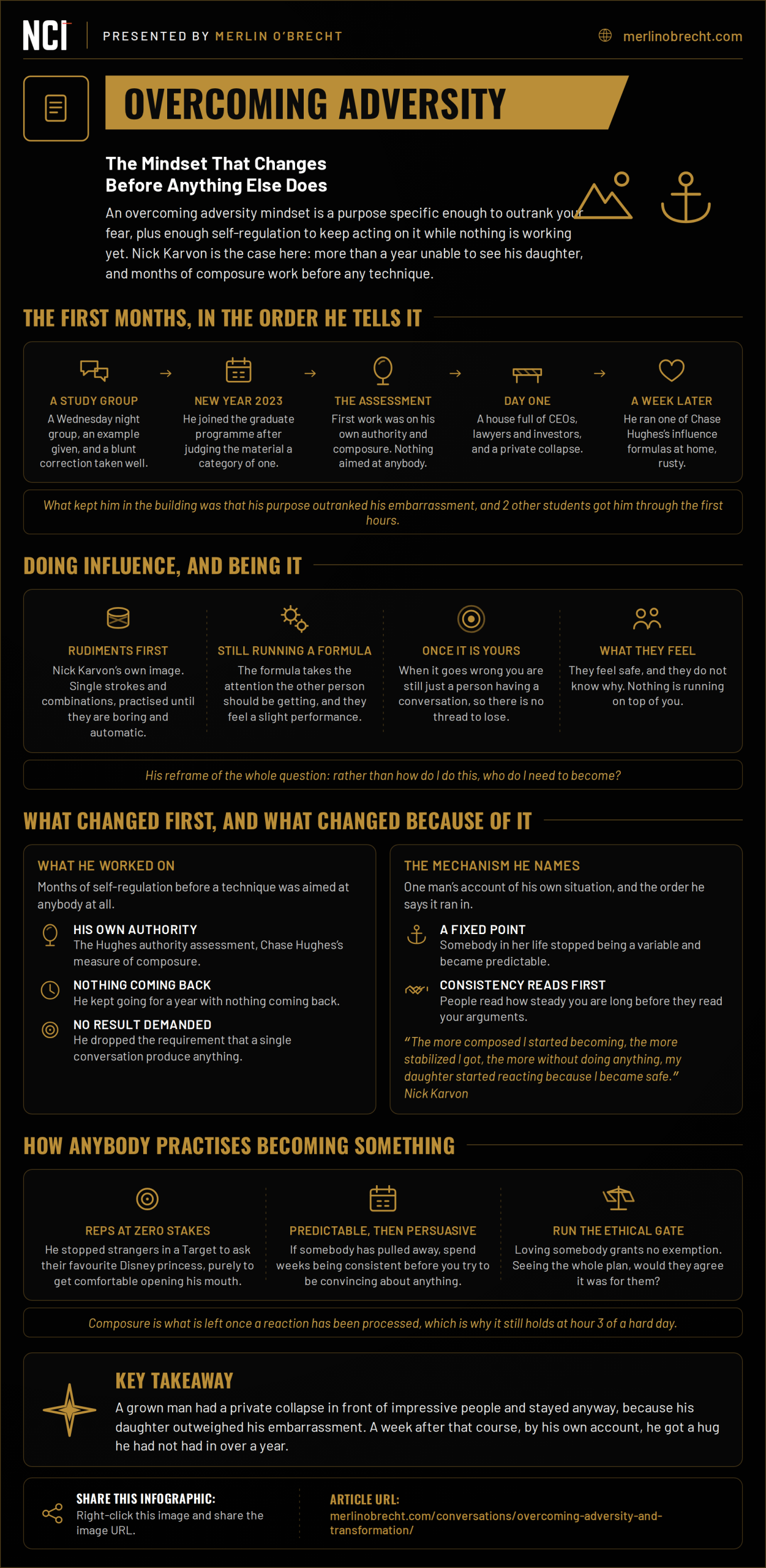
An overcoming adversity mindset is a purpose specific enough to outrank your fear, plus enough self-regulation to keep acting on it while nothing is working yet. It shows up as a change in how you behave under load rather than in what you tell yourself.
Nick Karvon is the case on this page, and everything below is his account of his own situation, recorded in May 2025.
Worth knowing who’s talking before you weigh any of it. Nick holds NCI-4 Author, the highest certification NCI University issues, and he was the 4th person ever to earn it. He’s a graduate of Chase Hughes’s Black Course, an Avery practitioner, and he helps run NCI’s Avery department. He arrived at all of it from studio drumming and then business, which is where the analogy at the end of this page comes from. He wrote Vanishing Parent about the situation described below, and he works with parents in it now.
What happened to Nick Karvon
When the pandemic hit, his daughter was taken out of school and he wasn’t able to see her. Courts were closed, nothing could be done procedurally, and it ran on for more than a year.
“Before I knew Chase or met Chase or knew about NCI, I was in a situation I know many parents find themselves in, this horrible situation, parental alienation… Up until that point, my daughter and I had a great relationship. We were really close and we shared custody.”
She was 12. His framing of why the timing hit so hard: those are formative years, roughly 12 through 16, and they were going past.
He found Chase Hughes through The Behavior Panel while looking at Mark Bowden’s work. His background was deep in NLP, so he had a reference point, and his verdict was blunt: this was in a category of one. Then came a decision closer to triage than curiosity.
“If this guy’s for real and the skills he’s talking about are real and he can give those to me and teach them, this is my guy.”
He joined the graduate programme on New Year’s Day 2023.
The change that came before any technique
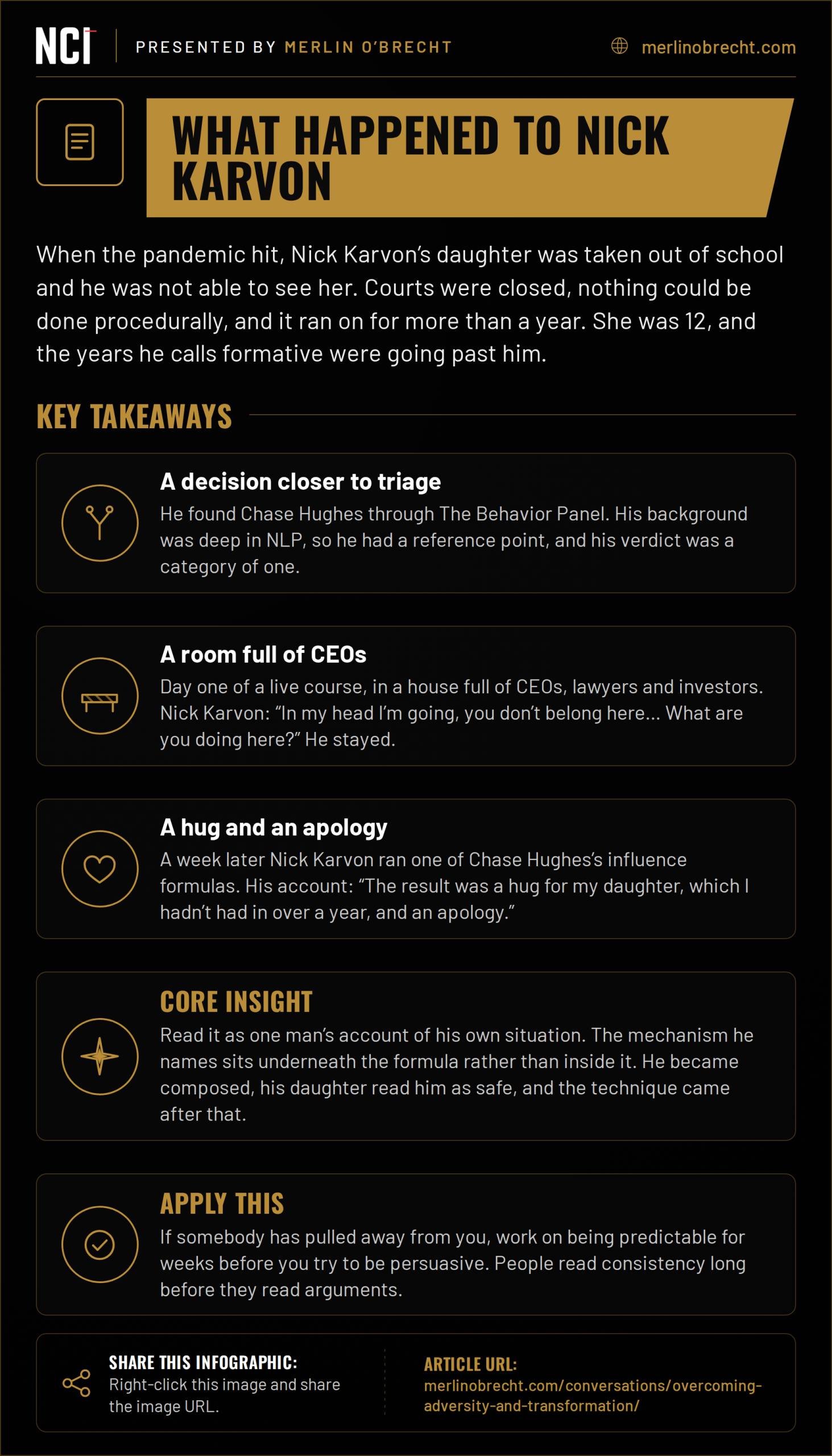
Here’s the part I’d underline. The first thing Nick worked on was the Hughes authority assessment, Chase Hughes’s measure of a person’s own authority and composure. Nothing aimed at his daughter at all.
He went in assuming he’d score well. Confident, running a business, all of that. His verdict on what it actually told him: “I wasn’t even close.”
Then the mechanism, in his words. This is the thesis of the page:
“The more composed I started becoming, the more stabilized I got, the more without doing anything, my daughter started reacting because I became safe.”
Read that twice. Nothing was done to her. Somebody in her life stopped being a variable and became a fixed point, and she moved toward the fixed point, because that’s what people do.
How do you rebuild trust with someone who has pulled away?
You start with your own state, because somebody who has pulled away reads your consistency rather than your arguments. Five steps, drawn strictly from what Nick says he did.
- Regulate yourself first. He worked on composure for months before anything moved.
- Become predictable before you try to become persuasive. She knew he wasn’t going to react either way. Predictability is what safety is made of.
- Drop the demand for a result from any single conversation. He kept going for a year with nothing coming back.
- Get your reps where the stakes are nothing. He’d stop strangers in a Target and ask their favourite Disney princess, purely to get comfortable opening his mouth.
- Let repetition compound. His phrase for the last 2 and a half years is building on little successes.
The room where he thought he did not belong
Six months later, day one of the Black Course. Chase’s top-tier live event, in a very large house in northern Virginia, with CEOs, lawyers, investors and hypnotists in the room.
“In my head I’m going, you don’t belong here. You haven’t had enough training. You haven’t had enough skill. What are you doing here?”
He calls it an internal meltdown. What kept him in the building:
“If it wasn’t for that purpose and my resolve for that purpose, I might have given up or collapsed inside so far that I didn’t come back.”
Two people got him through day one and he named both. Grant Morell saw him struggling and hypnotised him on the spot. Rob Ryder handed him an anchor: a button on his wrist, delivered in an Australian accent, that he still presses years later.
I like this part more than the success story. A grown man had a private collapse in front of impressive people and stayed anyway, because his daughter outweighed his embarrassment.
About a week later he went home and ran the Captor protocol, one of Chase Hughes’s influence formulas, on his daughter. His own assessment: rusty around the edges.
“The result was a hug for my daughter, which I hadn’t had in over a year, and an apology. And then a whole lot of other stuff came out of her.”
What it gave him was bigger than the hug. It gave him hope again, and a peace inside that everything was going to be okay.
From doing influence to becoming it
Nick was a professional drummer in a former life, so he explains this better than I do. You learn rudiments. Single strokes, double strokes, combinations, practised until they’re muscle memory and slightly boring. Then you play your first gig, your brain reaches for the patterns it already built, and you just play.
“Rather than how do I do this, who do I need to become?”
And on the far side:
“I couldn’t even tell you sometimes what technique I’m doing. You just become it and it just oozes out of you.”
| While you’re still doing it | Once it’s who you are |
|---|---|
| You focus on the formula and your place in it | You focus on the other person, because nothing else is competing for attention |
| They feel a slight performance, even if they can’t name it | They feel safe, and they don’t know why |
| It costs real effort and a fast heart rate | It costs you nothing |
| When it goes wrong you lose the thread and freeze | When it goes wrong you’re still just a person having a conversation |
His summary:
“If you just gain your authority, your confidence, your composure, you’ll see the ether, the world, the people bend around you and you won’t even know why.”
Which raises the question of how anybody practises becoming something. The composure that holds while somebody you love is upset with you gets built the way a rudiment does, through reps with feedback from a person who can see what you can’t. That’s what the NCI-1 Behavior Observer course is for, 6 hours, $252.
When the purpose got bigger than the purpose
He worked the NCI exam pathway level by level and became the 4th person ever certified at NCI-4, the hardest certification Chase offers. The pin is the author’s seal.
The author idea is NCI’s construct, and here’s how I put it to him. In a story you’ve got background characters stuck in little NPC loops, no story time and no control. You’ve got the main character, who gets the whole plot and every trial in it and is still at the mercy of whoever is writing. Then the author, who decides where it goes.
“It’s not necessarily about creating outcomes that are for you. You’re learning these skills so that you can help others break free from the chains that are holding them back and then be able to do whatever the hell they want.”
Nick’s version: it stopped being about him and started being about the other parents who kept asking how he did it. He coaches them now, and wrote Vanishing Parent: Conquering the Parental Alienation Beast.
His ethical gate, which he attributes to Chase:
“If they could see in their head what you’re doing and they would say yeah that’s exactly what I need in my life, then that’s good influence.”
And the line that gets passed around at NCI: with a scalpel, you could hurt somebody really badly or you could save their life.
Where a written explanation runs out
I’ll go first, because Nick did. At the exit retreat in Tulum, a few weeks before we recorded this, I was crying in a way I hadn’t cried since I was a little kid. An hour later at lunch it felt like taking off a backpack I’d worn for years. That part doesn’t happen in a notebook, and neither did his year of composure work.
One honest disqualifier before the questions. If what you want is a script for one hard conversation, this will disappoint you. The first module is about you.
Frequently asked questions
What does resilience mean in behavioural terms?
Resilience is regulation under load rather than positive thinking. The marker is behaviour that holds steady when pressure changes: same pace of speech, same volume, same willingness to sit in a silence. Nick Karvon’s daughter responded to exactly that before he used any technique.
How do you start rebuilding a relationship that has broken down?
Three steps, and the first is about you. Get your own reactions steady, because they read your consistency rather than your words. Become predictable over weeks. Then drop the demand for a result from any single conversation.
How long does this kind of change take?
Nick Karvon’s first visible result came about a week after his live course ended, and the arc he describes runs roughly 2 and a half years, from January 2023 to when we recorded. Anyone promising less than months is selling something.
Does behavioural training actually help in a personal crisis?
It helps with the part of a crisis that runs through your own behaviour, which is usually more of it than people expect. Being predictable and unreactive changes what somebody experiences around you. This is training rather than therapy, and it is not legal advice.
What is the difference between composure and suppressing what you feel?
Suppression takes effort and other people can see the effort. Composure is what’s left once the reaction has been processed, so there’s nothing to hold down. Suppression fails at hour 3 of a hard day. Composure doesn’t.
Is it manipulative to use influence skills on someone you love?
Run the empathy test on it. If they could see the whole plan from behind your eyes, would they agree it was for them? Getting a kid to brush their teeth passes easily. Getting a kid to stop asking about something you’d rather not answer doesn’t. Loving somebody grants no exemption.
Whose framework is the authority assessment?
Chase Hughes, the founder of NCI University. It measures the components of a person’s own authority and composure. Nick Karvon says it changed first, before anything he learned about influencing anyone else, and that it showed him how far from confident he actually was.
Who is Nick Karvon?
Nick Karvon is an NCI-4 Author, the highest certification NCI University issues, and the 4th person ever to earn it. He’s a graduate of Chase Hughes’s Black Course, an Avery practitioner, and he helps run NCI’s Avery department. He’s a former studio musician turned entrepreneur, and he’s the author of Vanishing Parent, written for parents separated from their children.
What is the first step if this is why you are looking at behavioural training?
Start with the regulation work rather than a conversation script. The disqualifier is worth saying plainly: the first thing this training asks you to examine is you, and people arriving in a crisis want to skip that part.
Where to go from here
Nick’s line about the rudiments is the one I’d keep. You practise the boring thing until it stops being a thing you’re doing, and then it shows up on its own on the night it matters.
If you want to build that, the entry point is NCI-1 Behavior Observer. 6 hours, $252, the first level everybody here starts on.
And if you’re in the middle of something hard right now, step 1 is free. Pick one small thing, promise it to yourself, do it tomorrow.