Is influence ethical?
Is influence ethical? The test that settles it
By Merlin OBrecht · Dean of Academic Affairs, NCI University
Is influence ethical?
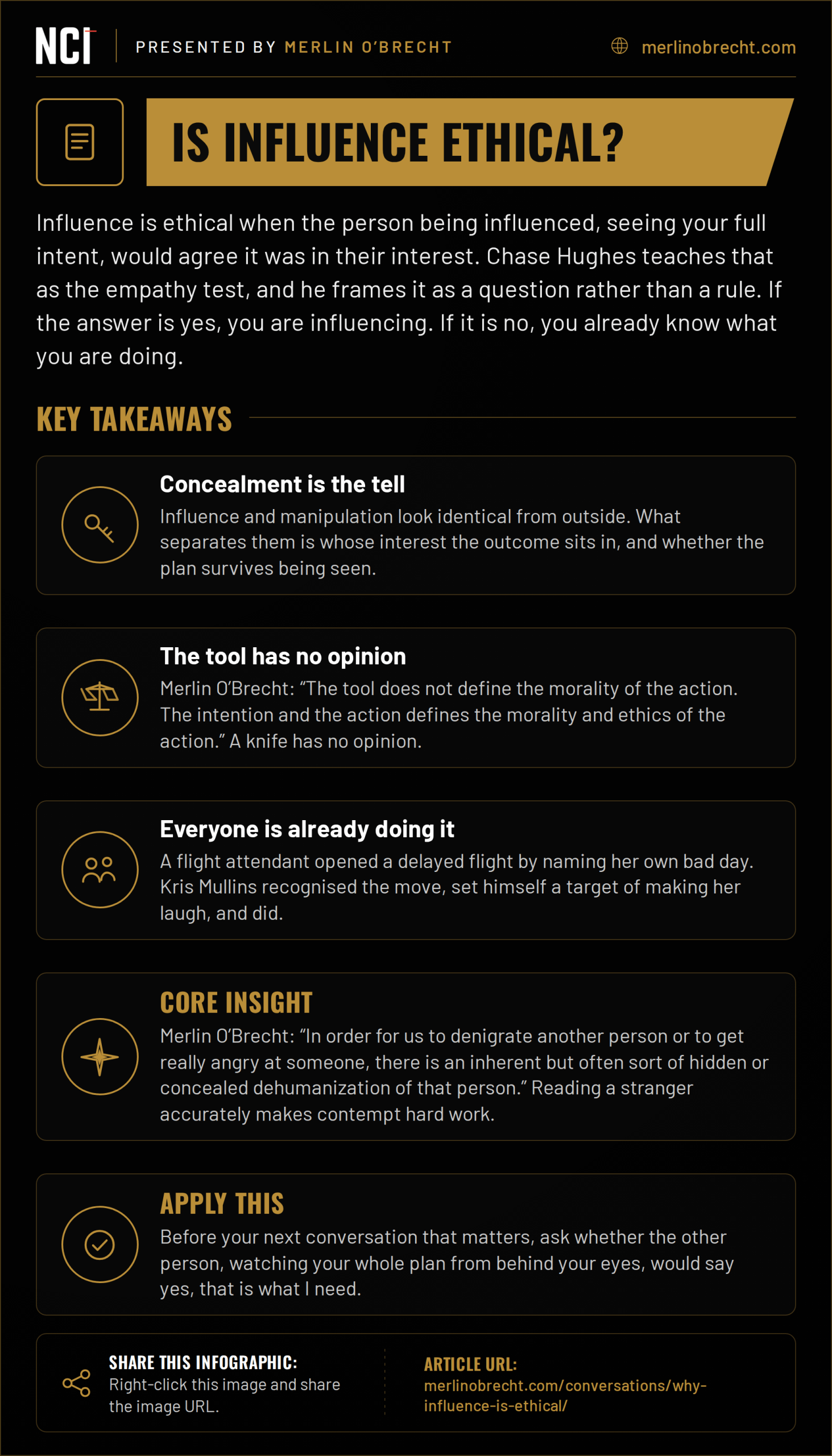
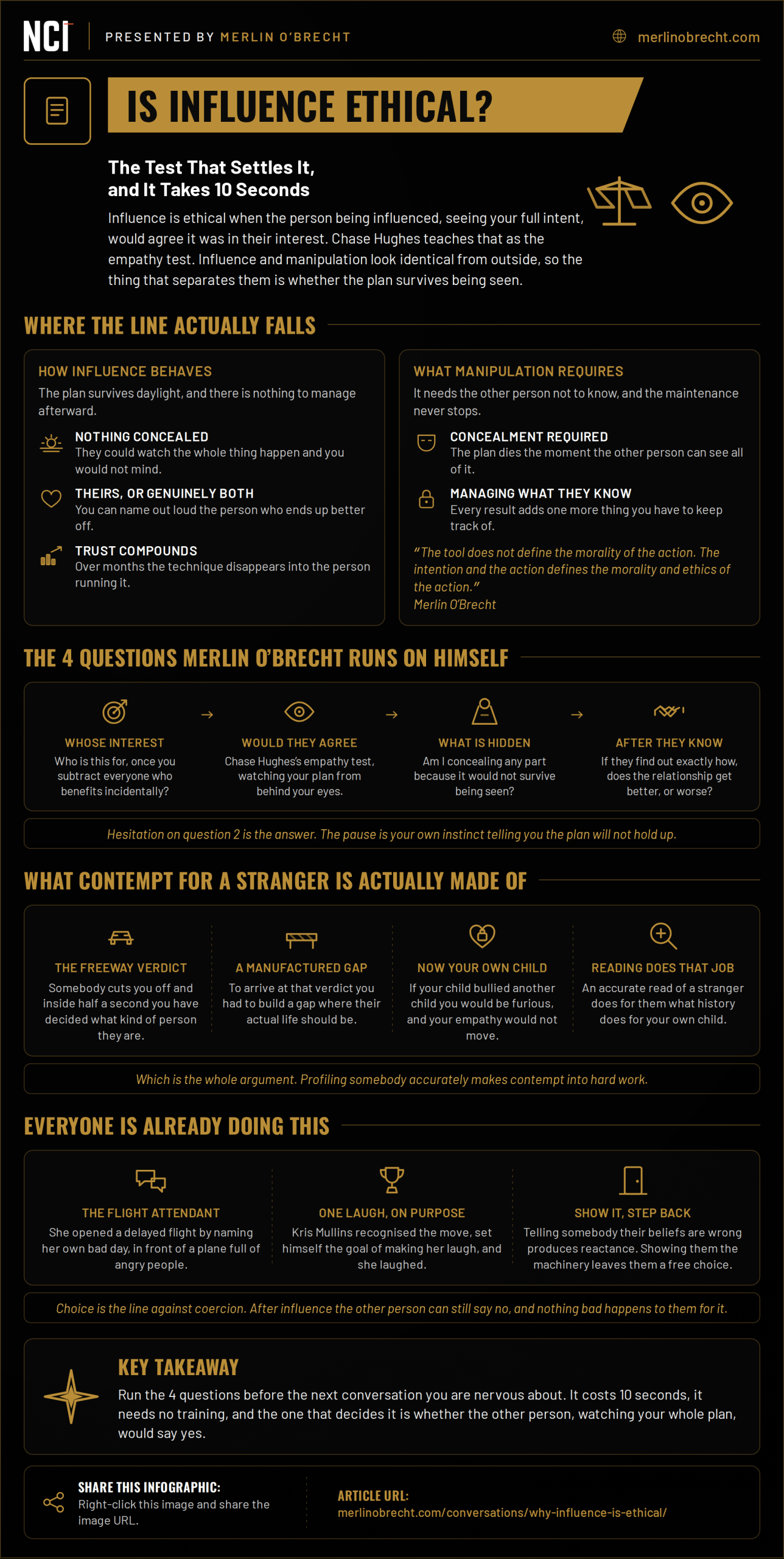
Influence is ethical when the person being influenced, seeing your full intent, would agree it was in their interest. Chase Hughes calls that the empathy test. The tool does not define the morality of the action. The intention and the action do. Manipulation fails the test, because manipulation needs concealment to work.
This was the first video we ever put on the NCI University channel. April 2025, Kris Mullins across from me. About 80 minutes in it turned into the ethics argument, and that’s the part people still send me.
The question shows up every time influence gets mentioned in public. Is it alright to do this to somebody on purpose. Most answers swap one definition for another and leave you where you started.
So here’s a gate you can run in 10 seconds, and then the part almost nobody explains: what contempt for a stranger is actually made of.
Key takeaways
- Influence is ethical when the other person, seeing your whole intent, would agree it was in their interest. Chase Hughes teaches this as the empathy test.
- Influence and manipulation look identical from outside. The difference is whose interest the outcome sits in, and whether the plan survives daylight.
- Contempt for a stranger requires knowing very little about them, which is why reading people accurately makes contempt harder to hold.
- The same mechanics run good movements and bad ones. Awareness is the defence.
Is influence ethical?
Influence is ethical when your intent would survive being seen. That’s the whole gate, and Chase Hughes phrases it as a question: are your intentions good with what you’re doing, if the person you’re doing them on was in your mind to see them from the back of your own eyes?
If the answer is yes, you’re influencing. If it’s no, you already know what you’re doing.
I said the flat version on camera and I’ll stand behind it:
“The tool does not define the morality of the action. The intention and the action defines the morality and ethics of the action.”
A knife has no opinion. Neither does a question.
The test Chase Hughes uses, and how to run it on yourself
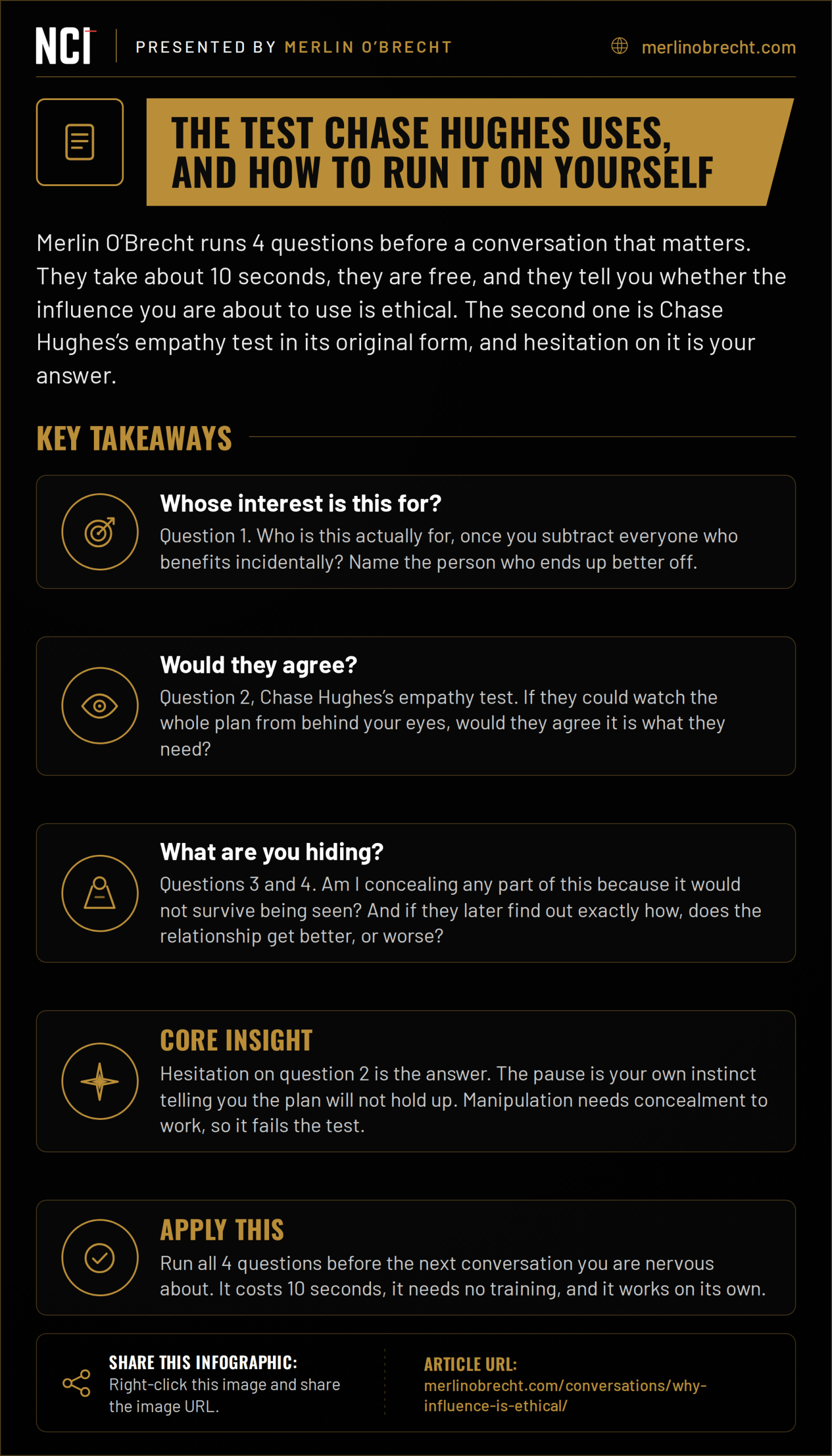
I run 4 questions before a conversation that matters. They take 10 seconds and they tell you whether the influence you’re about to use is ethical.
- Whose interest does the outcome sit in? Who is this actually for, once you subtract everyone who benefits incidentally.
- If they could watch the whole plan from behind my eyes, would they agree it’s what they need? Chase’s empathy test, in its original form.
- Am I concealing any part of this because it wouldn’t survive being seen? Concealment is the tell. Nothing else is.
- If this works and they later find out exactly how, does the relationship get better or worse?
Hesitation on question 2 is your answer. That’s your own nervous system telling you the plan won’t hold up.
Where the line actually falls
Influence and manipulation look identical from the outside. What separates them sits underneath, and it’s specific.
| Influence | Manipulation | |
|---|---|---|
| Whose interest the outcome sits in | Theirs, or genuinely both | Yours, and you know it |
| Concealment | None required. The plan survives daylight | Required. The plan dies if they see it |
| If they find out how you did it | They thank you, or shrug | The relationship takes damage |
| What it costs you | Nothing. You keep your own good opinion of yourself | A small ongoing tax on how you see yourself |
| What it does over time | Trust compounds and the technique disappears into you | You have to keep managing what they know |
The first person paying for manipulation is you, every day, in the maintenance.
Everyone is already doing it
Kris flew home from a live course and got delayed an hour and a half. The direct flight to Vegas became a forced layover. A plane full of angry people. Then the flight attendant came aboard, having one of her worst days, and opened with this:
“I know everybody’s pissed off. I’m having a real bad day too.”
Kris knew exactly what she’d done, because he’d spent the week learning it. So he set himself a target of making her laugh. His rule:
“If I can make one person laugh every day, I’ve completed my mission for the day.”
She laughed. After the flight she came back with a bag of drinks and told him he’d helped.
If you’ve ever tried to make a stranger’s day slightly better with a bad joke, you’ve already used influence and already passed the test. You wanted nothing from them.
“If I can influence you to just have a better day and that’s my only end outcome, how can there be anything more pure, better in the world than that?”
Why does "just be yourself" come up whenever influence is mentioned?
Because people picture influence as a layer bolted onto a person, and they’re right to distrust that picture. A rehearsed technique running on top of somebody is easy to feel and awful to be near. The picture stops being accurate once the material goes in properly.
“With real influence, there is no separation between the self and the influence. The influence is something that you’ve programmed into your brain to where it’s just a natural reflection of who you are. There really is no technique that’s being done.”
You’re influencing everyone you talk to already, conscious of it or not. Doing it on purpose, with a compass, tends to make people kinder rather than slicker.
What contempt actually requires
This is the passage I’d fight to keep. It’s a claim about mechanism, and once you see it you can’t unsee it.
“In order for us to denigrate another person or to get really angry at someone, there is an inherent but often sort of hidden or concealed dehumanization of that person.”
Take the freeway. Somebody cuts you off and inside half a second you’ve decided what kind of person they are. It doesn’t feel like dehumanising anybody. It just arrives. But to get there you had to build a gap where their actual life should be.
The overt version is wartime, where an enemy gets stripped of humanity so the killing weighs less. The micro version runs in workplaces and high school corridors.
Now hold that next to a child. If your kid started bullying another kid in front of you, you’d be furious, and your empathy wouldn’t move an inch, because you know what’s underneath it.
“As we start to profile them better, we can build relative stories that are fairly accurate about their history and about what might have led them to this less than desirable behavior, which allows us to see them as just another suffering, insecure human being like the rest of us.”
That’s the argument. Profiling a stranger accurately does the job history does for your own child. It makes contempt hard work.
Which raises a fair objection: that’s a claim about a skill you may not have yet. Reading and the ethical gate get taught together, in that order, starting with the NCI-1 Behavior Observer course, 6 hours, $252. That’s the door. Nobody’s pushing you through it.
The same mechanics run good movements and bad ones
Kris watched Chase list the characteristics successful movements share, the ones that also show up in groups people would call cults. A letter to your future self. A shared vocabulary. A closed environment. Us and them. Then he looked at communities he was already in and found the whole script running in daylight, doing good.
His conclusion is the honest one:
“The core concepts are there. It’s up to the person to intend to use them well or not.”
Telling somebody their beliefs are wrong produces reactance every time. Showing them the machinery and then leaving them alone with it produces something else.
“If you can kind of show somebody the framework, show somebody how all this stuff works at a base level, and then just allow them to make their own free choice.”
It’s handing somebody a different pair of glasses. What they do next is theirs.
What the ethics ask of you before they ask anything of anyone else
Here’s the uncomfortable one. I hedged it twice on camera, and both hedges were deliberate.
If you have a strong reaction to the idea of influence, it might be, and maybe it isn’t, but there’s a chance it’s saying something about you. Is the discomfort about what others might do to you, or about what you’d do if you got good at it?
Worth sitting with. Then there’s the frame I come back to:
“You’re going to die. Maybe soon, maybe in 60 years from now, maybe in 20. Who knows? No one gets to see our stopwatch. And nobody knows how long this carnival ride’s going to keep going for.”
Against that, the ethics get simpler. To strive and drive towards leaving the world a better place than you found it, by definition, requires that you understand influence. You’re describing a thing you want to influence.
One warning before the questions. The training starts with you and stays on you for a while. If what you want is a technique to use on somebody tomorrow, the first module will annoy you.
Frequently asked questions
What is ethical influence?
Ethical influence is changing how somebody thinks, feels or decides in a way they’d agree with if they could see your whole intent. Chase Hughes teaches this as the empathy test: would this person, watching your plan from behind your own eyes, say yes, that’s what I need?
How do you check your own intent before a conversation?
Three questions, 10 seconds. Whose interest does this outcome sit in? Would they agree with the plan if they saw all of it? Am I hiding any part because it wouldn’t survive being seen? Hesitation on the second one is the answer.
How long before influence stops feeling like a technique?
Months of real conversations rather than days of reading. The marker is the day you notice you’ve stopped rehearsing. Until then you’ll feel a gap between the person talking and the person watching yourself talk.
Do influence techniques actually work, or do people just believe they do?
They work probabilistically, which is a real answer rather than a hedge. A well-run approach shifts the odds of a conversation substantially and guarantees nothing. What reliably fails is a script delivered to somebody already defensive, because the defensiveness was what you needed to handle first.
What is the difference between influence and coercion?
Choice. After influence, the other person can still say no and nothing bad happens to them. After coercion, saying no carries a cost you attached to it. Threats, pressure and manufactured consequences are coercion regardless of how politely they get delivered.
How do you use influence ethically in sales?
By producing permission and safety instead of pressure. A person who feels safe tells you what they actually need. A person under pressure tells you whatever gets you off the phone.
Can you influence someone without them knowing, and is that manipulation?
Yes to the first, no to the second, and I won’t soften either half. Most influence is invisible while it happens, including the influence you’ve run your whole life by accident. The empathy test is the discriminator, and invisibility is beside the point.
Who created the empathy test?
Chase Hughes, the founder of NCI University. He frames it as a question about intent rather than a rule about technique. NCI’s own version of the same value: tools are neutral, and the integrity of the practitioner determines the outcome.
Is it wrong to use influence on your own family?
You’re already doing it. Getting a 3-year-old to brush their teeth is influence, and so is getting a teenager to make a bed. What’s worth asking is whether you’re any good at it and whose outcome you’re aiming at.
How do you learn influence without becoming manipulative?
By learning it in the order that keeps the ethics intact, which means starting with yourself. Reading people accurately raises empathy as a side effect, and empathy is what makes manipulation feel bad to run.
Where to go from here
I’d rather not pull a lever at the end of a page about levers, so here it is plainly. If you want the skill this argument depends on, the entry point is NCI-1 Behavior Observer. 6 hours, $252, the first level everybody here starts on, me included.
Or buy nothing and run the 4 questions before your next hard conversation. That part is free and it works on its own.