Merlin O'Brecht

Psychological manipulation

Psychological manipulation: the four levers it actually runs on

By Merlin OBrecht · Dean of Academic Affairs, NCI University

Psychological manipulation

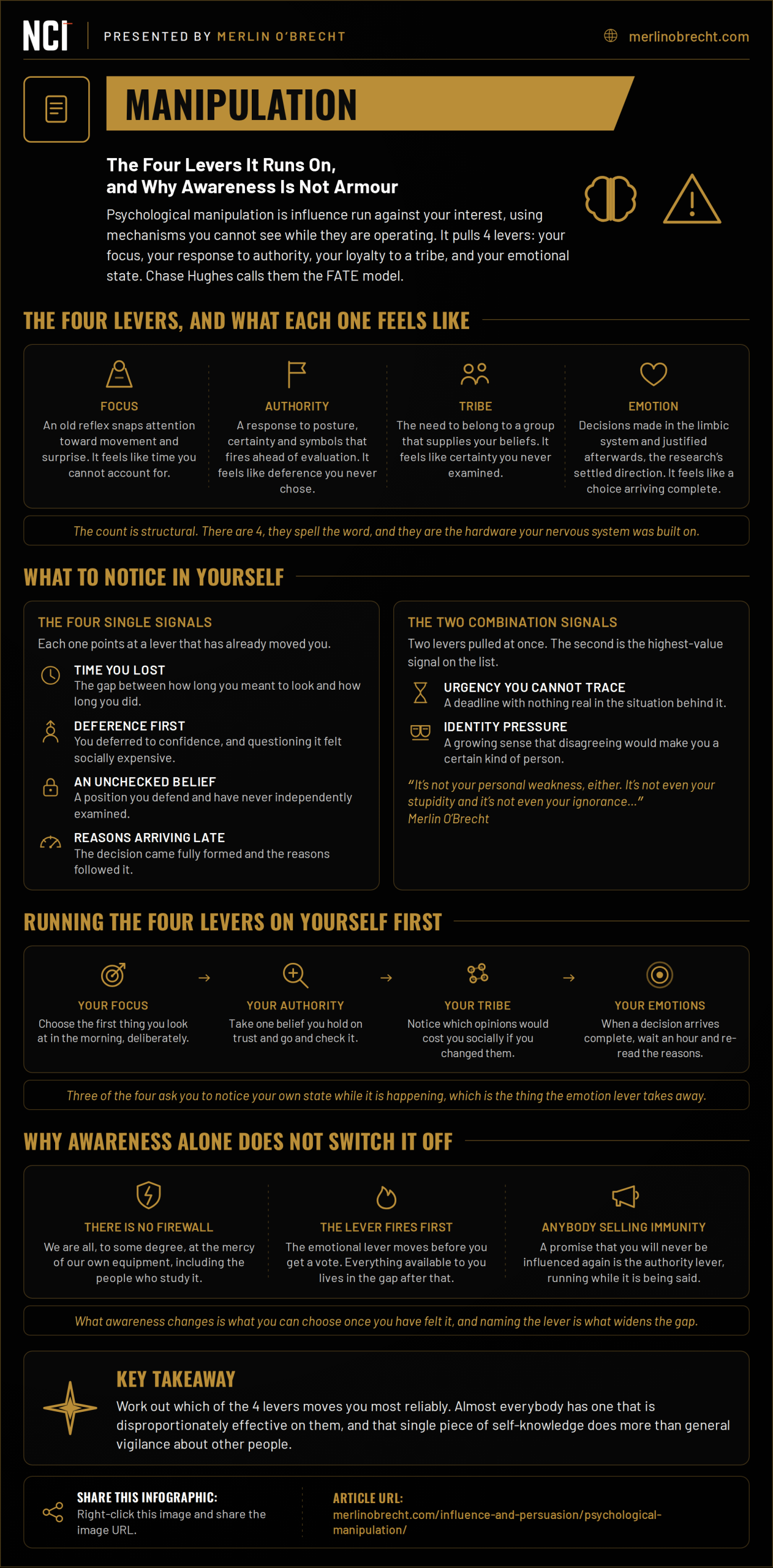
Psychological manipulation works by pulling four levers your brain runs on: focus, authority, tribe, and emotion. Chase Hughes calls this the FATE model, and NCI University teaches it as the structure behind advertising, recruitment and coercive relationships. Awareness alone does not switch it off. Recognising which lever is being pulled is what gives you a choice.
“If you don’t understand the fate model, you are likely not running your own life.”
I want to attach the honest limit to that immediately, because a page like this usually promises the opposite. There is no antidote or firewall to its power.
What there is, is a structure. Four levers, the same four every time, and they are not exotic. They are the hardware your nervous system was built on, which is exactly why the same four things work on an advertising audience, a congregation, a political tribe and one person in a kitchen.
If you arrived here because something happened and you have been going over it since, the next section is the one that matters most.

Key takeaways

What is psychological manipulation?

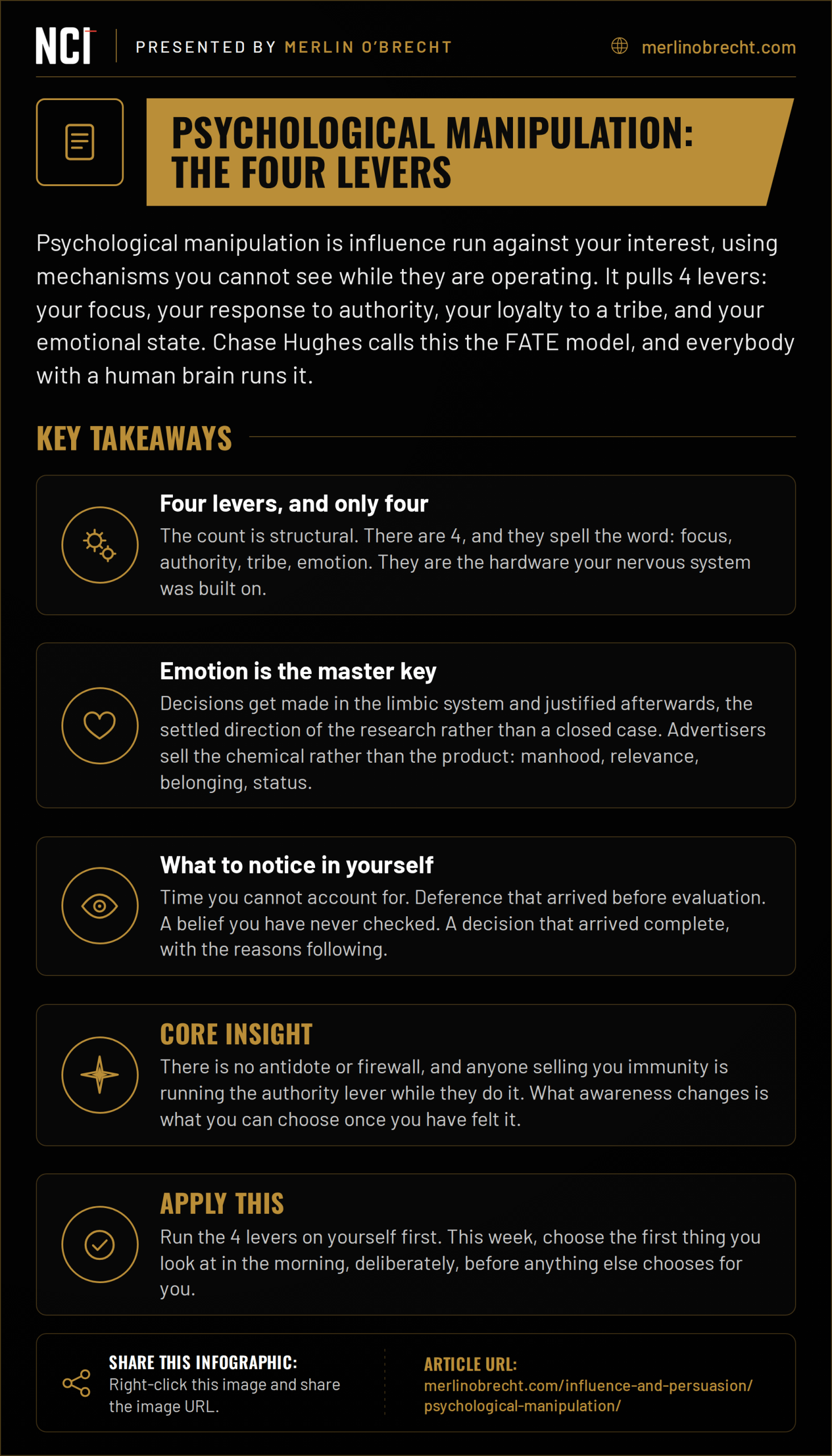
Psychological manipulation is influence run against your interest, using mechanisms you cannot see while they are operating. It works by pulling four levers: your focus, your response to authority, your loyalty to a tribe, and your emotional state.
Those four are Chase Hughes’s FATE model, taught through NCI University’s curriculum. Pull all four at once and somebody can move you in a direction you will experience as your own idea.

Why it is not a personal weakness

This is the part worth reading twice.
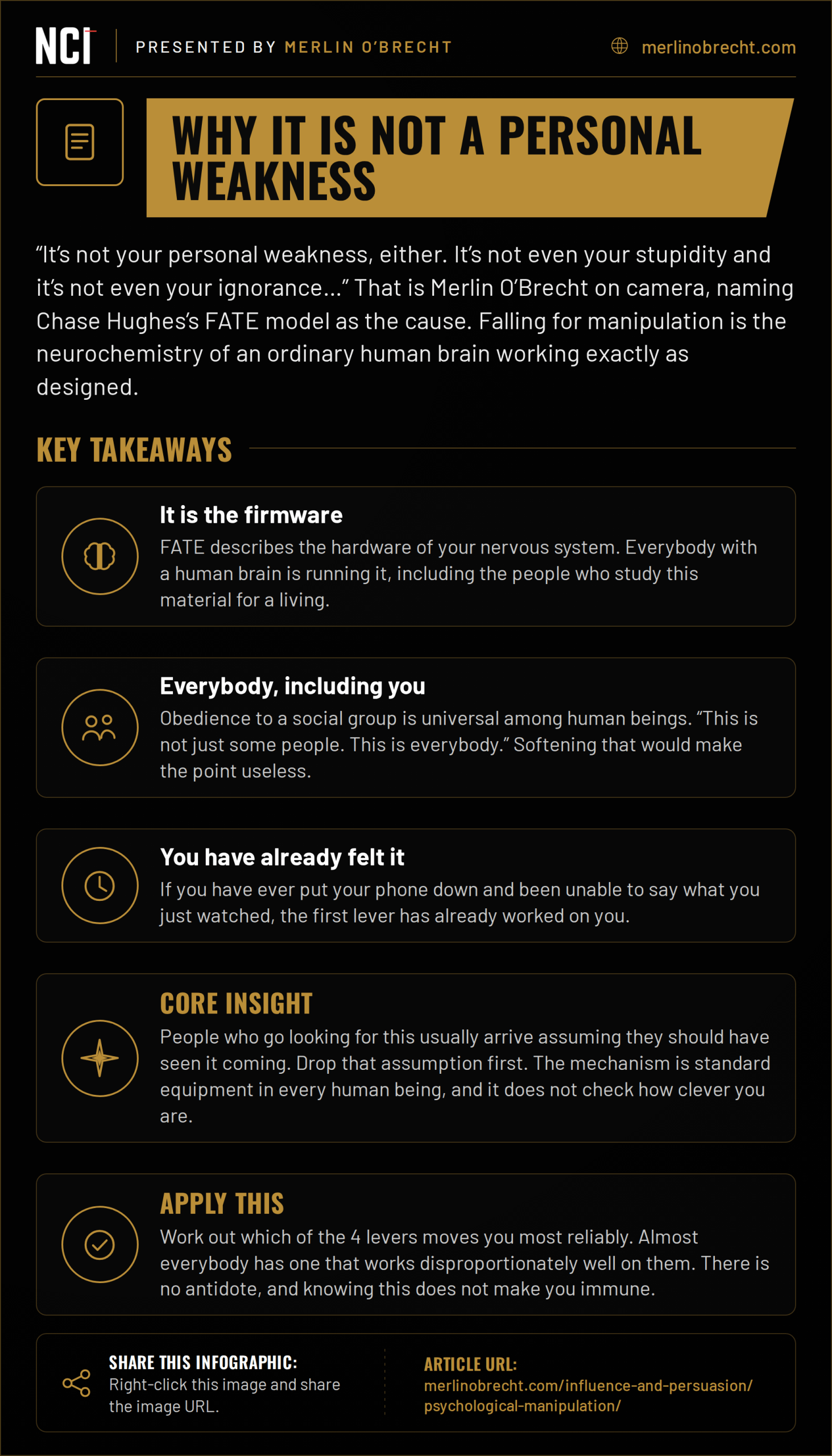
“It’s not your personal weakness, either. It’s not even your stupidity and it’s not even your ignorance. It is the fate model.”
It is the neurochemistry running inside your brain. FATE is a description of the firmware, of the hardware of your nervous system, and everybody with a human brain is running it. Not most people. Everybody, including the people who study this for a living.
The count matters too, and it is structural rather than rhetorical. There are not 50 of them, or 30, or five, or three. There are four, and they spell the word.
If you have ever put your phone down and been unable to say what you just watched, you have already felt the first lever work.

What are the four levers of the FATE model?

Lever What it exploits What it feels like from the inside
Focus An ancestral reflex that snaps your attention toward movement, colour, threat and surprise Time disappearing. Not being able to recall what you just consumed
Authority A hardwired response to symbols of authority that fires before evaluation does Deference you did not decide on. Feeling foolish for questioning
Tribe The universal human need to belong to a group that supplies your beliefs Certainty that arrived without you examining it. Discomfort when the group is criticised
Emotion Decisions being made in the limbic system and justified afterwards by the prefrontal cortex A choice that feels rational and arrived fully formed

Focus: how attention gets taken

Think about what actually kept you scrolling this morning. It was not just content, and I would bet it was not even creativity.

It was novelty. Interruption, pattern breaks, dopamine. You were not really watching videos, you were chasing an ancestral reflex that makes the nervous system snap toward movement, colour, threat and surprise.
“TikTok didn’t hack your attention. What they really did is they used a million-year-old instinct.”
Your brain locks onto anything that might have mattered for survival 5,000 or 100,000 years ago. Anything built to take your focus is using that exact part of the machine. That is commentary on how attention products are designed rather than a claim about any company’s intentions.
What to notice in yourself: the gap between how long you meant to look and how long you did.

Authority: why a symbol works faster than an argument

Your mammalian brain does not evaluate credentials. It sees posture. It sees certainty. Much more often, it sees the symbol, and the symbol carries one instruction, which is obey now.
Authority triggers obedience, and it has been hardwired into us for a very long time.
The reference point everybody reaches for here is Stanley Milgram’s obedience studies at Yale in the 1960s, and it is worth being precise about what they showed. Participants were instructed by a figure in a lab coat to deliver what they believed were increasingly dangerous electric shocks to another person. A majority continued past the point where they believed serious harm was being done. Nobody was actually shocked. The learner was an actor and no participant harmed anyone. What the studies demonstrated was how far ordinary people will go when instructed by somebody who appears to have the authority to instruct them.
Chase Hughes has discussed the same material publicly. The explanation does not require anything exotic. It is the presence of authority, plus a situation novel enough that nobody had a script for it.

What to notice in yourself: deference that arrives before you have evaluated anything, particularly toward confidence rather than toward evidence.

Tribe: beliefs you did not choose

You might think you have political beliefs. Most people do not. What they have is a tribe that tells them what their beliefs are.
“This is not just some people. This is everybody.”
Obedience to a social group is universal among human beings, which includes you and includes me. That is the uncomfortable version and softening it would make the page useless.
The practical consequence shows up whenever you try to change somebody’s mind about something tribal.
“You’re not actually talking to them. What you’re really talking to is basically a brick wall of beliefs and an identity that their tribe installed.”
Digital tribes are echo chambers, and they are more efficient at this than physical ones because membership is cheap and the feedback is instant.
What to notice in yourself: a belief you hold strongly and have never actually examined, particularly one where being wrong would cost you standing in a group.

Emotion: the master key

Emotion overrides logic every time, and it does it structurally rather than occasionally.
Look at what advertisers are actually selling. They are selling chemicals rather than products. Not a pickup truck, an idea of manhood. Not a scent, a kind of sexual relevance. Belonging. Status.
The mechanism underneath it is the sequence: human beings make decisions from the limbic system and then justify those decisions afterwards using the prefrontal cortex. That direction, affect before reasoning with rationalisation following, is the settled direction of the research, and I want to be careful not to overstate how completely it is settled.
If we think back to ancient Greek times, emotion is the Trojan horse and logic is the excuse we give ourselves later on.
Spike the right emotional cocktail and your brainstem takes the wheel. You might swear you are making a rational decision. Those are metaphors for what it feels like rather than a description of neuroanatomy, and they are accurate as metaphors.
What to notice in yourself: a decision that arrived fully formed with the reasons appearing immediately afterwards, in that order.

How do you tell if the four levers are being used on you?

Six things to notice in yourself. None of these are things to do to anybody.
That last one is the highest-value signal on the list, because it is the point where the tribe lever and the emotion lever are being pulled together.

Why awareness alone does not protect you

I said this at the start and it belongs here properly.
There is no antidote or firewall. We are all, to some degree, at the mercy of our own equipment. Anyone selling you immunity is running the authority lever on you while they do it.
What awareness changes is not what you feel. It is what you can choose once you have felt it. The emotional lever fires before you get a vote, and the gap between it firing and you acting is where everything available to you lives. Naming which lever is being pulled is what widens that gap.

Running the four levers on yourself first

This is the turn, and it is the half of the page worth keeping.

Build your own focus rather than letting the world scatter it to social media and everything else. One thing this week: choose the first thing you look at in the morning, deliberately, before anything chooses for you.

Choose your own authority rather than outsourcing it to whoever sounds confident or holds a symbol. One thing this week: pick one belief you hold because somebody credible said it, and go and check it yourself.

Build your own tribe deliberately rather than getting swallowed by digital mobs. One thing this week: notice which of your opinions would cost you something socially if you changed them.

Regulate your own emotions rather than letting the world poke and prod and hijack them. One thing this week: when a decision arrives fully formed, wait an hour and see whether the reasons still hold.

Three of those four require noticing your own state while it is happening, which is exactly the thing the emotional lever takes away from you. Naming a lever after the fact is a different skill from catching it live, and that gap closes with structure rather than with reading. That is the layer NCI-3 Behavior Scientist works on: 6 to 8 weeks, self-paced, $2,987.
One honest limit before the questions. If you came here for a way to never be influenced again, this page cannot give you that, and anybody offering it is pulling lever two while they say so.

Frequently asked questions

What counts as psychological manipulation?
Manipulation is influence run against your interest, using means the person would not disclose if you asked. The mechanism is ordinary rather than exotic: focus, authority, tribe and emotion, the same four levers that operate in advertising, recruitment and any relationship where somebody wants something they know you would not freely give.
What are the signs you are being psychologically manipulated?
Five signals. Time disappearing around a particular person or product. Deference that arrived before evaluation. Defending a belief you have never independently checked. Decisions that arrive complete, with reasons appearing afterwards. And urgency you cannot trace to a real deadline. Any one of them is worth a second look. Two together is worth stopping.
How long does it take to stop falling for manipulation?
Naming a lever takes a minute and you can do it now. Catching one while it is happening to you is slow, because the emotional lever fires before you get a vote, and no amount of study changes that sequence. Expect to get better at recognising it afterwards long before you get better at recognising it live.
Is psychological manipulation a real thing or just a label people use in arguments?
Both, and separating them matters. The underlying mechanisms are ordinary and well documented: attention capture, obedience to authority, in-group conformity, and affect preceding reasoning. The label also gets applied loosely in personal disputes, where it often means somebody was persuasive and the outcome was disappointing. A structural account is more useful than a label because it tells you what to look for.
What is the difference between influence and manipulation?
Influence becomes manipulation at the point where the other person would object if they could see everything you were doing and why. Intent and disclosure are the line rather than technique, since the same technique sits on both sides of it. The full treatment is on the influence and manipulation page.
How do you handle a manipulative person at work?
Slow the decision down, because urgency is where most of the leverage lives. Move the decision out of the room and into writing. Document what was actually agreed. And separate the decision from the relationship, since a manipulative pattern usually depends on you treating those as the same thing. One caution: an accusation converts a manageable situation into an unmanageable one very quickly.
Can you manipulate someone without realising you are doing it?
Yes, and it is the common case rather than the exception. Most of these patterns are learned early, run automatically, and are aimed at getting a need met rather than at harming anyone. That is worth holding onto, because it is the difference between a structural account of manipulation and a page about villains.
Who created the FATE model?
Chase Hughes, and it is taught inside NCI University’s curriculum. FATE stands for focus, authority, tribe and emotion, the four levers that move human decisions. It sits alongside his other influence architecture, and the version on this page is the protective reading of it rather than the applied one.
Is it ethical to learn manipulation tactics at all?
My own position is that the tool does not define the morality of the action. The intention and the action do. Understanding these four levers is what makes them visible when they are used on you, which is the main reason to learn them. The test Chase Hughes teaches, whether the other person would agree if they could see your full intent, settles the rest.
What should you learn first if you keep getting taken advantage of?
Your own four levers, before you learn to read anyone else’s. Work out which of the four moves you most reliably, since almost everybody has one that is disproportionately effective on them. That single piece of self-knowledge does more than any amount of vigilance about other people.

Where to go from here

The four levers are not going anywhere, and neither is the equipment they run on. What changes is whether you can name which one is being pulled while it is happening.
Start with the one you already suspect. Most people know, if they are honest, which of the four gets them.
“Mastering fate internally is really how you stop being a character in everyone else’s story and it’s how you’re going to start to become the author of your own.”
If you want the structured version, where catching a lever live gets drilled rather than described, that is NCI-3 Behavior Scientist. 6 to 8 weeks, self-paced, $2,987.
If you would rather buy nothing, run the four self-directed moves for a week. They cost nothing and nobody has to know you are doing it.