Behavior profiling
Behavior profiling: what it actually is, and why half of it fails on its own
Behavior profiling
Key takeaways
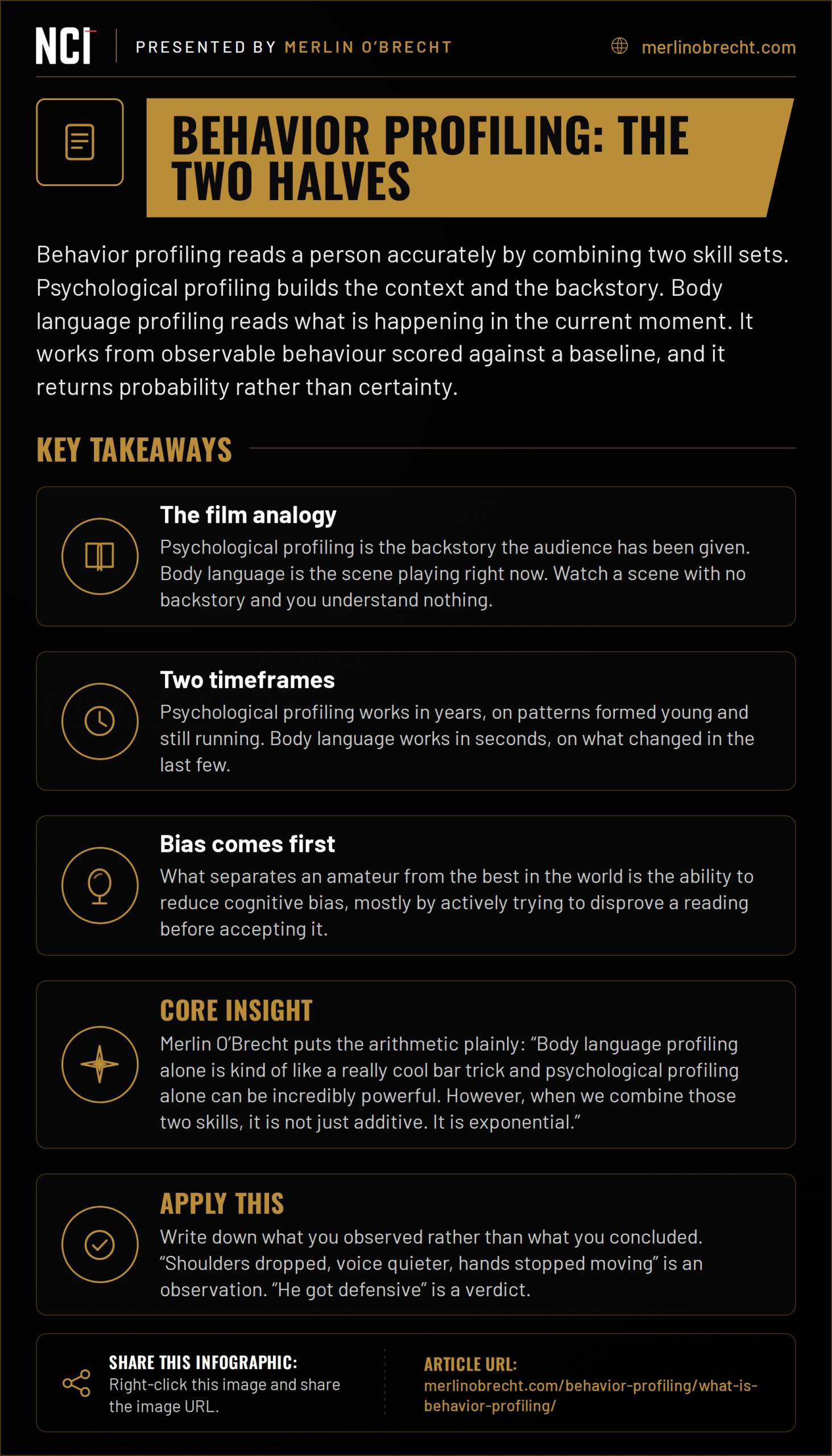
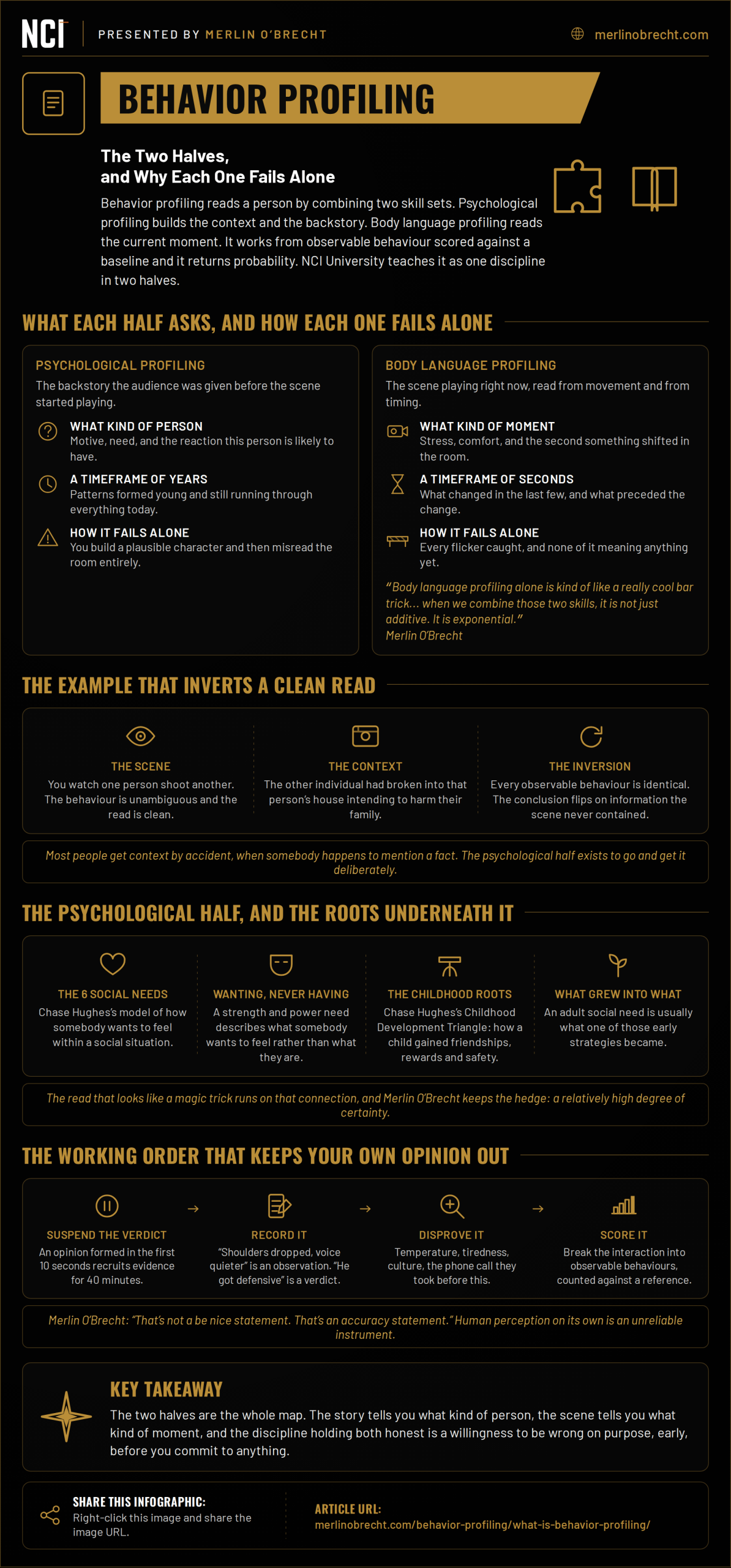
- Behavior profiling splits into psychological profiling (what kind of person is this) and body language profiling (what kind of moment are they in right now).
- Either half used alone produces confident, well-argued, wrong conclusions. The value sits in the combination.
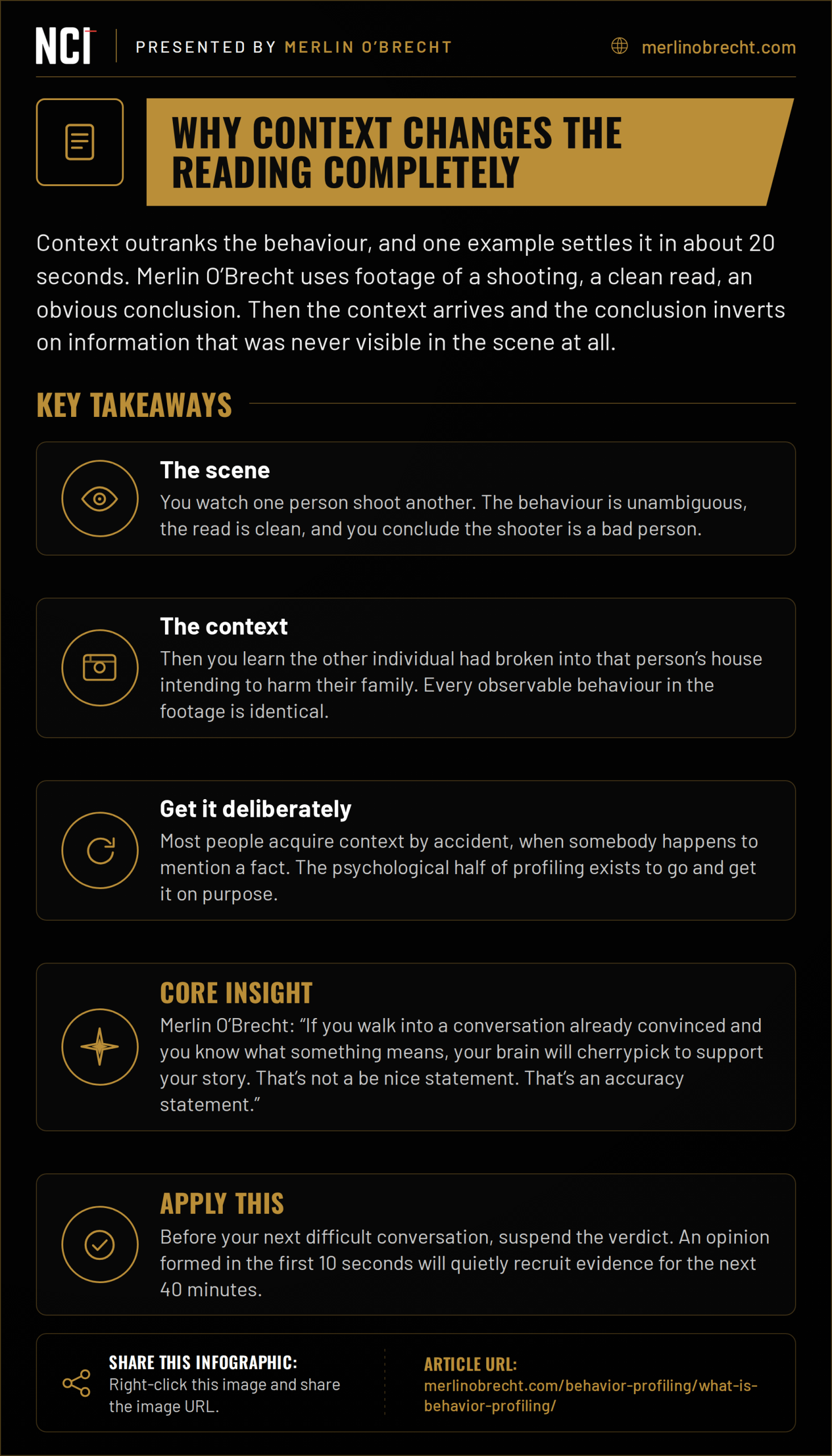
- What separates an amateur from a professional is the ability to reduce your own cognitive bias, mostly by actively trying to disprove what you think you are seeing.
- The psychological half runs on Chase Hughes's six social needs, and underneath those sits his Childhood Development Triangle.
- Behavior profiling and applied behavior analysis are different disciplines with different training and different scopes, and they get confused constantly.
What is behavior profiling?
The two halves, and what each one misses on its own
| Psychological profiling | Body language profiling | |
|---|---|---|
| The question it asks | What kind of person is this? | What kind of moment is this person in? |
| The timeframe | Years. Patterns formed young, still running. | Seconds. What changed in the last few. |
| What it gets you | Motive, need, likely reaction | Stress, comfort, the moment something shifted |
| How it fails alone | A plausible character, and you miss the room | Every flicker caught, none of it meaning anything |
| What it needs from the other half | A live scene to test the theory against | The backstory, so the scene means something |
Why context changes the reading completely
How do you profile behavior without your own opinion wrecking it?
- Suspend the verdict before you walk in. An opinion formed in the first 10 seconds will quietly recruit evidence for the next 40 minutes.
- Write down what you observed, not what you concluded. “Shoulders dropped, voice quieter, hands stopped moving” is an observation. “He got defensive” is a verdict wearing an observation’s clothes.
- Try to disprove your own reading first. What else could explain this? Temperature, tiredness, culture, the last phone call they took. If the read survives that, it is worth something.
- Score it instead of feeling it. An interaction can be broken into observable behaviours, counted and scored against a reference. That is the difference between profiling and vibe reading.
The psychological half: the six social needs
- Acceptance. Wants to belong, as a genuine part of the group.
- Approval. Wants to be told, explicitly, that what they do is appreciated.
Intelligence. Wants to be seen as smart, and as somebody who understands how things work. - Significance. Wants to be seen as important, as the one who made the difference.
- Strength and power. Wants control, and wants the room to know where it sits.
- Pity. Wants their difficulty acknowledged, and credit for carrying it.
The full model, with the four rules for using it without being obvious, sits on the six social needs, with a worked example for each.
The childhood roots underneath the needs
The body language half: what a current-moment read gets you
That filter has five parts and a name, and it lives on the five filters that keep a body language read accurate.
Is behavior profiling the same as behavioral analysis?
Where the reading stops and the practice starts
Frequently asked questions
Behavior profiling is reading a person by combining what kind of person they are, built from their patterns and needs, with what kind of moment they are in, read from their behaviour right now. Together those produce an accurate read. Separately they produce a confident guess.
Four steps. Establish their baseline, meaning how they look and sound when nothing is happening. Watch for a change from it. Require a cluster before concluding anything. Then place what you saw against their context, their culture and what they want to be seen as.
NCI University’s NCI-2 Behavior Profiler course runs 12 hours, so the reference material is learnable quickly. Reading a live conversation reliably, while participating in it, takes months of repetitions against real footage. No licensed profession sits at the end of this, so there is no exam date to aim at.
Where to go from here