Merlin O'Brecht

Behavior profiling

Behavior profiling: what it actually is, and why half of it fails on its own

By Merlin OBrecht · Dean of Academic Affairs, NCI University

Behavior profiling

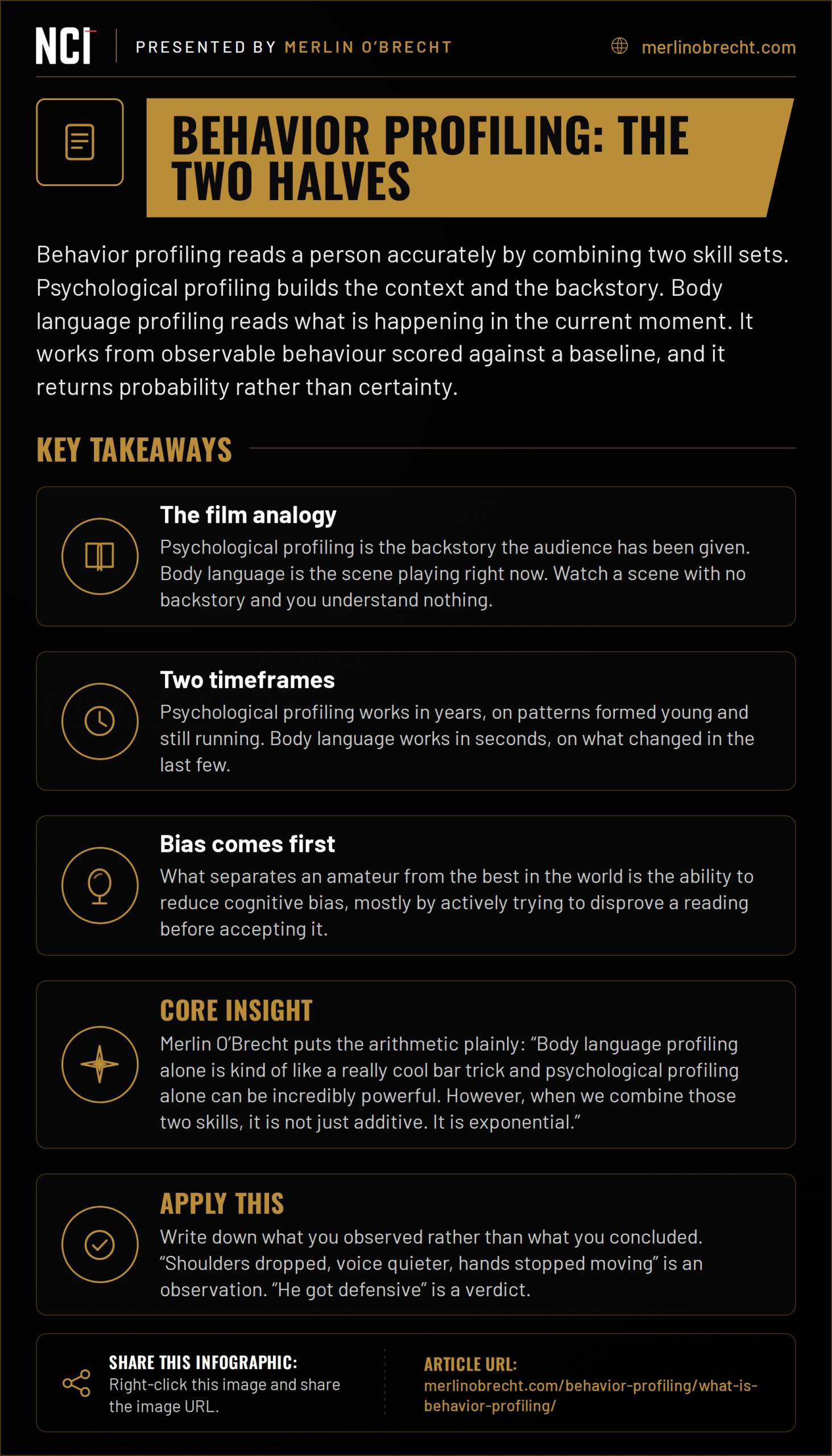
Behavior profiling is the combination of two separate skills: psychological profiling, which asks what kind of person this is, and body language profiling, which asks what kind of moment they are in. NCI University teaches both together because either one alone produces confident misreadings. Merlin OBrecht calls body language on its own a bar trick.
Everything anyone will ever teach you about reading people fits inside one of two categories. Most people spend years working on one of them and never find out the other exists.
That is why the reads keep failing at the exact moment accuracy matters. You watched the scene and you never got the story.
“Body language profiling alone is kind of like a really cool bar trick and psychological profiling alone can be incredibly powerful. However, when we combine those two skills, it is not just additive. It is exponential.”
I said that on camera in February 2026 and I stand behind the arithmetic. What follows is the clean version: the two halves, what each one asks, and the discipline that keeps both honest.

Key takeaways

What is behavior profiling?

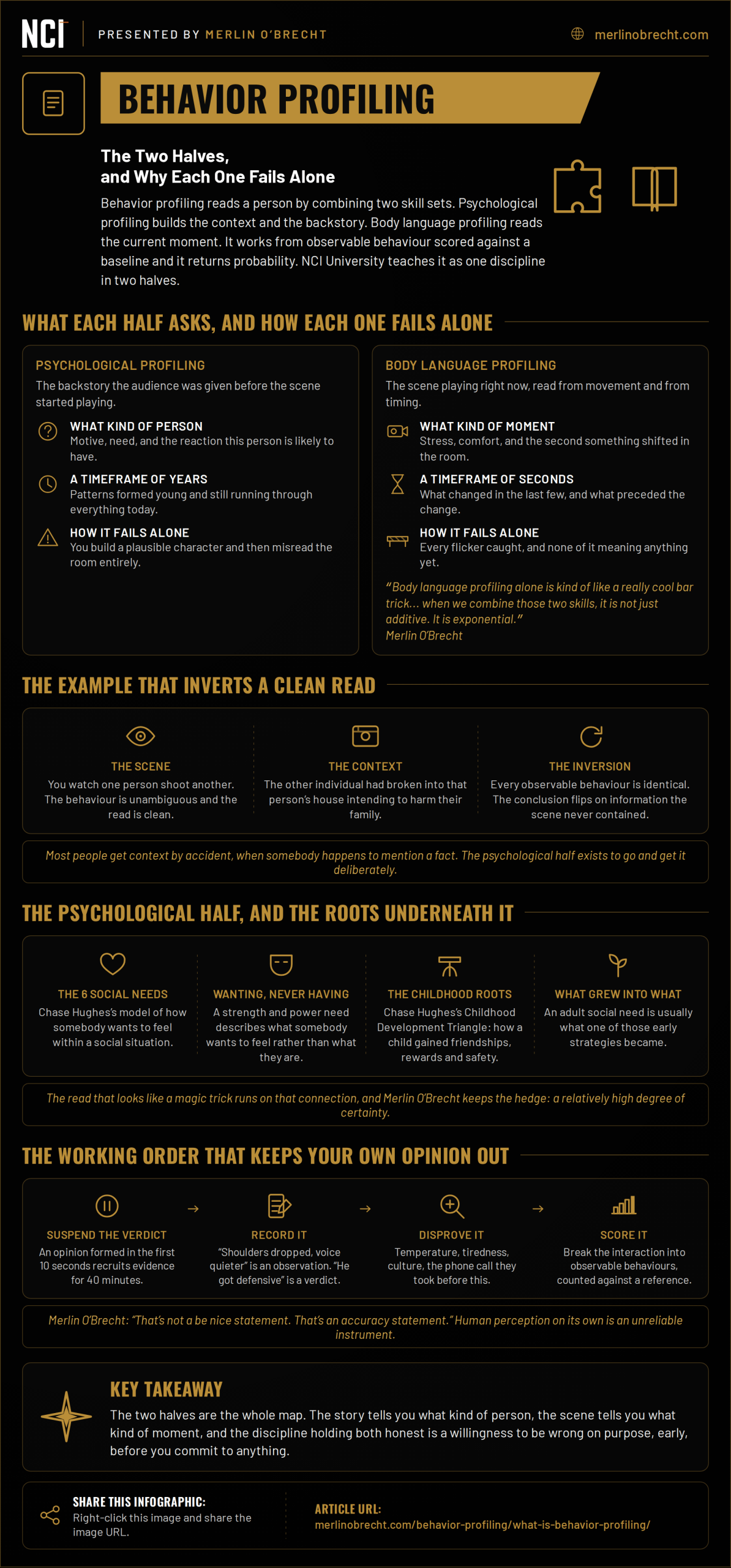
Behavior profiling is the practice of reading a person accurately by combining two skill sets: psychological profiling, which builds the context and the backstory, and body language profiling, which reads what is happening in the current moment. It works from observable behaviour scored against a baseline, and it returns probability rather than certainty. NCI University teaches it as one discipline in two halves.
Everything you will ever learn about profiling fits into one of those two groups. Not most of it. All of it.

The two halves, and what each one misses on its own

Think of it as a film. Psychological profiling is the backstory the audience has been given. Body language is the scene playing right now. Watch a single scene with no backstory and you will follow it perfectly and understand nothing.
Psychological profiling Body language profiling
The question it asks What kind of person is this? What kind of moment is this person in?
The timeframe Years. Patterns formed young, still running. Seconds. What changed in the last few.
What it gets you Motive, need, likely reaction Stress, comfort, the moment something shifted
How it fails alone A plausible character, and you miss the room Every flicker caught, none of it meaning anything
What it needs from the other half A live scene to test the theory against The backstory, so the scene means something
Run one without the other and you get a person who is very sure and frequently wrong, which is a worse outcome than not reading at all, because at least the person who is not reading knows they do not know.

Why context changes the reading completely
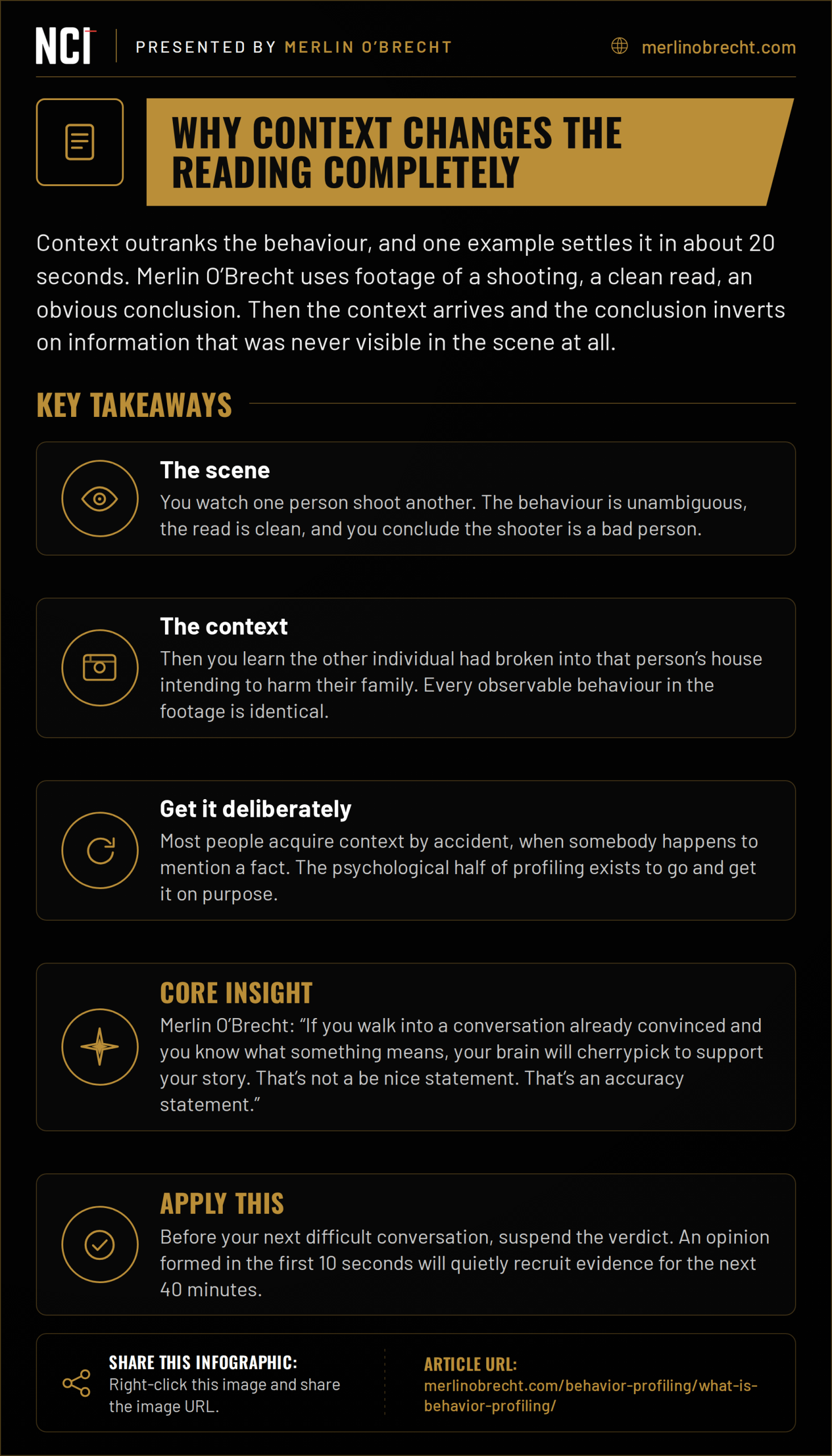
Here is the example I use, because it does the work in about 20 seconds.
You watch footage of one person shooting another person. You immediately assume the shooter is a bad person, and that is a relatively fair assumption from what you can see. The behaviour is unambiguous. The read is clean.
Then you get the context. The other individual had broken into that person’s house and was intending to do harm to that person’s family.
Nothing about the footage changed. Every observable behaviour is identical. Your conclusion inverted completely, on information that was never visible in the scene at all.
If you have ever changed your mind about somebody the moment you learned one fact about their history, you already know why context outranks the behaviour. What most people lack is a way to get that context deliberately rather than by accident, which is what the psychological half is for.

How do you profile behavior without your own opinion wrecking it?

You suspend judgment before you enter, record what you observed rather than what you concluded, and actively try to disprove your own reading before you accept it. One of the first principles taught in interrogation schools is a suspension of judgment, for a reason that has nothing to do with being fair-minded.
“If you walk into a conversation already convinced and you know what something means, your brain will cherrypick to support your story. That’s not a be nice statement. That’s an accuracy statement.”
The single biggest difference between an amateur at this and somebody genuinely one of the best in the world is their ability to reduce and minimise cognitive bias. Skill is downstream of that. Here is the working order.
  1. Suspend the verdict before you walk in. An opinion formed in the first 10 seconds will quietly recruit evidence for the next 40 minutes.
  2. Write down what you observed, not what you concluded. “Shoulders dropped, voice quieter, hands stopped moving” is an observation. “He got defensive” is a verdict wearing an observation’s clothes.
  3. Try to disprove your own reading first. What else could explain this? Temperature, tiredness, culture, the last phone call they took. If the read survives that, it is worth something.
  4. Score it instead of feeling it. An interaction can be broken into observable behaviours, counted and scored against a reference. That is the difference between profiling and vibe reading.
Step 4 sounds mechanical and it is meant to. Human perception on its own is an unreliable instrument, and the fix is to build something the perception has to pass through.

The psychological half: the six social needs

The six social needs are Chase Hughes’s model, describing how somebody wants to feel in a social situation. Acceptance, approval, intelligence, significance, strength and power, and pity.
  1. Acceptance. Wants to belong, as a genuine part of the group.
  2. Approval. Wants to be told, explicitly, that what they do is appreciated.
    Intelligence. Wants to be seen as smart, and as somebody who understands how things work.
  3. Significance. Wants to be seen as important, as the one who made the difference.
  4. Strength and power. Wants control, and wants the room to know where it sits.
  5. Pity. Wants their difficulty acknowledged, and credit for carrying it.
Get accurate at reading these and it feels close to a superpower, mostly because so few people do it deliberately. My advice for anyone starting is to not overintellectualise it. Somebody who loves explaining how things work is an intelligence need. Somebody counting the size of their accomplishments out loud is a significance need. The question is simply how this person wants you to see them, and you usually have a decent intuitive answer already.

The full model, with the four rules for using it without being obvious, sits on the six social needs, with a worked example for each.

The childhood roots underneath the needs

Most people never get to this layer, and it is where the psychological half stops being a personality quiz.
“If the social needs were a tree, the roots of that tree are actually the childhood development triangle.”
Chase Hughes’s Childhood Development Triangle has three roots: how you gained friendships as a child, how you gained rewards, and the things that kept you safe. A social need in an adult is what one of those strategies grew into.
That connection produces the read that looks like a magic trick. When somebody good at this deduces something about your childhood in a normal conversation, here is the mechanism: if I accurately understand your social needs, and I understand your culture and the background you come from, I have a pretty good sense with a relatively high degree of certainty of what occurred for you as a child.
Read that hedge carefully. A relatively high degree of certainty, from a person who has read a lot of people and knows what these patterns usually grow from. Not a fact about your childhood.

The body language half: what a current-moment read gets you

Body language tells you what is happening right now, in this exact second. That is a genuinely useful job, because the current moment is where every decision you are about to make actually lives.
What it cannot do is tell you why. Stress in the body looks the same whether it came from your question, from the meeting before this one, or from the flight of stairs they just climbed. Which is why the professional version runs every observed behaviour through a filter before allowing it to mean anything.

That filter has five parts and a name, and it lives on the five filters that keep a body language read accurate.

Is behavior profiling the same as behavioral analysis?

Different fields, and the overlap in the words causes real confusion. Applied behaviour analysis is a clinical and educational discipline with a board certification, a supervised training pathway and a regulated scope of practice, largely concerned with changing behaviour in a therapeutic or educational setting.
Behavior profiling as taught at NCI University is an observational skill set for live human interaction: reading a person accurately in the room, in real time, in a conversation, a negotiation or an interview. No licence exists for it and none is implied. If you arrived looking for the clinical discipline, the term you want is applied behaviour analysis.

Where the reading stops and the practice starts

Everything above is readable. You can finish this page understanding the two halves, the six needs, the three childhood roots and the discipline that keeps a read honest, and be genuinely ahead of where you were an hour ago.
The part a page cannot hand over is the combination. Running the psychological read and the body language read at the same time, on a live person, while holding up your end of the conversation, is a different skill from understanding either one, and the only thing that closes that gap is repetitions with somebody who tells you when you were wrong. That is what the NCI-2 Behavior Profiler course is built around: 12 hours of material, 22 video modules and 32 skills-building calls with facilitators, $795.
One honest warning first. The initial thing this training works on is your own bias, which is the least interesting part of profiling to almost everybody who arrives wanting to read other people.

Frequently asked questions

What is behavior profiling in simple terms?

Behavior profiling is reading a person by combining what kind of person they are, built from their patterns and needs, with what kind of moment they are in, read from their behaviour right now. Together those produce an accurate read. Separately they produce a confident guess.

How do you profile someone's behavior?

Four steps. Establish their baseline, meaning how they look and sound when nothing is happening. Watch for a change from it. Require a cluster before concluding anything. Then place what you saw against their context, their culture and what they want to be seen as.

How long does it take to become a behavioral profiler?

NCI University’s NCI-2 Behavior Profiler course runs 12 hours, so the reference material is learnable quickly. Reading a live conversation reliably, while participating in it, takes months of repetitions against real footage. No licensed profession sits at the end of this, so there is no exam date to aim at.
Is behavior profiling real, or is it pseudoscience?
It depends what is being claimed. That a gesture carries a fixed meaning does not survive contact with evidence, and this method rejects it. The actual claim is narrower: behaviour that deviates from a person’s own baseline, appears in clusters and survives a check for other explanations shifts a probability. Hence probability rather than verdict.
What is the difference between behavior profiling and criminal profiling?
Criminal profiling infers the characteristics of an unknown offender from crime scene evidence, after the event. Behavior profiling reads a specific person who is in front of you, while they are in front of you. Different data, different timeframe, different purpose.
How do managers and interviewers use behavior profiling?
A hiring manager who built a candidate’s baseline during the first 5 minutes of easy questions can see which later question moved it, which shows where to ask more rather than what to believe. A single reading is a reason to explore further, and acting on one unconfirmed is how a good method produces a bad decision.
Can you really read someone accurately just by watching them?
Not from watching alone. Accuracy comes from a cluster of behaviours measured against that person’s own baseline and checked against context and culture, and even then the output is a probability. The best profilers I have met speak almost entirely in probabilities, which is what makes them accurate rather than lucky.
Who created the behavior profiling system taught at NCI?
Chase Hughes built it. The six social needs, the Childhood Development Triangle, the Behavioral Table of Elements and the C5 filter are all his, taught through NCI University’s ladder from NCI-1 Behavior Observer into NCI-2 Behavior Profiler. My own role is teaching and translation rather than authorship.
Is it ethical to profile people without telling them?
The test Chase Hughes teaches: if the other person could see your full intent, would they agree it was in their interest? Reading somebody so you can respond to what they need passes comfortably. Reading somebody so you can find the pressure point does not, and the skill is identical either way.
What is the first step to learning behavior profiling properly?
Observation practice, before any purchase. Pick one person you see regularly and establish their baseline over a week: how they sit, speak, pause and move when nothing is happening. Almost nobody has done this once, and it is what everything else gets measured against.

Where to go from here

The two halves are the whole map. Psychological profiling gives you the story, body language gives you the scene, and the discipline that keeps both honest is the willingness to be wrong on purpose, early, before you commit.
If you want the structured version, where the two halves get trained together and somebody experienced tells you what you missed, that is NCI-2 Behavior Profiler. 12 hours, 22 video modules, 32 skills-building calls, $795.
If you would rather buy nothing, do the baseline exercise on one person this week. Almost nobody does it, and everything else here is measured against it.