Merlin O'Brecht

How to get information without asking

Elicitation techniques: how to get information without asking questions

By Merlin OBrecht · Dean of Academic Affairs, NCI University

Elicitation techniques

Elicitation techniques get information without asking for it, by giving people something to correct rather than something to answer. Merlin OBrecht teaches a three-part method: read the context and the person’s baseline, drop a slightly wrong statement people feel pulled to fix, then stack or pivot. Chase Hughes’s Hourglass Method buries the sensitive part in the middle.
Most advice on this subject amounts to “ask better open-ended questions.” That advice is what produces the interview feeling you are trying to avoid.
What follows is the mechanism instead: why questions cost you information, the reflex that gets it back, a structure for the sensitive part, and a set of signals telling you to stop.
One thing before any of it.
“I sincerely hope that every one of you use this to leave people better than you found them. Don’t be some kind of a weird creep with these skills.”
If nothing else, this page gives you the awareness to notice when someone is running these things on you in a way that is less than admirable. That is a real reason to read it and I would rather you had the skill than not.

Key takeaways

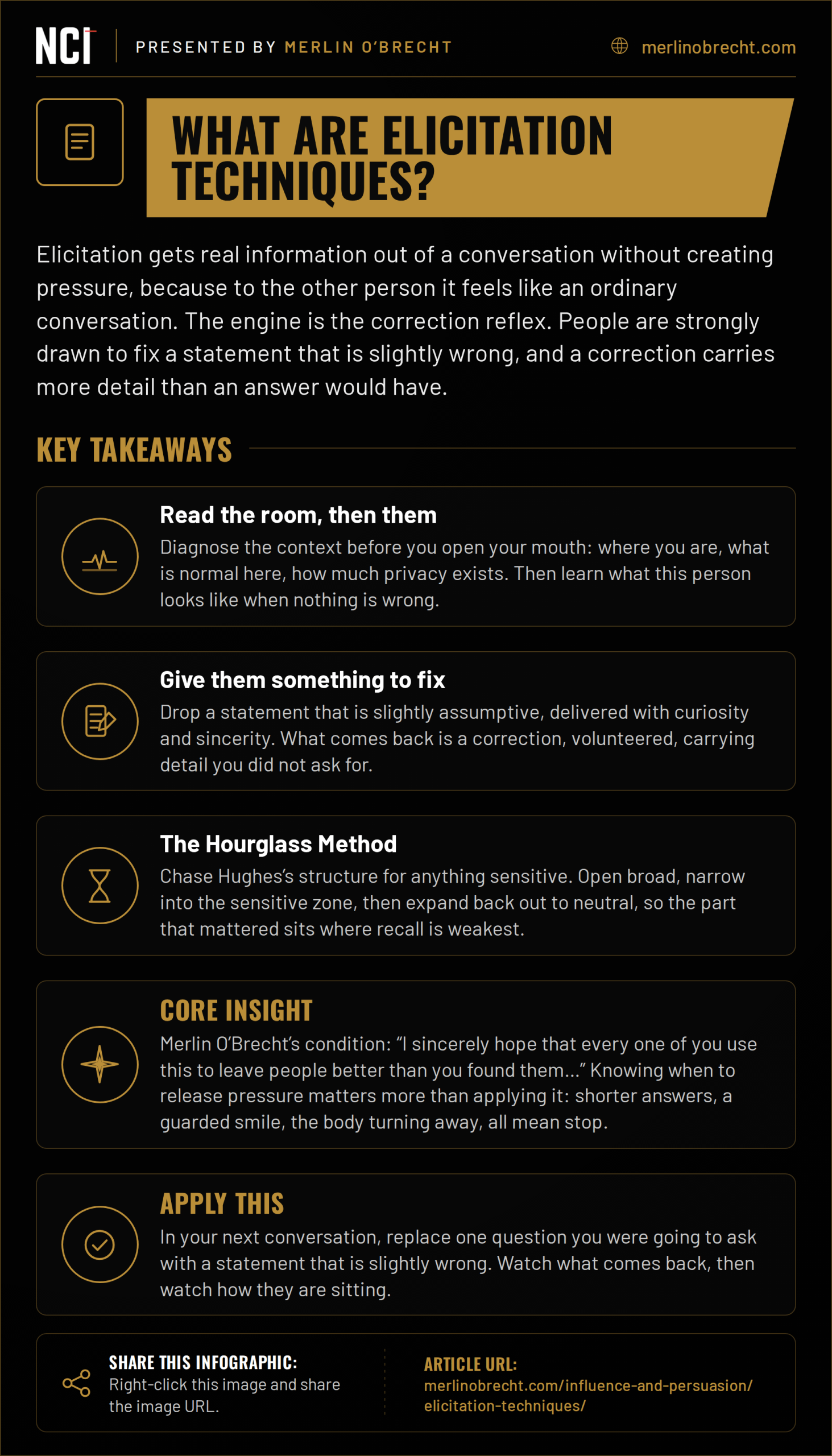
What are elicitation techniques?

Elicitation techniques get real information out of a conversation without creating pressure, because to the other person it feels like a normal conversation. The mechanism underneath almost all of them is the correction reflex: people are strongly drawn to fix a statement that is slightly wrong, and a correction carries more detail than an answer to a question would have.
That is the whole engine. Statements rather than questions, and the person volunteers what you were after.

Why direct questions close people down
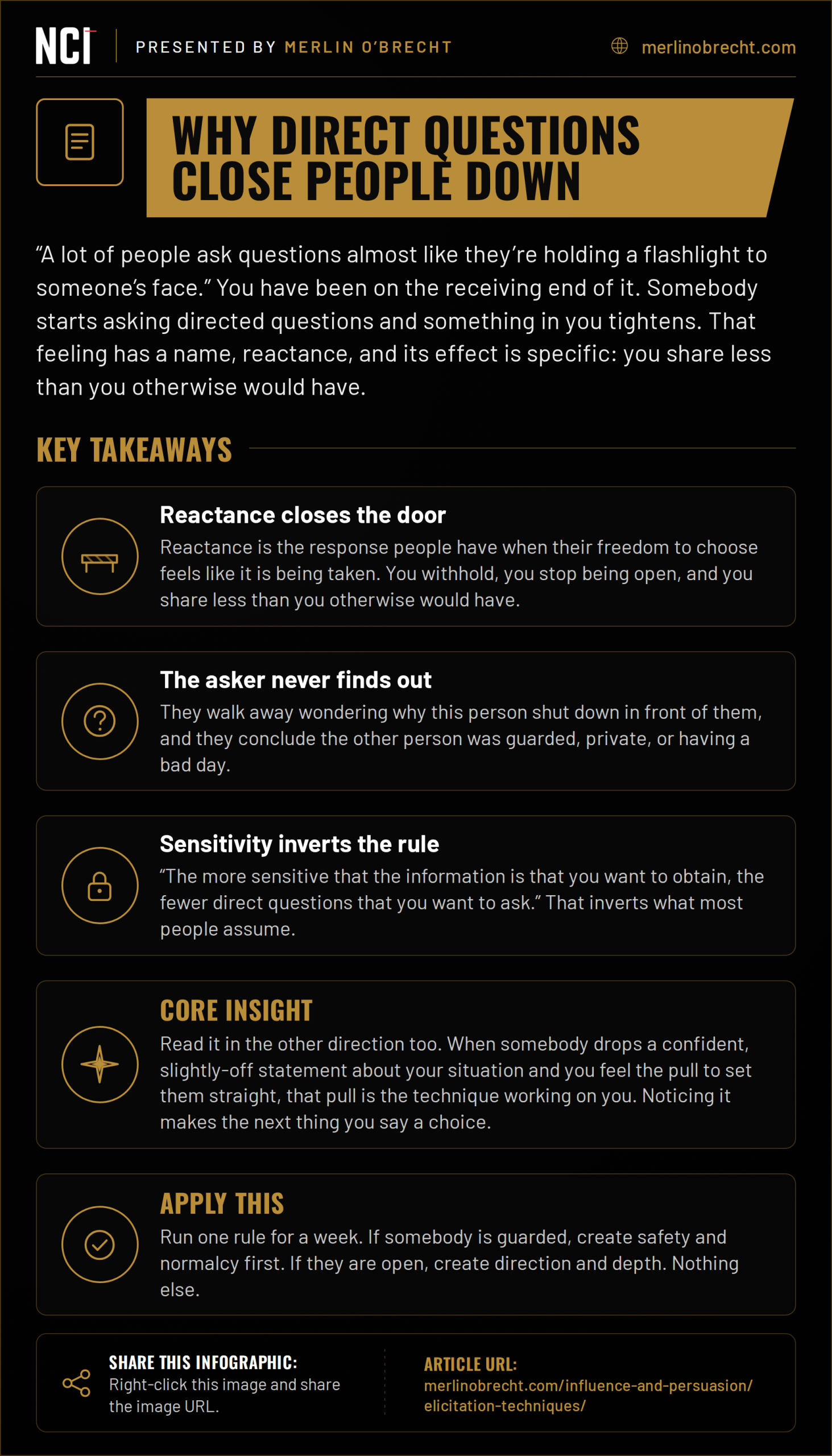
“A lot of people ask questions almost like they’re holding a flashlight to someone’s face.”
You have been on the receiving end of it. Someone starts asking directed questions and something in you tightens. That feeling has a name, reactance, and its effect is specific: you withhold, you stop being open, you share less than you otherwise would have.
The part that matters is what happens on the other side of it. The person asking almost never understands what they did. They walk away wondering why this person shut down in front of them, and they conclude the other person was guarded, or private, or having a bad day.
If you have ever gone quiet on someone because the questions started to feel like a form, you already know what reactance feels like from the inside. You have the data. This page is about not producing it in other people.

How do you get information without asking questions?

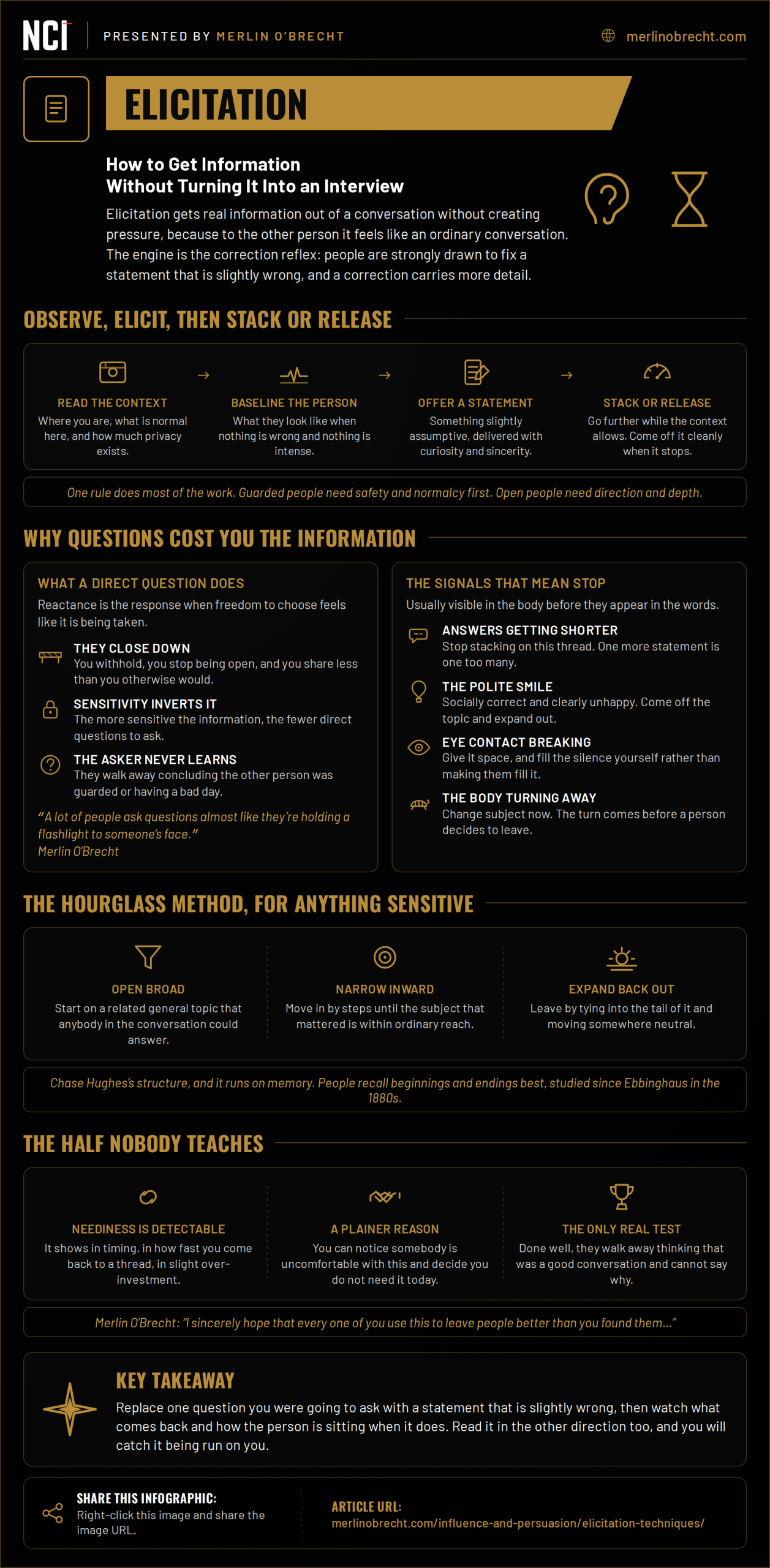
Three steps, and they run in this order every time.
  1. Observe the context and the baseline. Diagnose the room before you open your mouth, then read what this person looks like when nothing is wrong.
  2. Elicit with a statement, not a question. Give them something slightly assumptive to correct, delivered with curiosity, sincerity and confidence.
  3. Stack, or pivot and relieve pressure. Go deeper on the thread if the context still allows it. Come off it cleanly if the signals say stop.
Nothing here is magic words. It is a formula: baseline, direction without reactance, and pressure control.

Step one: reading the room before you open your mouth

Context is a set of invisible rules, and breaking the wrong one triggers reactance instantly. Three questions diagnose it.
Where are we? A public space, a workplace, a social group, and old friends you grew up with are four different rule sets. What is normal here? Some contexts expect quick polite exchange and treat depth as an intrusion. Others expect depth and treat surface talk as a snub. How much privacy exists? The felt need for privacy changes what a person will reveal more than almost anything else in the environment.

Then the person. Baseline is the simplest idea in behaviour reading and the most skipped: what do they look like when nothing is wrong and nothing is intense. Watch pace of speech, eye contact, comfort, gestural size, and emotional temperature. Some people make small closed movements at rest. Some make large ones. Neither means anything until you know which one this person is, which is how to read the baseline this method depends on.

The practical rule is the most portable sentence in the whole method. If somebody is guarded, your job is to create safety and normalcy first, above everything else. If they are open, your job is to create direction and depth.
This flow, context then baseline, is how elicitation is written down in Chase Hughes’s Behavior Ops Manual.

Step two: the statement people cannot help correcting

Here is the core principle, and it inverts what most people assume.
“The more sensitive that the information is that you want to obtain, the fewer direct questions that you want to ask.”
So instead of a question, you drop a statement that is slightly assumptive. Slightly wrong in a direction the other person will feel pulled to fix.
Say you are in an Uber and you are curious what the driver actually earns. The direct version, how much do you make, is a flashlight in the face. The elicitation version sounds like this:
“Man, it seems like being an Uber driver must be such a good paying job. I mean, I’m taking these rides all the time and I see what the prices are on the app. I heard from one of my friends that you guys get to keep almost the entire fare.”
What comes back is a correction. No, Uber takes this much of the fare, and on a good day I barely clear that. You did not pry and you did not demand anything. They volunteered it, and you got a data point you had not even asked for.
That example exists to demonstrate the reflex. It is not a template for extracting financial details from people who are working.
Worth reading it in the other direction too. When someone drops a confident, slightly-off statement about your situation and you feel the pull to set them straight, that pull is the technique working on you. Noticing it does not oblige you to stay quiet. It just means the next thing you say is a choice.

What is the Hourglass Method?

For anything genuinely sensitive, the statement needs a structure around it. Chase Hughes’s Hourglass Method gives it one, in 3 phases.
  1. Open broad. Start on a related general topic, not the specific thing you want.
  2. Narrow into the sensitive zone. Move inward in steps until the real data is in reach.
  3. Expand back out to neutral. Leave the topic by tying into the tail of it and moving on.
The fix is unglamorous. Slow down. Let the transition breathe. Show them it is safe before you ask them to go a level deeper.
The reason is memory. People recall the beginning and end of a conversation most clearly, an effect long-established in memory research going back to Ebbinghaus in the 1880s. Burying the sensitive detail in the middle puts it where recall is weakest.
Here is all 4 beats of it, on a subject people guard.
Broad. The dating scene has got strange with all the apps and the fixation on things that are basically temporary. General enough that anyone can respond, and they usually do, with something confirming or disconfirming.
Narrowing. “Yeah, I had an ex who really hated dating long distance.” Now the conversation has moved to specific relationships without a single question being asked.
Elicit. “It sounds like your last situation, and I could be wrong, but just from what you were sharing, it sounds like it had a pretty sharp ending.” Opened with as the first line, that produces reactance and a closed door. Arrived at through 2 broader beats, it produces an answer.
Expand. “Anyway, people are so different about commitment now. Have you seen that new show? There was a woman on it the guy was dating.” The topic moved on by attaching to the tail of the last one, which is what stops the sensitive part standing out in memory afterwards.

Step three: stacking, and knowing when to stop

Once you have a thread you want more of, you have 2 moves.
The first is stacking. It is normal for a first elicitation statement to produce a short response, something like “yeah, maybe sometimes.” That is not a failure and it should not throw you. Reorient, and stack another statement on the same thread as long as the social context still permits it.
Stack in 3 levels, in this order.

Elicit a fact. A statement that invites correction.
Elicit a story. “Can you walk me through that for a minute.”
Elicit emotion. Emotional recall, reached by sharing your own experience or by naming the impact you can see it is having on them.

The second move is pressure relief, and this is the half nobody teaches. The signals are visible and they are usually in the body before they are in the words.
Signal you are seeing What it calls for
Answers getting shorter on this thread Stop stacking. One more statement is one too many
The polite guarded smile, socially correct and clearly unhappy Come off the topic entirely and expand out
Eye contact breaking, gaze going elsewhere Give it space. Fill the silence yourself rather than making them fill it
Body closing off, ventral orientation turning away from you Change subject now. The turn happens before the person decides to end the conversation
An over-full answer that ends by changing the subject Take the exit they offered. Do not follow the thread back
A direct question coming back at you Answer it properly and honestly. They are checking what this conversation is
None of that means anything has failed. Reading these signals quickly is what allows openness and connection to keep building across the whole interaction, and it feeds every axis of Chase Hughes’s Six Axis model rather than just the information you came for.
There is also a plainer reason to release pressure. You can be a sincere, empathetic, kind person who notices that somebody is uncomfortable with this subject, and decide you do not need the information right now.

Why neediness is the thing that actually breaks it

“Anytime that we get stuck in that neediness or feeling like I have to have this thing from this person, we almost always guarantee that we will not achieve it.”
This is the argument that separates the method from tradecraft-flavoured advice, and it is worth sitting with.
Neediness is detectable. It shows up in timing, in the speed you come back to a thread, in the slight over-investment in a particular answer. The other person cannot always name what they are noticing, but they feel it as pressure, and pressure produces exactly the withholding you were trying to avoid.
Which means the state you are in going into the conversation is part of the technique. A person who genuinely does not need the answer today will get it more often than a person who does.

Using this in negotiation, hiring and everyday conversation

In a negotiation, the useful thing is almost never the number on the table. It is the constraint behind it, the deadline, the internal approval, the thing that cannot be said in a formal round. A statement like “sounds like your timeline on this is pretty open” gets corrected into the real one far more reliably than asking when they need it done.
In hiring, the same move surfaces why someone actually left a role. “Sounds like that was a good setup” invites the correction that a question would have received a rehearsed version of.

Beyond that it runs anywhere people talk: networking, dating, sales, parenting, and conflict repair, where it becomes how the same pressure control works in a live argument.

One caution that applies to all of them. Stacking past the point where somebody notices costs you more than the information was worth, because what they will remember afterwards is being worked on.

The test for whether you did it well

There is one standard and it lives entirely in what the other person walks away with.
Done badly, they think: why was that person interrogating me about that. Done well, they think that was a surprisingly good conversation, and they will often not be able to say why they enjoyed it.
That standard has an awkward property. You cannot administer it to yourself, because the entire method depends on the other person not noticing, which means the loop has no feedback in it unless somebody who knows what to look for is watching you run it.
The statements are easy to write and hard to time. Timing is the half that needs a person who has run this and can tell you which pivot you missed, and that is the shape of NCI-3 Behavior Scientist: 6 to 8 weeks, self-paced, $2,987.
If the goal is to extract something from somebody who would not give it to you knowingly, the method still works, and the ethics note at the top of this page was not decoration.

Frequently asked questions

What is elicitation?
Elicitation is getting information through ordinary conversation, using statements rather than questions. Instead of asking what someone earns, you say something slightly wrong about what you assume they earn, and they correct you with a figure they would not have handed over if you had asked for it.
How do you use elicitation in a conversation?
Four steps. Keep it socially normative and relevant to the context you are actually in. Stack statements to narrow in on the subject you want. Know when to move on, by pivoting or releasing the pressure using the hourglass shape. And stay empathetic enough to see yourself in the person in front of you.
How long does it take to learn elicitation?
The correction statement works the first time you try it, and most people are surprised by that. Reading when to relieve pressure is the slow half, because it depends on noticing small changes in a person you have only just baselined, and there is no way to build it except live repetitions with real people.
Does elicitation actually work on people who know about it?
Both answers are true. The correction reflex is not defeated by knowing it exists, which is why the technique still works on people who have studied it. A guarded person paying attention will notice a badly timed narrowing, though, and once they have noticed, everything after it is filtered.
What is the difference between elicitation and interrogation?
Elicitation removes pressure, and done properly the other person does not register that information was gathered at all. Interrogation applies pressure and both parties know exactly what is happening. They are different tools for different situations and neither one is the better version of the other.
How do you use elicitation in a negotiation?
Aim at the constraint rather than the price. “Sounds like you have got room on the timeline” gets corrected into the actual deadline, which tells you what the price is really made of. The caution is stacking past the point where they notice, because a counterparty who feels handled will get more guarded, not less.
Is elicitation just a fancy word for making conversation?
No. Ordinary good conversation has no direction. Elicitation has a target, a structure in the Hourglass Method, and a stopping rule in the pressure signals. Someone genuinely just chatting does not narrow in 3 beats and then expand back out to leave the sensitive part buried.
Where does elicitation training come from?
Interview and interrogation work, formalised into something teachable. Chase Hughes developed the frameworks used here, including the Hourglass Method, out of the interrogation training he has described from his Navy background, and the flow from context to baseline to elicitation is written down in his Behavior Ops Manual.
Is it ethical to use elicitation on someone who does not know?
My own answer is the one I give before teaching any of it: use this to leave people better than you found them, and do not be a creep with it. The gate Chase Hughes teaches settles the rest. Would this person, seeing everything you were doing and why, agree it was in their interest? If the honest answer is no, the fact that the technique works is not a reason to use it.
How do you practise elicitation safely?
Start with one low-stakes correction statement a day, on a subject that does not matter to you at all. When that stops feeling deliberate, spend a fortnight only baselining people and saying nothing. Add the hourglass last, on a topic you would happily abandon halfway through, because the skill you are building there is the abandoning.

Where to go from here

Take one thing into your next conversation: replace a question you were going to ask with a statement that is slightly wrong.
Watch what comes back. Then watch how the person is sitting when it does, because that is the other half.
If you want the version with somebody watching you run it, that is NCI-3 Behavior Scientist. 6 to 8 weeks, self-paced, $2,987.
If you would rather buy nothing, run the guarded-or-open rule for a week. Safety first for the guarded ones, direction and depth for the open ones, and nothing else.