How to de-escalate an argument
How to de-escalate an argument: the 4 steps, in order
By Merlin OBrecht · Dean of Academic Affairs, NCI University
How to de-escalate an argument
To de-escalate an argument, move the other person out of survival mode before you say anything reasonable. Merlin OBrecht teaches 4 steps: break the script with something unexpected, validate by conceding the argument, give one real observation about them, then open a collaborative frame instead of closing the conversation. Anger drops prefrontal activity, so logic lands on nobody.
A weeknight. Long day. You walk through the front door and your partner is at the kitchen table with the bank statement open. Or your brother says something at dinner about politics and you watch your dad’s jaw tighten.
What most of us do is react. We match whatever energy just got thrown at us, get louder or shut down completely, and quite often say the thing we have been holding for weeks, because it finally feels justified.
Four steps below, in order, with the words for each.
Before any of it. If there is a physical threat, a weapon, intoxication, or a pattern of abuse in the relationship, this page does not apply. Leave, get distance, and get help. None of what follows is a substitute for that and no communication technique makes an unsafe room safe.
Key takeaways
- Anger reduces prefrontal activity and raises limbic activity, so the reasonable version of what you want to say lands on a part of the brain that has gone offline.
- Every calming phrase people reach for is aimed at that offline part, which is why they escalate things.
- Step 2 works because conceding the argument is different from admitting fault, and only one of those costs you your position.
- The observation in step 3 has to be true. A hollow compliment mid-argument gets flagged instantly and costs you everything built so far.
- Almost everyone gets step 4 wrong by closing the conversation, at the exact moment the argument was nearly over.
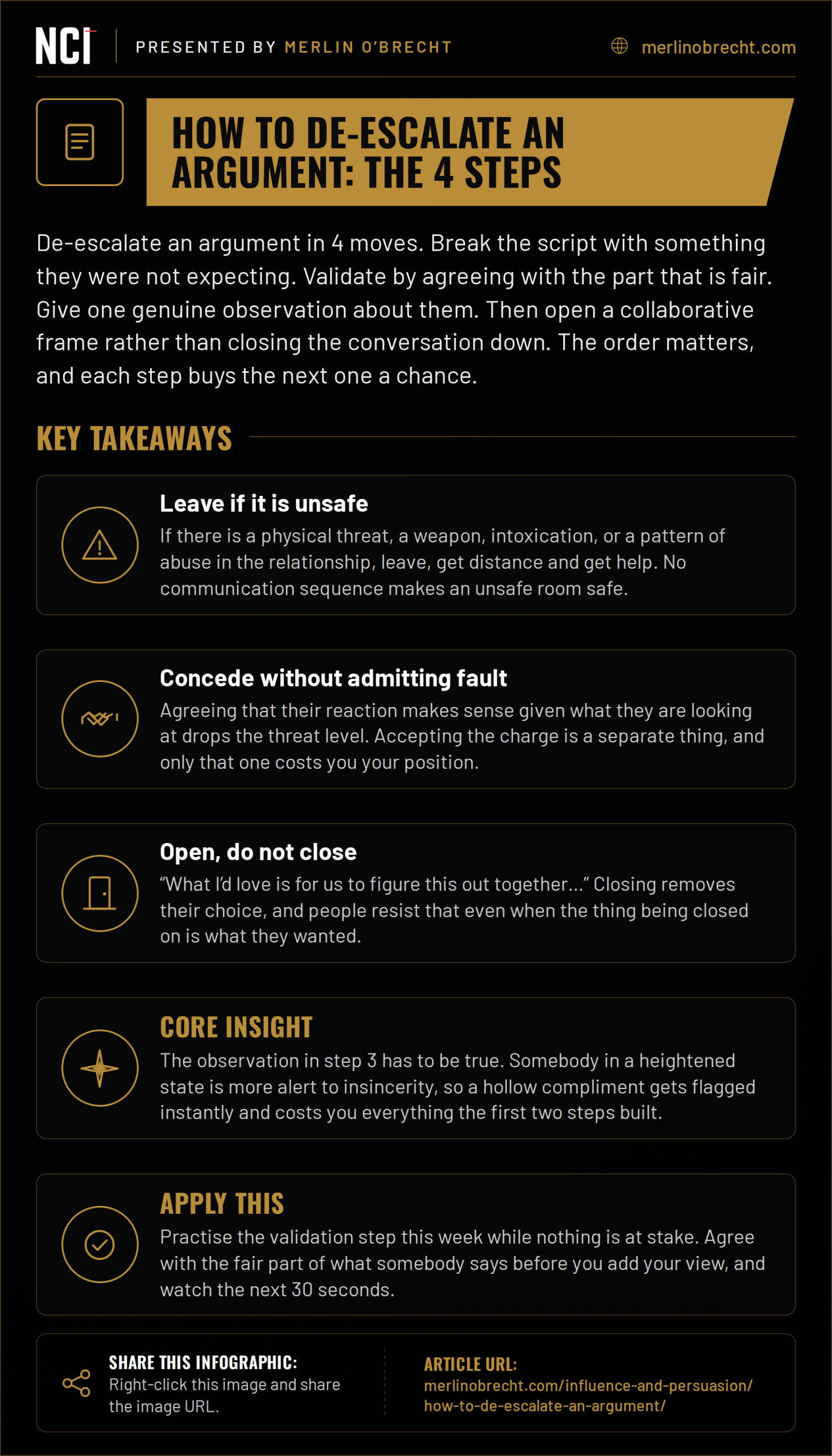
How do you de-escalate an argument?
De-escalate an argument in 4 moves: break the script with something they were not expecting, validate by agreeing with the part of it that is fair, give one genuine observation about them, then open a collaborative frame rather than closing the conversation down.
They run in that order for a reason. Each one buys the next one a chance of working, and step 4 attempted first is what turns a 5-minute argument into a 3-day one.
What is actually happening in the other person's head
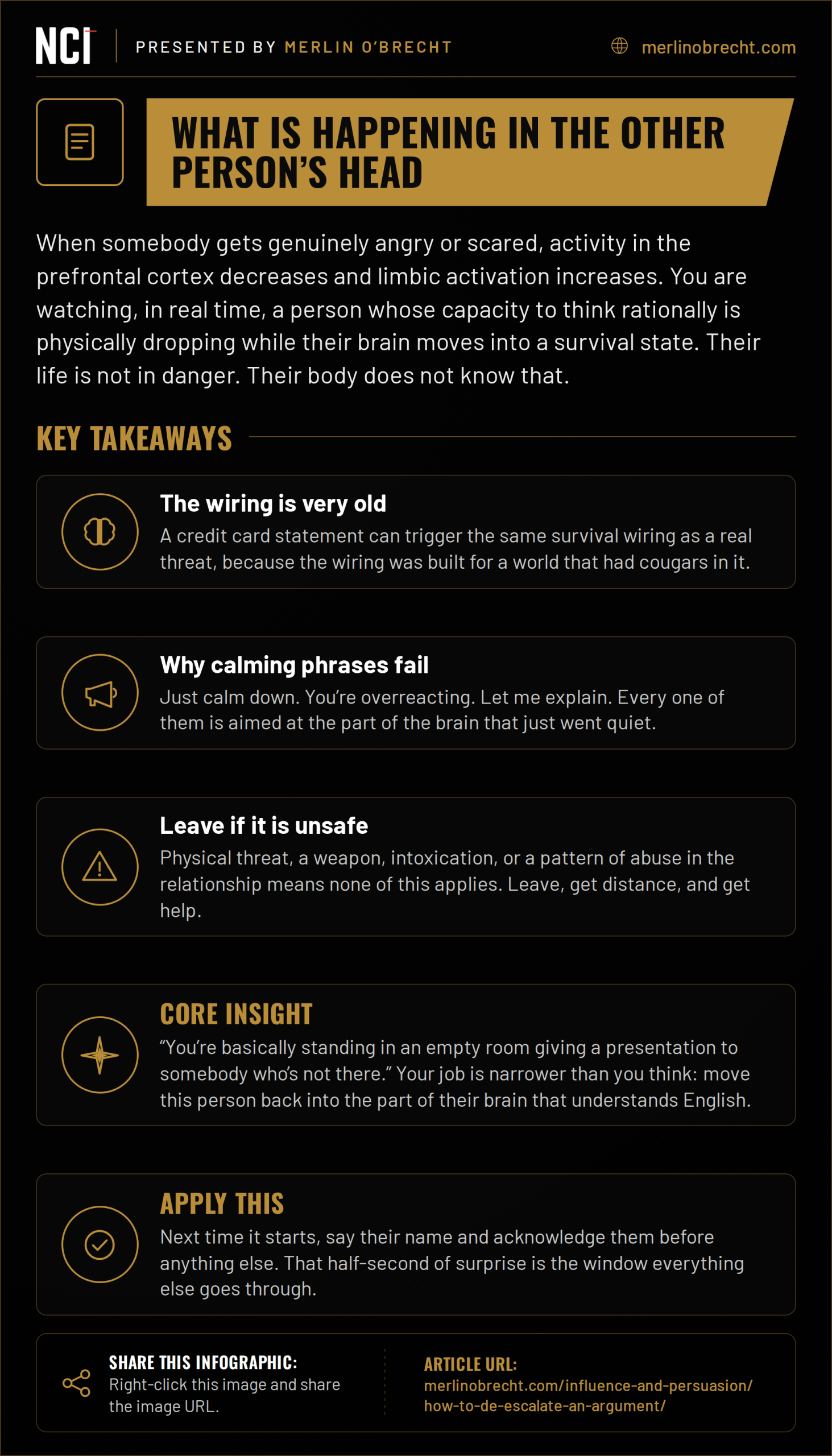
When somebody gets genuinely angry or scared, activity in the prefrontal cortex decreases. That is the region handling logic, reasoning, impulse control and long-term thinking, which is everything a productive conversation runs on. At the same time, limbic activation increases: the part that processes threat, fear, survival and emotion.
You are watching, in real time, a person whose capacity to think rationally is physically dropping while their brain moves into a survival state.
Their life is obviously not in danger. Their body does not know that. A credit card statement can trigger the same survival wiring as a real threat, because the wiring was built for a world that did not have credit card statements in it. It had cougars, and lions, and to some small degree grizzly bears.
Why "calm down" and "let me explain" both fail
Three phrases, and almost everybody reaches for at least one.
Just calm down. You’re overreacting. Let me explain what’s actually happening here.
Every one of them is aimed at rational logic and the prefrontal cortex, and that part of the brain just went quiet.
“You’re basically standing in an empty room giving a presentation to somebody who’s not there.”
If you have ever said “calm down” and watched it do the precise opposite, you already know the reasonable version does not work. Your job is narrower than you think: move this person out of survival mode and back into the part of their brain that understands English.
One warning ahead of the steps. There is a move at the very end that most people get wrong, and they get it wrong at the moment the argument was almost over. It is step 4, and it is the reason arguments restart after they have been settled.
What are the 4 steps to de-escalating an argument?
- Break the script. Say something they were not expecting, non-confrontationally. “Hey, Sarah, I completely hear you.”
- Validate. Agree with them. “I think you’re kind of right to be upset. Honestly, if I looked at a bank statement and saw a charge I didn’t know about, I’d be pretty annoyed too.”
- Observe. One true thing about them, aimed at competence, significance or intelligence. “You catch things I’d completely miss. You keep closer track of this than most people do.”
- Open, do not close. “What I’d love is for us to figure this out together, in a way where you don’t feel like you’re compromising on the things that actually matter to you.”
Step one: break the script
Here is the setup. You walk in, the laptop is open, the statement is beside it, and before your keys are down you hear: “Oh my God, $400? You spent $400 and you didn’t even think to mention it to me?”
Pause there, because that is the fork in the road, and by Merlin’s own rough estimate about 95% of people take the wrong path. Your limbic system is already loading a response. It was for work. You spend money too. Why are you going through my stuff?
Each one feels completely justified. Each one is a lit match in a room full of petrol.
Understand what the other person is doing. They are running a script. They already know how this argument goes, they have a line they have been working on, they expect yours, and they expect it to end with somebody storming off. Your first job is to break that script by injecting something unexpected enough that their brain has to stop and recalculate what this situation even is.
Sometimes it is as small as their name and an acknowledgement. They were braced for defence and they got seen instead, and that half-second of “wait, this is not how this usually goes” is your opening.
If you want to break the script harder, you can go further:
“Wow, $400? I can imagine that threw you for a loop when you saw that. Hey, did you notice that the neighbors finally mowed their lawn?”
That sounds absurd. It reads absurd. In practice the novelty pulls the brain out of the emotional spiral, because the pattern it was expecting is not available and it has to re-engage just to work out what is happening. Unexpected input forces a re-orientation of attention, which is commonly explained through the reticular activating system, though the popular version of that account is a simplification.
This is not the fix. It creates a brief behavioural window, and the next 3 steps are what you put through it.
Step two: concede the argument without admitting fault
Step through the window by doing the one thing nobody expects in a fight. You agree with them.
“You’re not admitting fault. What you’re doing is that you’re conceding the argument. And that distinction is really what changes everything.”
Conceding the argument means agreeing that their reaction makes sense given what they are looking at. Admitting fault means accepting the charge. Only the second one costs you your position, and the first one is what removes the thing they were bracing against.
The threat level drops. Maybe not all the way, but enough to continue.
Then stack undeniable truths on top: statements so plainly true that the brain has no option but to agree. It is Tuesday night. We are both tired. We are having this conversation because we both care where the money goes.
Every silent agreement builds a chain of unconscious agreement, and each link pulls their processing about 1% back toward the prefrontal cortex. You have stopped arguing and started syncing, and their suggestibility rises, which is what steps 3 and 4 need.
Step three: the observation that has to be true
Not a corny observation. A real one, aimed at something this person needs to feel about themselves: their competence, their significance, or their intelligence.
“You catch things I would honestly completely miss, and you keep closer track of this stuff than most people do. That is probably a large part of why our finances aren’t a disaster.”
What you are doing at this point is manufacturing calm inside another person’s body through genuine recognition. Through actually looking at the human in front of you and finding the thing that is true.
Here is the part you cannot skip. It has to be real. Drop a hollow compliment into a heated conversation and the other person’s brain, which is on high alert for exactly that, flags it instantly, and you lose everything you built in the previous 2 steps. Which means you have to pause and find something you actually mean.
Why does closing an argument make it start again?
Because closing removes their choice, and people resist that even when they agree with the thing being closed on.
Most people’s instinct at this point is to shut it down. So can we move on? Should we go watch our show? How long until dinner? The moment somebody feels their freedom to choose is under threat, they resist, and they will resist an option that is exactly what they wanted.
So the last move opens rather than closes. You shift out of a competitive frame and into a collaborative one that is difficult to decline.
| Competitive frame | Collaborative frame |
|---|---|
| “Here’s what we need to do going forward” | “What I’d love is for us to figure this out together” |
| Their brain hears an opponent, a winner and a loser | Their brain hears a teammate and an open question |
| The terms are being set for them | The terms are still being written and they hold a pen |
| They resist the terms, or accept and resent them | They add to the terms, which makes the terms theirs |
| The argument returns later, attached to the next one | The argument closes before it becomes the next one |
People fall into the competitive frame without noticing, get a strong negative reaction back, and cannot work out what they did. What they did was trigger a bid for competition while believing they were collaborating.
You are not asking them to agree with you. You are asking them to build something with you, and the previous 3 steps are what make that invitation land.
“The objective of good influence is to create a hallway or path whereby our preferred decision or behavioral choice becomes the natural, logical, and emotionally obvious solution for the person in front of us.”
Taking ownership before you are asked
One piece at the end, offered rather than extracted.
“I should have told you about the charge before you found it, and that’s on me.”
Ownership offered before it is demanded lands differently, because nothing before it escalated the situation and there is nothing left to defend. That is what lets the other person reach actual emotional closure rather than a truce. Timing is the whole thing here: the same sentence in the first 10 seconds is a bargaining chip, and in the last 10 seconds it is an apology.
The argument you win at the kitchen table is still in the room a week later. Closure is the only version that leaves.
De-escalating at work and with someone who is not your partner
A colleague comes to your desk angry about being left off a decision. The sequence is identical and only the words change.
Break the script by naming them and conceding the frame before they finish the sentence. Validate the part that is fair, which is usually that being told after the fact is genuinely bad. Observe one true thing, which at work almost always concerns competence, and it still has to be true. Then open: what does the version of this look like where you are in the room early enough for it to matter?
One caution specific to a customer or a colleague with a real complaint. If the substance of what they are saying is correct, the observation step reads as management technique unless the substance gets addressed first. Fix the thing, then use the sequence to keep the relationship intact while you do.
Understanding what somebody is actually defending is why the same argument keeps happening with the same person, and it is usually more useful than winning the current round.
How do you practise this before you need it?
“Please, do not wait for the next blowup to try this. Practice it when things are calm.”
Run the validation step in an ordinary conversation this week, where nothing is at stake and getting it slightly wrong costs you nothing. Build the muscle at low stakes, because the next argument is coming.
That is not because you are broken or your relationship is broken. It is because you are human, and being human means colliding with people you care about. That is the deal you make with life. The only real question is whether you collide the way you always have.
The 4 steps are easy to remember and hard to run while your own threat response is firing, which makes this a composure problem rather than a script problem. That layer is what NCI-3 Behavior Scientist works on alongside the influence architecture: 6 to 8 weeks, self-paced, $2,987.
Frequently asked questions
What does de-escalation mean?
De-escalation means moving somebody out of a threat state so that a conversation becomes physically possible again, rather than talking them out of a position. In this sequence it is 4 moves: break the script, validate, observe something true, and open a collaborative frame.
What do you say to calm someone down in an argument?
Four lines, in order. Use their name and acknowledge them, which breaks the script they were running. Agree with the fair part: “you’re right to be upset, I’d be annoyed too.” Say one true thing about them. Then open it up: “what I’d love is for us to sort this out together.” Skipping to the fourth line is what fails.
How long does it take to calm someone down using this?
The window opens in seconds, and the state takes minutes to come back. Somebody who has been escalated for an hour will not reset in one exchange, and expecting that is how people abandon the sequence halfway through. Steps 1 and 2 may need repeating before step 3 has anywhere to land.
Do de-escalation techniques actually work, or do people see through them?
They work when the observation step is true and they fail visibly when it is not, which is the most honest answer available. Somebody in a heightened state is more alert to insincerity, not less, so a hollow compliment is detected faster mid-argument than it would be over coffee. The mechanisms underneath are well established: a threat response reduces reasoning capacity, and people react against constrained choice.
What is the difference between de-escalation and just backing down?
Conceding the argument means agreeing their reaction makes sense given what they can see, which drops the fight and keeps your position. Backing down means dropping the position itself, and the sequence never asks you to do that.
How do you de-escalate a conflict with a colleague or a customer?
Same 4 steps, with the words adjusted for the setting and the observation aimed at competence. The caution is that a person with a genuine complaint needs the complaint addressed before anything else, because an observation offered while the underlying problem sits untouched reads as handling them, and they will name it.
Does agreeing with an angry person just encourage them?
No, and the fear behind that question is usually about admitting fault. Agreement removes the thing they were braced against, which drops the threat level. Conceding that their reaction makes sense given what they saw is different from conceding that they are right about the substance, and you can do the first without the second.
Where do these de-escalation steps come from?
This is Merlin’s own teaching structure for material he describes as drawn from behavioural negotiation and crisis-intervention practice, and he teaches it in this form inside NCI University’s curriculum. The underlying psychology is standard: threat responses, reactance, and suggestibility.
When should you not try to de-escalate and just leave?
If there is a physical threat, a weapon, intoxication, or a pattern of abuse in the relationship, leave. Get distance and get help from someone equipped to give it. No communication sequence makes an unsafe situation safe, and staying in the room to try one is the wrong call.
How do you get better at this without waiting for the next argument?
Use the validation step in ordinary conversation this week, on something that does not matter. Agree with the fair part of what somebody is saying before you add your own view, and notice how differently the next 30 seconds go. That is the whole drill, and it builds the reflex you will need when it is not a drill.
Where to go from here
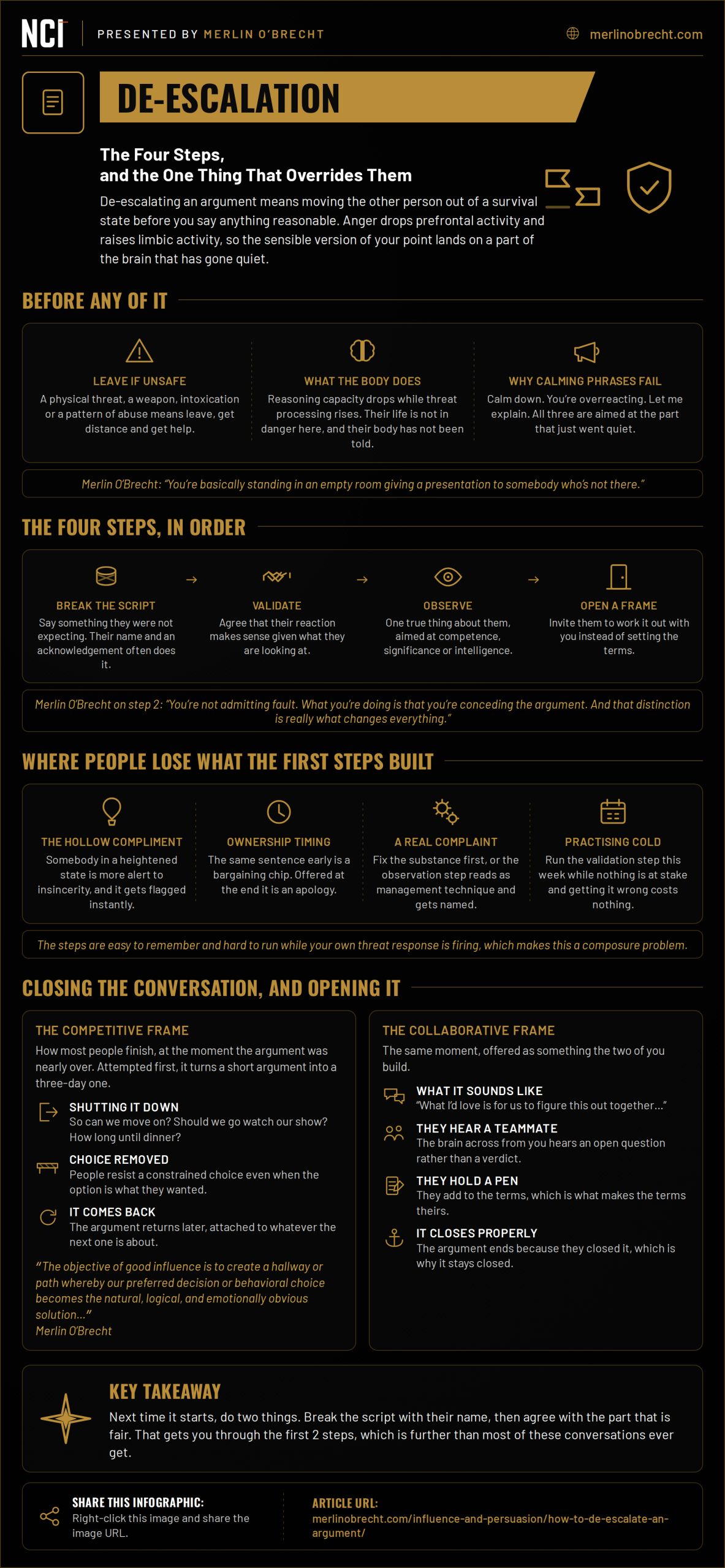
Next time it starts, do one thing. Break the script, then agree with the part that is fair.
That gets you past the first 2 steps, which is further than most conversations get.
If you want the version that also works on your own composure while you run it, that is NCI-3 Behavior Scientist. 6 to 8 weeks, self-paced, $2,987.
If you would rather buy nothing, practise the validation line this week while nothing is at stake.