Why people get defensive
Why people get defensive, and what actually gets through
Why people get defensive
Key takeaways
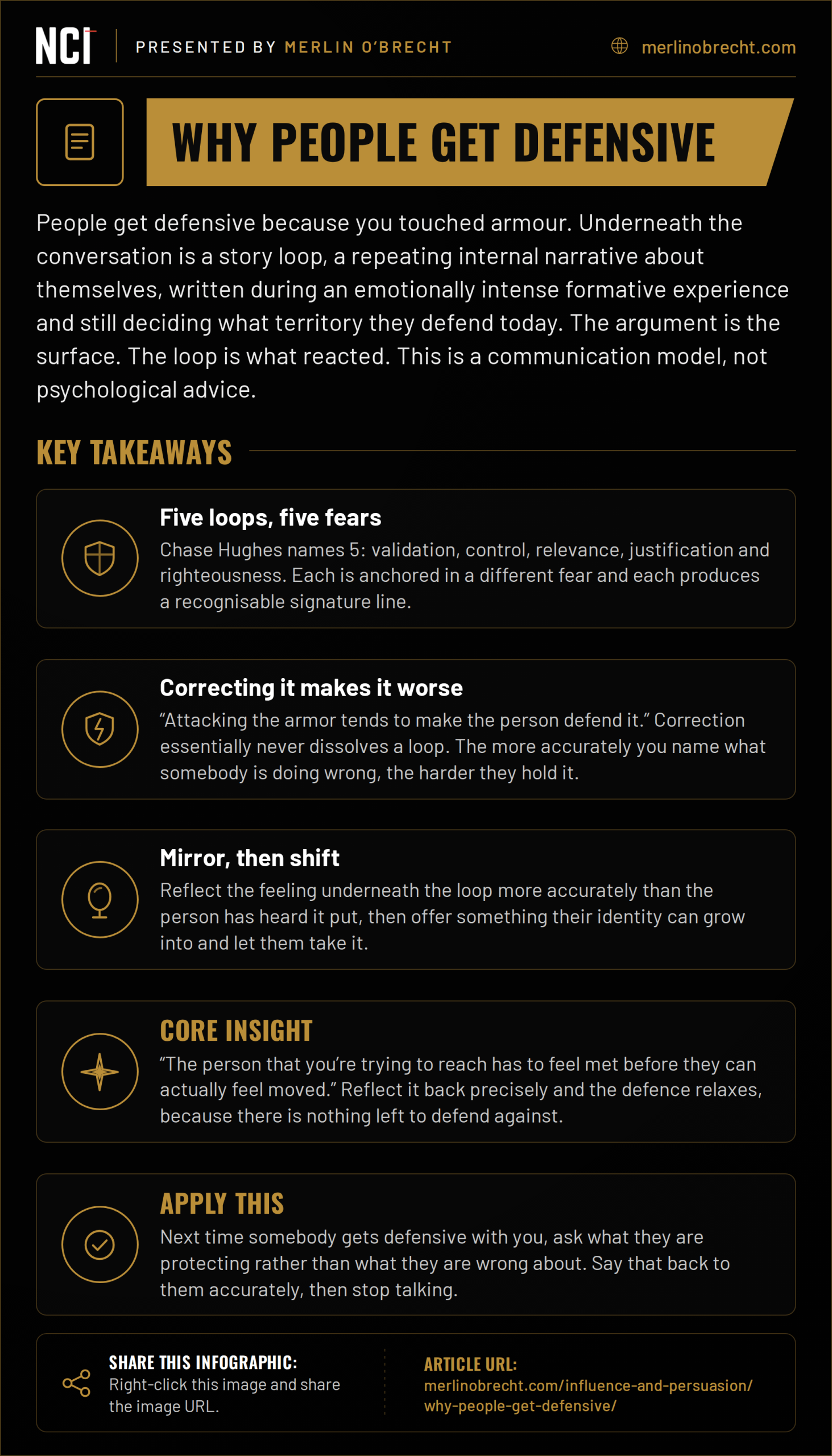
- Defensiveness is a response to a threat against identity rather than against an argument.
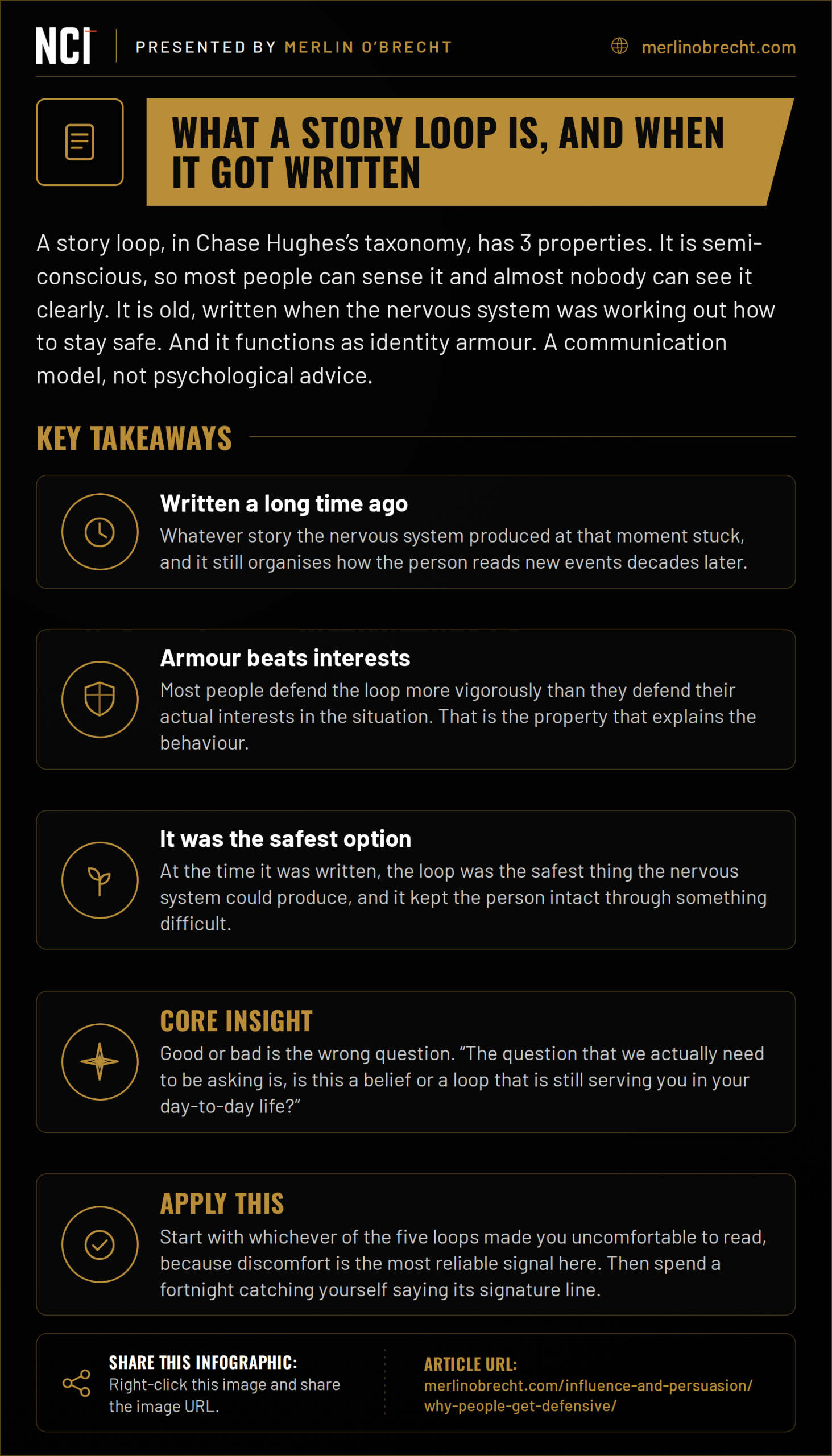
- A story loop is a repeating internal narrative, usually written decades ago, that decides what territory a person defends.
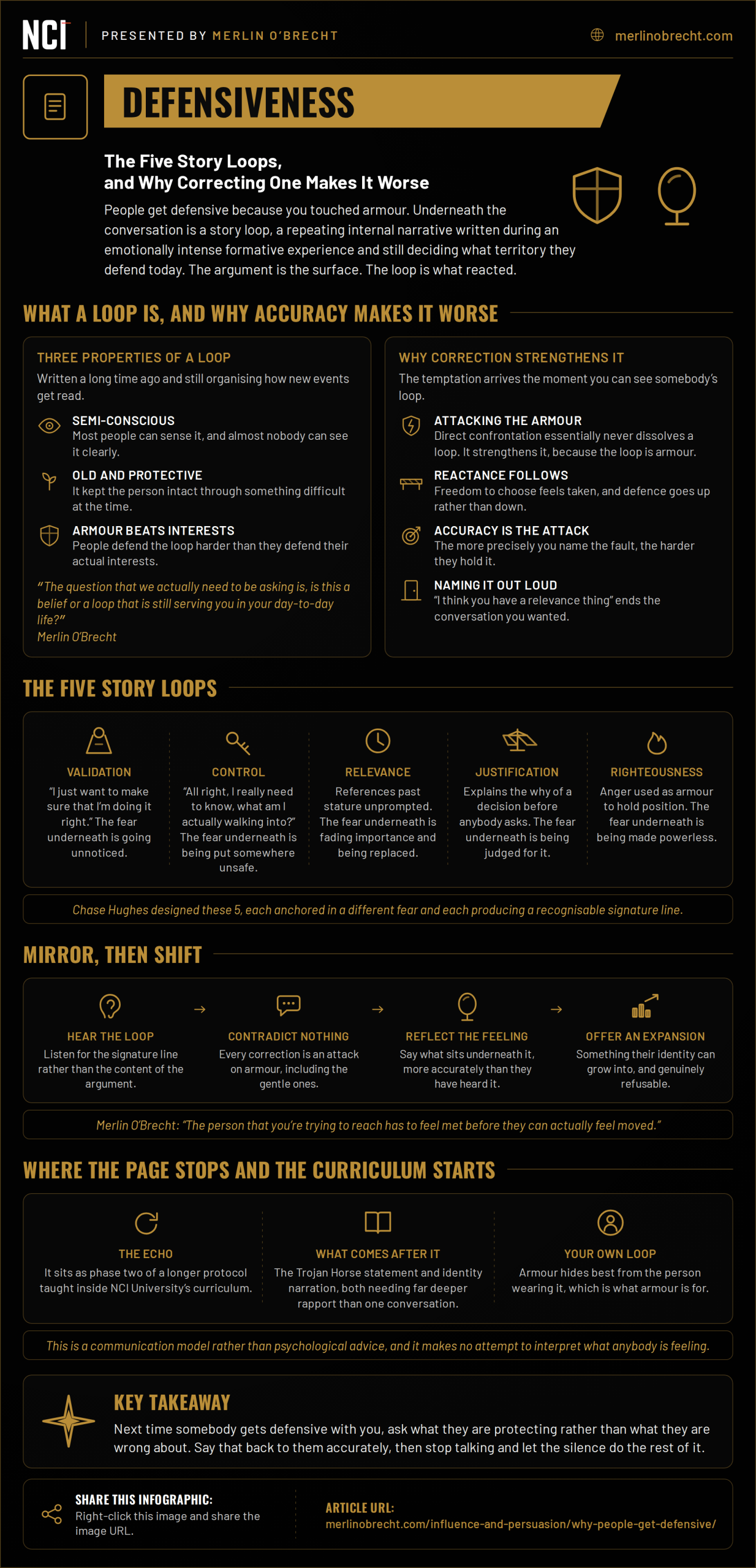
- Chase Hughes's taxonomy has 5 loops, each anchored in a different fear and each with a recognisable signature line.
- Contradicting a loop strengthens it, because the loop is armour and attacking armour produces defence.
- The move that works is reflecting the feeling underneath the loop before offering anything else.
Why do people get defensive?
That is why the response seems out of proportion to what you said. Its size comes from what your sentence got near rather than from the sentence itself.
What a story loop is, and when it got written
What are the 5 story loops?
| Loop | Signature line | Fear underneath | What you see |
|---|---|---|---|
| Validation | “I just want to make sure that I’m doing it right.” | Being invisible. Showing up earnestly and going unnoticed | Asks whether their effort registered. Replays small interactions for any sign of disapproval. Carries a quiet, unrecognised exhaustion, and pay does not fix it |
| Control | “All right, I really need to know, what am I actually walking into?” | Unpredictability, and being betrayed or put somewhere unsafe | Needs the agenda in advance. Would rather do it than delegate it. Treats even harmless surprise as dangerous |
| Relevance | “Back when I was managing this team of 10 people, things moved way smoother than they do now.” | Fading importance. Becoming outdated, replaced, or no longer central | References past stature unprompted. Frames the present against an older benchmark. Reacts disproportionately to being skipped or left out |
| Justification | “I don’t think the timing was just right. I’m really waiting for the perfect time.” | Being judged for the decision itself | Explains the why of every decision before anyone asks. Produces justifications faster than the situation requires |
| Righteousness | Anger or blame used as armour to hold power and position | Losing control, and being made powerless | Frames frustration as other people’s moral failure. Refuses to soften, because softening would feel like conceding the principle |
These line up with the six social needs, and that is not a coincidence. The loops grow out of the same territory and give a more nuanced reading of it, which is why the six social needs the loops grow out of sits underneath this page rather than beside it.
Why correcting someone makes it worse
How do you talk to someone who is being defensive?
- Work out which loop is running. Listen for the signature line rather than the content of the argument.
- Say nothing that contradicts it. Every correction is an attack on armour, including the gentle ones.
- Reflect the feeling underneath it, more accurately than the person has heard it put before.
- Offer an expansion and let them take it. The change has to be their own choice, which means the offer has to be genuinely refusable.
The echo, and 5 examples
- Validation. "It's wild how much energy most people spend doing invisible work around here. And one thing I've noticed about you is that regardless, you're the kind of person that has just been continuing to show up."c
- Control. "That's a move people tend to make when chaos has cost them before, and honestly, I don't blame them."
- Relevance. "To me, that sounds like someone who has really earned their way. Even if others don't realise it, it's clear they've put in so much effort and contributed so much to this organisation."
- Justification. "I think there's a difference between hesitation and discernment, because really what you did in that situation, in my opinion, took real care."
- Righteousness. "From what I've noticed, that kind of fire doesn't, most of the time, show up unless someone's been burned in some way first."
These are not magic words and they are not a script. They have to be edited for the context you are in and for who you actually are, because everything you say should sound like a genuine representation of you. Delivered verbatim off a page, they become the performed version, and performed sincerity is the single thing other people are best at detecting. Building the depth that makes an echo land is how to build the depth this move needs.
Why other people's loops are easier to see than your own
Giving feedback to someone whose loop you already know
Where a single conversation stops being enough
Frequently asked questions
Where to go from here