Influence versus manipulation
The difference between influence and manipulation
By Merlin OBrecht · Dean of Academic Affairs, NCI University
Influence versus manipulation
The difference between influence and manipulation is whether the other person would agree with what you are doing if they could see all of it. Chase Hughes’s empathy test asks exactly that. Merlin OBrecht adds a second one, the mirror test, and argues that the largest cost of unethical influence is what it does to the person using it.
Have you ever walked away from a win, a sale, an argument, a moment where you got exactly what you wanted out of someone, and felt strangely hollow afterwards?
You were not imagining it and it was not nothing. Your nervous system was handing you a bill.
This bolts almost directly onto Chase Hughes’s work on emotional debt, which is his concept and worth watching alongside this.
Key takeaways
- Ethics in the abstract are subjective, so the useful question is what your own rule is and whether you are living by it.
- Chase Hughes's empathy test: would they agree this was in their interest if they could see your intention and every technique you used?
- The mirror test is a 30-second daily version of the same question.
- Most everyday influence passes both tests easily and is not a moral event.
- The largest cost of unethical influence falls on the person using it, and it compounds quietly.
What is the difference between influence and manipulation?
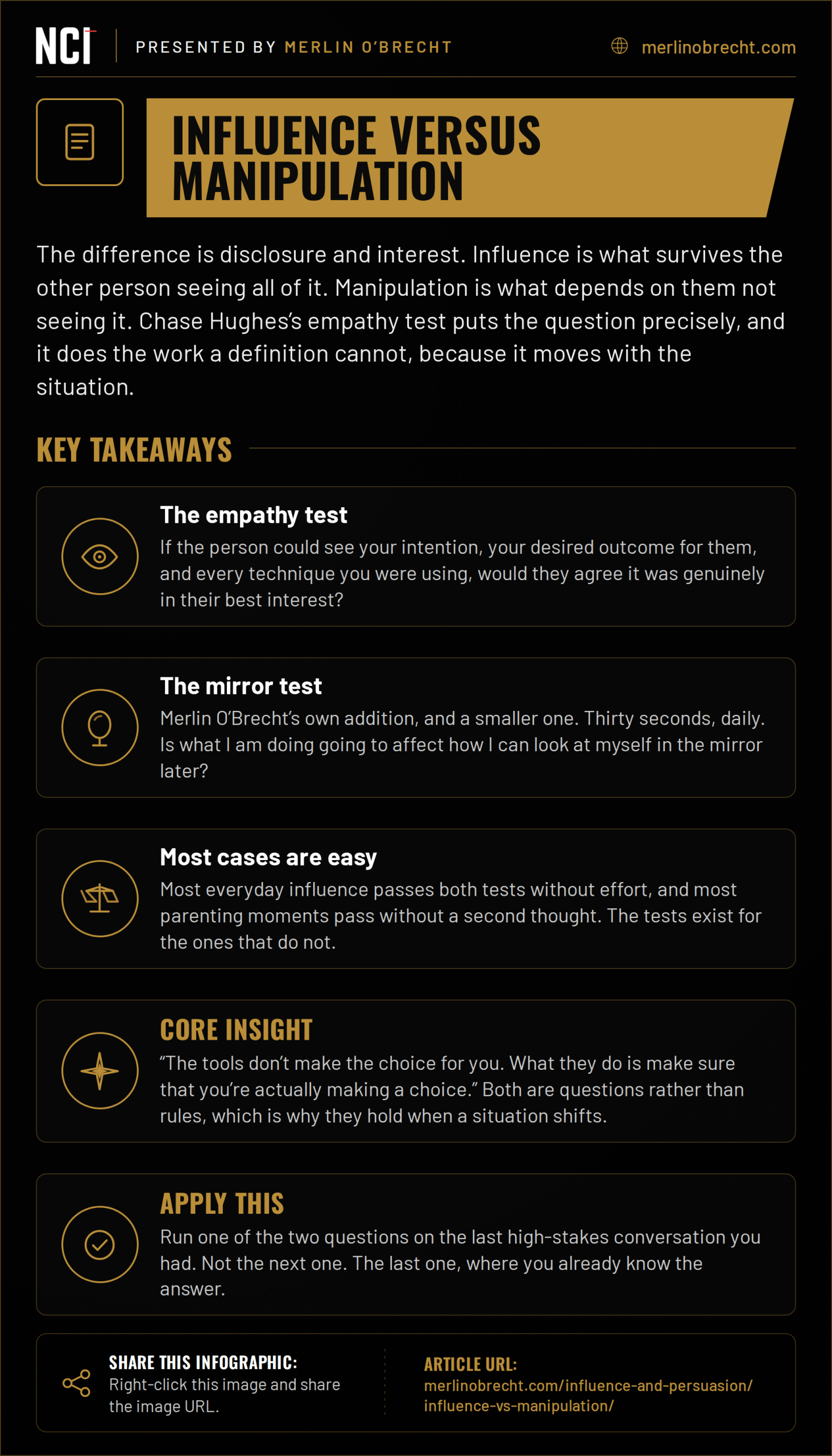
The difference is disclosure and interest. Influence is what survives the other person seeing all of it. Manipulation is what depends on them not seeing it.
Chase Hughes’s empathy test puts the question precisely: if the person you are influencing could be inside your mind and see your intention, your desired outcome for them, and every technique you were using, would they agree that what you are doing is genuinely in their best interest?
That test does the work a definition cannot, because it moves with the situation.
Why the clean rule and the shrug are both wrong
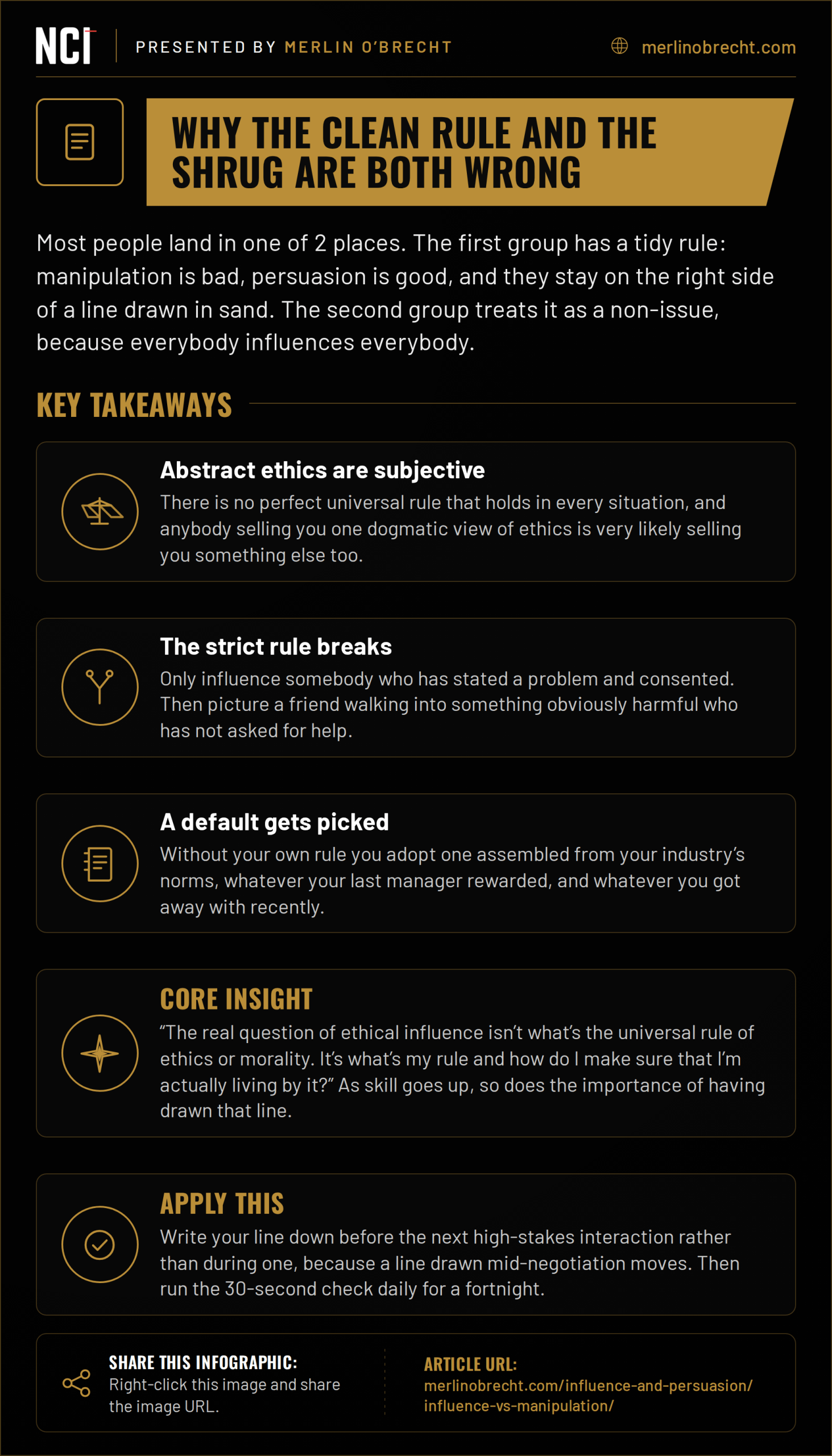
Most people land in one of 2 places on this.
The first group has a tidy rule. Manipulation is bad, persuasion is good, and they pat themselves on the back for staying on the right side of an imaginary line drawn in sand. The second group treats it as a non-issue. Everybody influences everybody, get over it, and the conversation is shrugged off.
Both miss what is happening, because ethics and morality in the abstract are subjective. There is no perfect universal rule that holds in every situation, and anybody selling you one dogmatic view of ethics is very likely selling you something else as well.
Which changes the question.
“The real question of ethical influence isn’t what’s the universal rule of ethics or morality. It’s what’s my rule and how do I make sure that I’m actually living by it?”
If you have ever won something and felt worse afterwards, you already have the data this page is about.
Where exactly does influence become manipulation?
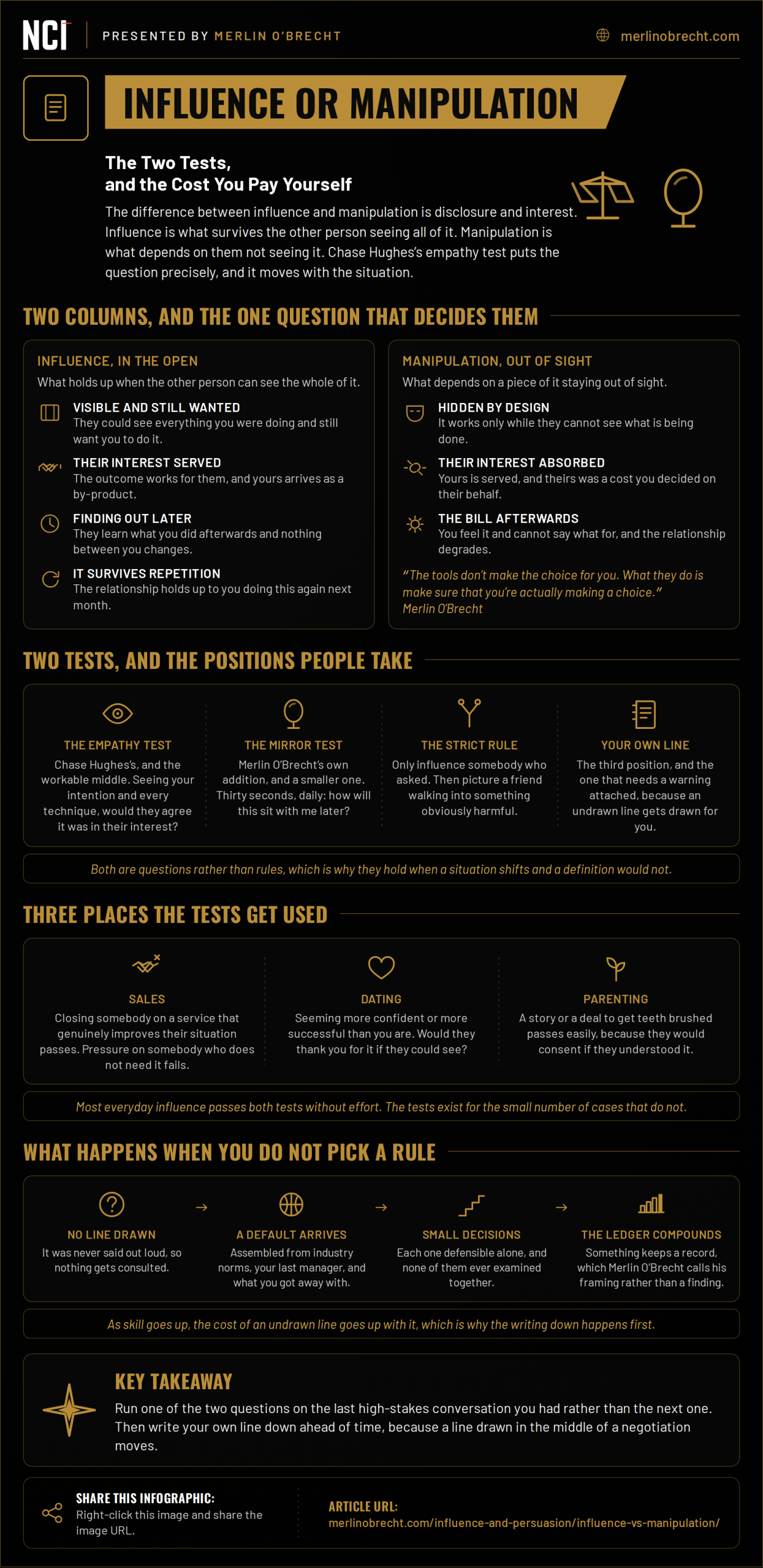
| Influence | Manipulation |
|---|---|
| They could see everything you were doing and still want you to do it | It only works while they cannot see what you are doing |
| The outcome serves their interest, and yours as a by-product | The outcome serves yours, and theirs is a cost you decided to absorb on their behalf |
| Finding out later changes nothing between you | Finding out later is the end of it |
| The relationship survives repetition | The relationship degrades every time it works |
| It costs you effort | It costs you a piece of how you see yourself |
| You sleep fine | You feel the bill in the morning and cannot say what for |
The rows are not independent. The first one decides most of the others, which is why the empathy test is one question rather than six.
The ledger you did not agree to keep
Here is the part I have not heard anybody else say.
Your amygdala does not care about philosophy. It runs its own scoring system, and if you have a working nervous system and empathy for other people, something in you keeps a record of every interaction where you knowingly traded somebody else’s autonomy for your own gain. Every time you got what you wanted by means you would not be proud of if the person could see them.
That is my framing rather than a finding, and I would rather say so than dress it up as neuroscience.
The ledger compounds. Slowly, invisibly, and it erodes your sense of self-worth, your confidence, and your felt sense of being a good person, even when nobody ever finds out. Even when you got away with it, your body knows.
How do you test whether what you are doing is ethical?
Two tools, and both are questions rather than rules.
- The empathy test, which is Chase Hughes’s, run before any high-stakes interaction. If they could see exactly what I am doing right now and why, would they still consent knowing everything going on in my head?
- The mirror test, which is mine, run daily and taking about 30 seconds. Is what I am doing going to affect how I am able to look at myself in the mirror later?
“The tools don’t make the choice for you. What they do is make sure that you’re actually making a choice.”
Three places the tests get used
Sales. Closing somebody on a service that genuinely improves their life passes. Using influence to push somebody into something they do not need fails, and it does not matter how much commission is on the line.
Dating. If you are using a behavioural technique to seem more interesting, more confident, or more successful than you actually are, run it. If they could see exactly what you were doing, would they thank you for it, or would they feel manipulated? That answer tells you everything.
Parenting. A child who will not brush their teeth, and you influence them with a story, a deal, a stern voice, or something more covert. It passes easily, because clean teeth are in their interest and they would consent if they understood what you were doing and why.
Which is worth saying plainly: not every influence interaction is an ethical crisis. Most of them are easy, and most parenting moments pass without a second thought. The tests exist for the ones that do not.
The three positions people take, and the one that gets people into trouble
Strict and conservative. Only use advanced influence on somebody who has clearly stated a problem they want fixed and has consented without duress. It is a clean rule and it almost never leaves anyone worse off.
It also breaks. Picture a friend who is walking into something obviously harmful to them and has not asked for your help, and by the strict rule you say nothing and watch. Most of us would agree that doing nothing there is the wrong choice, which means the rule cannot be the whole answer.
The empathy test, which is the workable middle and the one I use. It gives you room to actually help people while keeping you honest about what you are doing.
Whatever line you draw for yourself, which is the third position and the one that needs the warning attached.
“Anybody operating at a high level of persuasion and influence who hasn’t sat down and actually asked themselves where they will and where they aren’t willing to go is, in my opinion, a person who’s in trouble and probably just doesn’t know it yet.”
As skill goes up, the importance of having drawn that line clearly goes up with it. The techniques on the techniques these tests get run against are exactly the kind that make an undrawn line expensive.
What happens when you do not pick a rule
You still have one. It was just picked for you.
Without an operating system for your own ethics, you adopt a default, assembled out of your industry’s norms, whatever your last manager rewarded, and whatever you got away with recently. That default is very often what leads good, ethical, loving people down paths where they do things that slowly erode their sense of self-worth, one defensible decision at a time.
Nobody chooses that in a single moment. It arrives through a hundred small ones where no rule was consulted because no rule existed.
The cost nobody prices in
The biggest cost of unethical influence is not what it does to your reputation, and it is not even what it does to the people you use it on. The biggest cost is what it does to you.
Every time you influence somebody in a way you know was against their interest, 3 things erode, usually without you noticing. Your sense of self-worth. Your genuine confidence, the real kind rather than the performative kind. And if you believe in a soul, your soul. If you do not, we can just look at your psychology, and it is the same erosion either way.
It compounds quietly, over years, into somebody you did not choose to become.
If you have real empathy and a working nervous system, you do not get to opt out of this question, because your body keeps score whether you ask it to or not. And here is the cruel part. Even if the unethical route works, even if you win, you arrive and find a deep emptiness waiting, some shame, some regret, and the quiet realisation that you traded your ethics for a goal that was not what you actually wanted.
“Your nervous system is keeping receipts and make sure that they add up to a life that you can live with.”
Frequently asked questions
What is manipulation?
Manipulation is influence run against the other person’s interest using means you would not be willing to disclose. The tell is the second half: if the method has to stay hidden for the outcome to hold, that is what you are doing, whatever you are calling it.
How do you know if you are manipulating someone?
Three checks. Ask whether they would agree this was in their interest if they could see your intention and your methods. Ask whether you would be comfortable describing what you did to them afterwards. Then ask how it will sit with you tonight. If any of the three produces a flinch, that flinch is the answer.
Is all persuasion manipulation?
No. Every conversation influences somebody, and treating that as a moral problem makes the word useless. Most everyday influence passes both tests without effort, and most parenting moments are easy passes. What separates the two is interest and disclosure, not whether influence occurred.
Does the intention behind influence actually matter, or only the outcome?
Both matter and they answer different questions. The technique itself is neutral, so what determines whether an action was ethical is the intention behind it and what was actually done. The obvious objection is that good intentions produce harm all the time, and that is true, which is why the empathy test asks whether they would agree it was in their interest rather than whether you meant well. Meaning well is not the standard, and it never was.
What is the difference between the empathy test and just asking permission?
Permission requires the other person to already understand what they would be agreeing to. The empathy test asks whether they would agree if they did understand, which is why it still works with a child who will not brush their teeth.
How do you sell something without manipulating the buyer?
Run the test on the offer rather than on the close. If the thing genuinely improves the buyer’s situation, then skill applied to helping them see that is fine, including skill they cannot detect. What fails is pressure applied to somebody who does not need the product, and the commission on the line has no bearing on it.
How long does it take to notice this kind of erosion in yourself?
Longer than is useful, which is the whole problem. It compounds slowly and invisibly, and by the time it is obvious you have usually been paying for years. That is the reason for a 30-second daily check rather than an annual reckoning, because the daily version catches it while a single decision is still a single decision.
Who came up with the empathy test?
Chase Hughes. It is taught as the ethical gate throughout NCI University’s curriculum, and it connects directly to his work on emotional debt, which is where the idea of an accumulating cost to the person doing the influencing comes from. The mirror test is my own addition and a much smaller thing.
Is it wrong to use influence techniques on your own family?
Usually not, and most of it passes the test without a second thought, because the outcomes you want for your family are typically outcomes they would want too. The ones worth checking are the ones where you wanted something for yourself, and you will know which those were.
How do you decide where your own line is?
Write it down before the next high-stakes interaction rather than during one, because a line drawn mid-negotiation moves. Then run the mirror test daily for a fortnight and see which decisions it catches. Most people find the line is already there and has simply never been said out loud.
Where to go from here
Run one of the two questions on the last high-stakes conversation you had. Not the next one. The last one, where you already know the answer.
“The tools don’t make the choice for you. What they do is make sure that you’re actually making a choice.”
If you want more of this kind of thinking as it gets written, Merlin’s list is here.