Persuasion techniques that hold up
Persuasion techniques that hold up: the five-rung ladder
By Merlin OBrecht · Dean of Academic Affairs, NCI University
Persuasion techniques that hold up
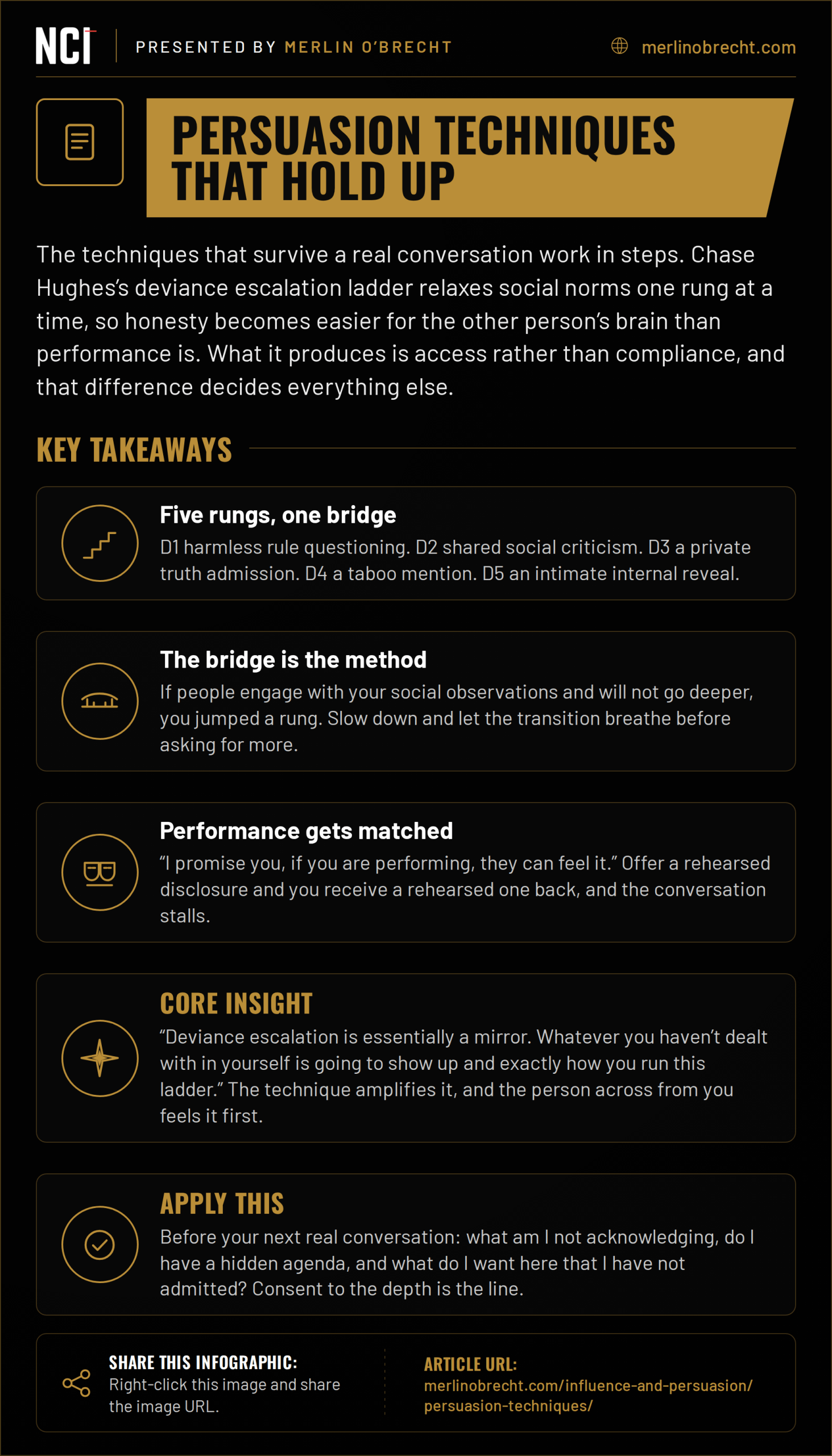
Persuasion techniques that hold up work by lowering social defences in steps rather than by finding the right phrase. Chase Hughes’s deviance escalation ladder moves a conversation through five rungs, from a harmless observation to a personal reveal. Merlin OBrecht says the ladder works when you do.
You have read the six principles. Reciprocity, scarcity, social proof, and the rest. They are real, they are well evidenced, and they operate on a decision somebody is already making.
None of them get a person out from behind their mask, which is where most conversations that matter actually stall.
What follows is a five-rung sequence that does, with a named failure point, a diagnostic for when it stalls, and one condition attached that no technique list contains.
Key takeaways
- Deviance escalation moves a conversation up five rungs, from a harmless observation to something genuinely personal.
- The critical moment is rung three, where the other person decides whether to match you or stay behind the mask.
- Almost every stall happens at the permission bridge, meaning you jumped a rung instead of letting the transition breathe.
- People detect performed vulnerability reliably, and they match whatever level of performance you brought.
- The technique amplifies whatever you have not dealt with in yourself, which is why the ladder works when you do.
What persuasion techniques actually work in a real conversation?
The techniques that hold up work in steps. Chase Hughes’s deviance escalation ladder relaxes social norms one rung at a time, so that honesty becomes easier for the other person’s brain than performance is. Five rungs, in order, from a harmless observation about the situation to something genuinely internal.
What it produces is not compliance. It is access, and the difference matters for everything below.
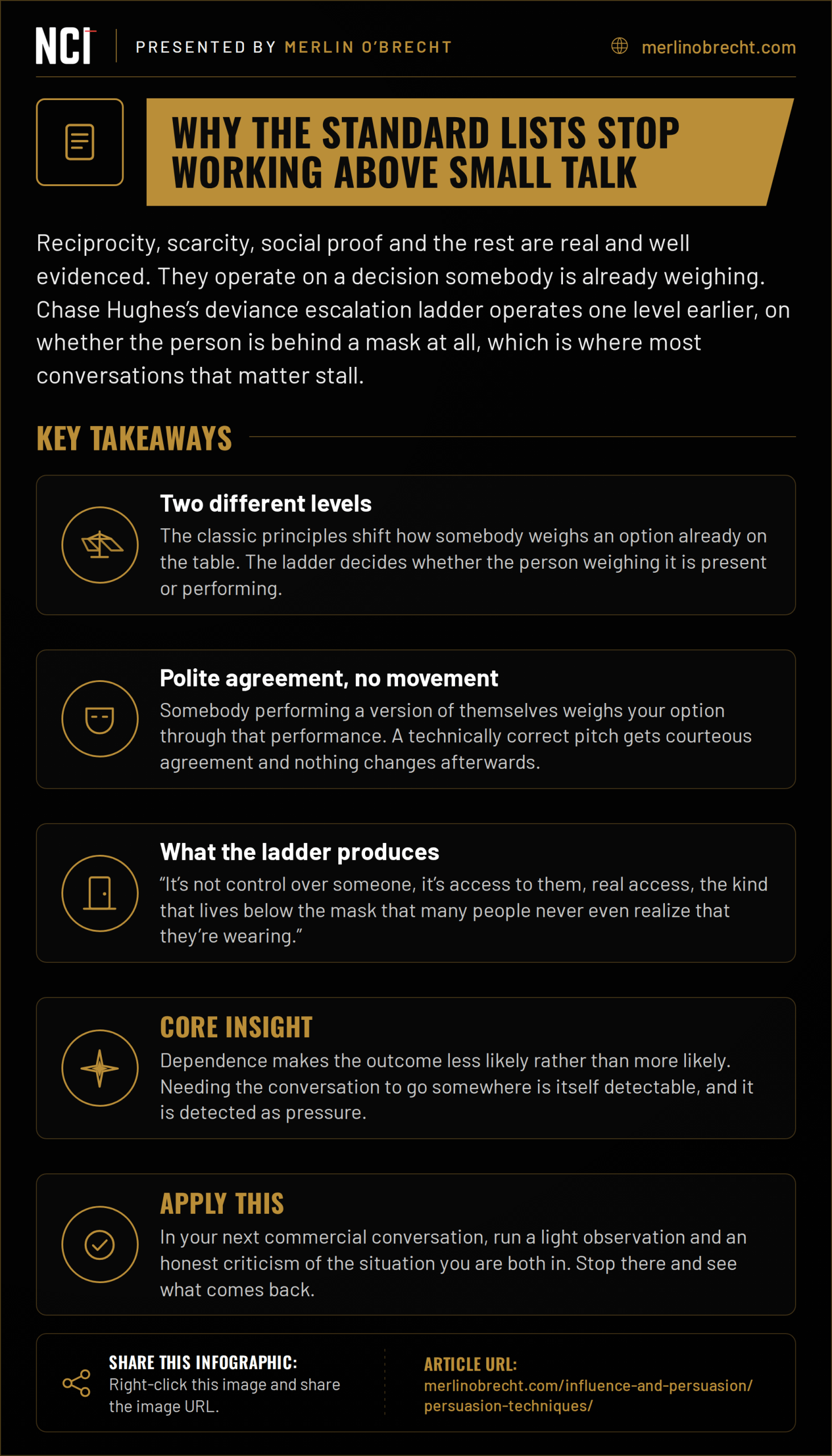
Why the standard persuasion lists stop working above small talk
The classic principles operate on a decision. They shift how somebody weighs an option that is already on the table.
This ladder operates one level earlier, on whether the person is behind a mask at all. Somebody who is performing a version of themselves will weigh your option through that performance, which is why a technically correct pitch can be met with polite agreement and no movement whatsoever.
There is a specific rung where almost everybody fails, and the failure looks like the other person being closed rather than like anything you did. I will name it after the ladder.
What are the five rungs of deviance escalation?
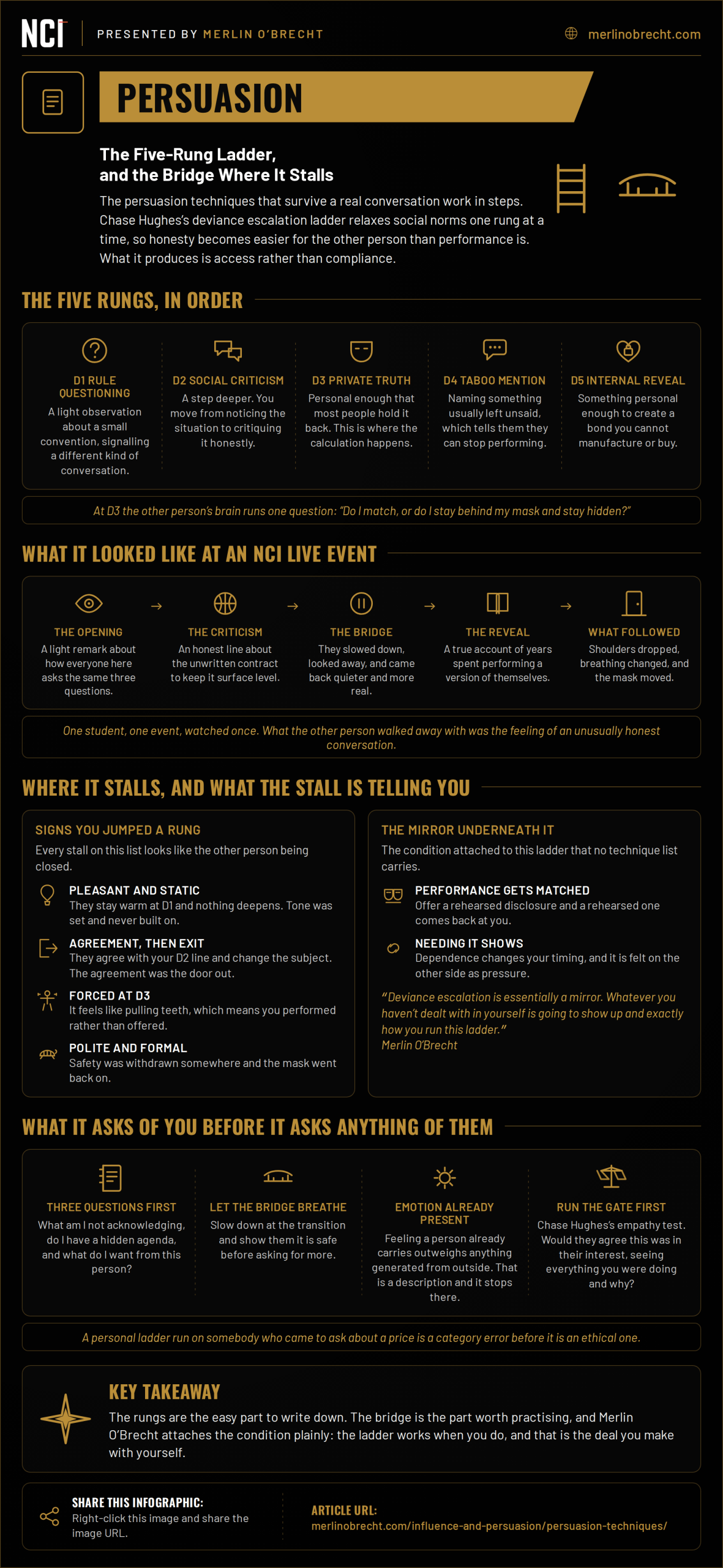
- D1, harmless rule questioning. A light observation that questions a small social convention. It establishes tone and signals the conversation will not follow the usual script, which triggers novelty and opens the person to a different reading of what this interaction is.
- D2, shared social criticism. A step deeper. You are no longer just noticing reality, you are critiquing it. An observation about people or society that changes how the moment feels.
- D3, private truth admission. The first rung where things get genuinely personal. Not deeply personal, but personal enough that most people would not say it in ordinary conversation. This is where the calculation happens.
- D4, taboo mention. Naming something that lives in the shadows of the mind. It lets the other person’s brain register that this is not a performance and that they are allowed to be who they actually are.
- D5, intimate internal reveal. Something personal enough that it creates a bond you cannot manufacture or buy. What is being transferred is a state: present, safe, and unfiltered.
At D3, the other person’s brain runs one question.
“Do I match, or do I stay behind my mask and stay hidden?”
Everything above D3 depends on how that question gets answered, and how it gets answered depends almost entirely on what you did on the rung below.
What it looks like when it works
At an NCI live event not long ago, I watched a student run the whole ladder on a stranger.
They opened at D1 with a light observation: it is funny how everyone at these events defaults to the same three questions. What do you do. Where are you from. How do you know Chase.
Then they moved to D2, fairly elegantly. It is strange how people do not say anything real at these things. It is almost as though everyone agreed to keep it surface level, like there is an unwritten social contract running in the background.
The other person nodded and leaned in slightly.
Then I watched the bridge happen, and this is the part worth slowing down for. The student slowed down. They looked away for a second. When they looked back, their energy was completely different, quieter and more real. And they said something at D3: a personal story about realising they had been performing a version of themselves for years without knowing it, until they finally experienced what it was like to live without it.
You could see the other person’s mask visibly shift. Their shoulders dropped. Their breathing changed.
Within four, maybe five minutes, they were at D4, talking about things neither of them would normally say in that setting. The bond that formed in those four minutes was deeper than what many people build in months of ordinary interaction.
There was no force in it and no manipulation. It was the systematic creation of conditions where honesty became easier than performance.
And here is what the other person experienced. They did not feel a technique had been run on them. They felt they had just had one of the most authentic conversations they had had in years. They felt seen, and being truly seen by another person is one of the most powerful experiences available to a human being.
“It’s not control over someone, it’s access to them, real access, the kind that lives below the mask that many people never even realize that they’re wearing.”
The permission bridge, and why the ladder usually stalls
Here is the failure point, and it is almost always the same one.
If people engage with your social observations but will not go to the deeper personal level, it is the permission bridge where you are failing. You jumped from one step to the next instead of allowing the transition to happen.
The fix is unglamorous. Slow down. Let the transition breathe. Show them it is safe before you ask them to go a level deeper.
| What it looks like when it stalls | What is actually missing |
|---|---|
| They stay pleasant at D1 and nothing deepens | Tone was established and never built on. You stayed at novelty |
| They agree with your D2 observation and change the subject | No bridge. The agreement was the exit, not the entry |
| Your D3 feels forced, like pulling teeth | You are performing vulnerability rather than offering it, and they can feel it |
| They go polite and slightly formal | You went up a rung before they were finished with the last one |
| The conversation reverts to small talk | The mask went back on, which means safety was withdrawn somewhere |
Why does the same technique work for one person and fail for another?
Because the ladder is a mirror, and this is the part no technique list contains.
If you are getting to D3 and it feels forced, look at yourself before you look at them. Are you actually sharing something real, or performing vulnerability because you know it is the right move?
“I promise you, if you are performing, they can feel it.”
Human brains have spent a very long time learning to distinguish performance from authenticity, and they are good at it. People match your level of performance. Offer a rehearsed disclosure and you will receive a rehearsed one back, and the conversation will stall exactly where it should.
Three questions worth asking before you start, and they are the page’s actual differentiator.
- What am I bringing to this interaction that I am not acknowledging?
- Do I have a hidden agenda?
- Is there something I want from this person that I am not fully willing to admit to myself?
That last one connects to something counter-intuitive. Dependence makes the outcome less likely rather than more likely. Needing the conversation to go somewhere is itself detectable, and it is detected as pressure.
“Deviance escalation is essentially a mirror. Whatever you haven’t dealt with in yourself is going to show up and exactly how you run this ladder.”
The technique amplifies it, and the person across from you will feel it before you do.
Working with emotion that is already there
One more mechanism, and it needs handling carefully rather than enthusiastically.
Everyone you will ever speak to is carrying a library of emotionally charged memories. The nervous system remembers those feelings precisely and can retrieve them quickly. Emotion that is already present in somebody’s body carries far more weight than anything you could try to generate from outside, which is Merlin’s own comparison rather than a measured one.
That is a description of why real feeling outperforms manufactured feeling in a conversation. It is deliberately not a set of steps, because steps here would be instructions for attaching somebody’s existing emotion to an outcome you wanted, which is the exact thing the ethics page exists to name.
The gate is the one Chase Hughes teaches: would this person, seeing everything you were doing and why, agree it was in their interest? Run it before you go anywhere near this, and read the test to run before you use any of this.
Using this in sales, hiring and partnerships without it becoming a script
A first conversation with a potential partner, where the useful information is never in the deck.
D1 is a light observation about how these meetings usually go. D2 is the honest version of what makes most partnerships fail. If those land, D3 is you saying something true about a mistake you made, not a humble-brag version of one. What comes back is usually the actual constraint, which was never going to appear in a formal answer.
One caution that matters more here than anywhere else. A ladder run on somebody who did not agree to that kind of conversation is where this becomes the other thing. A buyer who came for a price did not consent to a personal conversation, and running one on them is a category error before it is an ethical one.
What this asks of you before it asks anything of them
“So the ladder works when you do. That is the deal that you need to be willing to make with yourself.”
If you want a technique you can run without changing anything about yourself, this one will expose you faster than most, because the mechanism that makes it work is the same mechanism that makes performance visible.
The rungs are the easy part to write down. The permission bridge is the part that needs somebody watching you run it and telling you where you jumped, because from the inside a jumped bridge feels like the other person being guarded. That is the shape of NCI-3 Behavior Scientist: 6 to 8 weeks, self-paced, $2,987.
Worth picturing the room where this gets practised. An NCI live event, a student running this on a stranger in four minutes, with an instructor watching and able to tell them exactly which second the bridge happened.
Frequently asked questions
What is deviance escalation?
Deviance escalation is Chase Hughes’s five-rung sequence for building genuine depth in a conversation quickly, by relaxing social norms one step at a time. It moves from a harmless observation to a personal reveal. What it produces is access rather than compliance, and it is not a method for getting somebody to agree to something.
How do you get someone to open up to you?
Five steps. Question a small social convention lightly. Offer an honest criticism of the situation you are both in. Say something personal enough that most people would not say it. Name something usually left unsaid. Then reveal something genuinely internal. The rungs are the sequence; the content on each has to be true.
How long does it take to build real rapport with someone?
I watched a student cover four rungs in about four minutes at an NCI event, which is fast and was not luck. Most people take months with the same person and never get past the second rung, because they never build the bridge. Both numbers are real and the gap between them is entirely about the transitions.
Do persuasion techniques actually work, or do people see through them?
People see through performance very reliably, and that is the honest answer. The ladder fails when the person running it is performing, because human beings match the level of authenticity they are offered. Which means it works to exactly the degree that you are willing to be real, and that is a more useful answer than yes.
What is the difference between rapport and manipulation?
Consent to the depth of the conversation is the line. Two people who have both agreed, tacitly, to talk properly are building rapport. One person moving another somewhere they did not agree to go, for an outcome they have not been told about, is the other thing. The full test is on the influence and manipulation page.
How do you use persuasion techniques in a sales conversation?
Sparingly, and with the caution attached. D1 and D2 improve almost any commercial conversation, because they get past the script both parties arrived with. Running a personal ladder on somebody who came to ask about a price is a mismatch they will feel, and the damage is worse than the flat version would have been.
Is there a script for building instant connection?
No, and the reason is structural. The rungs are a sequence, and the content on each rung has to be true or it fails on arrival. A scripted D3 is performed vulnerability, which is the specific thing other people are best at detecting, and it stalls the conversation more reliably than never trying.
Who created deviance escalation?
Chase Hughes, and it is taught inside NCI University’s curriculum. It sits alongside his other models of how people organise themselves socially, including the six social needs, which describe what each person wants the room to give them and therefore what each rung has to feel like to them.
Is deviance escalation manipulative?
It can be, and whether it is depends on something other than the technique. My own framing is that it is access rather than control, and access given freely by somebody who wanted the conversation is not manipulation. The test Chase Hughes teaches settles the rest: would they agree it was in their interest if they could see everything you were doing?
How do you practise this without making people uncomfortable?
Run D1 and D2 only, for a fortnight, with no goal attached. Notice how often you want to skip ahead. That impulse is the thing to train out, because the bridge is where the whole method lives and skipping it is the single most common failure. Only add D3 once you have stopped wanting to rush.
Where to go from here
The ladder is five rungs and one bridge, and the bridge is the part worth practising.
Slow down at the transition. Let it breathe. Show somebody it is safe before you ask them to go a level deeper. That single habit will do more than memorising the five names.
If you want the version with somebody watching, that is NCI-3 Behavior Scientist. 6 to 8 weeks, self-paced, $2,987.
If you would rather buy nothing, take the three questions into your next real conversation. What am I not acknowledging, do I have an agenda, and what do I want from this person that I have not admitted to myself.