Merlin O'Brecht

Authority and confidence hub

Confidence: what it actually is, and why the behaviours are only half of it

By Merlin OBrecht · Dean of Academic Affairs, NCI University
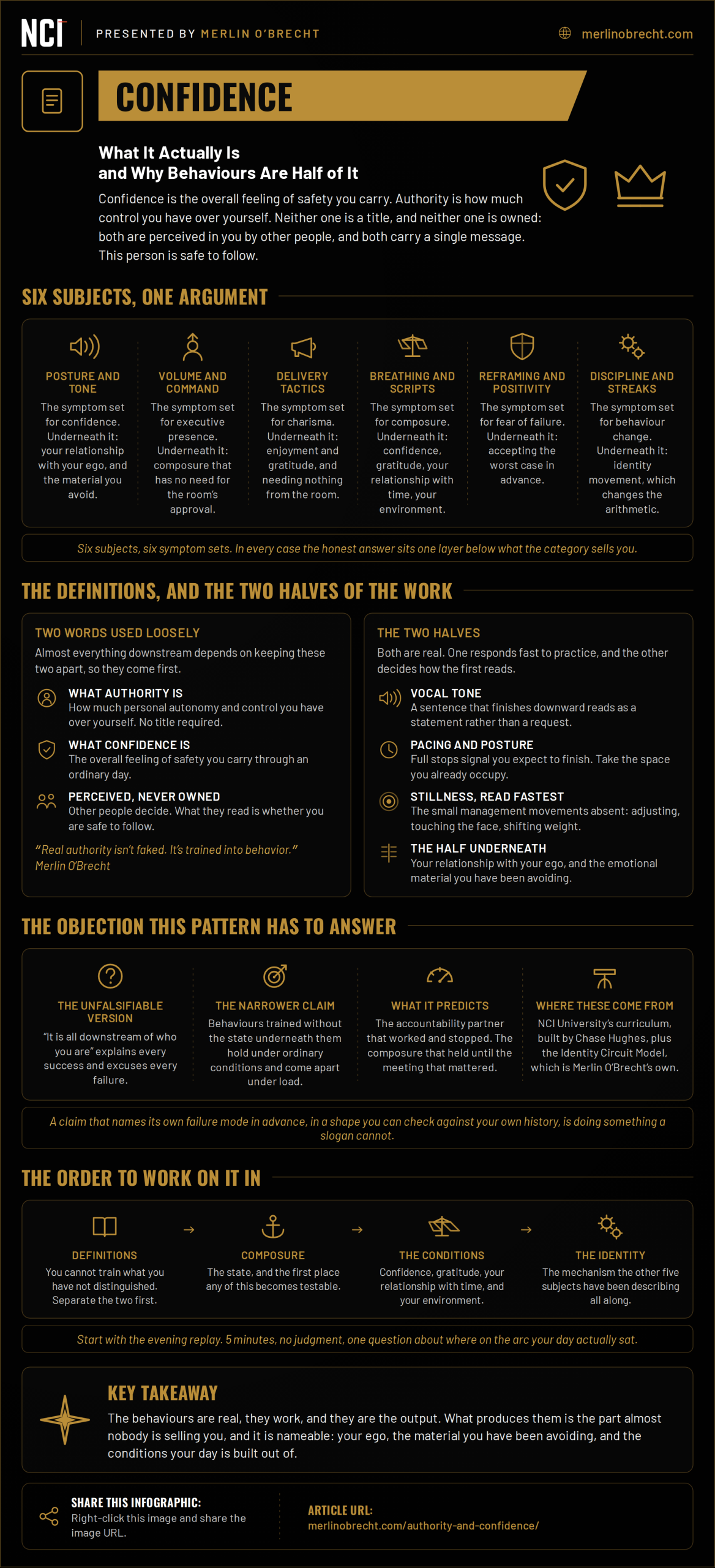
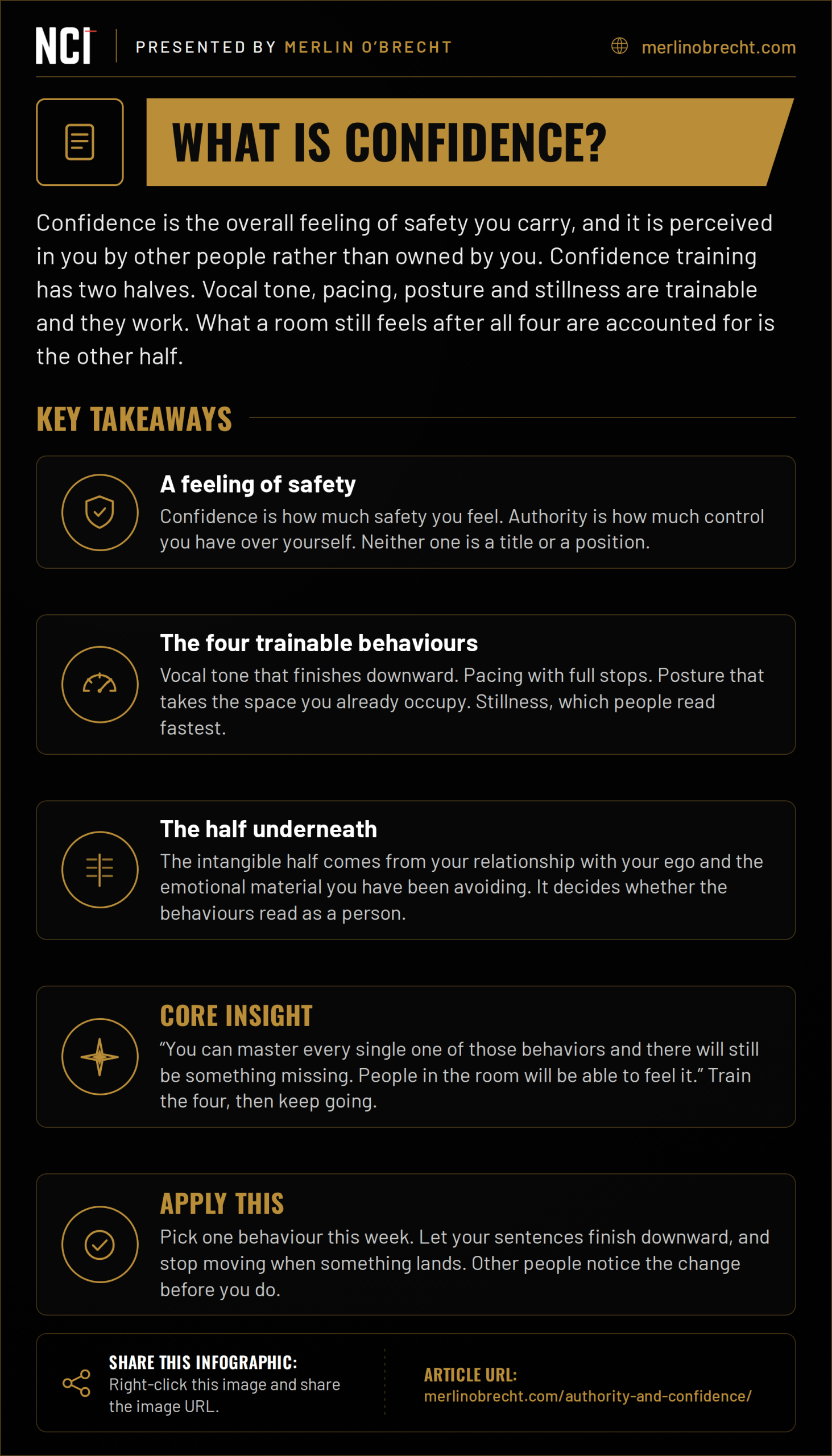
Confidence is the overall feeling of safety a person carries, and authority is how much control they have over themselves. Neither is something you own. Both are perceived in you by other people, and both communicate one message: this person is safe to follow. The behaviours are trainable and they are not the whole thing.
You have done it correctly and watched it not work.  You stood the way you were supposed to stand. You slowed your voice down and let your sentences finish downward. You held eye contact for the right length of time. And the room did not do the thing the room was supposed to do.  That experience is more useful than it feels, because it is data. What it tells you is that the visible markers of confidence are not the source of it. They are what the source looks like from outside, and a room can tell the difference between a signal that arrives on its own and a signal being produced deliberately.  That gap is what this cluster is about. Six articles sit underneath this page, on confidence, presence, charisma, composure, fear and behaviour change, and every one of them arrives at the same structure from a different direction: the thing everybody trains is a symptom, and the cause is somewhere else.  My role in this is narrower than it might look. Chase Hughes built most of these models over decades. NCI turned them into a curriculum with a standard. What I do is translate, which mostly means starting at step one when the person who built the thing has started at step four. One of the models below is genuinely mine, and I will say so when we get to it.  Two definitions first, because almost everything downstream depends on them.  Authority is how much personal autonomy and control you have over yourself. Not seniority, not headcount, not a title.  Confidence is the overall feeling of safety you carry. 

Key takeaways

What is confidence? 

Confidence training has two halves, and almost everything published on the subject covers one of them.  The tangible half is genuinely trainable and it works. Vocal tone, where a downward inflection reads as a statement and an upward one reads as a request for approval. Pacing, where full stops signal you expect to be allowed to finish. Posture, meaning taking up the space you already occupy. And stillness, which is the absence of the small management movements and the one people read fastest.  Train those four deliberately and you will be measurably better in a room inside a few weeks. That is worth saying without qualification before anything else, because the rest of this page describes a ceiling rather than a dismissal.  The intangible half is defined by subtraction: it is what people in the room still feel once all of that is accounted for. Some people call it presence. It comes from two places specifically, your relationship with your own ego and the emotional material you have been avoiding, and it is the half that decides whether the first four read as a person or as a performance. 

“You can master every single one of those behaviors and there will still be something missing. People in the room will be able to feel it.” That is covered properly in the two halves of confidence, and the ego work underneath.
What is executive presence?

Executive presence is what makes a room orient toward one person and defer to them before anybody has evaluated anything logically. It resolves to a single judgment made below conscious reasoning: whether this person would be safe to follow if things went wrong.  Three markers carry it. Stillness when conflict arrives, meaning you do not add motion to a room that is already agitated. Direction given without hedging, which is compatible with being extremely polite and has nothing to do with rudeness. And eye contact held with a calm energy, without scanning for approval.  The story underneath that page is a roof in July, a crew coming apart in the heat, and a foreman with very little English who gave two calm instructions and reoriented all of it. He had no volume and no authority anybody had granted him.  What is more useful is the inverse case, because most people have lived it: the appointed leader whose orders get followed resentfully, muttered about, executed slowly. Same instruction, same authority on paper, completely different result. 

“Those people underneath, deep down inside of themselves, are still seeking approval and they’re fearing rejection. And the brain is really able to just instantly kind of pick up on that.” Full treatment on why a room follows one person and not another.

Is charisma a skill or a trait?

Both, in a specific order, and this is the one page in the cluster where the research does real work.  People judge charisma from very short exposures, an approach known in the literature as thin-slice judgment, and those snap judgments predict who gets treated as the leader. The cues being scored are vocal delivery, eye contact, forward orientation and fluent speech.  There is also a published set of charismatic leadership tactics, tested in controlled interventions by Antonakis, Fenley and Liechti and published in Academy of Management Learning & Education in 2011. Metaphors, stories, contrasts, rhetorical questions, three-part lists, statements of moral conviction, reflecting the group’s sentiment, and setting ambitious goals. Those interventions raised participants’ rated charisma, which settles the question of whether the delivery layer can be taught. It can.  And then the turn that the rest of the cluster shares. 

“You may have noticed that everything I just mentioned were symptoms of charisma.” The cause, in my reading rather than in the research, sits on the internal side of Chase Hughes’s Authority Triangle, and specifically on enjoyment and gratitude: the actual capacity to feel them through an ordinary day, which then shows up in how you communicate without you managing it. Sources, tactics and the argument in full on what the charisma research actually measures.

What is composure?

Picture a pendulum. Collapse at one end, posturing at the other, composure at rest in the centre. Most people spend most of their time somewhere out on that arc.  Collapse shrinks. It over-apologises, volunteers against its own interest, and overgives time and patience, because somewhere along the line it learned that its needs are a burden. Posturing inflates. It needs to be seen as powerful and already arrived, and its whole architecture depends on the outside world cooperating with a preferred narrative.  They look like opposite personality types. They are the same move. 

“Collapse and posturing are not opposites, they’re the same disease basically wearing different clothes.” Both are extracting something from the room while concealing that anything is being extracted. One makes itself smaller so nobody can see how much it wants. The other makes itself bigger so nobody can see how afraid it is. Which is why the way out is perpendicular to the pendulum rather than along it. You do not get to composure by swinging better. You get there by stopping the swing, and four conditions make that possible: confidence, gratitude, your relationship with time, and your environment. The portrait of Maximus from Marcus Aurelius, the full table, and both practices are on collapse, posturing, and the four conditions between them.

What is fear of failure actually a fear of?

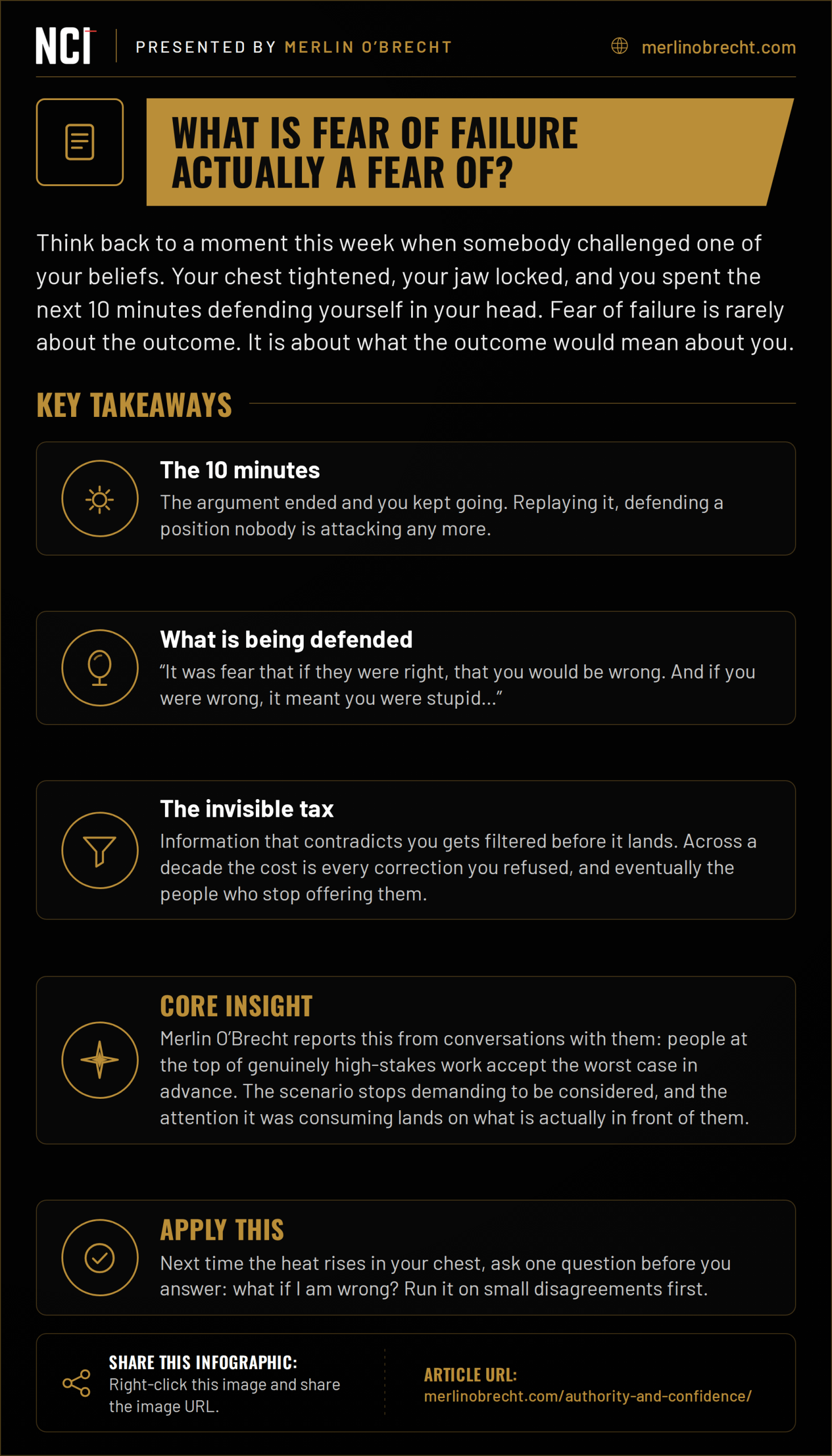
Not the outcome, in most people. What the outcome would mean about them.  Think back to a moment this week where somebody challenged one of your beliefs. Your chest tightened, maybe your jaw locked, and you spent the next 10 minutes defending yourself in your head, replaying a conversation that had already ended.  That was probably not anger and it may not have been conviction. 

“It was fear that if they were right, that you would be wrong. And if you were wrong, it meant you were stupid. It meant you weren’t worthy of love.” The cost is not the argument. It is everything the reflex prevented from arriving: the correction you did not take, the information that got filtered before it landed, and eventually the people who stop bothering to tell you things. Multiply that by a decade and you have been paying something substantial without ever seeing a receipt for it. The people at the top of genuinely high-stakes work do the opposite thing. They accept the worst case in advance, which frees the attention that would otherwise be spent rehearsing it. Full argument on what fear of failure is actually a fear of.
Why does willpower fail?

Because it acts on the wrong end of the system, and this is the mechanism the whole cluster has been circling.  Here is the model, and this one is mine rather than Chase’s. I call it the Identity Circuit, and my own framing is that it is not a completely brand new model, that it builds on the foundations of everything I have learned, and that I think it is a new way of thinking about it.  Picture two points. Your identity, meaning the version you are currently being: your needs, decisions, values and the role you are playing in your own story. And a behaviour, any behaviour at all.  Between them run four connections, produced by two states crossed with two charges. The two states are during the behaviour and not during, which is every other moment including anticipating and remembering it. The two charges are the good feelings tied to it and the bad ones. All four are always present, for every behaviour, in every person.  What separates one version of a person from another is not which connections exist. It is how loud each one is relative to the others. 

“The chemistry didn’t disappear, only the volume on each of those four connections. What was loud goes quiet and sometimes what was quiet gets loud.” Willpower turns the volume up or down from outside, temporarily, which is exactly why it produces a real result that decays the moment the pressure stops. Move the identity and the arithmetic changes on its own, and the behaviour follows without a fight. The diagram, the worked table and the three diagnostic questions are on the Identity Circuit Model, and why willpower fails.


Six subjects, one argument

Here is what only becomes visible once all six exist. 
The subject What people train What actually produces it
Confidence Posture, vocal tone, pacing, stillness Your relationship with your ego, and the material you have been avoiding
Executive presence Volume, chin, firm posture, commanding language Composure that does not need the room’s approval
Charisma Delivery tactics, metaphors, contrasts, three-part lists Enjoyment and gratitude, and not needing anything from the person in front of you
Composure Breathing, scripts, staying calm on purpose Confidence, gratitude, your relationship with time, your environment
Fear of failure Positive thinking, reframing, confidence-building Accepting the worst case in advance, which frees the attention it was consuming
Behaviour change Discipline, habit stacking, accountability, streaks Identity movement, which changes the arithmetic the behaviour runs on
Six subjects. Six symptom sets. In every case the honest answer sits one layer below what the category sells.
There is an obvious objection to that pattern and it deserves saying out loud. “It is all downstream of who you are” is unfalsifiable as stated. It explains every success and excuses every failure, it cannot be tested, and anybody who has bought personal development before has heard that exact sentence used to defend a method that did not work. If that is what this page is claiming, it is worth nothing.
So here is the narrower claim, which does make predictions.
Behaviours trained without the state underneath them decay in a specific and recognisable pattern: they hold under ordinary conditions and come apart under load. Not gradually, and not randomly. At the moment the pressure exceeds the attention available to maintain them.
That predicts things you have already observed. It predicts why the accountability partner worked and then stopped. Why the presentation went well and the following six weeks did not. Why the composure held right up until the meeting where it mattered. Why the person who has clearly read the same body language material you have still cannot get a room to follow them.
A claim that predicts its own failure mode, in advance, in a shape you can check against your own history, is doing something a slogan cannot.
Worth being straight about what these models are. They are NCI University’s curriculum, built by Chase Hughes, plus one framework of my own, taught and refined with students. They are not a peer-reviewed research programme and this page does not present them as one. Where actual research exists, as it does on charisma, it is cited and kept visibly separate from my reading of it.
Which leaves the order, and the order is most of the practical value here. Definitions first, because you cannot train what you have not distinguished. Then the state, which is composure. Then the conditions that make the state available. Then the identity underneath all of it.
“Real authority isn’t faked. It’s trained into behavior.”  That is the cluster in one sentence, and it is the version I would put in front of any other phrasing.  Which is also where a page reaches its limit. Everything above is readable. What it cannot do is tell you which of these six you are currently performing, because the faculty required to observe yourself accurately is the same one that degrades under exactly the conditions where it matters. Closing that gap takes structure and somebody watching, which is what NCI-3 Behavior Scientist is built around: 6 to 8 weeks, self-paced, $2,987. 

For people already operating at a level

One thing worth naming separately, because it is a different reader.  Some of the people who arrive at this material are not trying to build the skill. They are already operating somewhere the cost of misreading a person is measured in something other than money, and what they want is depth rather than instruction.  Avery is application only, and it is a significant investment. It is built for exactly that person. If the question is whether it is worth it, the honest answer is that it is not built for somebody asking that question yet.  Read who it is for, then decide whether to apply. 

Before the questions

If you want a shortcut, this will frustrate you. The first thing you work on is you, and it stays that way for longer than most people expect. 

Frequently asked questions

What is confidence?
Confidence is the overall feeling of safety a person carries, and it is distinct from how confident they appear. It is not what arrives after enough people have validated you, because that is approval and it comes from insecurity. Chase Hughes’s definition is the one worth keeping: a feeling of safety and a generalised expectation of positive outcomes in the future.
How do you build confidence?
Train the four observable behaviours first, since they respond quickly and give you something to stand on: vocal tone, pacing, posture and stillness. Then work on what sits underneath, which is your relationship with your own ego and whatever emotional material you have been avoiding. Doing only the first half produces a result that holds until something goes genuinely wrong.
How long does it take to become genuinely confident?
The visible behaviours change inside a few weeks of deliberate practice and other people notice before you do. The half underneath has no finish line, which I say on camera rather than selling a timeline, because every layer you work through reveals another. Anybody quoting a fixed number for the second half is describing the first half.
Is confidence something you are born with?
No, and composure specifically is the clearest case: it is not a gift some people receive and others do not, it is a state that emerges from a set of conditions, and conditions can be changed. The charisma research supports the same conclusion from a different direction, since controlled interventions have successfully taught the delivery layer to people who did not have it.
What is the difference between confidence and authority?
Confidence is the felt sense of safety you carry. Authority is how much autonomy and control you have over yourself. Neither is a position in a hierarchy, which is why somebody can hold a senior title and generate very little of either, usually obviously to everyone except them.
How do you build confidence for work and leadership?
Fix composure in low-stakes friction first, because that is where repetitions are free and consequences are not. Give one instruction a day without hedging it. Hold eye contact without scanning for approval. Then record where you lost composure and what preceded it, so you are working on a pattern rather than on a series of incidents you have already forgotten.
Can you fake confidence until you make it?
No, and the reason is structural. Real authority is trained into behaviour rather than performed, and it has to be felt internally first. A performance requires monitoring, monitoring divides your attention, and other people detect the division without being able to name what they noticed. That is also why people who try hardest to project confidence often radiate the least of it.
Where do these models come from?
Chase Hughes built most of them, including the Authority Triangle and its internal side, and they are taught through NCI University’s certification ladder. The composure structure and the four conditions are my own teaching framework. The Identity Circuit Model is my own model. The charisma research belongs to the psychology literature and is cited on that page rather than claimed by anyone here.
Is influencing how people perceive you manipulation?
The test Chase Hughes teaches is whether the other person, seeing your full intent, would agree it was in their interest. Most of what this cluster describes passes it by construction, since the effect on other people is a by-product of your own state rather than something done to them. The version that fails the test is composure held in order to win an exchange, which is posturing with a calm face.
Where should you start?
With the definitions, then with composure, because composure is where all of this becomes testable. Run the evening replay for a fortnight: five minutes, no judgment, one question about where on the arc you spent the day. Almost nobody has ever watched their own behaviour that way, and everything else in this cluster is easier once you have.
What is the Identity Circuit Model?
The Identity Circuit Model is my own model of behaviour change. It places identity and any behaviour as two points joined by four emotional connections: a positive and a negative during the behaviour, and a positive and a negative in every other moment. All four always exist, and what changes between versions of a person is how loud each one is relative to the others.
Which of these should you read first?
Start with confidence, since it defines the terms everything else uses. Then composure, which is where the ideas become testable against your own week. After that the order is yours: executive presence if you lead people, charisma if you present, fear of failure if you keep replaying conversations, and self mastery if you have been trying to change the same thing for years.

The Deep Dive

  1. The two halves of confidence, and the ego work underneath, including shadow work and three practices.
  2. Why a room follows one person and not another, the switch, the signals, and a roof in July.
  3. What the charisma research actually measures, four sourced strands and the published tactics.
  4. Collapse, posturing, and the four conditions between them, with Marcus Aurelius on Maximus.
  5. What fear of failure is actually a fear of, and the invisible tax it charges.
  6. The Identity Circuit Model, and why willpower fails, with the diagram and the three questions.

Reading people rather than yourself is the other half of this work, and it lives in the full guide to how to read people.

Where to go from here
Do the evening replay. Five minutes, tonight, one question: where on the arc between collapse and posturing did I spend today?
It costs nothing, almost nobody has done it, and it is the single fastest way to find out whether any of what is on this page applies to you.
If you want the structured version, where somebody experienced tells you what you cannot see about yourself, that is NCI-3 Behavior Scientist. 6 to 8 weeks, self-paced, $2,987.
Either way, keep the one thing. The behaviours are real, they work, and they are the output. What produces them is the part almost nobody is selling you.