Merlin O'Brecht

Behavior profiling hub

How to read people: the complete guide to behavior profiling

By Merlin OBrecht · Dean of Academic Affairs, NCI University
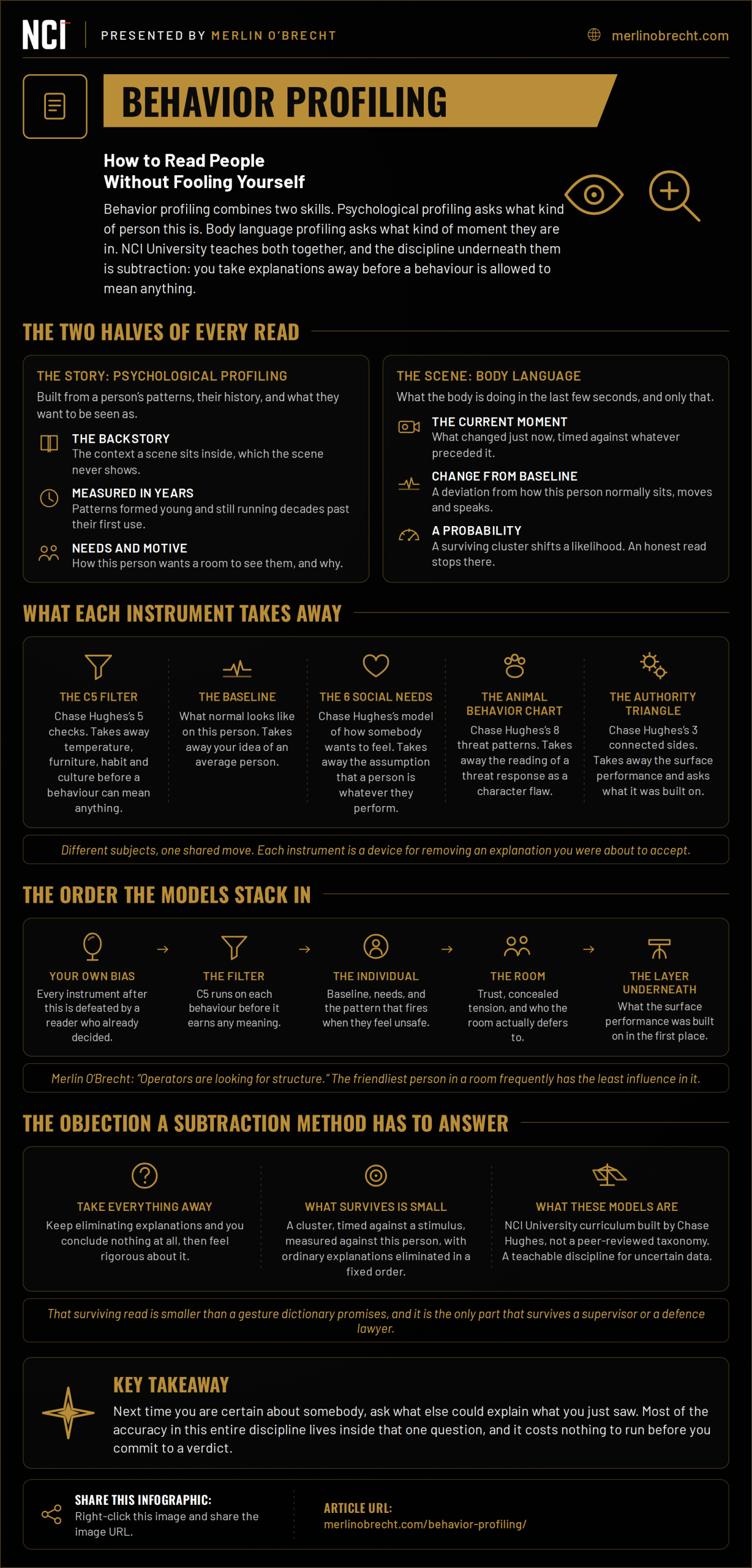
To read people accurately, measure behaviour against that person’s own baseline, require a cluster of behaviours before concluding anything, and check what else could explain what you saw. NCI University teaches this as behavior profiling: psychological profiling for context, body language profiling for the moment. The discipline is subtraction rather than recognition.

Somewhere in the last year you were completely certain about a person and completely wrong.

You noticed something. Arms folded, a pause that ran too long, eye contact that went somewhere it should not have gone. You knew what it meant. You adjusted how you spoke to them for the rest of that conversation, and possibly for the rest of that relationship, and nobody ever came along afterwards to tell you the read was wrong.
That is the actual problem with reading people. Not that it is hard. That being wrong at it feels exactly the same as being right.
Almost everything published on this subject makes that worse rather than better. Fifteen signs, memorise them, now you can read anyone. It is an addition problem: collect more meanings, get better results. What it produces is a person who is more confident and no more accurate, which is a worse outcome than where they started, because at least the person who was not reading knew they did not know.
The professional version runs the other way. Reading people accurately is mostly the work of taking explanations away. Before a behaviour is allowed to mean anything, you eliminate the ordinary reasons it could be there: the temperature, the chair, the habit, the culture, the flight of stairs, the meeting they had before this one. What survives that is small, and it is real, and it is the only part that holds up when somebody asks you to explain how you know.
That is what NCI University teaches, and my role in it is narrower than it looks from outside. Chase Hughes built these models over decades. NCI turned them into a curriculum with a standard. What I do is translate: take what Chase found and NCI codified, and make it land for somebody who is not yet either of those things. Chase will often start at step 4, assuming steps 1 through 3 are obvious. This page is steps 1 through 3.
Seven articles sit underneath it, each one a different instrument. Every one of them does the same job.

Key takeaways

What is behavior profiling? 

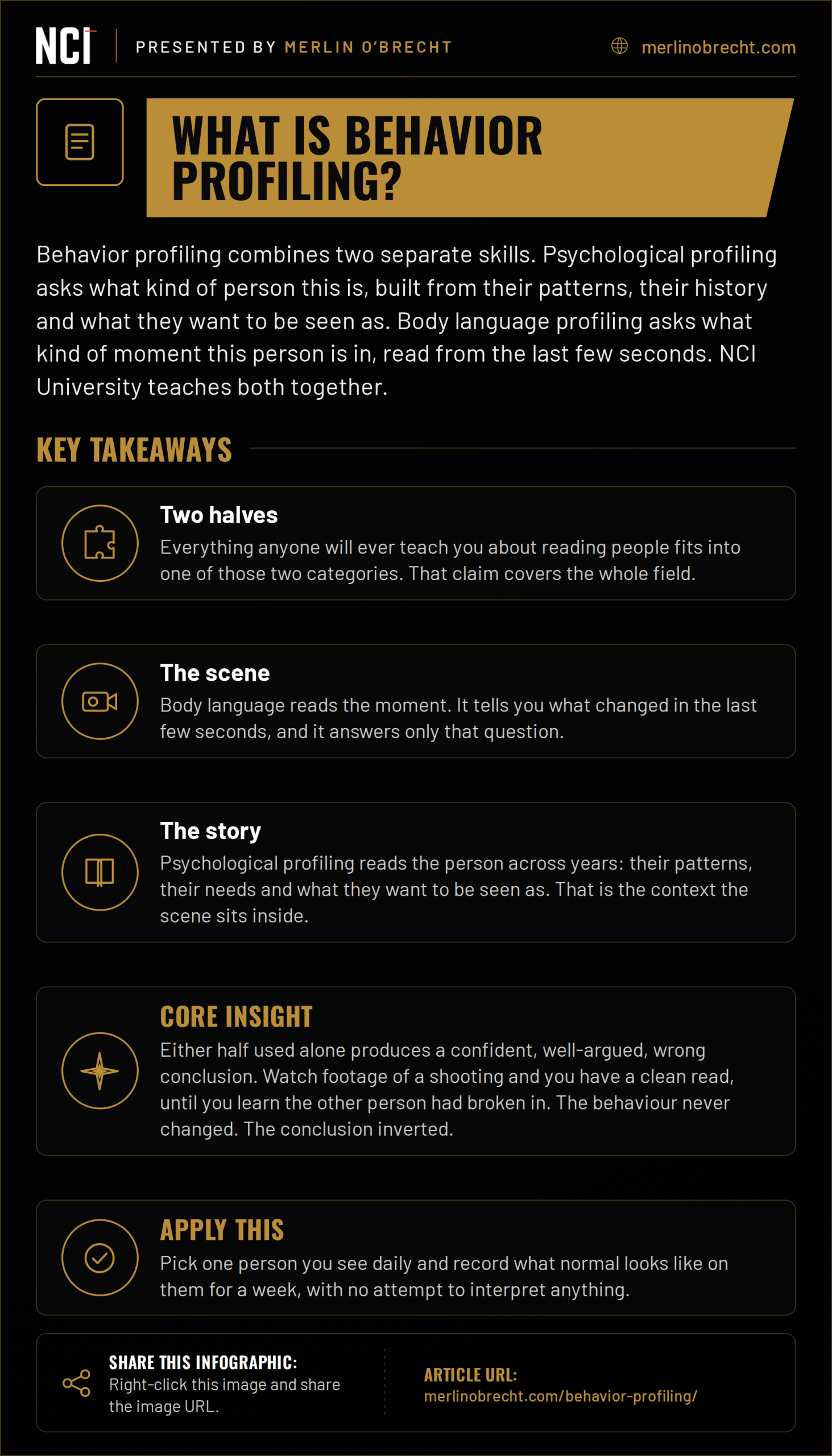
Behavior profiling is the combination of two separate skills. Psychological profiling asks what kind of person this is, built from their patterns, their history and what they want to be seen as. Body language profiling asks what kind of moment this person is in right now, read from what their body is doing in the last few seconds.
Everything anyone will ever teach you about reading people fits into one of those two categories. Not most of it. All of it.
The reason both are needed is easiest to see with an example that takes 20 seconds. You watch footage of one person shooting another, and you conclude the shooter is a bad person, which is a fair reading of what is on the screen. Then you learn the other individual had broken into that person’s house intending to harm their family. Not one observable behaviour changed. Your conclusion inverted, on information that was never visible in the scene at all.
Body language gives you the scene. Psychological profiling gives you the story the scene sits inside. Either one alone produces a confident, well-argued, wrong conclusion.

That is covered properly in what behavior profiling actually contains, including the discipline underneath both halves, which is the deliberate suspension of judgment before you walk in.
How do you read body language accurately?

You run every observed behaviour through five filters before you allow it to mean anything. Chase Hughes designed the model and NCI teaches it as C5, for five checks that all begin with C: change, context, clusters, culture, checklist.
Change. Is this a deviation from how this person normally is, or is it just how they sit? Body language does not appear in still images. It appears in movement, which means you need a baseline before you have anything to compare against.
Context. Does the situation explain it on its own? Somebody breathing heavily after climbing stairs is telling you about stairs.
Clusters. Does anything else confirm it? A single behaviour standing alone gets thrown out rather than interpreted, because erring toward caution costs nothing and a false conclusion costs the whole read.
Culture. Could a norm explain what you are reading as stress? Eye contact that would be low for an American may be perfectly ordinary elsewhere.
Checklist. Only now do you record what survived, against the specific moment it appeared.
Count what those five actually do. Four of them exist to take a behaviour away from you. One records what is left.

The full method, the baseline, and a drill you can run tonight are in the five filters a behaviour has to survive.

What do the six social needs tell you?

The six social needs are Chase Hughes’s model of how a person wants to feel in a social situation: acceptance, approval, intelligence, significance, strength and power, and pity.
The correction that the whole model turns on is one most people get backwards on first contact. The need is the wanting, never the having. Somebody with a strength and power need is not necessarily strong. They could be, in Merlin’s own phrasing on camera, a small, short, weak, frail person who is obsessed with feeling as though they are in control. Read a need as a description of the person and you have built your profile on a compliment, which is a strange foundation for accuracy.
The other thing worth knowing early is that you cannot ask. Walk up to somebody with an intelligence need and suggest they seem like they want to be seen as smart, and they will deny it, because admitting it costs them the exact thing the need is asking for. The social mask exists to keep this concealed, which is precisely why the reading has to be done rather than the question asked.

The six social needs and how to speak to each one carries the four rules for a compliment that lands, twelve worked examples, and the diagnostic for when one falls flat.

What happens when somebody feels threatened?

People change shape under threat, and they do it in about eight recognisable ways. Chase Hughes’s Animal Behavior Chart groups them into four categories.

Connection, which handles threat by reaching toward the other person: the puppy, who becomes disarming and impossible to stay angry at, and the sheep, who moves toward the group.
Strategy, which handles it through analysis: the wolf, who goes quiet while the eyes work the room, and the fox, who reframes the conversation in real time until it feels slippery.
Removal, which handles it by leaving: the rabbit, who physically exits, and the turtle, who stays in the room and dissociates.
Prevention, which handles it through aggression, in two opposite ways: the chihuahua, whose volume is the whole strategy, and the porcupine, who goes unusually still and then escalates fast.
Fight, flight and freeze is the vocabulary most people have for this, and it is too coarse to be useful on a Tuesday afternoon with somebody you actually know.

The framing that matters most is Merlin’s own, and it is a quote rather than a paraphrase:
“These aren’t pathological problems. They’re old solutions that are just still running in the present.”

Every one of the eight is a survival strategy a child worked out before they had words for any of it. The eight patterns people fall into under threat covers all of them, plus the one discrimination worth getting precisely right, which is volume against stillness.

How do you read a room? 

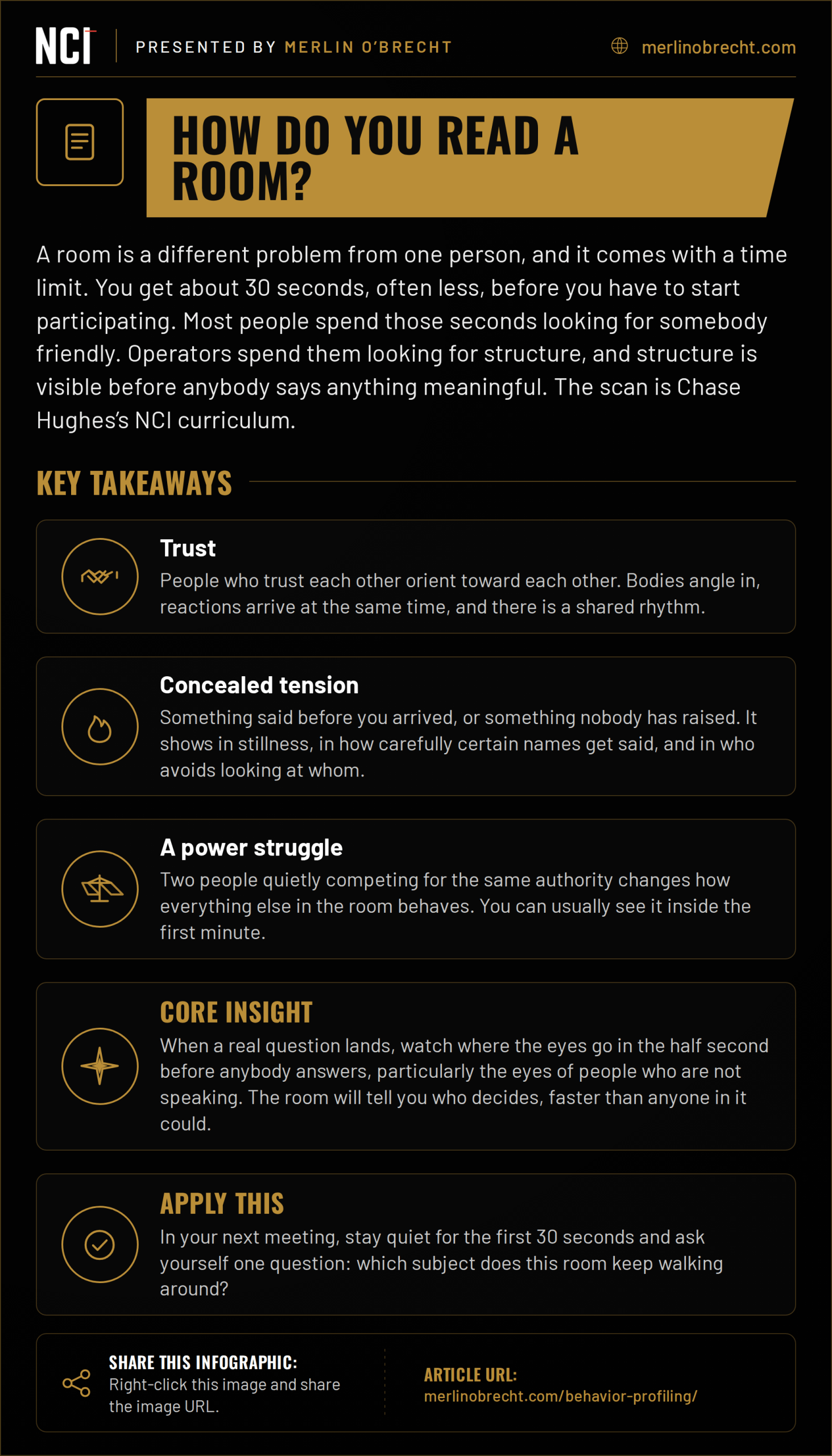
Everything above reads one person. A room is a different problem, and it has a time limit: you get about 30 seconds, often less, before you have to start participating. Most people spend those 30 seconds looking for somebody friendly. That is the amateur move.
“One of the big mistakes a lot of people make is they look for comfort or approval. Operators are looking for structure.”
Structure means three things, all visible before anybody says anything meaningful. Whether there is trust in the room. Whether there is concealed tension behind the scenes. Whether there is a power struggle between multiple decision makers.
The single most useful observation is also the cheapest. When a real question lands, watch where the eyes go in the half second before anybody answers, particularly the eyes of people who are not speaking. The room will tell you who decides, and it will do it faster than anyone in it could tell you themselves.
Then there is the rule almost nobody teaches: read the absence. What is not being said, which subject the conversation keeps steering around, who is in the room and has not been asked anything.

The 30-second scan for reading a room includes the boardroom where the loudest man in the room turned out to have no authority at all, and the whole deal came down to one calm nod from a quiet woman three seats away.
How is deception actually detected?

This is where the subtraction discipline stops being a preference and starts being the thing that protects somebody’s career.
Nothing observable in a human being is deception. There is no behaviour that means lying. What is observable is stress, discomfort, cognitive load and inconsistency, and every one of those has a long list of ordinary causes. Innocent people under interview produce stress. So do people telling the truth about something they are ashamed of.
So the professional method does not spot. It scores. Chase Hughes’s Deception Rating Scale defines the observation window precisely: it opens the moment a question begins, including everything that happens before the answer starts, and closes when the next question begins. One window, one score, one question.
The output is a probability, and it stays a probability. It is a reason to return to that question, never a reason to conclude something about a person.
The failure mode that matters here is the false positive. A guilty person reading as clean costs you a lead. An innocent person reading as deceptive can cost them a job, a case or a custody arrangement, and they usually never learn that a behavioural read is what moved the decision.

How deception gets scored rather than spotted has the full method, and it is deliberately explicit about what it refuses to give you.

What sits underneath body language?

There is a layer below all of this, and I did not find it for years. I thought body language and Chase’s 6MX system were the end of the story.
“It’s a set of psychological factors that make the rest of behavior profiling look like an old dented Toyota Corolla sitting next to a brand new Porsche 911.”
Three lenses. The Authority Triangle, which tracks a read across three connected sides, giving 125 combinations from 15 things you memorise. The rule to see suffering first, which takes the social mask somebody is presenting and inverts it to find the fear their ego formed around. And the Childhood Development Triangle of friends, rewards and safety, which is where the adult strategies came from.
Read the mask inversions carefully when you get to them, because every one carries the word “often.” Loud certainty often guards insecurity. Chronic superiority often guards a fear of not being enough. That hedge is not padding. It is the difference between a working heuristic and a claim about a person you will not be able to unmake.

The three lenses underneath body language works one observation all the way through all three sides, and keeps the caveat that a real profile would use far more data points than the exercise does.

Seven instruments, one operation

Here is what only becomes visible once all seven exist.
The instrument What it reads What it removes
The two halves Whether you have the scene, the story, or both The assumption that watching somebody is the same as understanding them
The C5 filter Whether a behaviour has earned its meaning Temperature, furniture, habit, culture, the last 10 minutes of their day
The baseline What normal looks like on this specific person Your idea of an average person, which is mostly a description of you
The six social needs How somebody wants to be perceived The assumption that a person is whatever they are performing
The Animal Behavior Chart What somebody does when they feel unsafe The reading of a threat response as a character flaw
The Deception Rating Scale How much stress clustered inside one bounded question The idea that any single behaviour indicates a lie
The Authority Triangle What the surface performance is built on The surface performance
Seven different subjects. One shared move. Every instrument in this cluster is a device for removing an explanation you were about to accept.
There is an obvious objection to a method built entirely out of subtraction, and it deserves saying out loud rather than being managed around. If you keep taking explanations off the table, you can take all of them off. What you would be left with is a person who concludes nothing, feels extremely rigorous about it, and is functionally identical to somebody who knows nothing at all. Elaborate humility is still not a read.
That objection is fair, and here is the answer.
What survives the subtractions is small and specific. A cluster of behaviours, appearing together, timed against a particular stimulus, measured against how that individual normally is, with the ordinary explanations eliminated in a fixed order rather than whichever order suits your existing theory. That is genuinely less than a gesture dictionary promises. It is also the only part that survives a supervisor, a defence lawyer, an HR review, or a friend asking how you could possibly know that.
Worth being straight about the status of all of this. These are NCI University’s models, built by Chase Hughes, taught through a curriculum. They are not a peer-reviewed taxonomy and this page does not present them as one. What they are is a structured, teachable discipline for working with genuinely uncertain data, which is a description that also fits several fields nobody calls pseudoscience.
Which leaves the order. The stack has a sequence, and it does not start where anybody wants it to. It starts with your own bias, because every instrument above is defeated by a reader who has already decided. Then the filter. Then the individual, then the room, then the layer underneath.

And that is the point at which a page stops being able to help you. Everything above is readable, and you can finish it genuinely ahead of where you started. What a page cannot do is tell you which of your own reads were confirmation dressed up as observation, because that requires somebody who watched the same footage and will say so. That is what the 32 skills-building calls with facilitators inside NCI-2 Behavior Profiler exist for, alongside 22 video modules and 12 hours of material, $795.

If you want this inside a team rather than inside your own head

One thing worth naming separately, because it is a different problem.
Most people arrive at this material as individuals. Some arrive because a team is misreading each other, or misreading a market, or losing deals in rooms where nobody could tell who actually decided.
If you want me working with your team rather than with you, that runs as a scoped engagement through NCI. It starts with an application and a conversation about what you are actually trying to change.
That last phrase is doing the qualifying. The engagements that work are the ones where somebody can name the specific thing they want different afterwards.

Before the questions

If you want a shortcut, this will frustrate you. The first thing you work on is you, and it stays that way for longer than most people expect.

Frequently asked questions

What does it mean to read people?
Reading people means identifying what somebody is likely experiencing or intending, from observable behaviour, measured against how that person normally is. Done properly it produces a probability rather than a conclusion, and it covers two separate questions: what kind of person this is, and what kind of moment they are in right now.
How do you learn to read people?
Start by building baselines on people you already see regularly, watching how they sit, speak, pause and move when nothing is happening. Then learn a filter, so that a behaviour has to survive checks for context, culture and confirmation before it means anything. Then practise against recorded footage, where you can rewind. Feedback comes last and matters most.
How long does it take to learn to read people?
The models take days to learn and you can apply them to footage the same week. Running them live, while you are also holding up your end of a conversation and managing your own state, takes months of repetitions. That gap between understanding a method and executing it under load is the real timeline, and nobody can shorten it for you.
Is reading people a real skill or pseudoscience?
It depends entirely on what is being claimed. The claim that a specific gesture carries a fixed meaning does not survive contact with evidence, and this method rejects it outright. The narrower claim, that behaviour deviating from a person’s own baseline, appearing in clusters, and surviving an explicit check for other explanations shifts the probability of an interpretation, is defensible. The output being a probability rather than a verdict is what keeps it honest.
What is the difference between behavior profiling and body language reading?
Body language reading is one half of behavior profiling. It reads the current moment from movement and posture. Behavior profiling adds the psychological half, which reads what kind of person you are looking at, built from their needs, patterns and history. The first tells you what is happening. The second tells you what it means.
How do you use this at work?
Three common places. In hiring, build a candidate’s baseline during easy questions and note which later question moved them, then ask more there. In negotiation, watch which term produces a change rather than which term gets argued about hardest. In managing, match recognition to what somebody actually wants to feel, since the same information delivered three ways lands three times better.
Can you tell if someone is lying?
No, and no behavioural method can. What can be measured is stress and inconsistency, clustered inside a defined window and compared against that person’s baseline, which shifts a probability. Innocent people under pressure produce stress routinely, which is exactly why a responsible method returns a likelihood and never a verdict.
Who created the system taught here?
Chase Hughes built it. The C5 model, the Behavioral Table of Elements, the Deception Rating Scale, the six social needs, the Childhood Development Triangle, the Animal Behavior Chart and the Authority Triangle are all his, taught through NCI University’s certification ladder from NCI-1 Behavior Observer upward. My own role is teaching and translating the system rather than having authored any part of it.
Is it ethical to read people without telling them?
The test Chase Hughes teaches is whether the other person, seeing your full intent, would agree that what you did was in their interest. Noticing somebody is uncomfortable and slowing down passes comfortably. Noticing they are uncomfortable and pressing there does not. The observation skill is identical in both cases, which is why the ethics sit with the practitioner rather than the tool.
Where should you start?
With one person and one week. Pick somebody you see daily and record what normal looks like on them, with no attempt to interpret anything. Almost nobody has ever done this deliberately, and every other instrument in this discipline is measured against it. Only after that does learning what individual behaviours indicate become useful rather than misleading.
How do you become a behavioral profiler?
There is no licence and no regulated profession at the end of this, which is worth knowing before anybody sells you a path to one. What exists is a certification ladder inside NCI University, starting with NCI-1 Behavior Observer and continuing into NCI-2 Behavior Profiler, plus the thing that actually produces skill, which is a large volume of scored footage reviewed by somebody who will tell you where you were wrong.
Which of these should you read first?
Start with what behavior profiling actually contains, then the five filters, since nothing else works reliably without those two. After that the order is yours: the six social needs if you manage people, the eight threat patterns if you are trying to understand somebody specific, the 30-second room scan if you are walking into meetings this week.

The Deep Dive

  1. What behavior profiling actually contains, the two halves and the discipline underneath both.
  2. The five filters a behaviour has to survive, Chase Hughes’s C5 model, plus baselines and a practice drill.
  3. The six social needs and how to speak to each one, with the four rules and twelve worked examples.
  4. The eight patterns people fall into under threat, the Animal Behavior Chart in full.
  5. The 30-second scan for reading a room, including the boardroom and the quiet woman three seats away.
  6. How deception gets scored rather than spotted, the Deception Rating Scale and what it refuses to claim.
  7. The three lenses underneath body language, the Authority Triangle, seeing suffering first, and the childhood roots.
New to all of it? Start here if you want the order to learn this in.

Where to go from here

Do the baseline exercise. One person, one week, no interpretation. It is free, almost nobody does it, and it is the thing every instrument on this page is measured against.
If you want the structured version, where the seven instruments get built in order and somebody experienced tells you which of your reads were wrong, that is NCI-2 Behavior Profiler. 12 hours, 22 video modules, 32 skills-building calls with facilitators, $795.
Either way, the thing worth carrying off this page is smaller than a technique. Next time you are certain about somebody, ask what else could explain what you just saw. Most of the accuracy in this entire discipline lives in that one question.