Authority and confidence hub
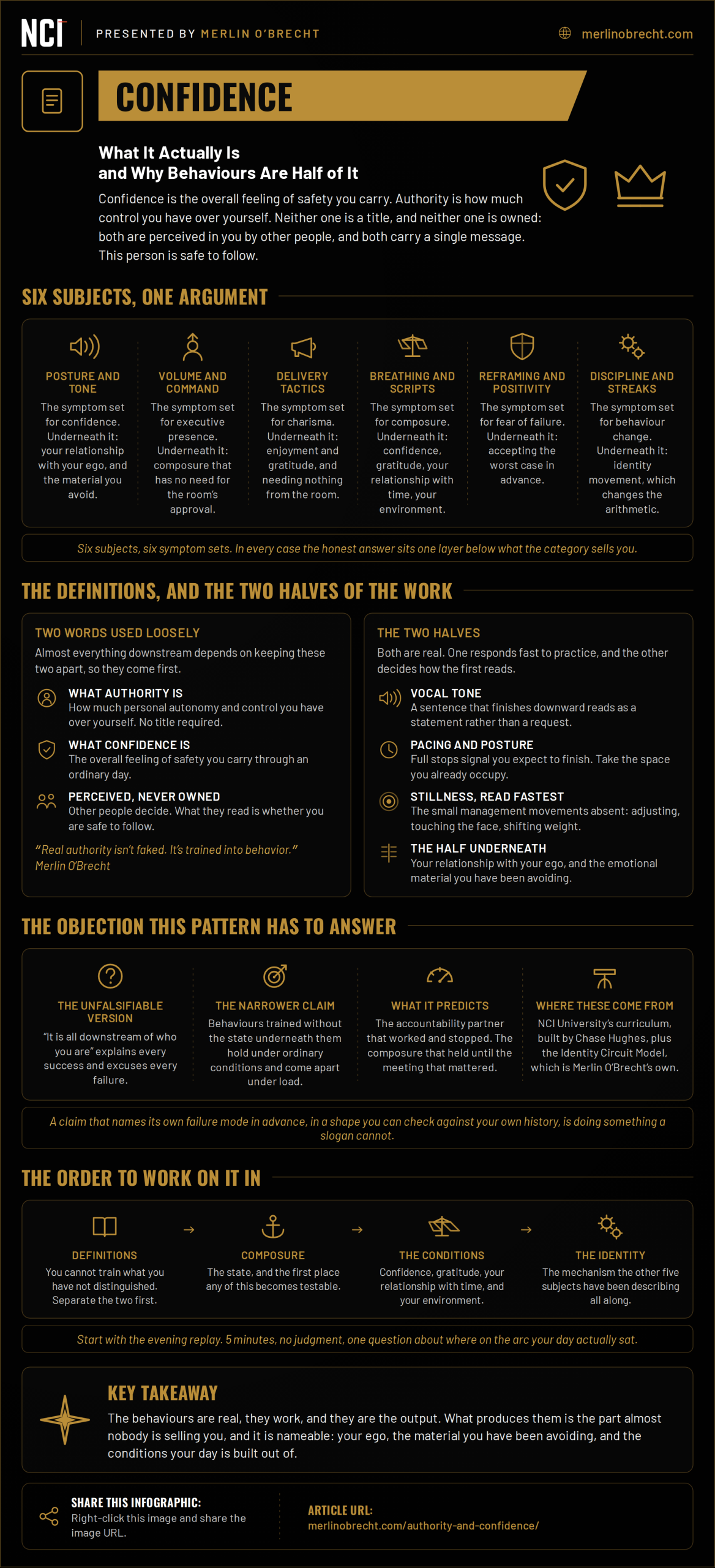
Confidence: what it actually is, and why the behaviours are only half of it
Key takeaways
- Confidence is a felt sense of safety. Authority is control over yourself. Neither is a position and neither is a performance.
- Every visible marker of both is a symptom, and symptoms trained directly produce something people can feel the seam in.
- The causes are nameable: your relationship with your ego, the material you have been avoiding, and the conditions your day is built out of.
- Composure sits between collapse and posturing, which look like opposites and turn out to be the same move.
- Behaviour follows identity. Willpower acts on the other end, which is why it produces a real result that fades.
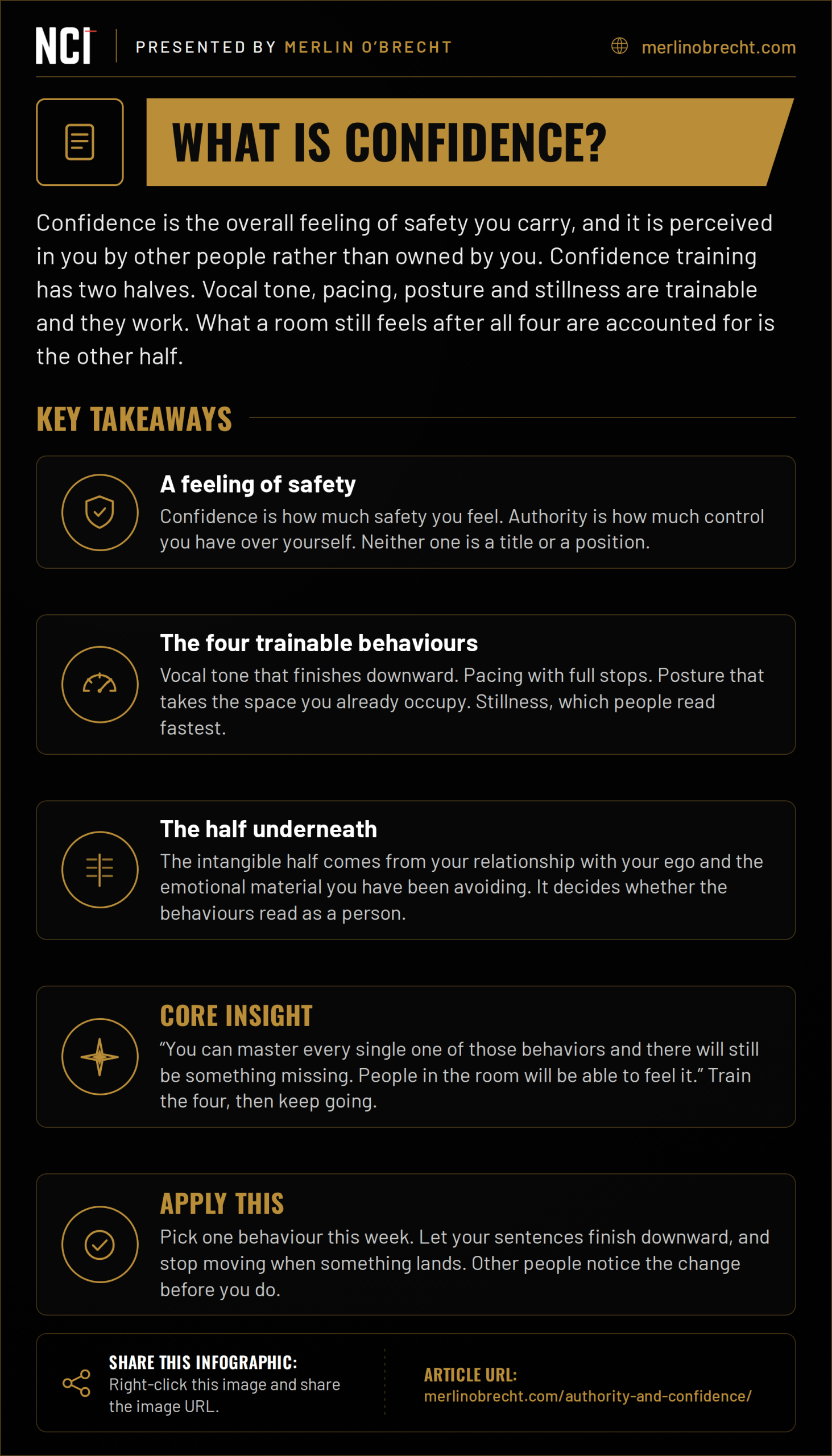
What is confidence?
“You can master every single one of those behaviors and there will still be something missing. People in the room will be able to feel it.” That is covered properly in the two halves of confidence, and the ego work underneath.
What is executive presence?
“Those people underneath, deep down inside of themselves, are still seeking approval and they’re fearing rejection. And the brain is really able to just instantly kind of pick up on that.” Full treatment on why a room follows one person and not another.
Is charisma a skill or a trait?
“You may have noticed that everything I just mentioned were symptoms of charisma.” The cause, in my reading rather than in the research, sits on the internal side of Chase Hughes’s Authority Triangle, and specifically on enjoyment and gratitude: the actual capacity to feel them through an ordinary day, which then shows up in how you communicate without you managing it. Sources, tactics and the argument in full on what the charisma research actually measures.
What is composure?
“Collapse and posturing are not opposites, they’re the same disease basically wearing different clothes.” Both are extracting something from the room while concealing that anything is being extracted. One makes itself smaller so nobody can see how much it wants. The other makes itself bigger so nobody can see how afraid it is. Which is why the way out is perpendicular to the pendulum rather than along it. You do not get to composure by swinging better. You get there by stopping the swing, and four conditions make that possible: confidence, gratitude, your relationship with time, and your environment. The portrait of Maximus from Marcus Aurelius, the full table, and both practices are on collapse, posturing, and the four conditions between them.
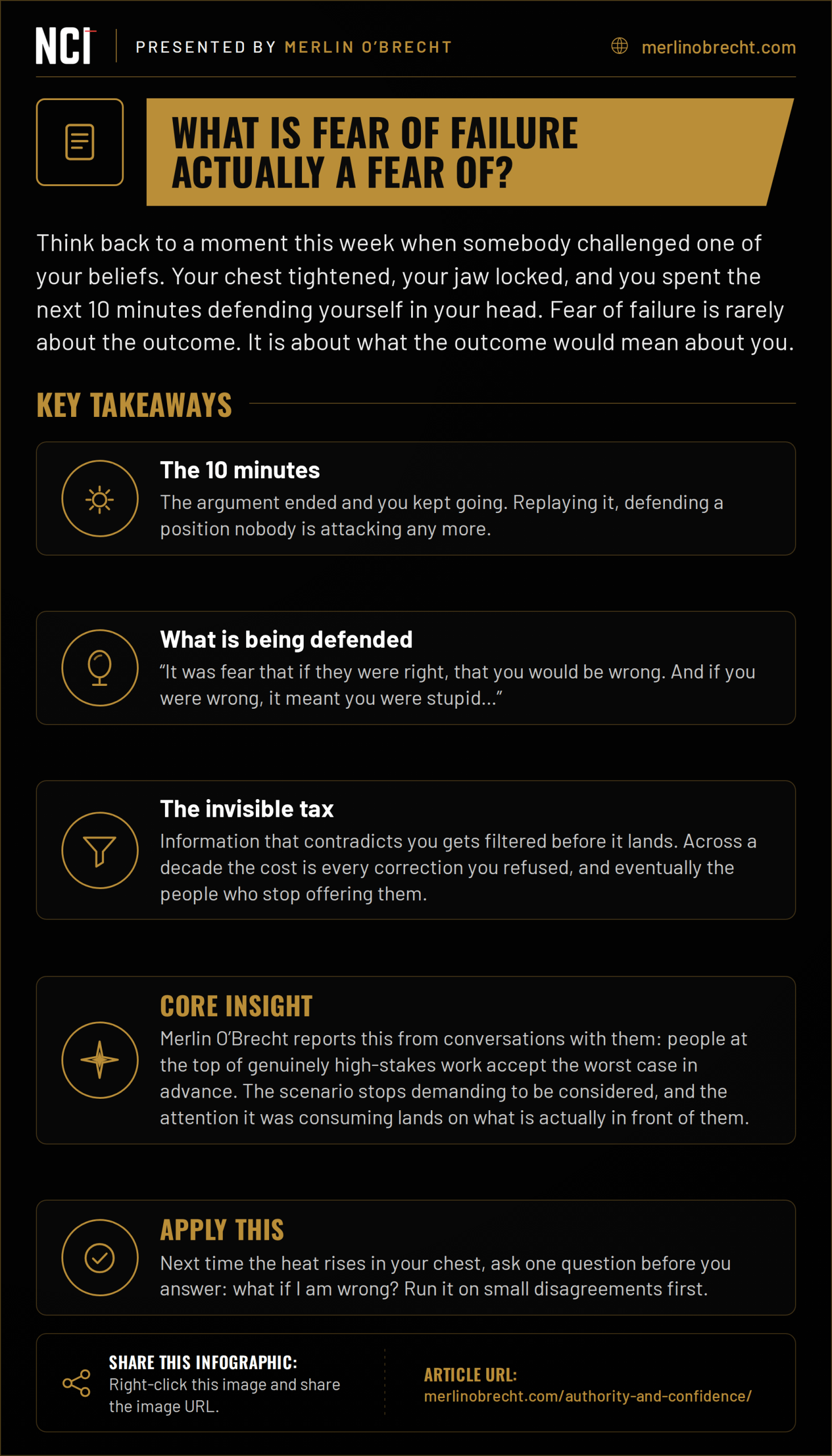
What is fear of failure actually a fear of?
“It was fear that if they were right, that you would be wrong. And if you were wrong, it meant you were stupid. It meant you weren’t worthy of love.” The cost is not the argument. It is everything the reflex prevented from arriving: the correction you did not take, the information that got filtered before it landed, and eventually the people who stop bothering to tell you things. Multiply that by a decade and you have been paying something substantial without ever seeing a receipt for it. The people at the top of genuinely high-stakes work do the opposite thing. They accept the worst case in advance, which frees the attention that would otherwise be spent rehearsing it. Full argument on what fear of failure is actually a fear of.
Why does willpower fail?
“The chemistry didn’t disappear, only the volume on each of those four connections. What was loud goes quiet and sometimes what was quiet gets loud.” Willpower turns the volume up or down from outside, temporarily, which is exactly why it produces a real result that decays the moment the pressure stops. Move the identity and the arithmetic changes on its own, and the behaviour follows without a fight. The diagram, the worked table and the three diagnostic questions are on the Identity Circuit Model, and why willpower fails.
Six subjects, one argument
| The subject | What people train | What actually produces it |
|---|---|---|
| Confidence | Posture, vocal tone, pacing, stillness | Your relationship with your ego, and the material you have been avoiding |
| Executive presence | Volume, chin, firm posture, commanding language | Composure that does not need the room’s approval |
| Charisma | Delivery tactics, metaphors, contrasts, three-part lists | Enjoyment and gratitude, and not needing anything from the person in front of you |
| Composure | Breathing, scripts, staying calm on purpose | Confidence, gratitude, your relationship with time, your environment |
| Fear of failure | Positive thinking, reframing, confidence-building | Accepting the worst case in advance, which frees the attention it was consuming |
| Behaviour change | Discipline, habit stacking, accountability, streaks | Identity movement, which changes the arithmetic the behaviour runs on |
For people already operating at a level
Before the questions
Frequently asked questions
The Deep Dive
- The two halves of confidence, and the ego work underneath, including shadow work and three practices.
- Why a room follows one person and not another, the switch, the signals, and a roof in July.
- What the charisma research actually measures, four sourced strands and the published tactics.
- Collapse, posturing, and the four conditions between them, with Marcus Aurelius on Maximus.
- What fear of failure is actually a fear of, and the invisible tax it charges.
- The Identity Circuit Model, and why willpower fails, with the diagram and the three questions.
New to all of it? Start here if you want the order to learn this in.
Reading people rather than yourself is the other half of this work, and it lives in the full guide to how to read people.
Where to go from here