How influence actually works
How to influence people: the three layers, in the order that matters
By Merlin OBrecht · Dean of Academic Affairs, NCI University
How influence actually works
Influencing people works through three layers in a fixed order: self-mastery, observation, and communication. Merlin OBrecht teaches that the person doing the talking shapes how a message lands before any word gets processed. Reading the person decides what to say. Words come last, and NCI University maps them with Chase Hughes’s FATE model.
Influence comes with a proposition attached: that words are magic. The perfect phrase at the perfect moment, and doors open, deals close, money falls from the sky.
I understand the appeal. It is a clean story and there is something genuinely seductive about it.
It is also incomplete, and you have probably watched the evidence yourself. Somebody with an apparently perfect technique, all the cadence and the delivery in place, and the conversation bombs. Nobody felt connected to them. Every word was right and the room did not move.
“The success or failure of any human interaction, it’s going to ultimately come down to three factors.”
Three layers, and the one everybody trains is the last one.
Key takeaways
- Influence runs on three layers in a fixed order: self-mastery, observation, then communication.
- The person doing the talking shapes how a message lands before any word gets processed.
- All the self-mastery available will not survive a mismatch between what you are offering and who you are offering it to.
- The technique layer is real and it is last, which is the reverse of how nearly all training sequences it.
- Once the right state exists in the other person, the ask can be almost anything.
How do you actually influence people?
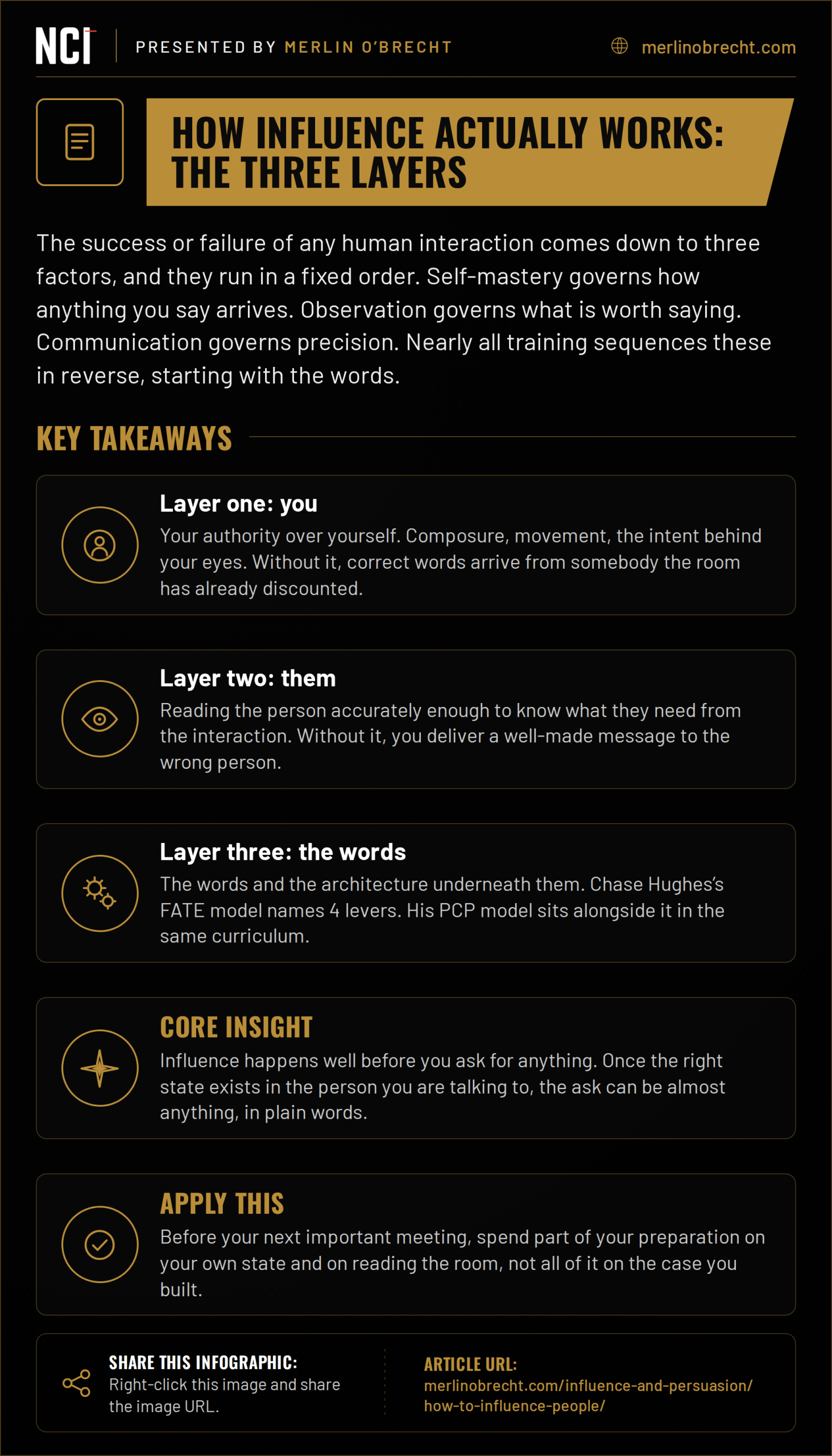
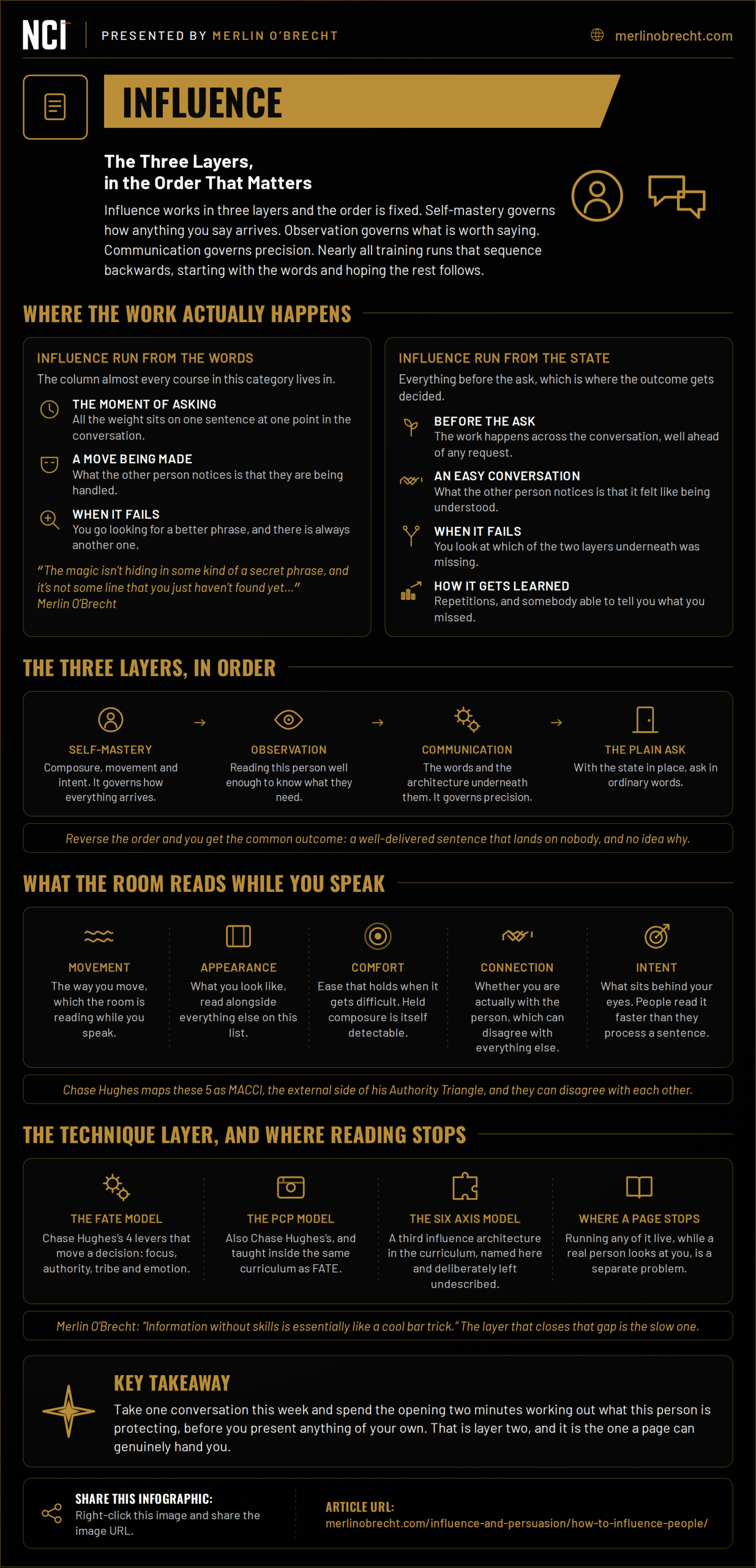
You work three layers in order. Self-mastery first, meaning your own authority over yourself, which shapes how anything you say arrives. Observation second, meaning reading who is actually in front of you, which decides what is worth saying. Communication third, meaning the words and the structures underneath them.
Reverse that order and you get what most people get: a well-delivered sentence that does not land, and no idea why.
Why the perfect line does not work on its own
Here is the demonstration, and you can check it against your own memory in about 10 seconds.
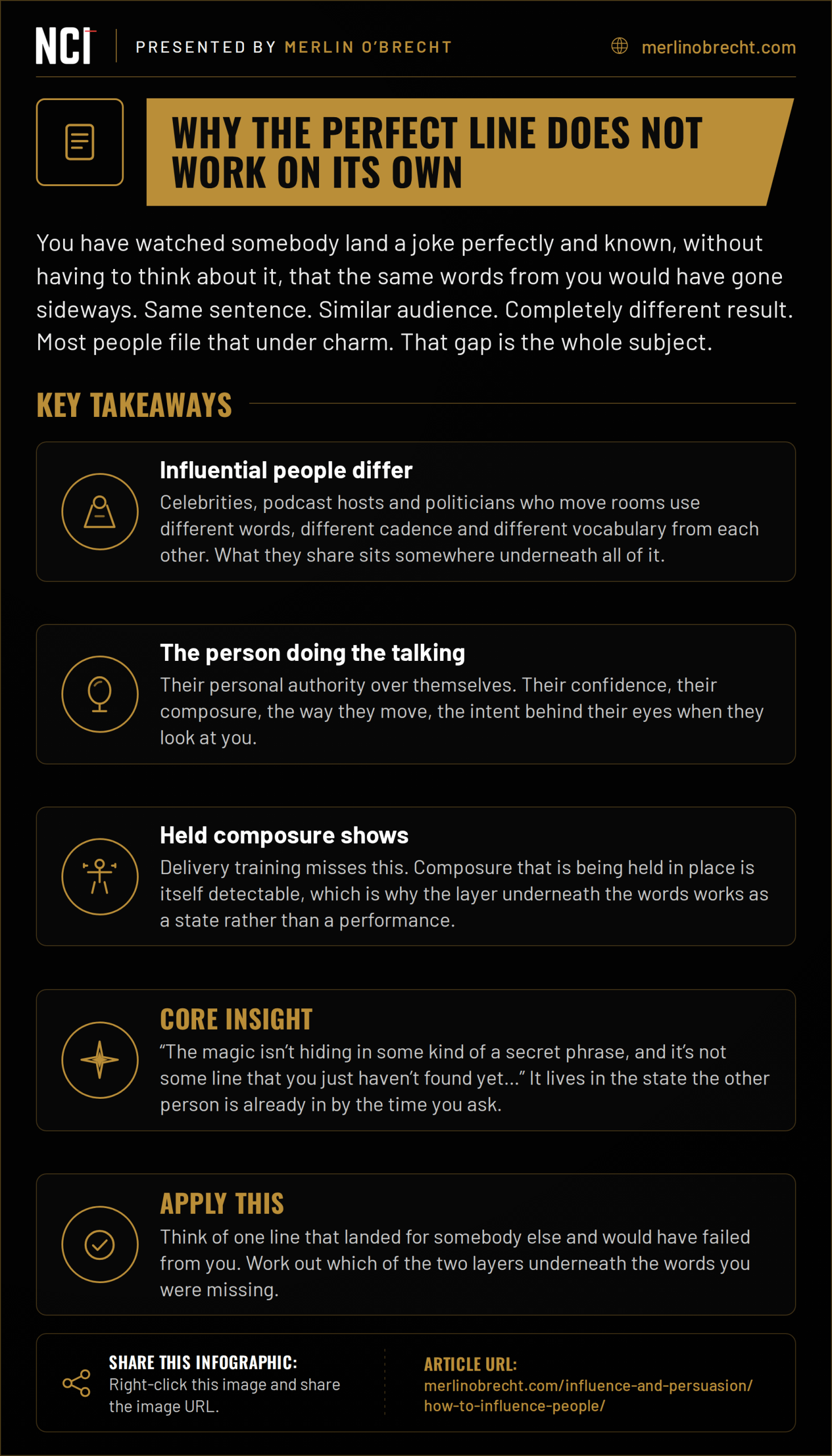
You have watched somebody make a joke that landed perfectly. And you knew, in the back of your mind without having to think about it, that if you had said the exact same thing it would have gone sideways. Same words. Similar audience. Completely different result.
That gap is the whole subject.
Look at the people who are genuinely influential, whether that is celebrities, podcast hosts or prominent politicians. They are not using the same words as each other. They are not even using the same cadence or vocabulary. What they have in common sits somewhere else.
The first thing that matters, more than anything else, is the person doing the talking, and specifically their personal authority over themselves. Their confidence. Their composure. The way they move. The intent sitting behind their eyes when they look at you. Every one of those shapes how the message lands before any word is processed.
If you have ever known in advance that a line would not work coming from you, you already believe the first layer exists.
What are the three layers of influence?
- Self-mastery. Your authority and autonomy over yourself: composure, movement, intent. It governs how everything you say is received. Without it, correct words arrive from somebody the room has already discounted.
- Observation. Reading the person in front of you accurately enough to know what they actually need from the interaction. It governs what is worth saying at all. Without it, you deliver a well-made message to the wrong person.
- Communication. The words, and the architecture underneath them. It governs precision. Without it, you have presence and understanding and no way to convert either into a specific outcome.
Layer one: the person doing the talking
The observable side of self-mastery is what other people are reading while you speak, and Chase Hughes maps it with MACCI, the external side of his Authority Triangle: movement, appearance, comfort, connection, intent.
Five elements, and the useful thing about them is that they can disagree with each other. Somebody can look entirely comfortable and be visibly disconnected from the conversation, which reads as something being off without anybody being able to name what.
None of that is a performance layer. Composure that is being held in place is itself detectable, which is the part most delivery training misses.
The material underneath this belongs to the authority and confidence work rather than to influence, and it is covered in the full guide to authority and confidence.
Layer two: reading who is actually in front of you
You can have every single element of self-mastery dialled in and still completely miss the mark.
It does not matter how confident you are, how clear your intent is, how you are dressed or how steady your eye contact is. All the self-mastery on the planet will not override a fundamental mismatch between what you are offering and who you are offering it to.
The good news is that you already run a version of this. Human beings can read emotion long before they learn anything about language, and everybody adapts without being taught to: you talk to your mother differently than you talk to your children, and differently again than you talk to friends from school. That is profiling, running informally.
What better profiling gives you is precision. Reading body language accurately, understanding psychological profiles, reading culture and context, all of it makes your communication more targeted, more efficient and more specific.
The method for doing that deliberately is how to read the person the second layer depends on.
Layer three: the words, and the architecture underneath them
The words carry real weight. What matters more is the architecture they sit inside.
“It’s the final piece, but for many people in a lot of training systems, it’s the only piece.”
At NCI the structures get mapped by named models. The FATE model is Chase Hughes’s four-lever account of what actually moves a human being: focus, authority, tribe and emotion. The PCP model covers perspective, context and permission. The Six Axis model is a third influence architecture in the curriculum, and I am naming it rather than describing it, because it is not something the public material explains.
Knowing the structures exist, and how they operate, is what lets you work out what makes influence happen in a particular brain and what stops it happening.
The four levers of FATE get their full treatment on the four levers the FATE model names, and how they get used on you.
Why does influence happen before you ask for anything?
“The magic isn’t hiding in some kind of a secret phrase, and it’s not some line that you just haven’t found yet that’s hiding in the deep annals of the internet.”
The magic lives inside the three elements, which together create a psychological state in the other person where influence becomes the natural result.
Which means influence happens well before you ask for anything. You do not need a phrase saved for a final moment. Once the right state exists in the person you are talking to, all you have to do is ask. You could literally say, “hey, let’s go do this thing.”
| Influence run from the words | ||
|---|---|---|
| Where the work happens | In the moment of asking | In everything before the ask |
| What the other person notices | That a move is being made on them | That the conversation was easy |
| What happens when it fails | You look for a better phrase | You look at which layer was missing |
| How it feels on the receiving end | Like being handled | Like being understood |
| What it takes to learn | Memorisation | Repetitions, and being told what you missed |
The left column is where almost every course in this category lives, and it is also the column that produces the confidently delivered sentence nobody agreed with.
What this looks like in a negotiation or a leadership conversation
A cross-functional meeting where you need a decision from somebody who does not report to you.
The words-first version arrives with a prepared case and a close. The state-first version spends the opening minutes finding out what this person is actually protecting, which is usually not the thing on the agenda, and then says something short that speaks to it.
One number worth holding: the case you prepared is layer three. If you spent 90% of your preparation on it and none on the other two, you built a tenth of the argument and rehearsed it very well.
The gap between understanding this and being able to do it
Here is the honest part, in my own words on camera.
Understanding everything on this page will change your life in a practical sense by about 0.125% if you do not go and implement it. That figure is a rhetorical one rather than a measurement, and the point it is making is exact.
“Information without skills is essentially like a cool bar trick.”
I see this constantly. People who can explain how something works and why it works, and who have no ability to do it themselves, because they never spent the time developing their own composure, their own self-mastery, or their ability to see the room clearly.
The middle layer is the one a page can genuinely hand over. Running the architecture live, while a real person is looking at you and your own nervous system is doing its thing, is a different problem, and it closes with structure and repetitions rather than with reading. That is what NCI-3 Behavior Scientist is built around: 6 to 8 weeks, self-paced, $2,987.
One warning before you go looking. If what you came for is the phrase, this will frustrate you, because the first layer has nothing to do with phrases and it is the one that takes longest.
Frequently asked questions
What is influence?
Influence is the creation of a psychological state in which the answer is already yes before anything has been asked. It runs on three layers: your own self-mastery, your reading of the person in front of you, and the words you finally choose. Most definitions cover only the third, which is why most influence advice underperforms.
How do you influence someone step by step?
Five steps, in order. Settle your own state before you speak. Read what this specific person needs from the interaction. Work out what they are actually protecting. Say the short thing that speaks to it. Then ask plainly, without dressing the ask up, because by that point the phrasing is doing very little of the work.
How long does it take to get good at influence?
The model takes ten minutes to understand and you will recognise it in your own past conversations immediately. The self-mastery layer is the slow one and it is measured in months of noticing yourself rather than weeks of study. My own version of this is that understanding it changes almost nothing without implementation, which is deliberately unflattering and accurate.
Does influence training actually work, or is it just confidence?
The observation layer is trainable and testable, and the structures underneath communication are learnable in a matter of weeks. The composure layer is slower and it is what most people are actually missing. What no training gives you is a phrase that works on everyone, and any programme offering one is selling the third layer as though it were all three.
What is the difference between influence and charisma?
Charisma is a judgment other people make about you, usually within seconds and largely from delivery. Influence is a sequence you run deliberately across a conversation. They correlate because both sit on the same self-mastery layer, and they come apart often enough to be worth separating.
How do you influence people at work without authority over them?
Authority over yourself is the version that works when you have no authority over anyone else, and it is the one people notice. In a cross-functional meeting, the move is to find out what the other person is protecting before you present anything. One caution: this does not work on somebody who has already decided and is attending to defend the decision.
Is there a magic phrase that makes people say yes?
No. The magic is not hiding in a secret phrase or in some line you have not found yet. It lives in the state the other person is in by the time you ask, which is produced by the two layers underneath the words. Once that state exists, the ask can be almost anything.
Who created the FATE model?
Chase Hughes, and it is taught inside NCI University’s curriculum alongside the PCP model and the Six Axis model. FATE stands for focus, authority, tribe and emotion, and it maps the four levers that move human decisions. My own role is teaching and translating those structures rather than having built them.
Is it wrong to influence people on purpose?
The test Chase Hughes teaches is whether the other person, seeing your full intent, would agree that what you were doing was in their interest. That question resolves most cases quickly and it resolves them better than any rule about technique. The full treatment is on the influence and manipulation page.
Where should you start if you want to learn influence properly?
Self-observation first, profiling second, technique third, which is the reverse of how nearly everybody starts. Beginning with technique produces somebody who can explain influence and cannot perform it, which is the most common outcome in this field and the one worth avoiding deliberately.
Where to go from here
The three layers are the map, and the order is the part worth keeping.
Self-mastery decides how anything you say arrives. Observation decides what is worth saying. Communication decides precision. Run them in that order and the words stop having to carry weight they were never able to carry.
If you want the structured version, where the architecture gets drilled live and somebody tells you which layer you were missing, that is NCI-3 Behavior Scientist. 6 to 8 weeks, self-paced, $2,987.
If you would rather buy nothing, go out and practise this. Take one conversation this week and spend the first two minutes on the second layer instead of on your own case.