Behavior profiling hub
How to read people: the complete guide to behavior profiling
Somewhere in the last year you were completely certain about a person and completely wrong.
Key takeaways
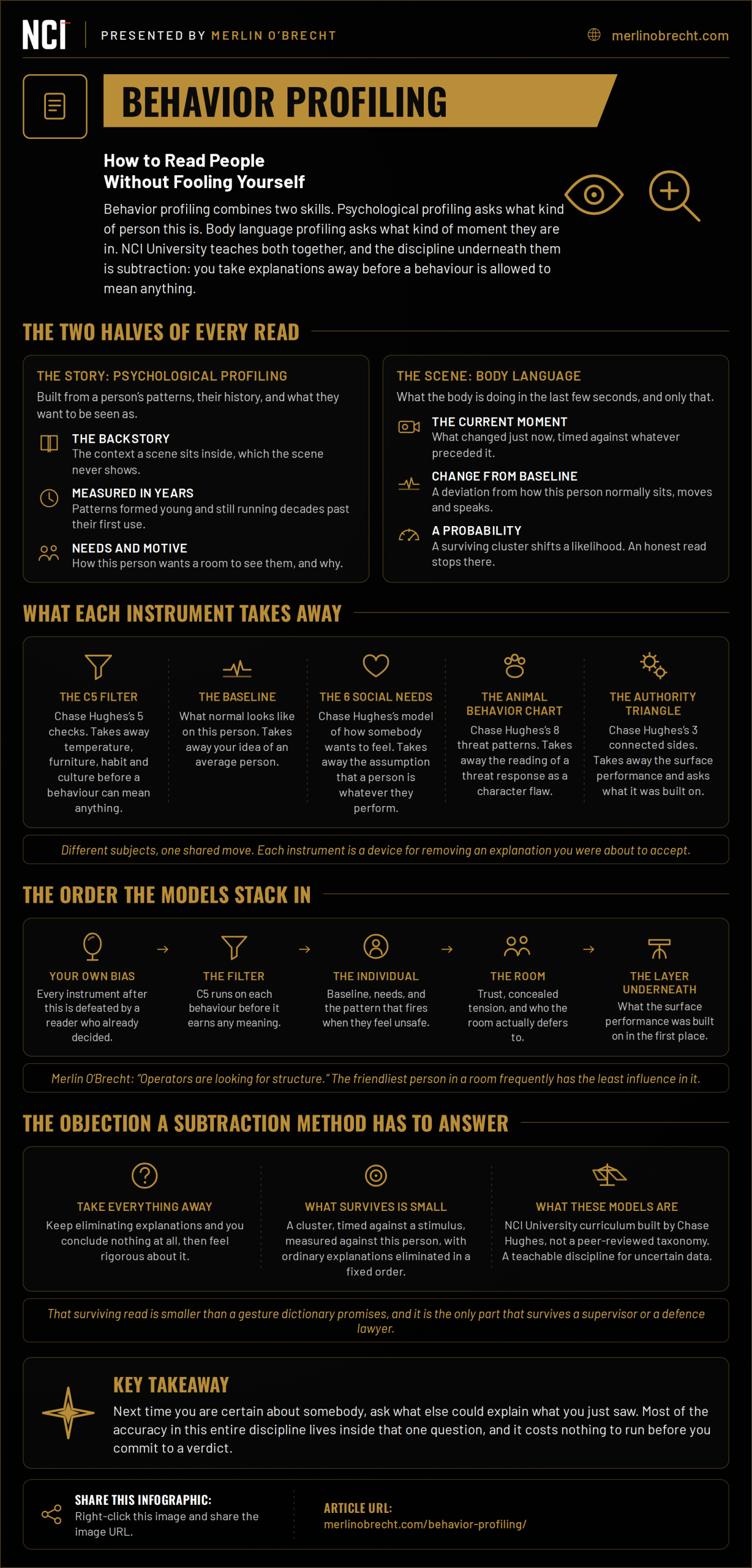
- Reading people accurately is mostly the work of eliminating explanations rather than collecting signs.
- Everything in behavior profiling splits in two: what kind of person this is, and what kind of moment they are in.
- A behaviour means nothing until it has survived a filter, appeared alongside other behaviours, and been measured against that person's own baseline.
- The models stack in an order. Your own bias first, then the filter, then the individual, then the room, then the layer underneath.
- The honest output of a good read is a probability, and the people who are best at this speak almost entirely in probabilities.
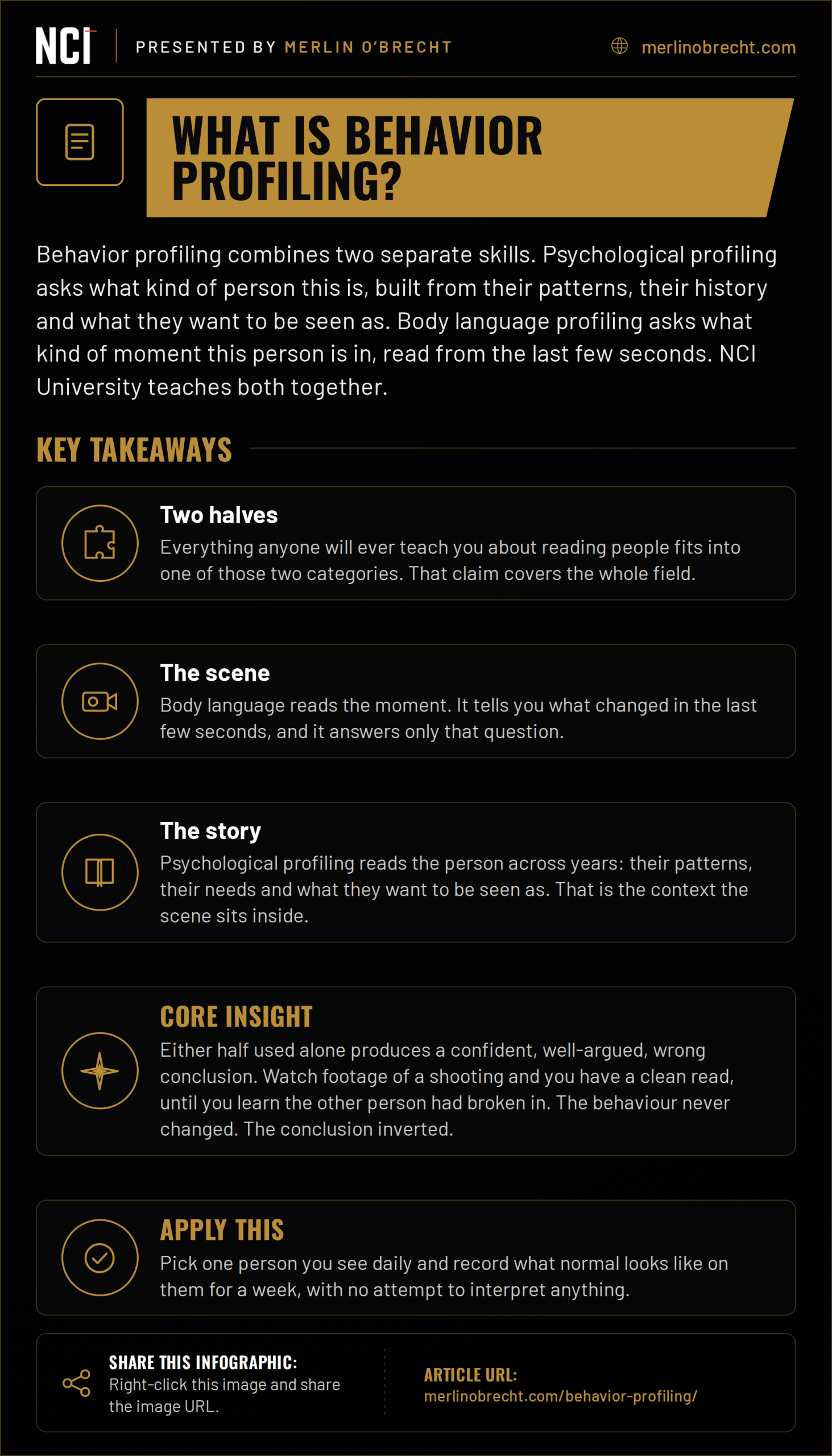
What is behavior profiling?
That is covered properly in what behavior profiling actually contains, including the discipline underneath both halves, which is the deliberate suspension of judgment before you walk in.
How do you read body language accurately?
The full method, the baseline, and a drill you can run tonight are in the five filters a behaviour has to survive.
What do the six social needs tell you?
The six social needs and how to speak to each one carries the four rules for a compliment that lands, twelve worked examples, and the diagnostic for when one falls flat.
What happens when somebody feels threatened?
Connection, which handles threat by reaching toward the other person: the puppy, who becomes disarming and impossible to stay angry at, and the sheep, who moves toward the group.
Strategy, which handles it through analysis: the wolf, who goes quiet while the eyes work the room, and the fox, who reframes the conversation in real time until it feels slippery.
Removal, which handles it by leaving: the rabbit, who physically exits, and the turtle, who stays in the room and dissociates.
Prevention, which handles it through aggression, in two opposite ways: the chihuahua, whose volume is the whole strategy, and the porcupine, who goes unusually still and then escalates fast.
Fight, flight and freeze is the vocabulary most people have for this, and it is too coarse to be useful on a Tuesday afternoon with somebody you actually know.
Every one of the eight is a survival strategy a child worked out before they had words for any of it. The eight patterns people fall into under threat covers all of them, plus the one discrimination worth getting precisely right, which is volume against stillness.
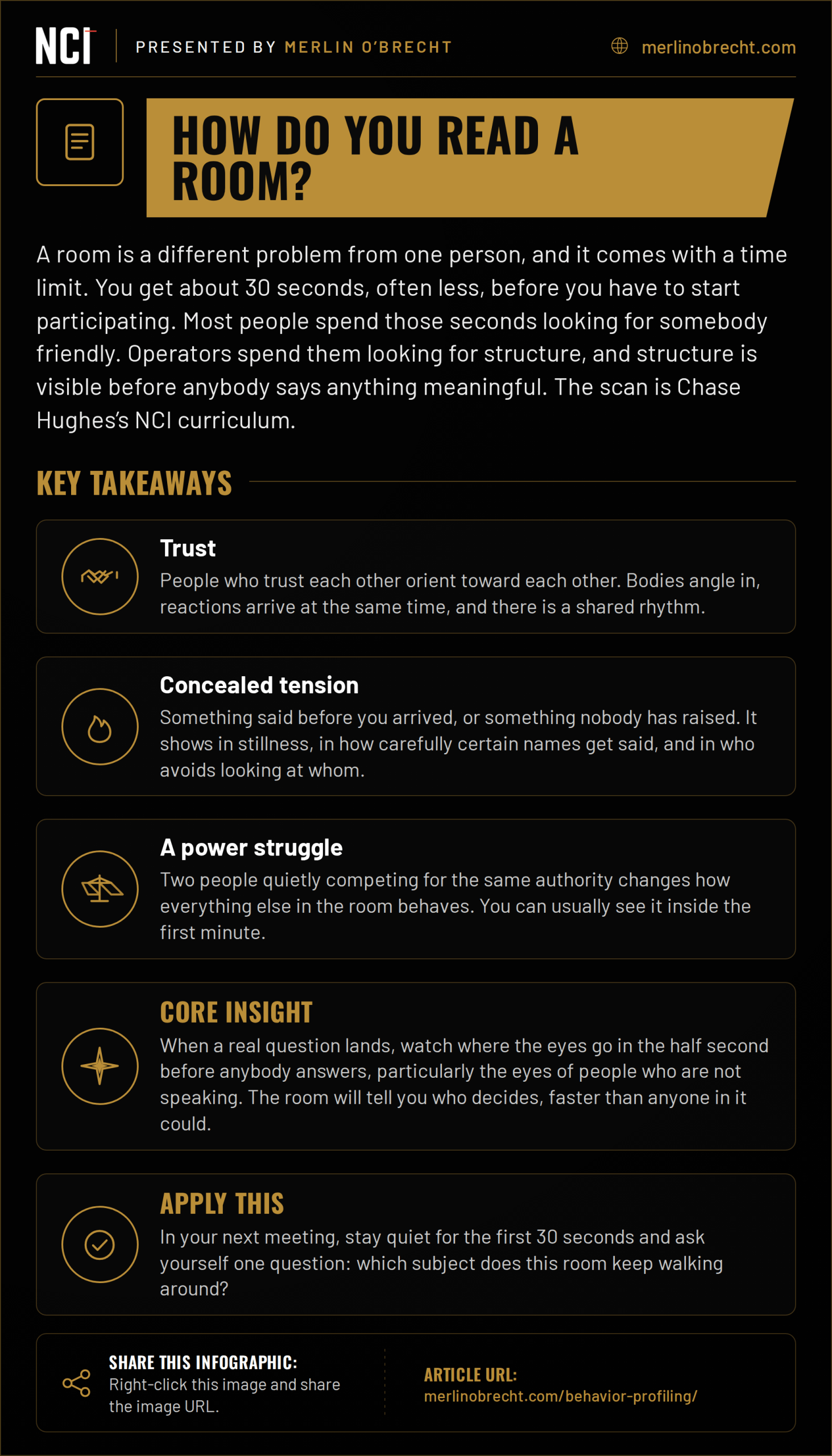
How do you read a room?
The 30-second scan for reading a room includes the boardroom where the loudest man in the room turned out to have no authority at all, and the whole deal came down to one calm nod from a quiet woman three seats away.
How is deception actually detected?
How deception gets scored rather than spotted has the full method, and it is deliberately explicit about what it refuses to give you.
What sits underneath body language?
The three lenses underneath body language works one observation all the way through all three sides, and keeps the caveat that a real profile would use far more data points than the exercise does.
Seven instruments, one operation
| The instrument | What it reads | What it removes |
|---|---|---|
| The two halves | Whether you have the scene, the story, or both | The assumption that watching somebody is the same as understanding them |
| The C5 filter | Whether a behaviour has earned its meaning | Temperature, furniture, habit, culture, the last 10 minutes of their day |
| The baseline | What normal looks like on this specific person | Your idea of an average person, which is mostly a description of you |
| The six social needs | How somebody wants to be perceived | The assumption that a person is whatever they are performing |
| The Animal Behavior Chart | What somebody does when they feel unsafe | The reading of a threat response as a character flaw |
| The Deception Rating Scale | How much stress clustered inside one bounded question | The idea that any single behaviour indicates a lie |
| The Authority Triangle | What the surface performance is built on | The surface performance |
And that is the point at which a page stops being able to help you. Everything above is readable, and you can finish it genuinely ahead of where you started. What a page cannot do is tell you which of your own reads were confirmation dressed up as observation, because that requires somebody who watched the same footage and will say so. That is what the 32 skills-building calls with facilitators inside NCI-2 Behavior Profiler exist for, alongside 22 video modules and 12 hours of material, $795.
If you want this inside a team rather than inside your own head
Before the questions
Frequently asked questions
The Deep Dive
- What behavior profiling actually contains, the two halves and the discipline underneath both.
- The five filters a behaviour has to survive, Chase Hughes’s C5 model, plus baselines and a practice drill.
- The six social needs and how to speak to each one, with the four rules and twelve worked examples.
- The eight patterns people fall into under threat, the Animal Behavior Chart in full.
- The 30-second scan for reading a room, including the boardroom and the quiet woman three seats away.
- How deception gets scored rather than spotted, the Deception Rating Scale and what it refuses to claim.
- The three lenses underneath body language, the Authority Triangle, seeing suffering first, and the childhood roots.
Where to go from here