Behavioral science interviews
Behavioral science interviews: 4 conversations, 1 finding
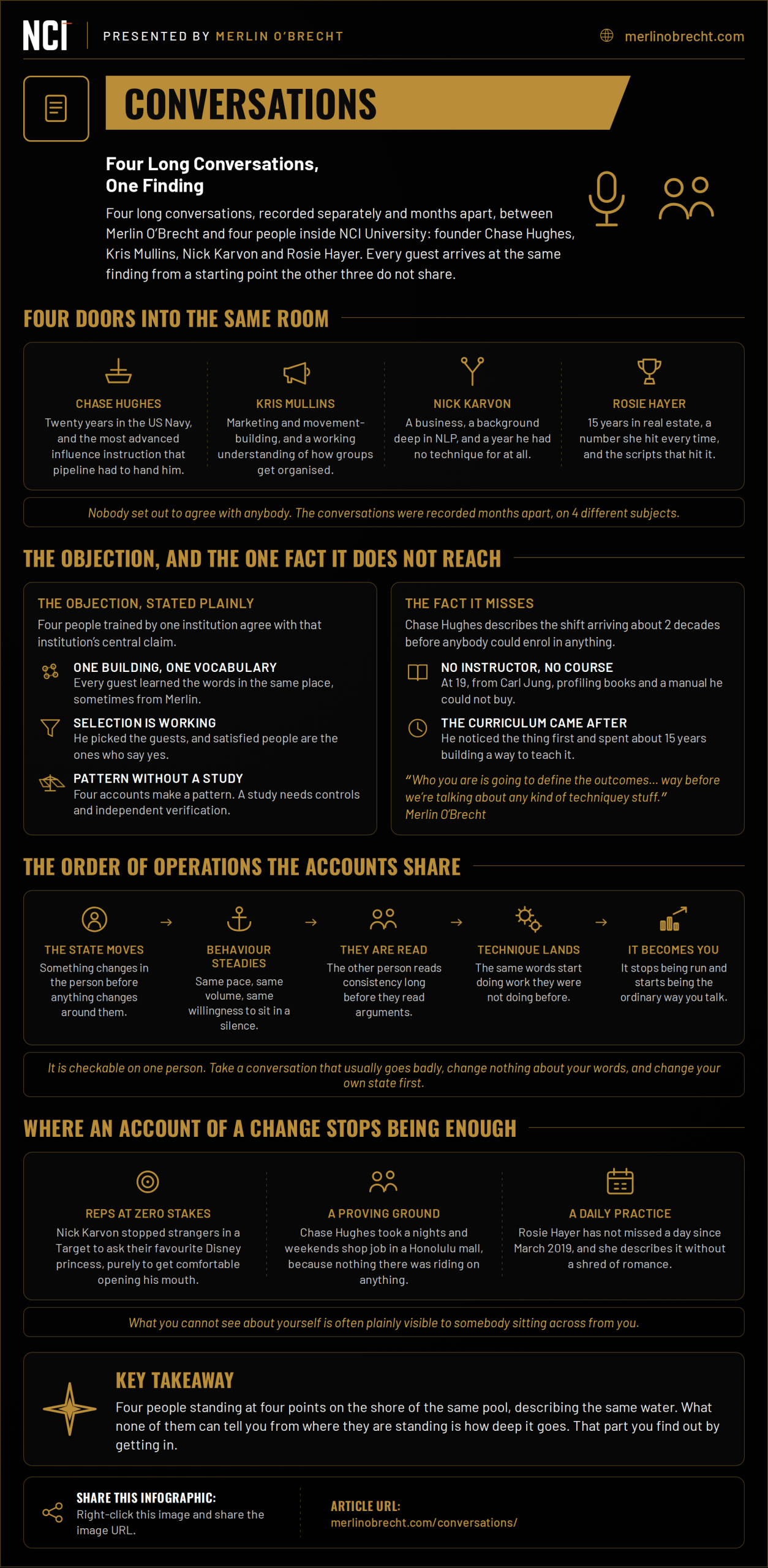
Behavioral science interviews on this site are 4 long conversations recorded by Merlin OBrecht with people inside NCI University: founder Chase Hughes, Kris Mullins, Nick Karvon and Rosie Hayer. Across roughly 5 hours, every guest describes the same finding from a different starting point: the technique works about as well as the person running it.
Four people who have almost nothing in common said the same thing to me in four different accents, and none of them knew the other three were going to say it.
One of them spent 20 years in the US Navy and came out of it with a chief petty officer’s rate, a stack of interrogation schools and a resume he shredded. One came out of marketing, DJ booths and a childhood spent reading rooms for safety. One was running a business and had a background deep in NLP when his life came apart in a way he had no technique for. One had been selling real estate for 15 years and had hit every number she set for herself.
Key takeaways
- Four long conversations, four guests, all of them inside NCI University: founder Chase Hughes, Kris Mullins, Nick Karvon and Rosie Hayer.
- Chase Hughes spent 20 years in the US Navy, including interview, interrogation, SERE and agent-recruiting schools, and built the NCI system after concluding that the training he was given was thinner than its reputation.
- Every guest describes the same order of operations: the internal state changes first, and the technique starts working afterward.
- Three of the guests arrived carrying a system they already knew (NLP, marketing and movement-building, sales scripts) and describe the same shift happening anyway.
- One of these conversations has been watched more than 190,000 times, which is more than everything else on the channel combined.
Who is Chase Hughes?
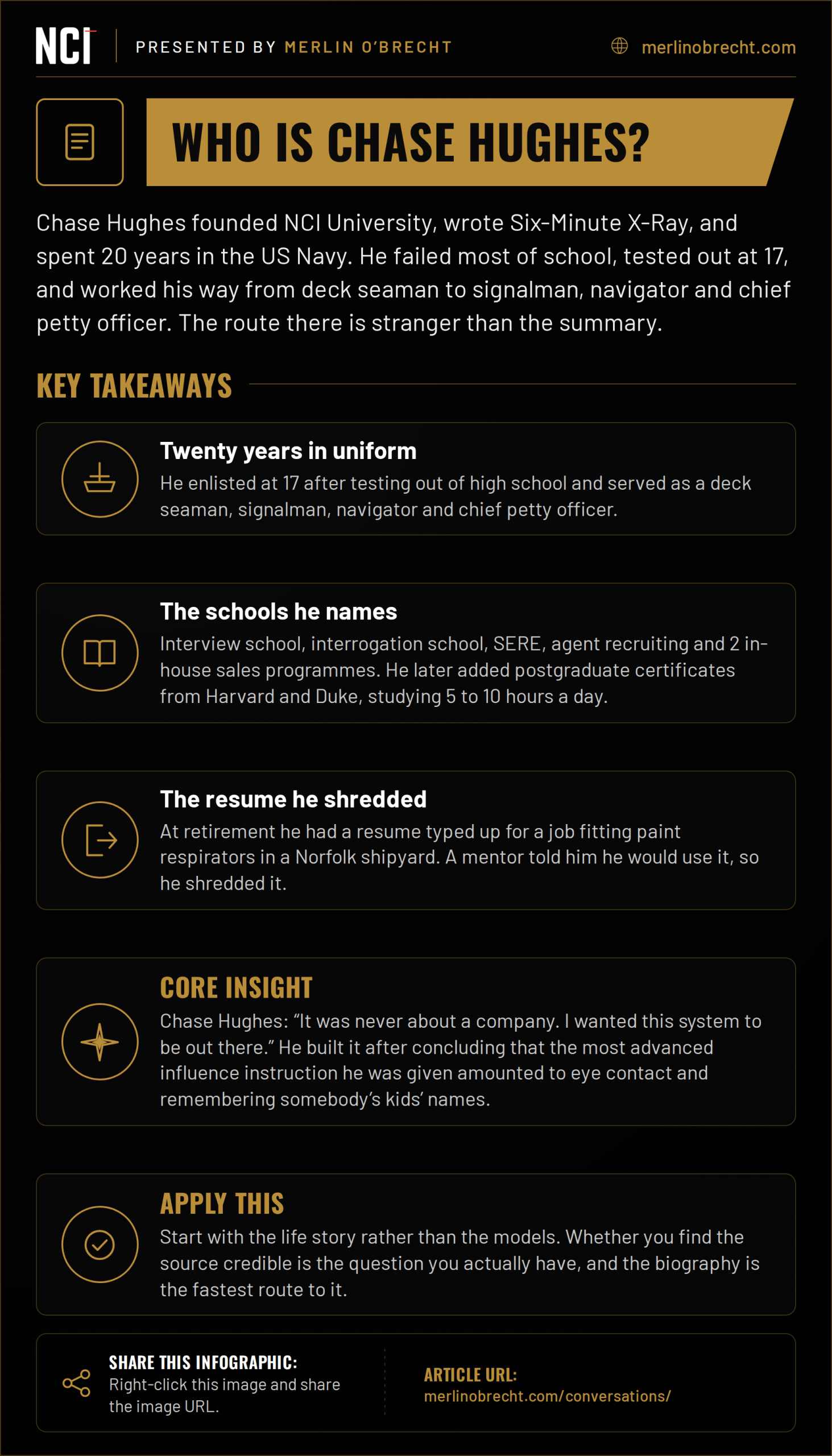
I have the only long-form account of that life on record, told in order, and it is written up in full as the whole life story, from Arkansas to the Navy to NCI. About half of what came out of that 90 minutes I had never heard, and I speak to the man constantly.
What Chase Hughes actually teaches
The origin of the whole thing is one night when he was 19. He was on a ship, reading Carl Jung, a stack of profiling books and an FBI profiling manual he had somehow got hold of. “It was a government manual that you couldn’t even find on Amazon. To this day, you can’t find it on Amazon.” He had no instructor and no course, and his own description of the process is the funniest honest thing in the conversation: “piecing all this stuff together like a schizophrenic with the yarn.”
His objection to the state of the field follows directly from having built his own:
He compares it to Neo seeing the code behind the Matrix. What actually happened is smaller and more useful than that. He changed the question, from what is this man doing to what is this man feeling, and the answer inverted. Everyone else on the beach was watching an angry man. He was watching a frightened one.
And the reason it left the military and reached civilians at all is one line he says almost in passing while realising it out loud: a human brain is a human brain. They were human skills all along, taught in a military building to people who happened to be wearing a uniform.
The methodology half of that interview, including what he says he is still chasing and what he wants the system to become after he is gone, is written up as the methodology half of the Chase Hughes conversation.
Is influence ethical?
The whole argument, including the 4 questions I run on myself before a conversation that matters, is at the ethics argument in full, with the empathy test.
What changes before the technique does
He is careful about what did the work, and so am I. Nothing on this page suggests that behavioural training produces custody outcomes or reconciliations. It is one man’s account of his own situation, and the mechanism he names sits underneath the formula rather than inside it. The full arc, from the study group to the certification, is at the composure story, told from the middle.
Why hitting the goal can feel like nothing
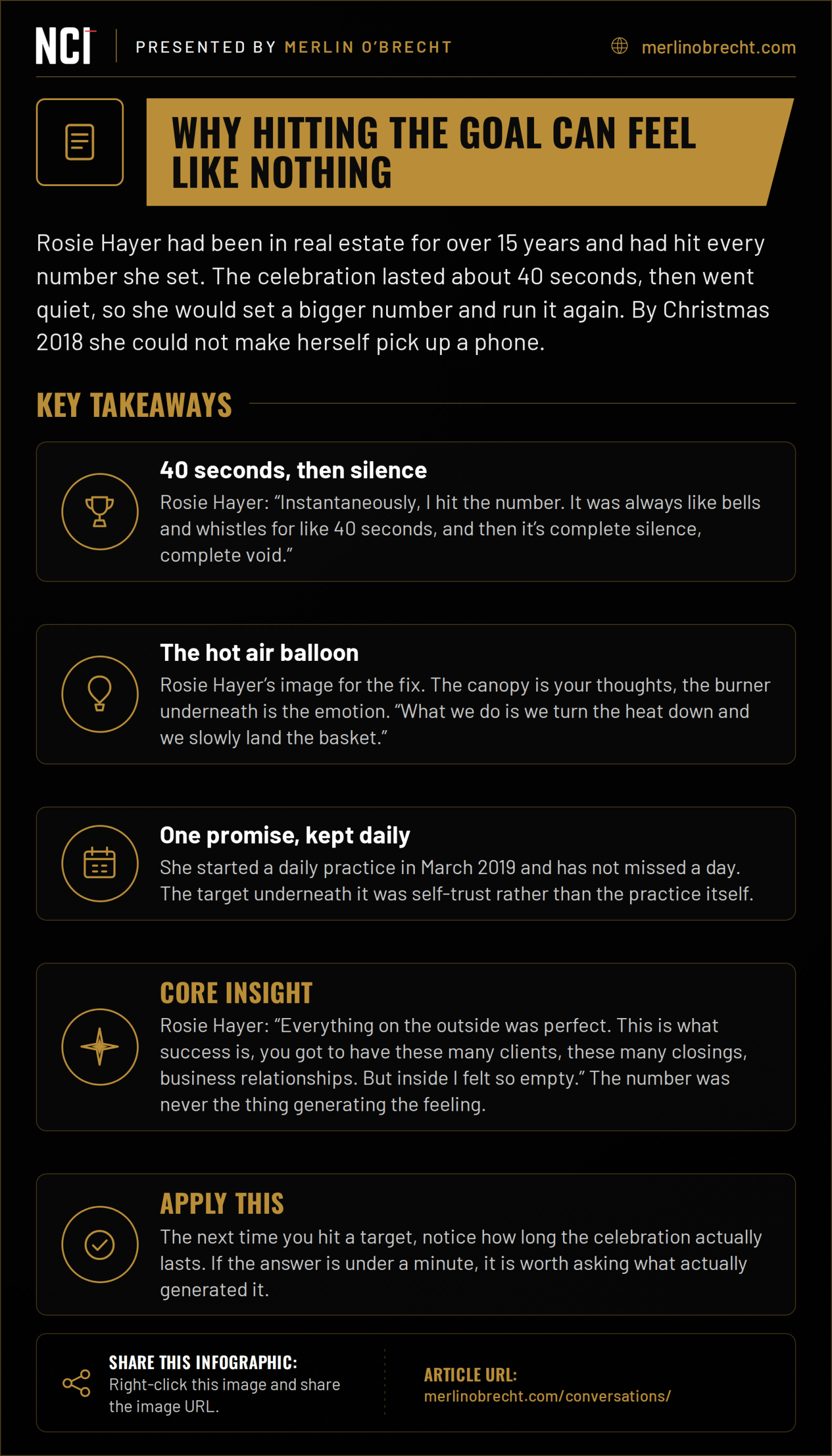
The full practice, step by step, including what to do with an emotion once you have named it, is at the enjoyment conversation, and the practice underneath it.
Four doors, one finding: what these behavioral science interviews share
| Guest | Arrived from | What they already had | What they say changed it |
|---|---|---|---|
| Chase Hughes | 20 years in the US Navy, interrogation and SERE schools | The most advanced training the military offered him | Reading a frightened man as frightened, at 19, with no framework for it |
| Kris Mullins | Marketing, DJ booths, and a childhood spent reading rooms for safety | A working understanding of how groups get organised | The intent behind the tool, rather than the tool |
| Nick Karvon | A business, and a background deep in NLP | Technique, and plenty of it | Becoming composed, and being read as safe |
| Rosie Hayer | 15 years in real estate sales | A number she hit, and the scripts that hit it | Working the emotion underneath the thought |
The objection, stated properly
That objection is correct as far as it goes, and I am not going to pretend otherwise. If this page tried to wave it away, everything else on it would deserve less trust.
The one fact that survives it
What this is worth, at its actual strength
Why the curriculum is built in that order
If you want the mechanics of the reading skill itself, that lives at how behaviour profiling actually works. If you want the state work underneath it, which is what every guest on this page is really describing, it is at the authority and confidence work every guest describes.
What NCI University is, for anyone who arrived cold
- NCI-1, Behavior Observer. $252. A 6-hour course covering foundational nonverbal reading. This is where every student starts, me included.
- NCI-2, Behavior Profiler. $795. A 12-hour course built on a 3-part model of baseline, deviations and drivers, with 22 video modules and 32 practice calls run with facilitators.
- NCI-3, Behavior Scientist. $2,987. Influence, persuasion and authority at a professional level, 6 to 8 weeks self-paced.
- NCI-4, Author and Elite Operator. A 12-month graduate programme with weekly live mentorship, an application and an orientation call. Nick Karvon is the 4th person ever certified at this level, by his own account on camera.
If you want the sequenced version of where a person actually starts, that is written up at where to start if you want to learn this properly.
Where a page like this stops being enough
Frequently asked questions
The conversations: all 4, and the 5 pages they produced
- Who Chase Hughes is, and the 20 years before NCI. The full life story in order, from the report card nobody could save to the resume he shredded. Start here if your first question is whether the source is credible.
- What Chase Hughes actually teaches about reading behaviour. The methodology half of the same conversation: chasing layers, the manual he taught himself from, and why he says most influence training is 60 years out of date.
- The test Chase Hughes applies before using any of it. With Kris Mullins. The empathy test, what contempt is actually made of, and 4 questions you can run on yourself in 10 seconds.
- What composure did for one father in the hardest year of his life. With Nick Karvon. A year without seeing his daughter, the composure work that came before any technique, and a hug.
- Why hitting the number can feel like nothing. With Rosie Hayer. The 40 seconds of celebration after a target lands, the hot air balloon, and the practice she has not missed since 2019.
Anyone deciding what to do with material like this runs into the same problem in the same order, and there is a sequence that works better than picking a video at random. It is written out, with the actual first steps and what each one costs, at where to start if you want to learn this properly. It assumes nothing and it will tell you honestly if the answer is that you should buy nothing yet.
Where to go from here