Merlin O'Brecht

Influence and persuasion hub

Influence skills: the three layers, and why the words come last

By Merlin OBrecht · Dean of Academic Affairs, NCI University
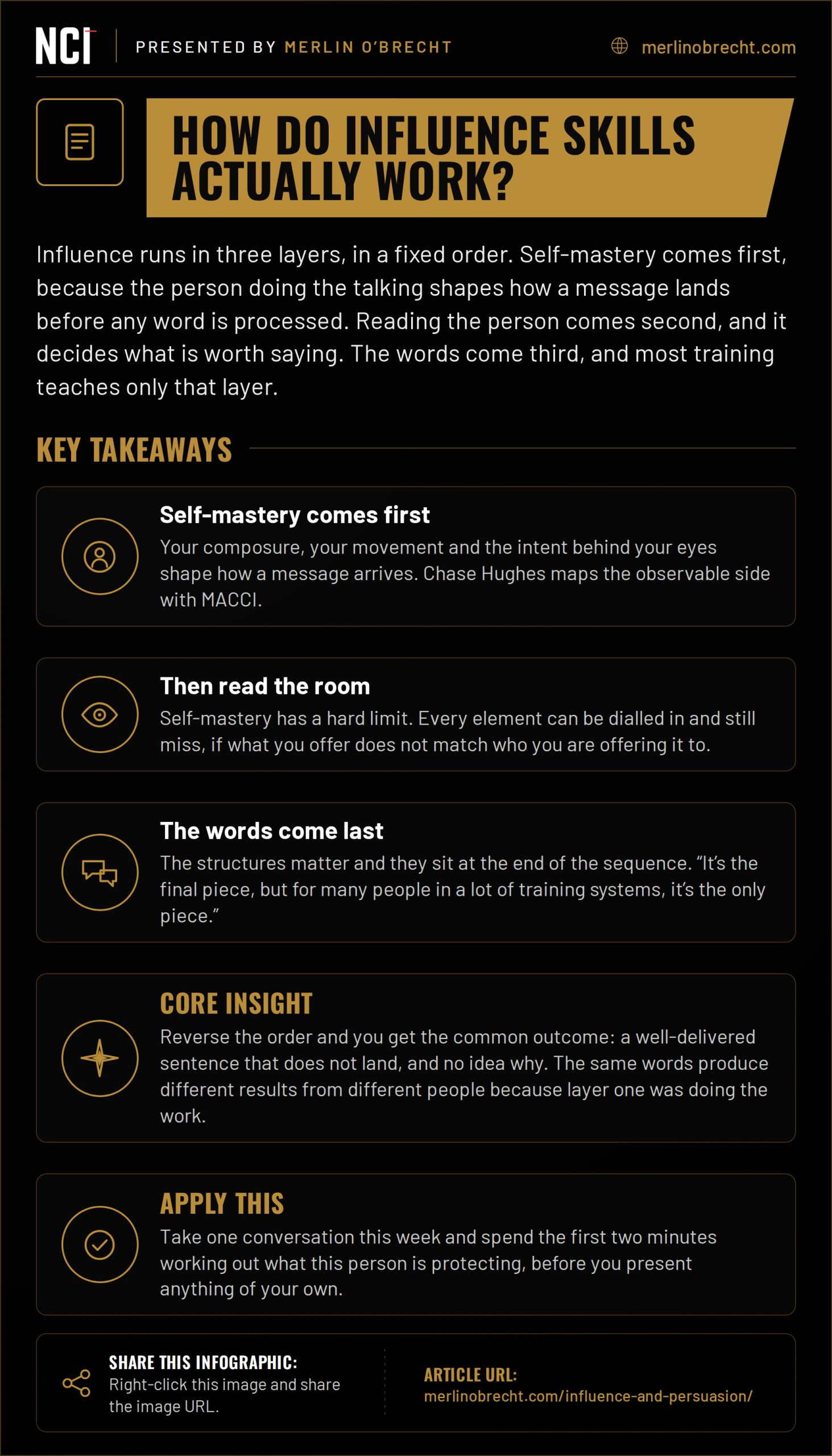
Influence skills work in three layers: self-mastery, reading the person in front of you, and the words. Most training teaches only the third. Merlin OBrecht teaches that the person doing the talking shapes how a message lands before any word is processed, which is why the same sentence produces different results from different people.
You have watched somebody land a line in a room and known, in the moment, that the same words from you would have gone sideways.
Same sentence. Similar audience. Completely different result. Most people file that under charm and move on, and the gap it points at is the most useful thing in this entire subject.
Seven articles sit underneath this page, on how influence works, how it gets used against people, elicitation, persuasion, defensiveness, de-escalation, and where the line is. They cover different skills and they arrive at the same place from seven directions: the method is real, and the ceiling on it is set by the person running it.
My role in this is narrower than it might look. Chase Hughes built most of the models below over decades. NCI turned them into a curriculum with a standard. What I do is translate, which usually means starting at step one when the person who built the thing started at step four. Two of the things on this page are mine and I will say which.
Precision is what makes any of it work. Responsibility is what decides whether it should have been used, and in this cluster that is a structural question rather than a closing note, because the cost of getting it wrong lands somewhere specific.

Key takeaways

How do influence skills actually work?

Three layers, in a fixed order.

Self-mastery comes first: the personal authority of the person doing the talking. Composure, movement, and the intent sitting behind your eyes shape how a message lands before any word is processed. Chase Hughes’s MACCI, the external side of his Authority Triangle, names what gets read there, and the training for it lives in the self-mastery layer.

Observation comes second, because self-mastery has a hard limit. You can have every element dialled in and still miss, if what you are offering does not match who you are offering it to. Everyone already runs a rough version of this. You speak differently to your mother than to your children than to friends from school. Better profiling makes it targeted rather than approximate, and that is the observation layer.

Communication comes third. The words, the structures, the models.
“It’s the final piece, but for many people in a lot of training systems, it’s the only piece.”

That is the whole problem with the category in one sentence, and it is why the three layers, and why the words come last is the page to read first.
What is the FATE model?

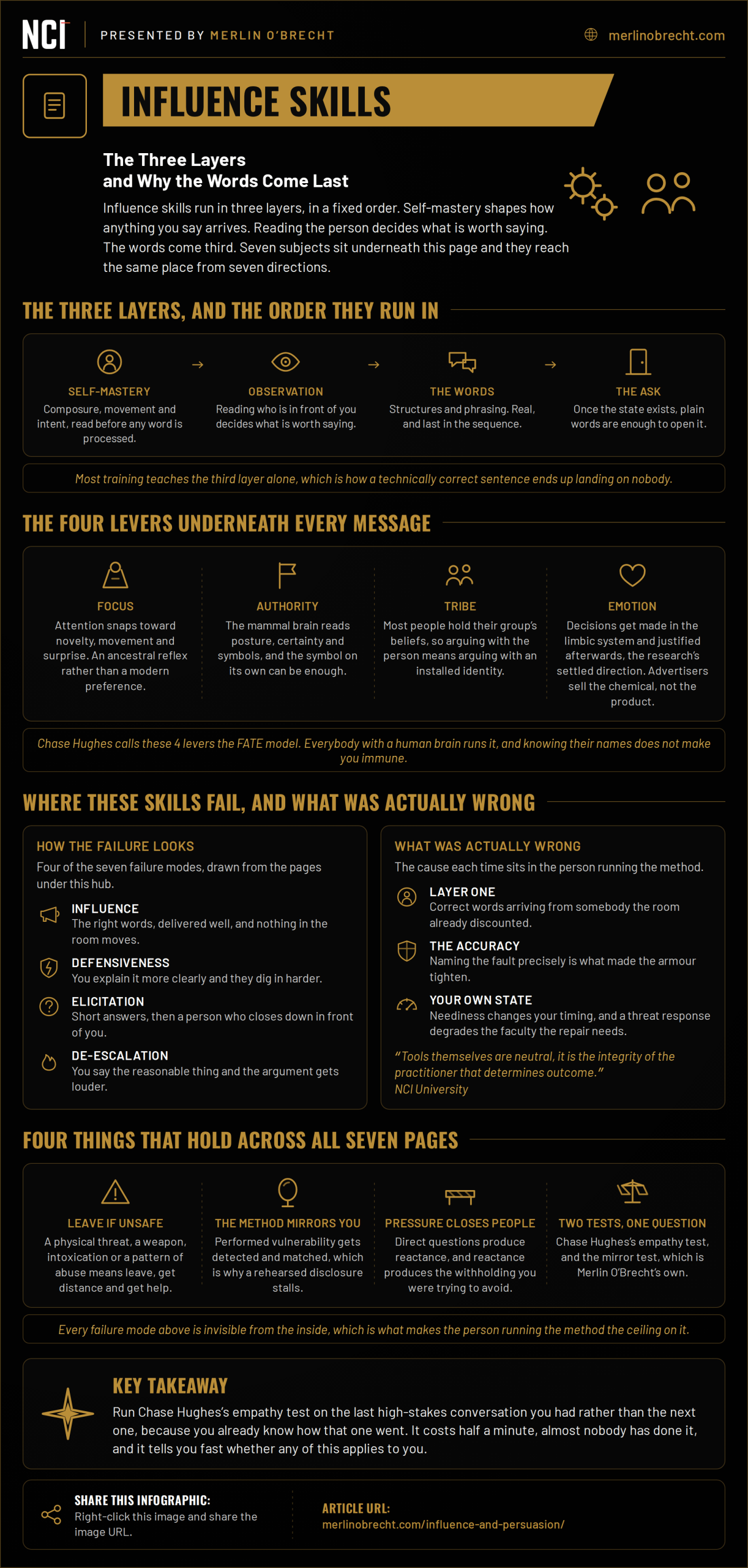
Underneath the words are 4 levers, and Chase Hughes’s FATE model names them.
Focus. Attention is captured by novelty, pattern breaks and movement, which is an ancestral reflex rather than a modern preference.
Authority. The mammal brain reads posture, certainty and symbols, and the symbol alone can be enough.
Tribe. Most people hold their group’s beliefs rather than beliefs they arrived at, and arguing with the individual means arguing with an installed identity.
Emotion. The master key, because decisions get made emotionally and justified afterwards. Advertisers have known this for a century and sell the chemical rather than the product.

The honest part, and the part the page insists on: knowing the levers exist does not make you immune to them. It gives you the ability to notice which one is being pulled, which is a different and smaller thing. What it does give you is the option of running all 4 on yourself first, deliberately, which is the only defence that holds. That is the four levers every message runs on.

Why do people get defensive?

Because you touched armour.
Underneath most defensiveness is a story loop: a repeating internal narrative written during an early stressful experience, still deciding what territory the person defends today. Chase Hughes names 5, each anchored in a different fear. Validation, control, relevance, justification, righteousness.
The governing correction is flat and it costs people years. Correcting somebody’s loop essentially never dissolves it. It strengthens it, because the loop is identity armour and attacking armour produces defence. Which means the more accurately you name what somebody is doing wrong, the harder they hold it.
What works instead is reflecting the feeling underneath the loop back to them more precisely than they have heard it put, then offering something their identity can grow into. Mirror, then shift.

And then the part that makes this a cluster problem rather than a technique problem: other people’s loops are far easier to see than your own, because the armour hides best from the person wearing it. The one loop you cannot read is yours. Full treatment in the five story loops, and why correcting one strengthens it.

What is elicitation?

Elicitation gets real information out of a conversation without creating pressure, because it feels like a normal conversation. The engine is the correction reflex: people are strongly pulled to fix a statement that is slightly wrong, and a correction carries more than an answer would have.
Statements rather than questions. The more sensitive the information, the fewer direct questions you ask.
For anything genuinely sensitive, Chase Hughes’s Hourglass Method gives it a shape. Open broad, narrow into the sensitive zone, then expand back out to neutral, so the part that mattered sits in the middle where recall is weakest.
Before any of it, one rule does most of the work. If somebody is guarded, your job is to create safety and normalcy first. If they are open, your job is direction and depth.

The half nobody teaches is when to stop. Shorter answers, the polite guarded smile, eye contact breaking, the body turning away. And the reason to stop matters more than the signals: neediness is detectable, it reads as pressure, and it produces exactly the withholding you were trying to avoid. That is how to get information without turning it into an interview.

What are the five rungs of deviance escalation?
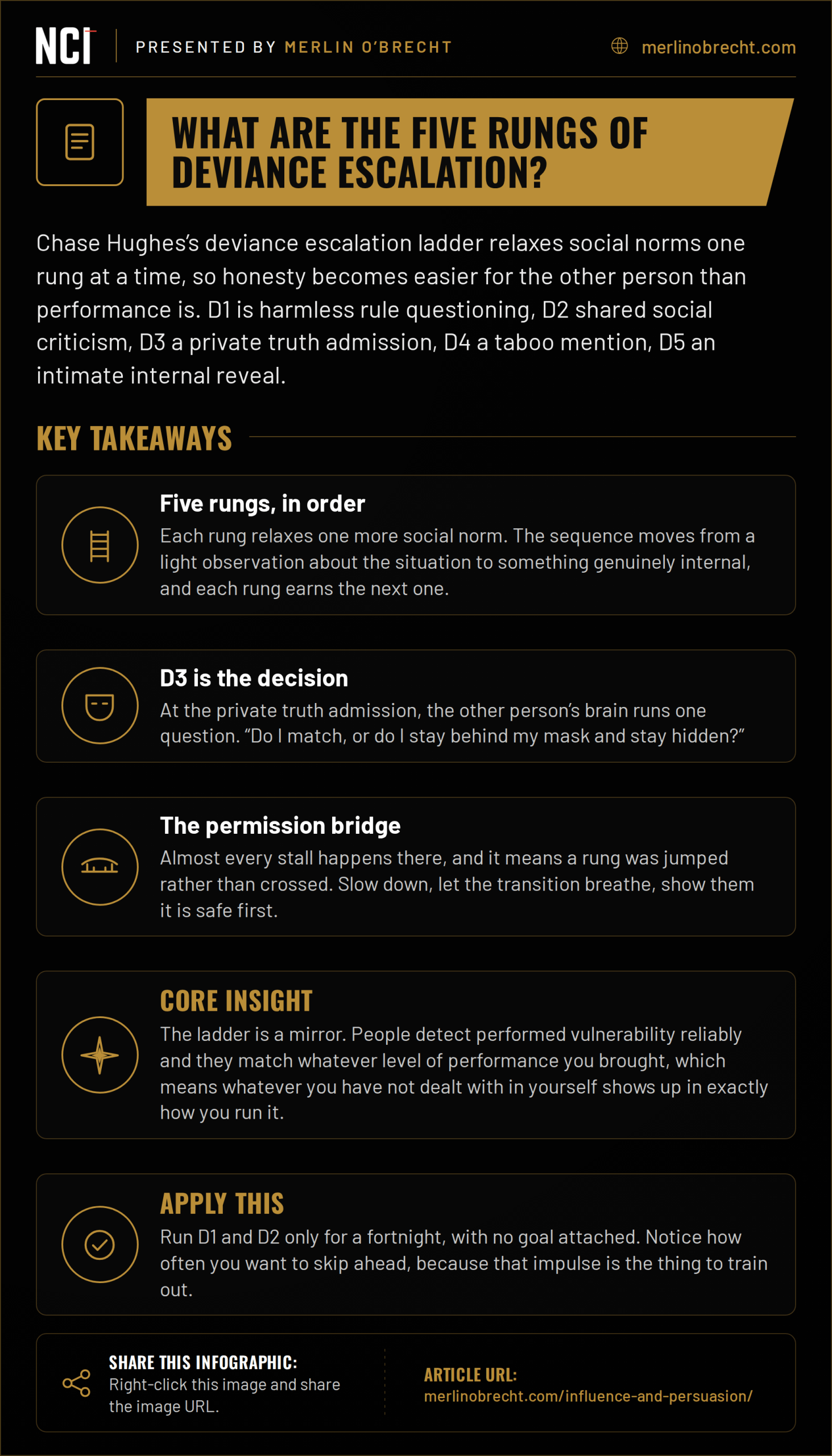
Chase Hughes’s deviance escalation ladder relaxes social norms one rung at a time, so that honesty becomes easier for the other person than performance is. D1 is harmless rule questioning, D2 shared social criticism, D3 a private truth admission, D4 a taboo mention, D5 an intimate internal reveal.
D3 is where the other person’s brain runs the only question that matters: match, or stay behind the mask.
Almost every stall happens at the permission bridge, which means a rung was jumped rather than crossed. The fix is unglamorous. Slow down, let the transition breathe, show them it is safe before asking them to go deeper.
And there is a condition attached that no technique list carries. People detect performed vulnerability reliably and they match whatever level of performance you brought, which makes the ladder a mirror. Whatever you have not dealt with in yourself shows up in exactly how you run it.
“So the ladder works when you do. That is the deal that you need to be willing to make with yourself.”

How do you de-escalate an argument?

First, the thing that overrides all of it. If there is a physical threat, a weapon, intoxication, or a pattern of abuse in the relationship, leaving is the move. No communication sequence makes an unsafe room safe and none of what follows applies.
When somebody gets angry, prefrontal activity drops and limbic activity rises. Their capacity to reason is physically decreasing, which is why “calm down,” “you’re overreacting” and “let me explain” all fail. Every one of them is addressed to the part of the brain that just went offline.
When somebody gets angry, prefrontal activity drops and limbic activity rises. Their capacity to reason is physically decreasing, which is why “calm down,” “you’re overreacting” and “let maFour steps. Break the script with something they were not expecting. Validate by agreeing with the fair part, which concedes the argument without admitting fault. Give one observation about them that is actually true. Then open a collaborative frame instead of closing the conversation, because closing removes their choice and people resist that even when they wanted the thing. e explain” all fail. Every one of them is addressed to the part of the brain that just went offline.

The catch is the same one as everywhere else in this cluster. The steps are simple, and the person who has to run them is the one whose own threat response is firing at the same time. That is the four steps for an argument that has already started.

What is the difference between influence and manipulation?

Disclosure and interest.
Chase Hughes’s empathy test puts it precisely: if the person you are influencing could see your intention, your desired outcome for them and every technique you were using, would they agree it was genuinely in their best interest? Run it before anything high-stakes.
The mirror test is mine and it is smaller. Thirty seconds, daily: is what I am doing going to affect how I can look at myself later?
Underneath both is an argument I have not heard made elsewhere. Ethics in the abstract are subjective, so the useful question stops being what the universal rule is and becomes what my rule is and whether I am living by it. And something in you keeps a ledger of every time you traded somebody else’s autonomy for your own gain. That is my framing rather than a finding, and I would rather say so than dress it in neuroscience.

The ledger compounds quietly, and the biggest cost of unethical influence is neither reputational nor what it does to the people you used it on. It is what it does to you. Full argument in the two tests that decide which one you are doing.

Seven subjects, one argument

Here is what only becomes visible once all seven pages exist.
The skill What it looks like when it fails What was actually wrong
Influence The right words, delivered well, and nothing lands The person delivering them, which is layer one
Manipulation resistance You know the levers and get moved anyway The levers were never running on your knowledge
Defensiveness You explain it more clearly and they dig in harder The accuracy was the attack
Elicitation They give short answers and close down You needed the answer, and needing is detectable
Persuasion You reach for depth and it feels like pulling teeth You performed vulnerability and they matched the performance
De-escalation You say the reasonable thing and it escalates Your own threat response was firing while you said it
Ethics You won and felt hollow afterwards The cost was always going to land on you
Seven skills. Seven failure modes. In every case the spoke locates the cause in the person running the method rather than in the method.
Now the objection, because a reader who has bought personal development before has already had it. “Work on yourself first” is the oldest unfalsifiable claim in this category, and it has been used for decades to explain away methods that simply did not work. If that is where your scepticism is, it is well placed and I would rather meet it than route around it.
The claim here is narrower than the slogan, and it makes predictions.
Performed vulnerability gets detected and matched, which is why a scripted D3 stalls in a specific and repeatable way. Neediness changes your timing, which is why the elicitation you cared most about is the one that failed. Your own threat response degrades exactly the faculty the de-escalation sequence requires, which is why the four steps are easy on a page and hard at the kitchen table. Each of those names a mechanism and predicts an observable failure, and a claim that tells you in advance how it will break is doing more work than a slogan can.
What these are, stated at their real strength. Chase Hughes’s models taught inside NCI University’s curriculum, plus my own teaching structures and the mirror test. They are not a peer-reviewed research programme and I am not going to present them as one. The psychology they sit on is a different matter and is well established: reactance, threat responses reducing reasoning capacity, ego-protective responses to criticism that touches identity. The models organise that material into something teachable, and they work in the way a good map works.
The order the seven stack in is architecture, levers, defence, contact, depth, repair, ethics. NCI puts the reason for that last item plainly:
“Tools themselves are neutral, it is the integrity of the practitioner that determines outcome.”
Which is the formal version. Mine is the one from the ladder, and it generalises to all seven: the ladder works when you do, and that is the deal you make with yourself.
Which points at the one thing a page cannot give you. Every failure mode above is invisible from the inside. The jumped bridge feels like the other person being guarded. The neediness feels like focus. The loop you are running is the one you cannot see. The version where somebody experienced watches you run this and tells you which second you missed is NCI-3 Behavior Scientist: 6 to 8 weeks, self-paced, $2,987.

If you want Merlin working with your team rather than with you, that runs as a scoped engagement through NCI. It starts with an application and a conversation about what you are actually trying to change.

If you want a shortcut, this will frustrate you. The first thing you work on is you.

Frequently asked questions

What are influence skills?
Influence skills are the abilities that decide whether what you say changes anything, and they run in 3 layers: your own composure and personal authority, your ability to read the person in front of you, and the words themselves. Most training covers the third layer only, which is why people who have studied persuasion still lose rooms.
How do you learn to influence people?
In the reverse order of how almost everybody starts. Self-observation first, because it is slowest. Reading people second, because it is the most teachable and produces the fastest visible improvement. Techniques third, because they only work on top of the other two. Starting at techniques is what produces someone who can explain influence and cannot run it.
How long does it take to get good at influence?
Layer by layer, and the honest answer is uneven. The models take an evening to understand. The observation layer improves noticeably within weeks of deliberate practice, because it is pattern recognition and you already have partial skill in it. Self-mastery is measured in months of catching yourself, and there is no number I can give you for it that would be true.
Does influence training actually work, or is it just confidence?
Parts of it are well evidenced and parts are a teaching model, and the difference is worth being precise about. The mechanisms underneath are established: reactance is real, a threat response really does reduce reasoning capacity, and people really do defend identity harder than interests. What no training gives you is a phrase that works on everybody, and anyone selling that is selling the thing this cluster spends seven pages arguing against.
What is the difference between influence and persuasion?
Persuasion works on a decision somebody is already weighing, which is what the classic principles operate on. Influence works one level earlier, on the state the person is in while they weigh it, which is why a technically correct pitch can be met with polite agreement and no movement at all.
How do you influence people at work without authority over them?
You already have the layer that matters, because positional authority was never what made rooms follow anyone. In a cross-functional meeting, the useful move is finding the constraint the other team cannot say out loud, which elicitation gets at faster than asking does. The caution is that none of it works on somebody who has already decided and is now defending the decision, and that is a defensiveness problem rather than an influence one.
Is there a magic phrase that makes people say yes?

“The magic isn’t hiding in some kind of a secret phrase, and it’s not some line that you just haven’t found yet that’s hiding in the deep annals of the internet.”

It lives in the three layers. Once the right state exists in the person you are talking to, you can simply ask, in plain words, and that is genuinely all it takes.
Where do these influence models come from?
The FATE model, the Authority Triangle and MACCI, deviance escalation, the Hourglass Method, the five story loops and the empathy test are all Chase Hughes’s, developed over decades and taught inside NCI University’s curriculum. The three-layer ordering and the four-step de-escalation sequence are my teaching structures for that material rather than named frameworks. The mirror test is my own.
Is influencing people manipulation?
Every conversation influences somebody, so the word only means something if it points at something narrower. It points at influence run against the other person’s interest by means you would not disclose. Two questions settle almost every case: would they agree this was in their interest if they could see everything you were doing, and how will it sit with you tonight.
Where should you start?
With how influence actually works, because it gives you the three layers everything else sits inside. Then whichever problem you actually have. If people close down on you, start with defensiveness. If you cannot get information, start with elicitation. If conversations detonate, start with de-escalation.
What is the difference between the FATE model and the six social needs?
They answer different questions and both are Chase Hughes’s, which is why they get confused. FATE names the 4 levers a message runs on, so it describes how something gets through. The six social needs name what a person wants a room to give them, so it describes what they are looking for in the first place. FATE is about the channel and the needs are about the person.
Which of these should you read first?
The order they are laid out in above works as a curriculum: how influence works, then the levers, then why people are defended, then elicitation, then persuasion, then de-escalation, then ethics. If you would rather solve a specific problem than learn a subject, skip to the one that describes your week.

The Deep Dive

Where to go from here

Run the empathy test on the last high-stakes conversation you had. Not the next one, the last one, where you already know the answer.
It costs 30 seconds, almost nobody has done it, and it tells you faster than anything else on this page whether the rest of it applies to you.
If you want the structured version, where somebody experienced tells you what you cannot see about yourself, that is NCI-3 Behavior Scientist. 6 to 8 weeks, self-paced, $2,987.
Either way, keep the one thing. The techniques are real and they work. What sets the ceiling on them is the person running them, and that part is not for sale.