Influence and persuasion hub
Influence skills: the three layers, and why the words come last
Key takeaways
- Influence runs in 3 layers and most training teaches only the third, which is why technically correct persuasion often fails.
- The 4 levers underneath every message are focus, authority, tribe and emotion, and they run on you whether or not you know their names.
- People close down in response to pressure and to threats against identity, which makes both things you control rather than things they are.
- Every instrument here amplifies whatever the operator brought with them, including the parts they have not looked at.
- The largest cost of using any of it against somebody's interest lands on the person using it, and it compounds quietly.
How do influence skills actually work?
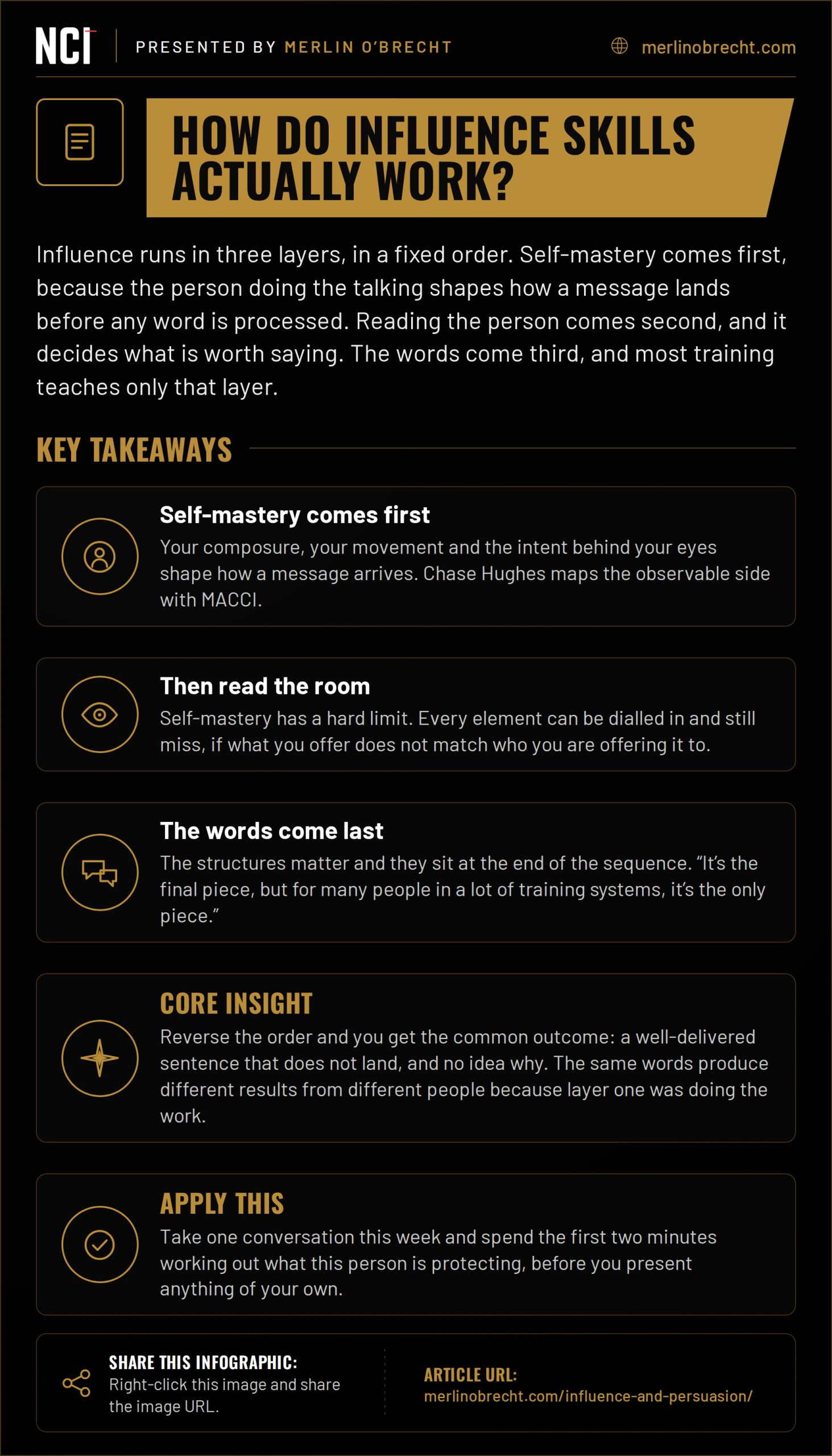
Self-mastery comes first: the personal authority of the person doing the talking. Composure, movement, and the intent sitting behind your eyes shape how a message lands before any word is processed. Chase Hughes’s MACCI, the external side of his Authority Triangle, names what gets read there, and the training for it lives in the self-mastery layer.
Observation comes second, because self-mastery has a hard limit. You can have every element dialled in and still miss, if what you are offering does not match who you are offering it to. Everyone already runs a rough version of this. You speak differently to your mother than to your children than to friends from school. Better profiling makes it targeted rather than approximate, and that is the observation layer.
That is the whole problem with the category in one sentence, and it is why the three layers, and why the words come last is the page to read first.
What is the FATE model?
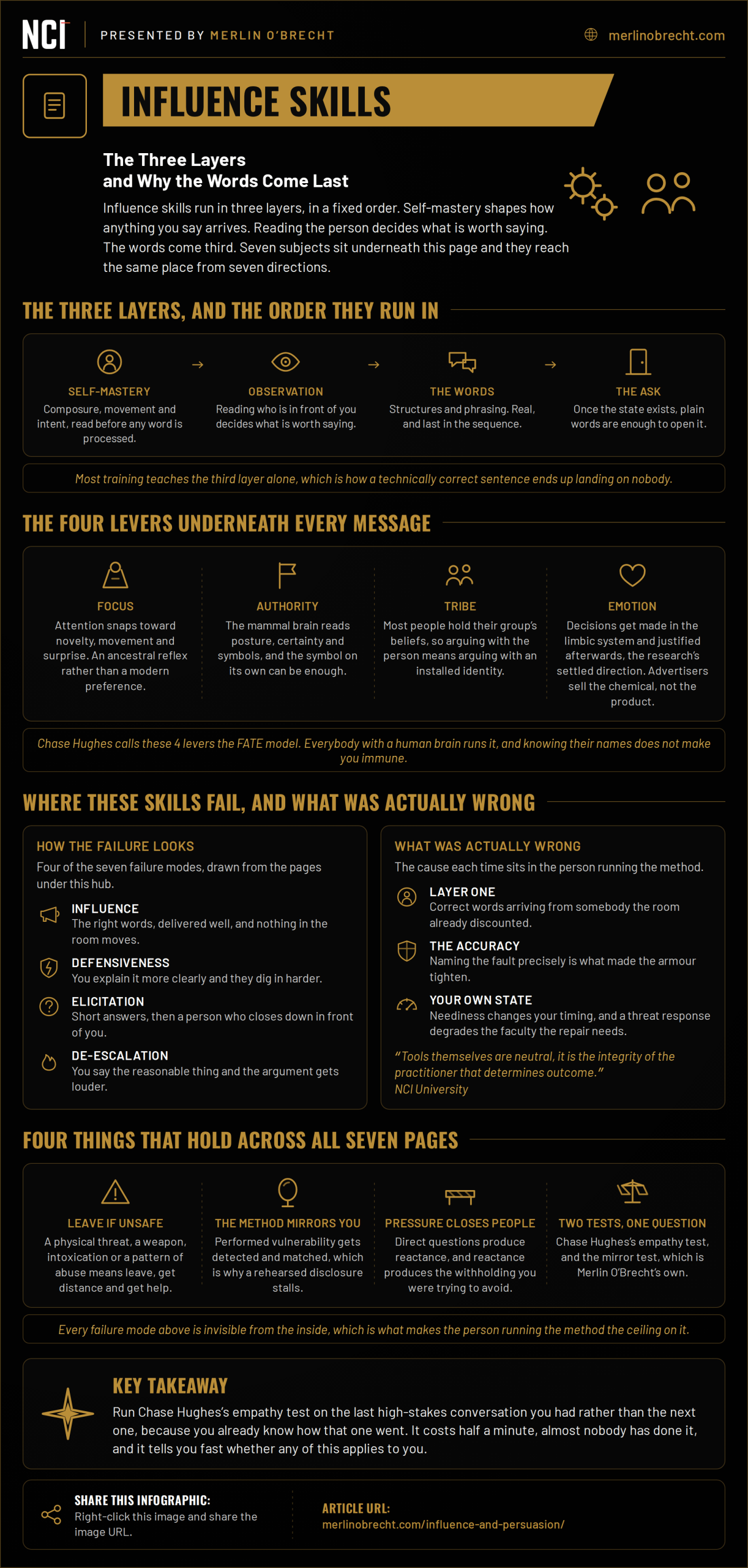
The honest part, and the part the page insists on: knowing the levers exist does not make you immune to them. It gives you the ability to notice which one is being pulled, which is a different and smaller thing. What it does give you is the option of running all 4 on yourself first, deliberately, which is the only defence that holds. That is the four levers every message runs on.
Why do people get defensive?
And then the part that makes this a cluster problem rather than a technique problem: other people’s loops are far easier to see than your own, because the armour hides best from the person wearing it. The one loop you cannot read is yours. Full treatment in the five story loops, and why correcting one strengthens it.
What is elicitation?
The half nobody teaches is when to stop. Shorter answers, the polite guarded smile, eye contact breaking, the body turning away. And the reason to stop matters more than the signals: neediness is detectable, it reads as pressure, and it produces exactly the withholding you were trying to avoid. That is how to get information without turning it into an interview.
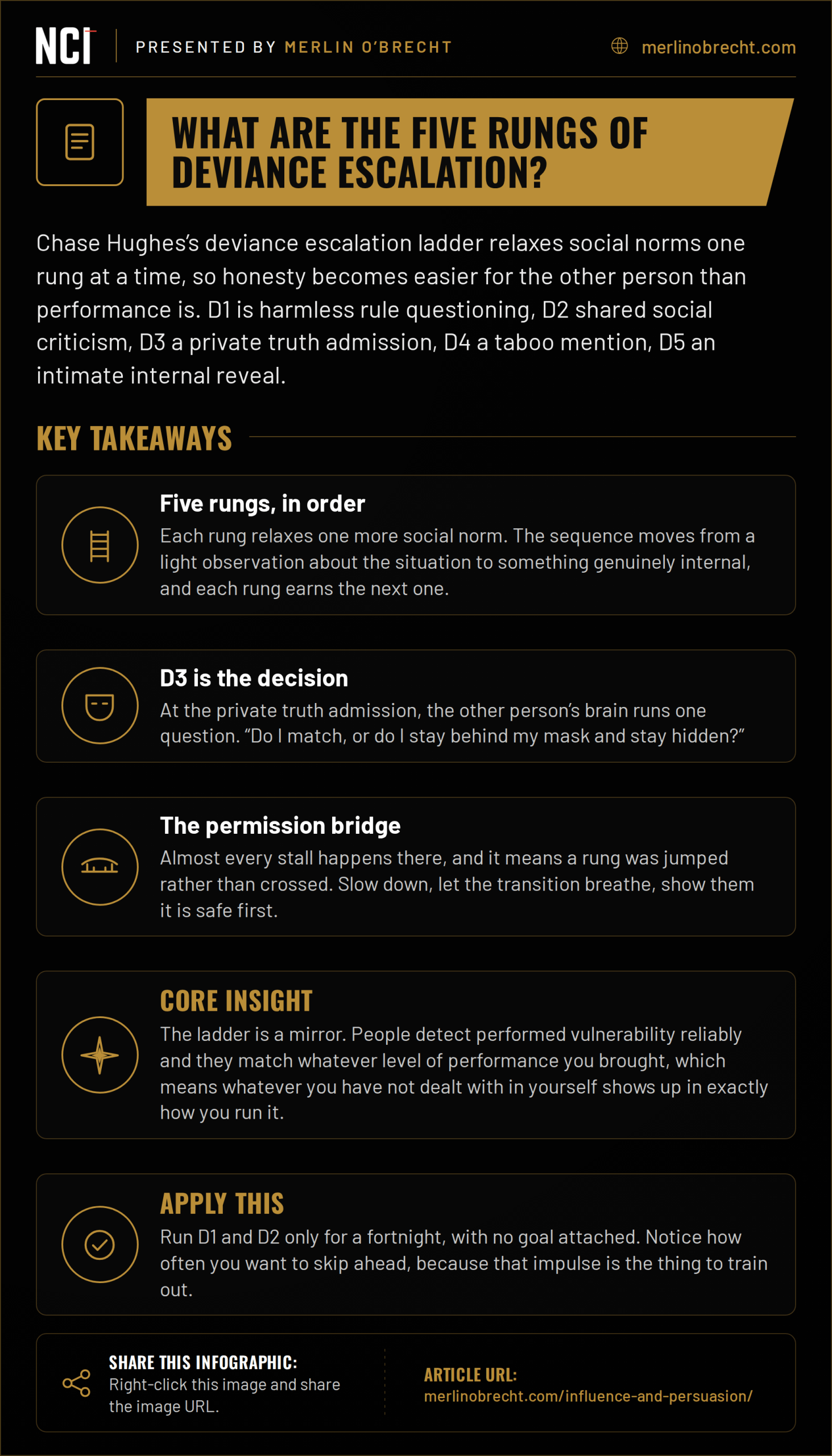
What are the five rungs of deviance escalation?
How do you de-escalate an argument?
The catch is the same one as everywhere else in this cluster. The steps are simple, and the person who has to run them is the one whose own threat response is firing at the same time. That is the four steps for an argument that has already started.
What is the difference between influence and manipulation?
The ledger compounds quietly, and the biggest cost of unethical influence is neither reputational nor what it does to the people you used it on. It is what it does to you. Full argument in the two tests that decide which one you are doing.
Seven subjects, one argument
| The skill | What it looks like when it fails | What was actually wrong |
|---|---|---|
| Influence | The right words, delivered well, and nothing lands | The person delivering them, which is layer one |
| Manipulation resistance | You know the levers and get moved anyway | The levers were never running on your knowledge |
| Defensiveness | You explain it more clearly and they dig in harder | The accuracy was the attack |
| Elicitation | They give short answers and close down | You needed the answer, and needing is detectable |
| Persuasion | You reach for depth and it feels like pulling teeth | You performed vulnerability and they matched the performance |
| De-escalation | You say the reasonable thing and it escalates | Your own threat response was firing while you said it |
| Ethics | You won and felt hollow afterwards | The cost was always going to land on you |
If you want Merlin working with your team rather than with you, that runs as a scoped engagement through NCI. It starts with an application and a conversation about what you are actually trying to change.
Frequently asked questions
“The magic isn’t hiding in some kind of a secret phrase, and it’s not some line that you just haven’t found yet that’s hiding in the deep annals of the internet.”
It lives in the three layers. Once the right state exists in the person you are talking to, you can simply ask, in plain words, and that is genuinely all it takes.
The Deep Dive
- The three layers, and why the words come last
- The four levers every message runs on
- The five story loops, and why correcting one strengthens it
- How to get information without turning it into an interview
- The five-rung ladder that takes a conversation deeper
- The four steps for an argument that has already started
- The two tests that decide which one you are doing
- Start here if you want the order to learn this in
Where to go from here